
John J. Hennessy
Author of Return to Bull Run: The Campaign and Battle of Second Manassas
About the Author
John J. Hennessy began his career in history at Manassas and is currently chief historian at Fredericksburg and Spotsylvania National Military Park. He is author of the definitive book on Second Manassas, Return to Bull Run.
Disambiguation Notice:
Do not confuse with Hennessy, John (John J.) (LC 88065660), sports writer and journalist. John J. Hennessy writes on the Civil War.
Image credit: Cheryl Hennessy
Works by John J. Hennessy
Associated Works
MHQ: The Quarterly Journal of Military History — Autumn 2001 (2001) — Editor "'Dear Union': A Federal Artilleryman at Antietam" — 9 copies
Tagged
Common Knowledge
- Canonical name
- Hennessy, John J.
- Birthdate
- 1958
- Gender
- male
- Occupations
- Superintendent (Fredericksburg and Spotsylvania National Military Park)
- Disambiguation notice
- Do not confuse with Hennessy, John (John J.) (LC 88065660), sports writer and journalist. John J. Hennessy writes on the Civil War.
Members
Reviews
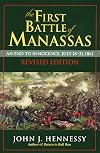
The First Battle of Manassas is a brief (209 page) but well-written book that ascribes Union defeat to the fact that Irvin McDowell, the Union commander, “did not know what victory would look like on July 21, 1861, and neither did most men on the field....” The time between noon and 2 pm, when Northern troops failed to advance against the improvised Confederate defense on Henry Hill, were not a lull, but rather a “revelation — the first real recognition that the war would require show more more than bluster and posturing.” The Confederates, meanwhile, exploited their opportunity, “consistently [converting] time gained into more men and stronger positions.”
The book starts out too quickly, essentially beginning with Union troops setting out from Washington in search of the Confederate army. Other than that, it has no major faults. I read the “revised edition”, a paperback published in 2015. It remedied a major flaw in the first, hardback edition, a lack of maps. In this edition, the maps are numerous and clear, with only one minor error (on p.87, the regiments labelled as “3rd ME” and “2nd CT” should be the 3rd Connecticut and the 2nd Maine). show less
The book starts out too quickly, essentially beginning with Union troops setting out from Washington in search of the Confederate army. Other than that, it has no major faults. I read the “revised edition”, a paperback published in 2015. It remedied a major flaw in the first, hardback edition, a lack of maps. In this edition, the maps are numerous and clear, with only one minor error (on p.87, the regiments labelled as “3rd ME” and “2nd CT” should be the 3rd Connecticut and the 2nd Maine). show less

In Return to Bull Run, John J. Hennessy does an excellent job of describing how the Union was whipped at Second Manassas. A “well-oiled performance of the Confederate army” under Lee, Jackson, and Longstreet “contrasted sharply with the disorganized toil of Pope’s Army of Virginia.” “The Union army at Second Manassas toiled under poor or average leadership at every level of the high command,“ but “the primary architect of the calamity was John Pope.” Once Jackson marched show more around Pope’s right flank and into his rear, Pope tried to pin him down and destroy him in a “series of misguided lunges.” “He failed to recognize the possibilities offered by blocking the Bull Run Mountain gaps. He failed to gauge the skills of his opponents. He presumed always that the Confederates would do precisely as he expected. Then, when they did not (as on August 28 and 29), he sought to cast the blame on others, notably [Fifth Corps commander Fitz John] Porter.”
Once battle was joined, Pope “utterly failed in the basic responsibilities of commanding an army on the battlefield. Insufficient attention to the army’s logistics left his army wilted and dispirited. Inadequate reconnaissance left him with a wishful, wholly inaccurate view of the battlefield. Failure to put the attacks of August 29 into a larger tactical context, by making concurrent diversions or at least providing additional support, doomed each [Union] assault to failure.” In the end, he had to go. show less
Once battle was joined, Pope “utterly failed in the basic responsibilities of commanding an army on the battlefield. Insufficient attention to the army’s logistics left his army wilted and dispirited. Inadequate reconnaissance left him with a wishful, wholly inaccurate view of the battlefield. Failure to put the attacks of August 29 into a larger tactical context, by making concurrent diversions or at least providing additional support, doomed each [Union] assault to failure.” In the end, he had to go. show less
First Battle of Manassas: An End to Innocence July 18-21, 1861 (Virginia Civil War Battles and Leaders Ser.) by John J. Hennessy

An outstanding account of the American Civil War's first major battle. I could find little wrong with this book. The maps are well done and while I would have liked one or two more, the book does not suffer for their lack. Recommended.
The Second Bull Run battle was the low point of the attempt to build a competent Union Army in the East. It pointed out the degree to which George McClellan had been useful in creating a useful army. Pope's conglomeration was badly used and Henessey gets a bit lost in the details, but has the right idea of this battle.
You May Also Like


Associated Authors
Statistics
- Works
- 5
- Also by
- 3
- Members
- 487
- Popularity
- #50,714
- Rating
- 4.1
- Reviews
- 6
- ISBNs
- 9
- Favorited
- 1