
Jason Letts
Author of Powerless: The Synthesis
About the Author
Series
Works by Jason Letts
The Carafers (Powerless #5) 6 copies
Agency (#MeToo #2) 4 copies
Agent Nora Wexler Mysteries (Deadly Accounts, Deadly Pasts, Point of Failure) (Nora Wexler Mystery Universe) (2020) 2 copies
Girls' Night (Girls' Trilogy) 2 copies
Sightless (Survivors #2) 1 copy
Girls' Trip (Girls' Trilogy) 1 copy
Associated Works
Lessons IV: The Dead Carnival and Other Morbid Drabbles — Contributor — 2 copies
Tagged
Common Knowledge
- Gender
- male
Members
Reviews
Powerless Series (Omnibus 1-3)by Jason Letts
I first tested the single first book(Synthesis) for free- I believe it is still offered as free. I would recommend that someone start with that and decide if they like it enough to try the rest then I'd recommend the omnibus because it will save a little money.
I really liked the first book for getting the reader started into this world. It at first reminded me of Anne of Green Gables meets Harry Potter. It quickly shifted into Harry Potter meets show more Genius Girl. And that's all good. I would class this as a Young Adult fantasy though it might easily fit into some steam-punk category. The one problem was that I couldn't readily place it into any particular era or time frame. It might be alternate earth or it could somehow be ins some sort of quasi-dystopic future. It just doesn't conform to any particular framework though it does use the Earth as a reference. Certain elements of the world building seemed to be skipped over, though that did not impede the overall development of the storyline.
I enjoyed the development of the characters and though the first book almost start out a bit like juvenile fiction it segued into Young Adult much as it started to look a bit like Genius Girl. There are a number of good characters in the story and several of them undergo changes as the story develops.
The story begins with Mira Ipswich who lives a sheltered life at age fifteen. She is being home-schooled by her parents Kevin and Jeana and has no idea that there is a whole world out there. There are reasons for all of this, which will come out later in the story. It's almost an unbelievable situation and I think that that's one thing that gives this book initially a feel of being juvenile fiction. It doesn't last long because Mira is about to discover the real world that's out there and she'll be thrust into it quite abruptly.
In this world everyone has some sort of power - except Mira. This will make life difficult for Mira, but she wants to live out there in the real world and her parents home schooling has prepared her for it as much as possible. Mira will join the academy and meet the people who shall become her worst enemies and best friends. The twist here is that she may well be thrust into the thick of life in the next year. Some of these friends are Aoi and Vern,Mary and Rowland, Roselyn and Kurt, Jeremy and Chucky and many more.
There is a thread that runs in this that is reminiscent of Lord of the Flies in that it has rather young people having to deal with the horror of war early in life. That's not to say that there are not young people out there who do have to deal with this it's just not normal fare for me in my fiction. These are fifteen year-olds just edging into sixteen who are going to -at the age of 16 begin training for war.
One almost disturbing element in the story is that the youths seem to handle the situation as though this is some sort of mmorpg instead of real life. Also the adults seem to encourage this. There is a heavy element of competition and in a short time the reader finds that people can be hurt during the competition. They will all be vying for the position of leader -not just of the class but of the unit when they eventually go to war. They seem to have somehow been encouraged to make this an every man for himself competition. There are elements of this that lend to the thought- yes we need to teach them the seriousness of the war they will have to face- yet we must ask - should we kill them before they reach the field.
Mira will have to join in this competition without a special gift or power and having to use her one most powerful resource- her mind. She's not to be deterred and gets right into the spirit of the whole thing. At the same time she understands the need to bring in teamwork- which is going to be a daunting task.
There are so many characters with so many attributes and so much depth and Jason does a fantastic job of introducing them and keeping them all in order so its not difficult to keep track. These characters are youths that are growing and developing and I think the author does a good job here though it might put off many readers because they seem to often shift around and change more than what many readers are comfortable with. It's been said that Mira is a very conflicted character and I agree- but in truth many of the characters in the story are conflicted for different reasons. I think the author lays the seeds for this well, but has taken on an awesome task with perhaps too many characters spreading his talent a bit thin at times. Thankfully he tells a story well and keeps track of his characters as he goes.
In the first book - eventually the group is all going to be confronted with a first hand look of the horror of war and they will have to learn to work as a unit.
The next two stories The Shadowing and Stasis continue bringing our ersatz heroes into the thick of the war.
The first half of Shadowing is about the shadowing, which is how each person learns to use their skill from someone who has mastered a like skill.
This reads a bit like Karate Kid with all sorts of instruction that almost makes no sense to our somewhat anxious trainees. Most will learn once they come to an understanding , but for some their choice of masters to shadow may come close to fatal conclusions. This is all leading to another challenge for leadership, which may, in itself, prove fatal for some.
This all leads to the war in the Stasis where the reader can't help but feel sympathy for these youths who will have to grow up early. The war is so wide spread that it seems that not only do most youth end up in it, but most don't return. This third book reminded me a lot of The Death Stalker series by Simon R. Green and I'm not sure I'd recommend it as a young adult book. That's just me though.
There's two more books and if you make it this far you will want to read those. My one quibble would be that once you get this far and with the way it abruptly comes to its conclusion it leaves you thinking,"oh, he should have put the forth one in this set."
I recommend this Omnibus for anyone who likes dystopic steam-punk,mmorpg's, magic and wizards, and seat of your pants conflicts. Something for everyone and sometimes not for the faint of heart.
J.L.Dobias show less
I first tested the single first book(Synthesis) for free- I believe it is still offered as free. I would recommend that someone start with that and decide if they like it enough to try the rest then I'd recommend the omnibus because it will save a little money.
I really liked the first book for getting the reader started into this world. It at first reminded me of Anne of Green Gables meets Harry Potter. It quickly shifted into Harry Potter meets show more Genius Girl. And that's all good. I would class this as a Young Adult fantasy though it might easily fit into some steam-punk category. The one problem was that I couldn't readily place it into any particular era or time frame. It might be alternate earth or it could somehow be ins some sort of quasi-dystopic future. It just doesn't conform to any particular framework though it does use the Earth as a reference. Certain elements of the world building seemed to be skipped over, though that did not impede the overall development of the storyline.
I enjoyed the development of the characters and though the first book almost start out a bit like juvenile fiction it segued into Young Adult much as it started to look a bit like Genius Girl. There are a number of good characters in the story and several of them undergo changes as the story develops.
The story begins with Mira Ipswich who lives a sheltered life at age fifteen. She is being home-schooled by her parents Kevin and Jeana and has no idea that there is a whole world out there. There are reasons for all of this, which will come out later in the story. It's almost an unbelievable situation and I think that that's one thing that gives this book initially a feel of being juvenile fiction. It doesn't last long because Mira is about to discover the real world that's out there and she'll be thrust into it quite abruptly.
In this world everyone has some sort of power - except Mira. This will make life difficult for Mira, but she wants to live out there in the real world and her parents home schooling has prepared her for it as much as possible. Mira will join the academy and meet the people who shall become her worst enemies and best friends. The twist here is that she may well be thrust into the thick of life in the next year. Some of these friends are Aoi and Vern,Mary and Rowland, Roselyn and Kurt, Jeremy and Chucky and many more.
There is a thread that runs in this that is reminiscent of Lord of the Flies in that it has rather young people having to deal with the horror of war early in life. That's not to say that there are not young people out there who do have to deal with this it's just not normal fare for me in my fiction. These are fifteen year-olds just edging into sixteen who are going to -at the age of 16 begin training for war.
One almost disturbing element in the story is that the youths seem to handle the situation as though this is some sort of mmorpg instead of real life. Also the adults seem to encourage this. There is a heavy element of competition and in a short time the reader finds that people can be hurt during the competition. They will all be vying for the position of leader -not just of the class but of the unit when they eventually go to war. They seem to have somehow been encouraged to make this an every man for himself competition. There are elements of this that lend to the thought- yes we need to teach them the seriousness of the war they will have to face- yet we must ask - should we kill them before they reach the field.
Mira will have to join in this competition without a special gift or power and having to use her one most powerful resource- her mind. She's not to be deterred and gets right into the spirit of the whole thing. At the same time she understands the need to bring in teamwork- which is going to be a daunting task.
There are so many characters with so many attributes and so much depth and Jason does a fantastic job of introducing them and keeping them all in order so its not difficult to keep track. These characters are youths that are growing and developing and I think the author does a good job here though it might put off many readers because they seem to often shift around and change more than what many readers are comfortable with. It's been said that Mira is a very conflicted character and I agree- but in truth many of the characters in the story are conflicted for different reasons. I think the author lays the seeds for this well, but has taken on an awesome task with perhaps too many characters spreading his talent a bit thin at times. Thankfully he tells a story well and keeps track of his characters as he goes.
In the first book - eventually the group is all going to be confronted with a first hand look of the horror of war and they will have to learn to work as a unit.
The next two stories The Shadowing and Stasis continue bringing our ersatz heroes into the thick of the war.
The first half of Shadowing is about the shadowing, which is how each person learns to use their skill from someone who has mastered a like skill.
This reads a bit like Karate Kid with all sorts of instruction that almost makes no sense to our somewhat anxious trainees. Most will learn once they come to an understanding , but for some their choice of masters to shadow may come close to fatal conclusions. This is all leading to another challenge for leadership, which may, in itself, prove fatal for some.
This all leads to the war in the Stasis where the reader can't help but feel sympathy for these youths who will have to grow up early. The war is so wide spread that it seems that not only do most youth end up in it, but most don't return. This third book reminded me a lot of The Death Stalker series by Simon R. Green and I'm not sure I'd recommend it as a young adult book. That's just me though.
There's two more books and if you make it this far you will want to read those. My one quibble would be that once you get this far and with the way it abruptly comes to its conclusion it leaves you thinking,"oh, he should have put the forth one in this set."
I recommend this Omnibus for anyone who likes dystopic steam-punk,mmorpg's, magic and wizards, and seat of your pants conflicts. Something for everyone and sometimes not for the faint of heart.
J.L.Dobias show less
This is a book idea which deserved better treatment than it received. The initial premise - a world in which everyone has super powers except one unfortunate girl - is compelling. Unfortunately, the author simply isn't up to the task.
The book is riddled with language problems. Every third sentence, it seems, is redundant (example: Jeanna is "startled by her daughter's unexpected and sudden appearance," when only one of those modifiers was necessary). Incorrect word forms abound ("she let out show more an agonizing sigh," which should use the adjectival form "agonized"). Imagery is often clumsy ("He considered it for a moment, rolling his head around his neck") or simply relies on malapropisms. The latter chapters are very slightly less error-prone than the first, indicating that this is a first draft, the author learning as he went along, and that he never really revised the text.
All of this might be forgivable if the story held together, but it doesn't. Mira's parents have carefully kept her hidden away , ignorant of all society, for fourteen years...then, for no particular reason, at the first sign of an *actual* threat to her safety, they turn her loose, unsupervised, into a world of killers. Although she has supposedly never seen another person, Mira is familiar with all the social niceties, such as how to greet perfect strangers, and displays no real social awkwardness other than that of any teen in a new school. The big war which supposedly threatens Mira's people is never explained. One teacher briefly mentions the enemy is 'jealous of the peace' of their society...a society which places all its children into warrior academies and live-fire attack drills at an early age. The book supposedly takes place in some pre-industrial society, reliant on farming...yet Mira plans on making "paper *airplanes*" for her birthday decorations, and later mentions "spaceships." The inconsistencies are vast, the character motivations absent.
Perhaps worst of all, the author never seems to have thought out the implications of his initial premise. The whole plot hinges on the idea that Mira is uniquely unpowered, at risk in a dangerous world...yet we find that another classmate has no observable power, and hasn't for years, and that other members of society have utterly useless powers. Theoretically, Mira is going to save herself by virtue of her uniquely logical and practical brain...yet the author grossly abuses the laws of physics. At one point he claims that because objects accelerate at 9.8 meters per second per second, they fall 9.8 meters in the first second, which is simply untrue. At another point, Mira suggests one grease-producing student can somehow glide, frictionlessly, over rough terrain, even though if he were able to do so, he wouldn't be able to move, and would use more oil than he has body mass within seconds. Later, Mira fashions a mechanical bird which she will mount on one arm to lift her off the ground...even though if she did so, it would take a ridiculously powerful fuel cell, the size of a car battery, it would need wings the size of a glider, and the thrust described would tear her arm off. If, as I suspect, the novel was partially intended to serve as an inspiration for teens who feel displaced or unpopular, the route is not through teaching them bad science, or inconsistent plotting.
I am aware of how difficult it is to write a complete novel. I respect the author's intentions. Perhaps Letts will do better at some later time, or if he worked with an editor. However, I can't recommend this book.
EDIT: I have had to lower my rating, as it has come to my attention that the author is dishonestly marketing this book by planting fake 'reviews.' Gross. show less
The book is riddled with language problems. Every third sentence, it seems, is redundant (example: Jeanna is "startled by her daughter's unexpected and sudden appearance," when only one of those modifiers was necessary). Incorrect word forms abound ("she let out show more an agonizing sigh," which should use the adjectival form "agonized"). Imagery is often clumsy ("He considered it for a moment, rolling his head around his neck") or simply relies on malapropisms. The latter chapters are very slightly less error-prone than the first, indicating that this is a first draft, the author learning as he went along, and that he never really revised the text.
All of this might be forgivable if the story held together, but it doesn't. Mira's parents have carefully kept her hidden away , ignorant of all society, for fourteen years...then, for no particular reason, at the first sign of an *actual* threat to her safety, they turn her loose, unsupervised, into a world of killers. Although she has supposedly never seen another person, Mira is familiar with all the social niceties, such as how to greet perfect strangers, and displays no real social awkwardness other than that of any teen in a new school. The big war which supposedly threatens Mira's people is never explained. One teacher briefly mentions the enemy is 'jealous of the peace' of their society...a society which places all its children into warrior academies and live-fire attack drills at an early age. The book supposedly takes place in some pre-industrial society, reliant on farming...yet Mira plans on making "paper *airplanes*" for her birthday decorations, and later mentions "spaceships." The inconsistencies are vast, the character motivations absent.
Perhaps worst of all, the author never seems to have thought out the implications of his initial premise. The whole plot hinges on the idea that Mira is uniquely unpowered, at risk in a dangerous world...yet we find that another classmate has no observable power, and hasn't for years, and that other members of society have utterly useless powers. Theoretically, Mira is going to save herself by virtue of her uniquely logical and practical brain...yet the author grossly abuses the laws of physics. At one point he claims that because objects accelerate at 9.8 meters per second per second, they fall 9.8 meters in the first second, which is simply untrue. At another point, Mira suggests one grease-producing student can somehow glide, frictionlessly, over rough terrain, even though if he were able to do so, he wouldn't be able to move, and would use more oil than he has body mass within seconds. Later, Mira fashions a mechanical bird which she will mount on one arm to lift her off the ground...even though if she did so, it would take a ridiculously powerful fuel cell, the size of a car battery, it would need wings the size of a glider, and the thrust described would tear her arm off. If, as I suspect, the novel was partially intended to serve as an inspiration for teens who feel displaced or unpopular, the route is not through teaching them bad science, or inconsistent plotting.
I am aware of how difficult it is to write a complete novel. I respect the author's intentions. Perhaps Letts will do better at some later time, or if he worked with an editor. However, I can't recommend this book.
EDIT: I have had to lower my rating, as it has come to my attention that the author is dishonestly marketing this book by planting fake 'reviews.' Gross. show less
This review was written for LibraryThing Member Giveaways.
Since I read this series back-to-back I am going to review it as one entry. The first thing you have to know about this series is that it’s set in an imagery world where they have absolutely NO IDEA how to educate children. If this is going to bother you then don’t read the Powerless Series, because it will be a big deal in the first few books and really set the underlying tone for the world-building.
The next thing you need to know is that because of the education system the military is show more run by power hungry dunder-heads. If an completely incompetent military will drive you nuts that you probably shouldn’t read this series.
Those things aside, this is one of the most unique worlds I’ve ever visited in a book. The author’s idea for the world is so outrageous that I just had to read through all the books to find out where he was planning on taking it.
The back drop is a world where everyone has some sort of power, everyone that is except for Mira. These powers range from useful (controlling the weather) to bizarre (sweating oil or giving birth to random animals.) Basically instead of relying on scientific understanding to get things done they reply on finding someone who has the power to do it.
We being the story with Mira, who has been kept from the outside world by her fathers ability to control the weather who has created a cloud wall around their home. Her mother (who has the power to put you to sleep with a touch) and father are afraid that a powerless person would be a freak and wouldn’t be able to make it in the outside world. So they’ve kept her at home teaching her from a series of scientific manuals.
Teenage Mira finally gets to join her peers in school and tries her best to fit in. The problem is that her peers do think shes a freak, and the education system is set up to pit power against power to see whose power can win in a fight (really, I warned you that their system was the worst.) It becomes a story about overcoming the odds, coming of age and learning to work together.
Like any series some books are better than others, but over all I enjoyed the journey. show less
The next thing you need to know is that because of the education system the military is show more run by power hungry dunder-heads. If an completely incompetent military will drive you nuts that you probably shouldn’t read this series.
Those things aside, this is one of the most unique worlds I’ve ever visited in a book. The author’s idea for the world is so outrageous that I just had to read through all the books to find out where he was planning on taking it.
The back drop is a world where everyone has some sort of power, everyone that is except for Mira. These powers range from useful (controlling the weather) to bizarre (sweating oil or giving birth to random animals.) Basically instead of relying on scientific understanding to get things done they reply on finding someone who has the power to do it.
We being the story with Mira, who has been kept from the outside world by her fathers ability to control the weather who has created a cloud wall around their home. Her mother (who has the power to put you to sleep with a touch) and father are afraid that a powerless person would be a freak and wouldn’t be able to make it in the outside world. So they’ve kept her at home teaching her from a series of scientific manuals.
Teenage Mira finally gets to join her peers in school and tries her best to fit in. The problem is that her peers do think shes a freak, and the education system is set up to pit power against power to see whose power can win in a fight (really, I warned you that their system was the worst.) It becomes a story about overcoming the odds, coming of age and learning to work together.
Like any series some books are better than others, but over all I enjoyed the journey. show less
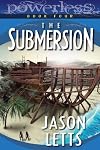
Powerless: The Submersion
This book is number four in the series and its one of those series that you can love and hate. The reason for this is that the pace is one that keeps building the adrenaline pump, only bringing you half way down before the next pump and it can almost get tiring.
Couple that with all the tension and wonder about how the hero's are going to solve all the problems and then add some -old serial novel traits- and it can almost become daunting. I remember reading some of show more those Edgar Rice Burroughs novels and getting near the last pages trying to figure out when all the plot twists are going to even out only to discover that it's not happening in this episode.
This means that many people who drop out, from exhaustion, at the third novel are going to miss out on the whole tie-up of loose ends. By the time I reached the end of the third book I felt about the same as I did near the middle of the Deathstalker series. You almost need a set of file cards to keep track of all the action and deception and intrigue.
There's also a match with all of the paranoid schizoid traits of half the cast. It's funny that some people often complain that the characters in a book seem one dimensional and unrealistic. I think it's safe to say in this book that you'll be happy for the one or two of those that show up.The characters in this story are pretty multifaceted and when they appear to deviate from what I expect I find myself reflecting back to see why they did that bit of surprise and find that it makes sense.
Mira has been jumping around like the needle on a compass in the hands of feeble trembling old man. She's naive by nature but has throughout the series undergone some changes- some for the worse at times. Some times it almost seems the naivete is cured then it starts to rear its head again.
We pick up the characters in Submersion with everyone captured and subdued by the evil Warlord. Even Mira's sister, Clara, is being held captive. The main group have been split up and everyone who survived the battle is suffering under the thumb of the warlord while building a ship, which will take him off to expand his kingdom.
There are two groups; the Sunfighters who are under the Warlords coercive control and the others who have eluded that influence but are prisoners of the Warlord and his sunfighters. None of these people are being treated well or fed and cared for well and my one quibble is that based on the chancy nature of how people are fed there should be a huge number of casualties of hunger and famine and disease and just plain loss of spirit.
Since this is a prisoner of war type novel this time through it could be rather trying if not for the constant build up and sometimes partial setbacks in the various plots to subvert the authorities.
There's a lot going on in a small space so this book really keeps the reader pumped up all the way to the end. Much similar to the third book Stasis. Thankfully the reader will be delighted with a bit more resolution to some of the conflicts that have run throughout the other three books.
There are a lot of elements revealed in this book that help drive into the last book, which is the fifth one named Carafe.
Make no mistake; despite some of the mentions above I loved this story/ series and I very much appreciate the pace that it's had to sustain. For those who love a good fantasy with lots of conflict and interesting characters those are all here and there's light at the end of the tunnel in knowing that it will wrap up beautifully in the final book.
J.L. Dobias show less
This book is number four in the series and its one of those series that you can love and hate. The reason for this is that the pace is one that keeps building the adrenaline pump, only bringing you half way down before the next pump and it can almost get tiring.
Couple that with all the tension and wonder about how the hero's are going to solve all the problems and then add some -old serial novel traits- and it can almost become daunting. I remember reading some of show more those Edgar Rice Burroughs novels and getting near the last pages trying to figure out when all the plot twists are going to even out only to discover that it's not happening in this episode.
This means that many people who drop out, from exhaustion, at the third novel are going to miss out on the whole tie-up of loose ends. By the time I reached the end of the third book I felt about the same as I did near the middle of the Deathstalker series. You almost need a set of file cards to keep track of all the action and deception and intrigue.
There's also a match with all of the paranoid schizoid traits of half the cast. It's funny that some people often complain that the characters in a book seem one dimensional and unrealistic. I think it's safe to say in this book that you'll be happy for the one or two of those that show up.The characters in this story are pretty multifaceted and when they appear to deviate from what I expect I find myself reflecting back to see why they did that bit of surprise and find that it makes sense.
Mira has been jumping around like the needle on a compass in the hands of feeble trembling old man. She's naive by nature but has throughout the series undergone some changes- some for the worse at times. Some times it almost seems the naivete is cured then it starts to rear its head again.
We pick up the characters in Submersion with everyone captured and subdued by the evil Warlord. Even Mira's sister, Clara, is being held captive. The main group have been split up and everyone who survived the battle is suffering under the thumb of the warlord while building a ship, which will take him off to expand his kingdom.
There are two groups; the Sunfighters who are under the Warlords coercive control and the others who have eluded that influence but are prisoners of the Warlord and his sunfighters. None of these people are being treated well or fed and cared for well and my one quibble is that based on the chancy nature of how people are fed there should be a huge number of casualties of hunger and famine and disease and just plain loss of spirit.
Since this is a prisoner of war type novel this time through it could be rather trying if not for the constant build up and sometimes partial setbacks in the various plots to subvert the authorities.
There's a lot going on in a small space so this book really keeps the reader pumped up all the way to the end. Much similar to the third book Stasis. Thankfully the reader will be delighted with a bit more resolution to some of the conflicts that have run throughout the other three books.
There are a lot of elements revealed in this book that help drive into the last book, which is the fifth one named Carafe.
Make no mistake; despite some of the mentions above I loved this story/ series and I very much appreciate the pace that it's had to sustain. For those who love a good fantasy with lots of conflict and interesting characters those are all here and there's light at the end of the tunnel in knowing that it will wrap up beautifully in the final book.
J.L. Dobias show less
Awards
You May Also Like


Associated Authors
Statistics
- Works
- 34
- Also by
- 2
- Members
- 464
- Popularity
- #53,000
- Rating
- 3.8
- Reviews
- 35
- ISBNs
- 9
