
About the Author
John Buschman is dean of university libraries at Seton Hall University in South Orange, New Jersey. He was previously associate university librarian for scholarly resources and services at Georgetown University. Buschman is on the editorial boards of Library Quarterly and the Journal of Academic show more Librarianship. He is the author of Dismantling the Public Sphere: Situating and Sustaining Libraries in the Age of the New Public Philosophy (2003) and editor of Critical Approaches to Information Technology in Librarianship: Foundations and Applications (1993). show less
Works by John E. Buschman
Dismantling the Public Sphere: Situating and Sustaining Librarianship in the Age of the New Public Philosophy (Contributions in Librarianship and Information Science) (2003) 90 copies, 1 review
Libraries, Classrooms, and the Interests of Democracy: Marking the Limits of Neoliberalism (2012) 5 copies
Critical approaches to information technology in librarianship : foundations and applications (1993) 2 copies
Progressive Llibrarian #32 1 copy
Progressive Librarian #31 1 copy
Progressive Librarian #29 1 copy
Tagged
Common Knowledge
- Gender
- male
- Short biography
- Associate university librarian for scholarly resources and services at Georgetown University Library.
Members
Reviews
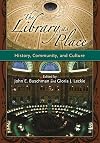
The Library as Place: History, Community, and Culture, is a collection of mostly accessible – and mostly readable – research essays about libraries as physical spaces that were submitted to Library Quarterly in 2003. The investigation of libraries as bricks-and-mortar places has been hot in academic circles since the rise of remote access by electronic means.
The essays most worthy of note discuss libraries of the past – from military libraries in the British Empire to the furnishing show more and design of “Social Libraries” in the period of 1800-1860 to the Greensboro Carnegie Negro Library, 1904-1964. English professor Ronald Tetreault writes that military libraries “offered an alternative to places of bad resort, and enforced norms of civility. Their club-like atmosphere and the recreational facilities commonly attached to them were a world away from the drinking, swearing, whoring, and gambling of the tavern and brothel.”
Especially insightful, and useful to public librarians, is the essay by information studies professor Paulette Rothbauer on spatial considerations – such as offering spaces that promote privacy – in regards to serving lesbian and gay patrons. And readers likely will be charmed by the final essay, “Going to Hell,” by assistant professor of English and American Studies Adriana Estill, who analyses the role of the library in Buffy the Vampire Slayer.
Although all the essays were for peer-review, some clearly were written to be readable – and readable by a larger audience. These tended to limit research jargon and abbreviate descriptions intended solely for the academy. Other less-interesting essays, while describing worthwhile research, were penned by authors less concerned with appealing to audiences outside of the library profession. -- Jeanie Straub show less
The essays most worthy of note discuss libraries of the past – from military libraries in the British Empire to the furnishing show more and design of “Social Libraries” in the period of 1800-1860 to the Greensboro Carnegie Negro Library, 1904-1964. English professor Ronald Tetreault writes that military libraries “offered an alternative to places of bad resort, and enforced norms of civility. Their club-like atmosphere and the recreational facilities commonly attached to them were a world away from the drinking, swearing, whoring, and gambling of the tavern and brothel.”
Especially insightful, and useful to public librarians, is the essay by information studies professor Paulette Rothbauer on spatial considerations – such as offering spaces that promote privacy – in regards to serving lesbian and gay patrons. And readers likely will be charmed by the final essay, “Going to Hell,” by assistant professor of English and American Studies Adriana Estill, who analyses the role of the library in Buffy the Vampire Slayer.
Although all the essays were for peer-review, some clearly were written to be readable – and readable by a larger audience. These tended to limit research jargon and abbreviate descriptions intended solely for the academy. Other less-interesting essays, while describing worthwhile research, were penned by authors less concerned with appealing to audiences outside of the library profession. -- Jeanie Straub show less
The Library as Place: History, Community, and Culture is a collection of essays edited by John Buschman and Gloria Leckie. Designed to "provide diverse and wide-ranging perspectives on the role and place of different kinds of libraries as cultural institutions as well as the library as a physical, social, and intellectual place within the hearts and minds of its clientele and the public at large" (p. 4) the essays cover a great deal of scholarly ground.
While many of the selections included show more here were too theory-based for my liking (just not my cup of tea), some of the essays were very worthwhile and enlightening nonetheless. I enjoyed Adam Arenson's study of early "social libraries" (athenaeums and other institutions) and his comparison of those facilities with the first true "public" libraries (beginning with the establishment of Boston's in 1859). The differences not only in collection priorities but also in terms of aesthetic design were striking. Thomas Mann's excellent argument for the continued usefulness of research libraries is an important addition to the debate over digitization and library priorities. Perhaps most novel (and thus most intriguing) was Adriana Estill's distillation of the role of the high school library in the first three seasons of the television show "Buffy the Vampire Slayer." As she notes, the episodes of those first seasons "consistently addressed the cultural and social negotiations around reading, literacy, research, and, pivotally, the library's meaning as place (p. 235).
A well-chosen compilation of library scholarship; as always with such things some pieces are far more exciting than others, but for those whose interests run to deep discussions of library philosophy, this book's for you.
http://philobiblos.blogspot.com/2007/01/book-review-library-as-place.html show less
While many of the selections included show more here were too theory-based for my liking (just not my cup of tea), some of the essays were very worthwhile and enlightening nonetheless. I enjoyed Adam Arenson's study of early "social libraries" (athenaeums and other institutions) and his comparison of those facilities with the first true "public" libraries (beginning with the establishment of Boston's in 1859). The differences not only in collection priorities but also in terms of aesthetic design were striking. Thomas Mann's excellent argument for the continued usefulness of research libraries is an important addition to the debate over digitization and library priorities. Perhaps most novel (and thus most intriguing) was Adriana Estill's distillation of the role of the high school library in the first three seasons of the television show "Buffy the Vampire Slayer." As she notes, the episodes of those first seasons "consistently addressed the cultural and social negotiations around reading, literacy, research, and, pivotally, the library's meaning as place (p. 235).
A well-chosen compilation of library scholarship; as always with such things some pieces are far more exciting than others, but for those whose interests run to deep discussions of library philosophy, this book's for you.
http://philobiblos.blogspot.com/2007/01/book-review-library-as-place.html show less
Dismantling the Public Sphere: Situating and Sustaining Librarianship in the Age of the New Public Philosophy (Contributions in Librarianship and Information Science) by John E. Buschman
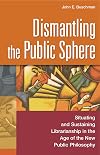
Pretty dense, but very thoughtful. The shift in libraries that he described in 2003 has only intensified as of 2018.
You May Also Like


Associated Authors
Statistics
- Works
- 16
- Members
- 187
- Popularity
- #116,276
- Rating
- 3.2
- Reviews
- 5
- ISBNs
- 8