

Helmut Thielicke (1908–1986)
Author of A Little Exercise for Young Theologians
About the Author
Image credit: Thielicke, Prof. Dr.: Evangelischer Theologe, Bundesrepublik Deutschland November 1973
Series
Works by Helmut Thielicke
Wer darf sterben?: Grenzfragen d. modernen Medizin (Herderbucherei) (German Edition) (1979) 4 copies
THE WORLD OF THE NEW TESTAMENT 4 copies
An die Deutschen 3 copies
Das Lachen der Heiligen und Narren: Nachdenkl. uber Witz u. Humor (Herderbucherei ; Bd. 491) (German Edition) (1974) 3 copies
El sentido de ser cristiano: invitación al tiempo y a la esperanza (El Pozo de Siquem, Volumen 7) (1978) 2 copies
God In The WatseLands 2 copies
Evangelical Faith: Two Volumes. Volumes 1 and 2. By Helmut. Thelicke. Published by Eerdmans. 1974 Edition (1974) 2 copies
Menneskelivets mening 1 copy
The Faith Letter 1 copy
Begegnungen 1 copy
Weltanschauung und Glaube 4 1 copy
Geschichte und Existenz 1 copy
The five brothers of the rich man: one part in the parable of the rich man and lazarus (Falcon booklets) (1962) 1 copy
Guds billedbog 1 copy
Goethe e o Cristianismo 1 copy
Sana keskellämme 1 copy
Isä meidän 1 copy
New Life in Christ 1 copy
Weltanschauung und Glaube 1 copy
Le parabole del Signore 1 copy
Die Bergpredigt 1 copy
Associated Works
Die Erziehung des Menschengeschlechts und andere Schriften (1980) — Afterword, some editions — 34 copies
Tagged
Common Knowledge
- Legal name
- Thielicke, Helmut
- Other names
- 邸立基
- Birthdate
- 1908-12-04
- Date of death
- 1986-03-05
- Gender
- male
- Education
- University of Erlangen
- Occupations
- theologian
- Organizations
- University of Hamburg
- Short biography
- Helmut Thielicke was a German Protestant theologian and rector of the University of Hamburg from 1960 to 1978.
Thielicke grew up in Wuppertal, where he went to a humanistic Gymnasium and took his Abitur (final school examinations) in 1928. After this he began to study philosophy and theology in Erlangen, but soon had to undergo an operation on his thyroid. Despite the negative outcome of this operation (pulmonary embolism, tetanus), which were still causing complications 4 years later, he finished his studies and in 1932 he got his doctorate in philosophy with "Das Verhältnis zwischen dem Ethischen und dem Ästethischen" (The relationship between the ethical and the aesthetic).
After his health improved, Thielicke listened to Karl Barth in Bonn, whom he criticized, mainly because of Barth's exclusion of natural anthropology. Eventually he did his doctor's degree in theology in 1934 with a work under the supervision of Paul Althaus in Erlangen. He took his postdoctoral lecture qualification with "Offenbarung, Vernunft und Existenz. Studien zur Religionsphilosophie Lessings" (Revelation, reason and existence; studies in Lessing's religious philosophy) in 1935 under the growing pressure of the Nazi-Regime, which refused him an appointment to Erlangen in view of his activity within the "Confessing Church". In 1936 he obtained a professorship in systematic theology in Heidelberg, where he met Marie-Luise Herrmann, to whom he was married in 1937. They had four children.
After repeated interrogations by the Gestapo from the mid-1930s onwards, he was finally dismissed in 1940. Thielicke was conscripted, but nine months later he was able to take over a church in Ravensburg with the help of regional bishop Theophil Wurm. In 1942 he assumed theological office in Stuttgart, from where he delivered numerous sermons and went on lecture tours, continually made difficult by the government by means of bans on travel, publication and preaching. Thielicke published a critique of Bultmann's composition about the demythologisation of the New Testament, which gave rise to a respectful, but inconclusive correspondence between the two. He also contacted the resistance group Freiburger Kreis, but without working actively in their plans for a revolution.
The bombing of Stuttgart in 1944 forced Thielicke and his family to go to Korntal, where he continued his lecture tours and preaching services in the following years; these were anonymously translated into many languages in Switzerland and read on various fronts of the war. Immediately after the end of the war Thielicke traveled with a group of delegates to Frankfurt, where he was invited by the government to participate in talks regarding the resumption of academic work to fill the political and academic vacuum of the postwar period. As a consequence, he took over a professorship at the newly reopened theological faculty in Tübingen in 1947, being made administrative head of the university and President of the Chancellor's Conference in 1951. In 1954, continuing his postwar efforts to revive Germany's academic and spiritual heritage, he accepted a call to Hamburg to found a new theological faculty, where he acted as both dean and professor while also pastoring the main church of Hamburg, St. Michaelis.
He personally met with Billy Graham and was received by President Jimmy Carter during lecture tours in the USA in 1977. Thielicke also traveled to Asia, South Africa, Latin America, Australia and New Zealand in the 1960s and 1970s. - Nationality
- Germany
- Birthplace
- Wuppertal, Germany
- Places of residence
- Heidelberg, Germany
Tubingen, Germany
Hamburg, Germany - Place of death
- Hamburg, West Germany
- Associated Place (for map)
- Germany
Members
Reviews

Imagine the scene. After decades of life as a tradesman, with growing awareness of his true vocation, Jesus goes to the Jordan River to be baptized by his cousin. What relief! The heavens open, the Spirit descends, the voice of the Father validates his Son and his Son's ministry.
Immediately, the same Spirit that descended gently like a dove throws the Son into the wilderness where he encounters Satan and wrestles with the depths of temptation. This trial will define his ministry.
Helmut show more Thielicke, a German theologian, first published this meditative study on the temptation of Jesus in 1938 in order to "strengthen the followers of Jesus Christ in their resistance to ideological tyranny" (v). The book was reissued in 1946 after the collapse of the Nazi regime. The book was most recently reissued in 2010 emphasizing the fact that the tempter works in every era.
If we are going to resist the tempter, we need to look to Jesus, the perfect human, who resisted temptation until the end. Thielicke approaches the temptation of Jesus with a keen understanding of anthropology and human weakness.
Between God and Satan is an excellent devotional book which will open up many avenues for understanding the significance of Jesus' temptation. show less
Immediately, the same Spirit that descended gently like a dove throws the Son into the wilderness where he encounters Satan and wrestles with the depths of temptation. This trial will define his ministry.
Helmut show more Thielicke, a German theologian, first published this meditative study on the temptation of Jesus in 1938 in order to "strengthen the followers of Jesus Christ in their resistance to ideological tyranny" (v). The book was reissued in 1946 after the collapse of the Nazi regime. The book was most recently reissued in 2010 emphasizing the fact that the tempter works in every era.
If we are going to resist the tempter, we need to look to Jesus, the perfect human, who resisted temptation until the end. Thielicke approaches the temptation of Jesus with a keen understanding of anthropology and human weakness.
Between God and Satan is an excellent devotional book which will open up many avenues for understanding the significance of Jesus' temptation. show less

Helmut Thielicke is a German theologian of scholastic depth who withstood the years of Nazism with his honor intact. Always in the background of his writing we are given glimpses of lessons learned during that dark period. In this book, Thielicke gives us a fresh way of looking at the parables; he mines much food for thought in sometimes unexpected ways. The Parable of the Prodigal Son is perhaps the most famous of Jesus' parables and here Thielicke gives us a lesson on the prodigal who only show more wanted to be free and ended up bound. The son declares, 'For me freedom means to be able to do what I want to do," and the father quietly replies, "And for me freedom means that you should become what you ought to be. You should not, for example, become a servant of your desires, a slave to your ambition, to your need for recognition, your love of Mammon, your blase intellectual boredom. That's why I forbid you so many things. Not to limit your freedom but just the opposite, in order that you may remain free of all this, that you may become worthy of your origin and be free for sonship, just because you are a king's son. Don't you understand that it is love that is behind my bidding and forbidding?" A book that is easily read, but inspires much time in reflection. show less

Pastors always have difficult situations to address—the death of a child, a natural disaster, or an incurable illness. There are times when the situation is so central to the life of the congregation that the pastor must address it from the pulpit. The difficulty here is perspective. The pastor, often in the middle of the situation, must rise beyond the situation and speak to the messiness of life from a divine perspective. It's not easy to do. It's almost impossible to do well.
Put show more yourself in the shoes of Helmut Thielicke during the Second World War. In light of the bombings, mass burials, and infiltration of demonic philosophy, he preached. In the preface to these sermons he admits that sermons at this time "have to be expressed before distracted people whose eyes still reflect the glare of the last air-raid and who thus have very accurate scales by which to assess the message" (ix).
Fortunately, you don't have to live through the horrors of war to recognize that Thielicke's words are solid truth. These messages are hard, always avoiding false hope while pointing the listener to the true light.
If you've read Thielicke before, you'll recognize the way he transforms perceptive observations into a pithy phrase:
"If the last hour belongs to us, we do not need to fear the next minute" ("I Am Not Alone with My Anxiety" 9).
"Jesus is the one place in the world where we need not restrain our sorrows because He already knows them all" ("The Great Mercy" 36).
"We cannot sink so low that God is not lower" ("The Message of Redeeming Light" 63).
"Golgotha means pain in God" ("The Final Dereliction" 70).
"The trouble is that we speak far too much about God in the third person" ("The Final Dereliction" 75).
When you take a minute to reflect on Thielicke's pastoral setting, you can't help but thank God that he still speaks to us through his servants in our struggles. show less
Put show more yourself in the shoes of Helmut Thielicke during the Second World War. In light of the bombings, mass burials, and infiltration of demonic philosophy, he preached. In the preface to these sermons he admits that sermons at this time "have to be expressed before distracted people whose eyes still reflect the glare of the last air-raid and who thus have very accurate scales by which to assess the message" (ix).
Fortunately, you don't have to live through the horrors of war to recognize that Thielicke's words are solid truth. These messages are hard, always avoiding false hope while pointing the listener to the true light.
If you've read Thielicke before, you'll recognize the way he transforms perceptive observations into a pithy phrase:
"If the last hour belongs to us, we do not need to fear the next minute" ("I Am Not Alone with My Anxiety" 9).
"Jesus is the one place in the world where we need not restrain our sorrows because He already knows them all" ("The Great Mercy" 36).
"We cannot sink so low that God is not lower" ("The Message of Redeeming Light" 63).
"Golgotha means pain in God" ("The Final Dereliction" 70).
"The trouble is that we speak far too much about God in the third person" ("The Final Dereliction" 75).
When you take a minute to reflect on Thielicke's pastoral setting, you can't help but thank God that he still speaks to us through his servants in our struggles. show less
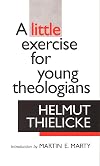
This is a very short book detailing the dangers of theological study. Many of the thoughts are ones I have already had myself, but they were very good reminders and gave some reasons I had not already thought through. This is a book that will encourage you to pursue theology while always remembering that it is not knowledge in and of itself that you pursue, but rather God himself. It is easy to forget this, and so this is a book that I believe I should read at least twice a year going show more through seminary. Perhaps my favorite thought that he introduces is the ease with which we move from the second to the third person in our theological pursuits. By this he means that we cease to talk TO God and instead only speak OF God. I have seen this danger in my own life and heart and it is one to combat continually. show less
You May Also Like


Associated Authors
Statistics
- Works
- 106
- Also by
- 1
- Members
- 4,792
- Popularity
- #5,238
- Rating
- 3.8
- Reviews
- 21
- ISBNs
- 160
- Languages
- 6
- Favorited
- 1