
Miguel de Unamuno (1864–1936)
Author of Mist
About the Author
Miguel de Unamuno y Jugo was born in Bilbao, Spain on September 29, 1864. He received a doctorate in philosophy and letters from the University of Madrid in 1884. He became a professor of Greek language and literature at the University of Salamanca in 1891. Although he also wrote poetry and plays, show more Unamuno was primarily known as an essayist and novelist. His works include The Life of Don Quixote and Sancho, The Tragic Sense of Life, and The Agony of Christianity. His novels include Peace in War, Mist, and Abel Sanchez. He took a controversial, vocal stance on political and social issues. He was removed as rector of the University of Salamanca in 1914 after publicly espousing the Allied cause in World War I. He was forced into exiled in 1924 because of his opposition to General Miguel Primo de Rivera's rule in Spain. When Primo de Rivera's dictatorship fell, Unamuno returned to the University of Salamanca and was reelected rector of the university in 1931. He was removed again in October 1936 after he denounced General Francisco Franco's Falangists and was placed under house arrest. He died of a heart attack on December 31, 1936. (Bowker Author Biography) show less
Image credit: Miguel de Unamuno
Series
Works by Miguel de Unamuno
San Manuel Bueno, Martir / Saint Manuel Bueno, Martyr: Como Se Hace Una Novela / How to Make a Novel (Spanish Edition) (1987) 84 copies, 2 reviews
Short Stories by the Generation of 1898/Cuentos de la Generación de 1898: A Dual-Language Book (Dover Dual Language Spanish) (2004) 22 copies
Como Se Hace Una Novela. La Tía Tula. San Manuel Bueno, Martír Y Tres Historias Más (1999) 11 copies
En torno a las artes : (del teatro, el cine, las bellas artes, la política y las letras) (1976) 10 copies, 1 review
El resentimiento tragico de la vida/ The Tragic resentment of Life (Alianza tres) (Spanish Edition) (1991) 9 copies
La novela de Don Sandalio, jugador de ajedrez ; Un pobre hombre rico, o, El sentimiento cómico de la vida (2005) 8 copies, 1 review
Pensamientos y sentimientos 8 copies
Epistolario Miguel de Unamuno Juan Maragall : con escritos complementarios (1976) 6 copies, 1 review
Mi vida y otros recuerdos personales 6 copies
Antología. Poesía, narrativa, ensayo (Heteroclasica/Pensar En Espanol) (Spanish Edition) (2007) 6 copies
Armastus ja pedagoogika ; Kolm näitlikku novelli ja proloog ; Malemängija don Sandalio romaan (2011) 4 copies
Libros y Autores Espa~noles Contemporaneos (Colección austral, no. 1513) (Spanish Edition) (1972) 3 copies
Viajes y paisajes: Antología de crónicas de viaje (Solvitur Ambulando. Clásicos) (Spanish Edition) (2014) 3 copies, 1 review
De Fuerteventura a Paris. Diario intimo de confinamento y destierro vertido en sonetos (1901) 3 copies, 1 review
Cartas inéditas de Miguel Unamuno 3 copies
Ensayos y artículos 2 copies
Poesías escogidas 2 copies
Obras completas. Tomo III: Ensayos 2 copies
Mechanopolis (short story) 2 copies
Tre romanzi esemplari 2 copies
De paradox als filosofie bloemlezing uit de essays van de filosoof van het tragisch levensgevoel (1990) 2 copies
Gramatica y glosario del Poema del Cid: Contribucion al estudio de los origenes de la lengua espanola (Coleccion boreal ; 10) (Spanish Edition) (1977) 2 copies
Unamuno : pensamiento político 2 copies
Vida de Dom Quixote e Sancho 2 copies
Romanzi e drammi 2 copies
Abel Sanchez; Como Se Hace Una Novela; San Manuel Bueno, Martir y Otras Prosas (Spanish Edition) (2006) 2 copies
Diario íntimo 2 copies
De esto y de aquelo - Tomo II 2 copies
Our Lord Don Quixote: The Life of Don Quixote and Sancho with Related Essays (Selected Works Volume 3) (1967) 2 copies
Autodialogos 1 copy
الخالة تولا 1 copy
Das tragische Lebensgefühl 1 copy
Niebla Abel Sánchez 1 copy
De Fuerteventura a París: confinamiento y destierro vertido en sonetos por Miguel de Unamuno: 1671 (Hispánicas) (2021) 1 copy
El Cristo de Velázques 1 copy
Obras Completas Tomo VII 1 copy
São Manuel Bueno, Mártir 1 copy
Ensayos, Tomo V 1 copy
Mir u ratu 1 copy
Um Homem 1 copy
Obras Completas II 1 copy
El hermano Juan o El mundo es teatro : vieja comedia nueva / por Miguel de Unamuno .-- 1ª ed. 1 copy
Cincuenta poesías inéditas / Miguel de Unamuno ; introducción y notas de Manuel García Blanco 1 copy
Mi religión 1 copy
El Otro y El Hermano Juan 1 copy
De mi pais 1 copy
Туман ; Абель Санчес / Мигель де Унамуно. Тиран Бандерас / Рамон дель Валье-Инклан. Салакаин… 1 copy
Vida de Don Quijote y Sancho 1 copy
Y va de cuento 1 copy
Del odio a la piedad 1 copy
Niebl [34] 1 copy
OBRAS COMPLETAS X 1 copy
UNA La tía Tula 1 copy
NIVOLA 1 copy
El contertulio 1 copy
Agonia crestinismului 1 copy
MJEGULL 1 copy
La venda 1 copy
משנאה לרחמים 1 copy
Amores 1 copy
Niebla: Miguel de Unamuna 1 copy
Poesía 1 copy
Visiones de España 1 copy
SOMBRAS DE SUEÑO. 1 copy
Solitaña y Amor y pedagogía 1 copy
España y los españoles 1 copy
Een kerel uit één stuk 1 copy
Essays on faith 1 copy
Poèmes 1 copy
Poesía II 1 copy
Ensayos (Vida de Don Quijote y Sancho ; Del sentimiento trágico de la vida ; La agonía del cristianismo) (2009) 1 copy
Unamuno: sus mejores páginas 1 copy
Narrativa 1 copy
San Manuel Bueno, mártir 1 copy
Relatos de Unamuno 1 copy
Creio no futuro 1 copy
Two Mothers 1 copy
Novelas inmortales 1 copy
Pravi čovek 1 copy
Manual de quijotismo ; Cómo se hace una novela ; Epistolario Miquel de Unamuno-Jean Cassou (2005) 1 copy
Soliloqui e conversazioni 1 copy
Obras completas IV 1 copy
Tutto un uomo: romanzo 1 copy
Sonetos del siglo XX 1 copy
Monodiálogos 1 copy
Teatro completo 1 copy
Il segreto della vita 1 copy
Obras Completas I 1 copy
Obras Completas VIII 1 copy
ضباب 1 copy
Frieden im Krieg 1 copy
Abel Sánchez 1 copy
IKI ANA 1 copy
Selected Works of Miguel Unamuno: Our Lord Don Quixote - The Life of Don Quixote and Sancho with Related Essays, Vol. 3 (1967) 1 copy
Narrativa completa. II 1 copy
Cuentos 1 copy
Niebla-Pasta – II (1958) 1 copy
POESÍAS ESCOGIDAS 1 copy
من ذاكرة الطفولة والشباب 1 copy
Aşkın Hücumu 1 copy
Cartas (1903-1933) 1 copy
الشعور المأساوي بالحياة 1 copy
El gaucho Martín Fierro 1 copy
Commento al Don Chisciotte 1 copy
Il fiore dei miei ricordi 1 copy
Mecanópolis 1 copy
Associated Works
The Big Book of Science Fiction: The Ultimate Collection (2016) — Contributor — 521 copies, 8 reviews
Cosmos Latinos: An Anthology of Science Fiction from Latin America and Spain (2003) — Contributor — 75 copies, 2 reviews
Fifty Years: Being a Retrospective Collection of Novels, Novellas, Tales, Drama, Poetry, and Reportage and Essays: All Drawn from Volumes Issued during the Last Half-Century by… (1965) — Contributor — 56 copies
Leonis. Una historia de amor, magia misterio y muerte (Spanish Edition) (2011) — Illustrator, some editions — 5 copies
Tagged
Common Knowledge
- Canonical name
- de Unamuno, Miguel
- Legal name
- de Unamuno y Jugo, Miguel
- Other names
- de Unamuno, Miguel
- Birthdate
- 1864-09-29
- Date of death
- 1936-12-31
- Gender
- male
- Education
- University of Madrid
- Occupations
- teacher
novelist
poet
playwright - Nationality
- Spain
- Birthplace
- Bilbao, Spain
- Places of residence
- Hendaye, France
Madrid, Spain - Place of death
- Salamanca, Spain
- Burial location
- Cementerio Municipal San Carlos Borromeo, Salamanca, Castilla y León, España
- Associated Place (for map)
- Spain
Members
Reviews

Originally published in 1914, this is Unamuno's best-known work of fiction. It's very much a novel written by a philosophy professor, where the characters are constantly breaking off the action to discuss the fundamental problems of human existence, but it's presented in a very playful and entertaining way. The ostensible storyline is a rather silly romantic comedy full of rival suitors, servants, scheming aunts and misunderstandings: it could a P.G. Wodehouse story, but it also has an show more Enlightenment flavour that would go well with Beaumarchais, Diderot, or Sterne (in fact, it would have been perfect for the plot of a Mozart/Da Ponte opera). However, the Bertie Wooster/Almaviva protagonist, Augusto, is not a romantic buffoon, but a tragic existentialist hero after the manner of Meursault, who is ultimately destroyed by his inability to find convincing evidence of his own existence. There is also a metatextual element, with not one but two putative authors jumping in and out of the story and arguing about whether it is a novel or something quite different, a nivola. It sounds like a mess, but Unamuno has both the charm and the intellectual strength of purpose to get away with it, and I think it would be quite readable even for someone who doesn't really care for philosophy. show less
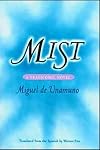
I have read some heavy handed pseudo-philosophy novels recently [The Elegance of the Hedgehog] immediately springs to mind and so it was a joy to read Unamuno’s Mist, which refuses to take itself too seriously although it deals with issues such as the insecurity of modern man and existential existence. Published in 1914 and translated from the Spanish by Marciano Guerre as recently as 2013 it starts by telling the simple story of Augusto Perez: a well to do young man who has recently lost show more his mother. He is out for his morning constitutional and for no particular reason finds himself following a young woman back to her house. He makes enquiries through the concierge and finds out that the young woman (Eugenia) is a piano teacher, he soon fancies himself as a suitor and makes more polite enquiries. Augusto lives alone with his two servants and a foundling dog and is vaguely seeking some direction to his life. He has monologues mainly addressed to his dog, has conversations with his servants and a couple of friends on the subject of women (whom he has only recently discovered) and finds himself chatting up his laundry maid Rosario. Eugenia rejects his suite as she is in love with the lazy out of work Mauricio, but when she learns about Rosario she feels slighted and sets out to win back Augusto.
The reader is alerted by the Prologue written by Victor Goti (who is a character in the novel) that all is not as it seems. A post prologue written by Unamuno questions the existence of Señor Goti and takes him to task about questioning the fate of Augusto. Goti has hinted in his prologue that Unamuno delights in playing tricks with metaphysical concepts and has been criticised for producing material that is for jesting and romping. It soon becomes clear that this is exactly what Unamuno is doing with Mist. There is irony and there is satire all encompassed in the story of Augusto’s love life which is a mystery to him and for which he seeks answers, but they all gets lost in the mist/fog of love. That may well be because of the characters that Augusto seeks out: for example the author and philosopher Paparrigopulos who is writing a book on a study of Spanish women maintaining that he only needs to study one. Paparrigopulos is also writing a book on forgotten Spanish authors who have had work published and is about to write a further book of that third class of authors; those who having thought of writing, had never got to the point of doing so.
Never trust yourself to a surgeon who has not amputated a limb of his own
Don’t take a woman to Paris; that is like taking codfish to Scotland
matrimony is an experiment …. a psychological experiment; paternity is also an experiment but … pathological
These are some of the nuggets of wisdom an ever more confused Augusto is given as he tries to make up his mind whether to pursue Eugenia or Rosario, of course he never really has that choice.
Half way into the book, Victor reveals that he is writing a novel which he calls a nivola and tells Augusto what he is doing. He says he is writing a novel just as we live and so he doesn’t know where it is going. He is asked if there is any psychology in it and he sidesteps this by saying that it will consist mainly of dialogue, because people like conversation even when it says nothing. He may be guiding his characters but at the end of the day they may well be guiding him “It often happens that an author ends by being the plaything of his own inventions” Umanuno then interjects himself to say:
“While Augusto and Victor were carrying on this ‘nivolistic' conversation, I the author of this nivola which you my dear readers are holding in your hand and reading, I was smiling enigmatically seeing my nivolistic characters advocating my case and justifying my methods of procedure. And I said to myself “Think how far these poor fellows are from suspecting that they are only trying to justify what I am doing with them! In the same fashion, whenever a man is seeking for reasons wherewith to justify himself, he is, strictly speaking, only seeking to justify God, and I am God of these two poor novelistic devils”
As a piece of Meta-fiction this book is taken right up to the denouement when Augusto travels to Salamanca to meet the author Unamuno to ague about his right to commit suicide. Unamuno will have none of it explaining that Augusto does not really exist. And so from a simple story of Augusto looking for a wife the reader is gently led down a path that becomes more weird, but the signs have been there from the start and the ride along the way if full of fun moments. I was soon entranced by this Novel/nivola’s unique atmosphere and so 4.5 stars. show less
The reader is alerted by the Prologue written by Victor Goti (who is a character in the novel) that all is not as it seems. A post prologue written by Unamuno questions the existence of Señor Goti and takes him to task about questioning the fate of Augusto. Goti has hinted in his prologue that Unamuno delights in playing tricks with metaphysical concepts and has been criticised for producing material that is for jesting and romping. It soon becomes clear that this is exactly what Unamuno is doing with Mist. There is irony and there is satire all encompassed in the story of Augusto’s love life which is a mystery to him and for which he seeks answers, but they all gets lost in the mist/fog of love. That may well be because of the characters that Augusto seeks out: for example the author and philosopher Paparrigopulos who is writing a book on a study of Spanish women maintaining that he only needs to study one. Paparrigopulos is also writing a book on forgotten Spanish authors who have had work published and is about to write a further book of that third class of authors; those who having thought of writing, had never got to the point of doing so.
Never trust yourself to a surgeon who has not amputated a limb of his own
Don’t take a woman to Paris; that is like taking codfish to Scotland
matrimony is an experiment …. a psychological experiment; paternity is also an experiment but … pathological
These are some of the nuggets of wisdom an ever more confused Augusto is given as he tries to make up his mind whether to pursue Eugenia or Rosario, of course he never really has that choice.
Half way into the book, Victor reveals that he is writing a novel which he calls a nivola and tells Augusto what he is doing. He says he is writing a novel just as we live and so he doesn’t know where it is going. He is asked if there is any psychology in it and he sidesteps this by saying that it will consist mainly of dialogue, because people like conversation even when it says nothing. He may be guiding his characters but at the end of the day they may well be guiding him “It often happens that an author ends by being the plaything of his own inventions” Umanuno then interjects himself to say:
“While Augusto and Victor were carrying on this ‘nivolistic' conversation, I the author of this nivola which you my dear readers are holding in your hand and reading, I was smiling enigmatically seeing my nivolistic characters advocating my case and justifying my methods of procedure. And I said to myself “Think how far these poor fellows are from suspecting that they are only trying to justify what I am doing with them! In the same fashion, whenever a man is seeking for reasons wherewith to justify himself, he is, strictly speaking, only seeking to justify God, and I am God of these two poor novelistic devils”
As a piece of Meta-fiction this book is taken right up to the denouement when Augusto travels to Salamanca to meet the author Unamuno to ague about his right to commit suicide. Unamuno will have none of it explaining that Augusto does not really exist. And so from a simple story of Augusto looking for a wife the reader is gently led down a path that becomes more weird, but the signs have been there from the start and the ride along the way if full of fun moments. I was soon entranced by this Novel/nivola’s unique atmosphere and so 4.5 stars. show less

Gran tipo, Unamuno: "No quiero que digan de mí que hablo como un libro; quiero que mis libros, que mis escritos todos, hablen como hombres. No quiero lascivias acústicas a costa del calor de lo dicho. Si eso otro es arte --que no lo es--, me chiflo del arte y me quedo con la vida."
Philosophies with legs, academics abstracted from academia, a fervor of dialogue and an idleness of musing, an anti-novel insistent upon self-discovery and a little man thinking himself into oblivion. Augusto strains to understand-the nature of love, of women, of self-but for all his talk-for he never ceases to talk-he manages only to, in straining for sense, leave himself senseless. At its best it brims with humorous wit, at its worst it drags with dry tedium, but it is always unique, and show more well worth the read. The work leaves me with the impression that if all of language is a construct, and we realize ourselves through language, then we are ourselves fictions. A book thus steeped in such linguistic self-realization really ought to be read in its own context, in its own language, but, having no intention of learning Spanish, this is the best I'll ever manage.
The letter from Eugenia is, by the way, one of the funniest missives in fiction. show less
The letter from Eugenia is, by the way, one of the funniest missives in fiction. show less
Lists
Awards


You May Also Like


Associated Authors
Statistics
- Works
- 373
- Also by
- 20
- Members
- 7,441
- Popularity
- #3,290
- Rating
- 3.9
- Reviews
- 151
- ISBNs
- 961
- Languages
- 26
- Favorited
- 25


