
Hilary McKay
Author of Saffy's Angel
About the Author
Image credit: Hilary McKay / Scholastic.co.uk
Series
Works by Hilary McKay
Associated Works
Tagged
Common Knowledge
- Legal name
- McKay, Hilary Jane
- Birthdate
- 1959-06-12
- Gender
- female
- Education
- University of St Andrews (BS; 1981)
- Occupations
- biochemist
children's book author - Agent
- Molly Ker Hawn
- Nationality
- UK
- Birthplace
- Boston, Lincolnshire, England, UK
- Places of residence
- Matlock, Derbyshire, England, UK
- Associated Place (for map)
- England, UK
Members
Reviews

The Conroy girls, now aged between eight and fifteen, encounter the “family failing” -- falling in love.
I didn’t find this quite as amusing as the previous two books, probably because Ruth’s crushes, which she neither wants nor wants others to know about, give the story an edge of second-hand embarrassment. But McKay is no less insightful about her characters, and each of the girls are no less intensely themselves. I still immensely enjoyed the time spent in their company.
I didn’t find this quite as amusing as the previous two books, probably because Ruth’s crushes, which she neither wants nor wants others to know about, give the story an edge of second-hand embarrassment. But McKay is no less insightful about her characters, and each of the girls are no less intensely themselves. I still immensely enjoyed the time spent in their company.
“I usedshow more
to think that fifteen would be nearly grown up,” said her sister Naomi, “until you started being it.”show less
Ruth knew exactly what she meant; she felt the same way herself and she thought the strangest thing about being so old was the fact that it made no difference at all. She was no more self-confident, or organised, or magically in charge of her emotions than she had been in the past. Nothing had changed; she was the same muddle-headed person she had always been, forever swinging between happiness and despair, never doing the right thing at quite the right moment. Naomi, eighteen months younger and two years behind her at school, had far more common sense.
Naomi was brainy, and a much more private person than Ruth [...] She and Ruth were very good allies; they understood each other. They read the same books, liked the same friends, detested the same enemies and managed to share a bedroom and yet remain on speaking terms most of the time. They endured with courage their little sisters Rachel and Phoebe.
“Although they really are insane,” remarked Ruth gloomily.
“Don’t be silly!” said their mother, although secretly thinking that Ruth had a point.
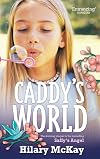
This latest addition to the Casson family chronicle (the prequel to the delightful SAFFY'S ANGEL) has a terrible cover. I'm sorry, Hoder's Children's Books UK, but it does. So I was a bit prejudiced from the beginning, and my prejudice was instantly strengthened when the first chapter introduced three new characters, none of whom appeared in the other four books, and none of whom, in my opinion, had any business being there. But I love Hilary McKay and I love the Cassons, so I persevered, show more and how glad I am that I did! This is a worthy prequel indeed, an excellent opportunity to focus on Caddy, to date the least developed character among the Casson children. CADDY'S WORLD opens Caddy's heart to the reader and she is so enchanting that I did not want the story to end. Cadmium Casson, the Bravest of the Brave. If there is a more endearing character in contemporary children's literature, it can only be Caddy's brother Indigo or sister Permanent Rose. Personally, I cannot choose between them. show less

{Stand-alone. Children’s (8-12), fantasy}(2020)
Catches the spirit of childhood without being twee or precious. Magical. (Set in London).
Eleven year old Abi (Abigail) was always an only child until her father, Theo, remarried and she acquired a stepmother and two brothers, one older and one younger and she didn't quite feel like she fitted in any more.
(This made me laugh, so I read it again and it made me laugh again. 😄 It reminds me of my kids. And of my sister.)
Then the family moved houses and their new house, covered in ivy, felt magical and right. Everyone finally got their own rooms and there was even space for Rocky, the antique rocking horse that Abi had inherited from her mother. But maybe the house really is magical.
You know the feeling you get when you're absorbed in a good book, as though you're really there? (Of course you do.) Abi starts to realise that she has been transported when, for example, she tastes salt water after reading a book about a sea voyage. And maybe six year old Louis's imaginary pet isn't quite so imaginary.
I really liked this book. The magical adventures felt believable. But behind the story you can see the family unconsciously coming together. Although the children have their resentments and reactions at losing their old way of life, before they became one family, they also have moments of thoughtless kindness towards one another. I found the children were portrayed realistically and not as ultra-sweet or from an adult's doting view point (as in some books I've read recently); they have their uncertainties, their flaws, their moments of selflessness, their moments of unreasonableness and their tantrums (but without coming across as brats either).
(Louis is 6 years old and rather literal-minded. Very much like my 12 year old. Boys! )
I like Theo and Polly and the way they relate to all the children. They don't show any favouritism and they know how to deal with fraught situations, especially Theo who is an emergency room nurse. Hah - maybe they're too good to be true ;0)
This was a gentle, sweet story but with some tension when it came to the adventures. It made me laugh out loud and it made me feel like hugging my kids. It says, in the copyright bumph, that the target audience is 8-12 years old but it doesn't talk down to readers. I would put the upper age range higher; as an adult, I really enjoyed it.
One last quote because this, too, was familiar.
Recommended.
March 2021
5 stars show less
Catches the spirit of childhood without being twee or precious. Magical. (Set in London).
Eleven year old Abi (Abigail) was always an only child until her father, Theo, remarried and she acquired a stepmother and two brothers, one older and one younger and she didn't quite feel like she fitted in any more.
Louis, although utterly messy in his appearance, was obsessively tidy in his room. .... Max lived in a great heap of Max junk. He and Louisshow more
stuck a line of tape across their bedroom floor, dividing the enormous Max mess from the extreme neatness of Louis. Nothing could stop Louis seeing over the line, though, just as nothing could save Max from having to listen to Louis droning himself to sleep at night, like an out-of-tune mosquito.
(This made me laugh, so I read it again and it made me laugh again. 😄 It reminds me of my kids. And of my sister.)
Then the family moved houses and their new house, covered in ivy, felt magical and right. Everyone finally got their own rooms and there was even space for Rocky, the antique rocking horse that Abi had inherited from her mother. But maybe the house really is magical.
You know the feeling you get when you're absorbed in a good book, as though you're really there? (Of course you do.) Abi starts to realise that she has been transported when, for example, she tastes salt water after reading a book about a sea voyage. And maybe six year old Louis's imaginary pet isn't quite so imaginary.
I really liked this book. The magical adventures felt believable. But behind the story you can see the family unconsciously coming together. Although the children have their resentments and reactions at losing their old way of life, before they became one family, they also have moments of thoughtless kindness towards one another. I found the children were portrayed realistically and not as ultra-sweet or from an adult's doting view point (as in some books I've read recently); they have their uncertainties, their flaws, their moments of selflessness, their moments of unreasonableness and their tantrums (but without coming across as brats either).
“I am not your sister, and don‘t you dare put your disgusting spitty feet on my quilt.”
“All right,” said Louis, and rubbed them on Abi‘s bedside rug instead.
“You are truly disgusting,” said Abi severely, “and you should put those horrible pajamas in the washing basket.”
“What, now?”
“YES NOW!” said Abi.
Louis slid off the bed and disappeared, but came back much too quickly.
“I‘ve done it,” he said cheerfully.
(Louis is 6 years old and rather literal-minded. Very much like my 12 year old. Boys! )
I like Theo and Polly and the way they relate to all the children. They don't show any favouritism and they know how to deal with fraught situations, especially Theo who is an emergency room nurse. Hah - maybe they're too good to be true ;0)
This was a gentle, sweet story but with some tension when it came to the adventures. It made me laugh out loud and it made me feel like hugging my kids. It says, in the copyright bumph, that the target audience is 8-12 years old but it doesn't talk down to readers. I would put the upper age range higher; as an adult, I really enjoyed it.
One last quote because this, too, was familiar.
... where a recorder club was tormenting a Christmas carol to shrieking ribbons, ...
Recommended.
March 2021
5 stars show less

I am distrustful, generally speaking, of sequels written by someone other than the original author, particularly when the sequel in question is following upon an especially beloved classic. It always seems, somehow, to be riding another's coattails (I know, I know - aren't all writers doing that, to some extent?, you might be wondering), and it rarely satisfies the reader who loved the original. I don't think I've ever come across a Jane Austen remake that impressed me (and I've read a few), show more and the current craze for "monster-mashups" - think Jane Slayre, Little Women and Werewolves, Android Karenina, and so on - leave me cold.
There are exceptions to this general rule of course, from John Gardner's Grendel, which offers the monster's view of the epic of Beowulf, to Jane Lesley Conly's two follow-ups (Racso and the Rats of NIMH and R-T, Margaret, and the Rats of NIMH) to her father's Mrs. Frisby and the Rats of NIMH. Hilary McKay's sequel to Frances Hodgson Burnett's classic Victorian tale, A Little Princess is, as it transpires, another such exception.
I adored Burnett's tale of a privileged young girl who discovers, for a time, what it means to be young, vulnerable, and poor in Victorian England, and read it countless times as a girl. I wasn't sure how McKay could expand upon her story without doing it violence, but as it turns out, she didn't try. Wishing for Tomorrow is not more of Sara Crewe's story, it is Ermengarde's story, and (to a lesser extent) the story of Lottie, Lavinia and the Misses Minchin. It is the tale of what happened at the "Select Seminary for Young Ladies," once Sara departed, and manages - wonder of wonders - to offer a convincing, and even sympathetic(!) explanation for the behavior of some of the less admirable characters in the original.
McKay doesn't make the mistake of trying to duplicate Burnett's style or worldview - she obviously has her own - nor does she take Burnett's view of these characters as her own. Lavinia is revealed as an intelligent girl who's simply never been given the opportunity to use her mind, Miss Minchin as a frustrated and embittered woman who was also denied, as a girl, the opportunities she deserved. As for Ermengarde, she emerges from the veil cast by Sara's perception of her, much less of a lumpen "clod" than first appeared. I was amazed to discover that I loved (or, in the case of Miss Minchin, could at least sympathize with) each of these characters, despite finding them either lackluster or repugnant in Burnett's original. No small achievement on McKay's part! I think I may have to track down more of her work... show less
There are exceptions to this general rule of course, from John Gardner's Grendel, which offers the monster's view of the epic of Beowulf, to Jane Lesley Conly's two follow-ups (Racso and the Rats of NIMH and R-T, Margaret, and the Rats of NIMH) to her father's Mrs. Frisby and the Rats of NIMH. Hilary McKay's sequel to Frances Hodgson Burnett's classic Victorian tale, A Little Princess is, as it transpires, another such exception.
I adored Burnett's tale of a privileged young girl who discovers, for a time, what it means to be young, vulnerable, and poor in Victorian England, and read it countless times as a girl. I wasn't sure how McKay could expand upon her story without doing it violence, but as it turns out, she didn't try. Wishing for Tomorrow is not more of Sara Crewe's story, it is Ermengarde's story, and (to a lesser extent) the story of Lottie, Lavinia and the Misses Minchin. It is the tale of what happened at the "Select Seminary for Young Ladies," once Sara departed, and manages - wonder of wonders - to offer a convincing, and even sympathetic(!) explanation for the behavior of some of the less admirable characters in the original.
McKay doesn't make the mistake of trying to duplicate Burnett's style or worldview - she obviously has her own - nor does she take Burnett's view of these characters as her own. Lavinia is revealed as an intelligent girl who's simply never been given the opportunity to use her mind, Miss Minchin as a frustrated and embittered woman who was also denied, as a girl, the opportunities she deserved. As for Ermengarde, she emerges from the veil cast by Sara's perception of her, much less of a lumpen "clod" than first appeared. I was amazed to discover that I loved (or, in the case of Miss Minchin, could at least sympathize with) each of these characters, despite finding them either lackluster or repugnant in Burnett's original. No small achievement on McKay's part! I think I may have to track down more of her work... show less
Lists
Awards


You May Also Like


Associated Authors
Statistics
- Works
- 87
- Also by
- 2
- Members
- 6,752
- Popularity
- #3,628
- Rating
- 4.1
- Reviews
- 242
- ISBNs
- 656
- Languages
- 15
- Favorited
- 21
