
Peter Cook (2)
Author of You Wouldn't Want to be at the Boston Tea Party!: Wharf Water Tea You'd Rather Not Drink
For other authors named Peter Cook, see the disambiguation page.
About the Author
He is a founding member of Archigram, is the chair of the Bartlett School of Architecture, University College London & a principal in the firm of Cook & Hawley Architects in London 010.
Works by Peter Cook
You Wouldn't Want to be at the Boston Tea Party!: Wharf Water Tea You'd Rather Not Drink (2006) 278 copies, 4 reviews
You Wouldn't Want to Sail on the Mayflower!: A Trip That Took Entirely Too Long (2005) 247 copies, 10 reviews
You Wouldn't Want to Sail on a 19th Century Whaling Ship! Grisly Tasks You'd Rather Not Do (2004) 67 copies, 4 reviews
Tagged
Common Knowledge
- Gender
- male
Members
Reviews
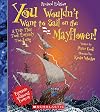
You Wouldn't Want to Sail on the Mayflower! was a wonderful example of an informational text that engages young readers. This book has great illustrations in a cartoon form that make it entertaining to read. In addition to this the information that was presented was accurate and taken more seriously. My only complaint with this book is that the font is a bit small and there is a lot of text on the page. It may have benefited from being a few pages longer in order to make it easier to digest show more what is on the page. show less
You Wouldn't Want To Sail On The Mayflower! (Turtleback School & Library Binding Edition) (You Wouldn't Want To... (Prebound)) by Peter Cook
Your name is Priscilla Mullins and you are a passenger on the Mayflower. Discover information about your shipmates, why you were aboard, the perils of life at sea, and then how you can survive the first year in the New World. “Handy Hints” throughout the book such as “Make friends with the captain and crew, you may need their help later in the voyage!” help make a point but also keep it lighthearted. The book is full of information without being overwhelming.
This book makes history show more fun. I enjoyed the cartoon type illustrations throughout. Each chapter reveals so much information in very little space. I especially thought the last section was interesting as it estimated that 12% of American people are direct descendents from the Mayflower. It shows pictures of Priscilla Mullins' descendants, including President John Adams, Henry Wadsworth Longfellow, and even Marilyn Monroe.
I liked how the legacy section shows how one person's life is important in the lives of many in history. I would let children in a classroom choose to either try to trace their own family tree back as far as they can or choose another person from the Mayflower and see what other famous people descended from that person. Another interesting point this book brings out is that Plymouth is also the name of the port in England from which the ship left. The students could research to discover what other New World colonies were named after a town in the Old World. show less
This book makes history show more fun. I enjoyed the cartoon type illustrations throughout. Each chapter reveals so much information in very little space. I especially thought the last section was interesting as it estimated that 12% of American people are direct descendents from the Mayflower. It shows pictures of Priscilla Mullins' descendants, including President John Adams, Henry Wadsworth Longfellow, and even Marilyn Monroe.
I liked how the legacy section shows how one person's life is important in the lives of many in history. I would let children in a classroom choose to either try to trace their own family tree back as far as they can or choose another person from the Mayflower and see what other famous people descended from that person. Another interesting point this book brings out is that Plymouth is also the name of the port in England from which the ship left. The students could research to discover what other New World colonies were named after a town in the Old World. show less
Summary: This story is all about the journey that 102 Pilgrims took from England to America in 1602. The story begins by talking about how the English Puritans broke off from their church because they wanted religious freedom. It talks about how the group from England joined with a group from Holland to make the journey. The author talks about the different parts of the ship and what they were used for on the trip. He also talks about the crew and their jobs on the ship during the voyage as show more well as some of the important people from England who made the journey. Next the book goes into detail about what life was like for people on the ship including illness and dealing with rough seas. They finally find land after 66 days although they ended up in New England not Virginia like they had planned. Several men went ashore to find a place to build their new settlement and started construction on houses and storage buildings. They later met a Native American named Squanto who helped them adjust to life in Plymouth.
Review: I thought that this book was very interesting and well written. I like how at the beginning of the book the author gave the reader an identity. He told us our name, age, and about our family who would be traveling with us to America. This helps the reader to become more engaged and make a stronger connection to the story. The book was also very informative. Although some of it was fictional it also provided a lot of facts about Pilgrims and their journey on the Mayflower. I liked that there were a lot of additional captions and side-notes that made the book more interesting to read. I thought that the illustrations were excellent. They captured what they author was trying to say but many of them were also rather comical. I know that I was engaged while reading this book and I think that many students would be too. show less
Review: I thought that this book was very interesting and well written. I like how at the beginning of the book the author gave the reader an identity. He told us our name, age, and about our family who would be traveling with us to America. This helps the reader to become more engaged and make a stronger connection to the story. The book was also very informative. Although some of it was fictional it also provided a lot of facts about Pilgrims and their journey on the Mayflower. I liked that there were a lot of additional captions and side-notes that made the book more interesting to read. I thought that the illustrations were excellent. They captured what they author was trying to say but many of them were also rather comical. I know that I was engaged while reading this book and I think that many students would be too. show less
You Wouldn't Want to Sail on a 19th-Century Whaling Ship!: Grisly Tasks You'd Rather Not Do by Peter Cook
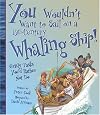
"You Wouldn't Want to Sail on a 19th Century Whaling Ship" is a wonderful book, both informative and hilarious. Though it is clearly intended for a younger audience then I what I will be teaching, it would really be very ideal for middle schoolers, though high school might also use it, though chiefly for pictures to illustrate reports and for the definitions provided for terms.
Though mostly the legendary tale of the whaling ship "Essex", which would be attacked by a giant whale, causing her show more crew to engage in cannibalism in order to survive a lifeboat voyage back to civilization, and thus inspire Herman Melville's "Moby Dick", it serves as an example example of 19th century whaling. Also, for younger students teaching them using an example, rather than speaking in large generalities I find would be most helpful in making an impression on them. To this end, I also applaud the authors for having a young boy serve as the Essex's and the books narrator. The students will be able to identify with the young Thomas Nickerson and learn with him as he learns all about 19th century whaling.
I really enjoyed this book and plan on adding a copy of it to both my personal collection and to my growing classroom collection.(less) show less
Though mostly the legendary tale of the whaling ship "Essex", which would be attacked by a giant whale, causing her show more crew to engage in cannibalism in order to survive a lifeboat voyage back to civilization, and thus inspire Herman Melville's "Moby Dick", it serves as an example example of 19th century whaling. Also, for younger students teaching them using an example, rather than speaking in large generalities I find would be most helpful in making an impression on them. To this end, I also applaud the authors for having a young boy serve as the Essex's and the books narrator. The students will be able to identify with the young Thomas Nickerson and learn with him as he learns all about 19th century whaling.
I really enjoyed this book and plan on adding a copy of it to both my personal collection and to my growing classroom collection.(less) show less
Lists
You May Also Like


Associated Authors
Statistics
- Works
- 5
- Members
- 659
- Popularity
- #38,282
- Rating
- 4.0
- Reviews
- 18
- ISBNs
- 159
- Languages
- 7