
John Bolton (2) (1951–)
Author of Harlequin Valentine
For other authors named John Bolton, see the disambiguation page.
Series
Works by John Bolton
The Evil Dead #4 — Illustrator — 2 copies
The Evil Dead #3 — Illustrator — 2 copies
The Evil Dead #2 — Illustrator — 2 copies
The Evil Dead #1 — Illustrator — 2 copies
John Bolton's Halls of Horror no. 2 2 copies
Manbat :Batman Part 2 2 copies
Epic Illustrated Ad 1 copy
John Bolton's Halls of Horror no. 1 — Illustrator — 1 copy
asylum #1 1 copy
The Air Smugglers 1 copy
Associated Works
9-11: The World's Finest Comic Book Writers & Artists Tell Stories to Remember (2002) — Illustrator — 256 copies, 1 review
Bad Doings & Big Ideas: A Bill Willingham Deluxe Edition (2011) — Illustrator — 47 copies, 3 reviews
Orbit: The Best of Isaac Asimov's Science Fiction Magazine (Graphic Science Fiction, No 1) (1990) — Illustrator — 15 copies, 1 review
Seekers Into the Mystery # 14 — Cover artist — 3 copies
Il Grifo n.13 — Cover artist — 1 copy
Aliens n.6 Settembre 1991 — Cover artist — 1 copy
Seekers Into the Mystery # 12 — Cover artist — 1 copy
Game, March 1977 (Volume 4, Number 3) — Illustrator — 1 copy
The Black Dragon #1 — Illustrator — 1 copy
Tagged
Common Knowledge
- Canonical name
- Bolton, John
- Legal name
- Bolton, John
- Birthdate
- 1951-05-23
- Gender
- male
- Nationality
- England (birth)
- Birthplace
- London, England, UK
Members
Reviews
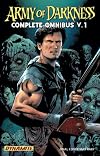
This was a beast! It's broken into five sections and each one tells the story of Ash's shenanigans with the Necronomicon, deadites, Evil Ash and time travel.
This has been a treat to read! It is full of time travel, Ash goobering up his one task to destroy the book over and over, fighting and endless deadite army, and multiple Evil Ashes. He saves the girl, loses the girl, ends up in the wrong time, travels backwards and forwards in time, gets sucked into a computer game and fights the evil show more digital version of himself and deadite soldiers. He travels back to the cabin where it all started, picks up [and loses] new allies, destroys the book on multiple occasions and still the Necronomicon finds a way back into his life every time.
The stories are amazing and the artwork is is phenomenal. Part of what took me so long to finish it was me staring at the art. Each section is done by different writers and illustrators, so that makes it that much more eye-grabbing noticing the differences in writing and art styles. It's a must read for anyone who is a fan of Ash Williams and the Evil Dead/Army of Darkness series. show less
This has been a treat to read! It is full of time travel, Ash goobering up his one task to destroy the book over and over, fighting and endless deadite army, and multiple Evil Ashes. He saves the girl, loses the girl, ends up in the wrong time, travels backwards and forwards in time, gets sucked into a computer game and fights the evil show more digital version of himself and deadite soldiers. He travels back to the cabin where it all started, picks up [and loses] new allies, destroys the book on multiple occasions and still the Necronomicon finds a way back into his life every time.
The stories are amazing and the artwork is is phenomenal. Part of what took me so long to finish it was me staring at the art. Each section is done by different writers and illustrators, so that makes it that much more eye-grabbing noticing the differences in writing and art styles. It's a must read for anyone who is a fan of Ash Williams and the Evil Dead/Army of Darkness series. show less

Summary: Hippolyta Hall is drifting through life, sleeping around and acting out to numb the pain of the hole in her life left by her kidnapped infant son. She signs on to travel to Greece with a theater troop, but when she gets there, she becomes caught up in an age-old battle between the Cronus, the last of the Olympians, and the Furies, who exist to punish patricide, and who are all too willing to use her as a pawn in their acts of vengeance.
Review: It's been a while - too long, in fact - show more since I've read the Sandman main series, but I'm really enjoying working my way through the spinoffs. This one is one of the best that I've read so far; it's got same blend of fantasy, horror, pathos, theology, and a heavy helping of mythology that made the main Sandman series so appealing. This book is not for those who haven't read the main series - it's not an independent spin-off so much as it is a wrapping-up of one of the storylines, and characters appear and past events are referenced with little-to-no explanation for new readers. It's also not a book for those who aren't at least passingly familiar with Greek mythology; I'd recommend brushing up at least on the creation myth, the Titans, and the coming of the Olympians before starting. (There's also an appearance by Philemon and Baucis, whose story I was unfamiliar with before starting.) The artwork is gorgeous, and in quite a different style than the rest of the Sandman novels; Bolton's style is part photograph and part painting, and the result is incredibly rich and lovely. (Although I'm not sure how I feel about Dream showing up in layered T-shirts.) Overall, I not only really enjoyed this book, but it also reminded me how much I enjoyed the Sandman series as a whole, and how much I want to go re-read it. 4.5 out of 5 stars.
Recommendation: If you've read through the whole main series of the Sandman, then you'll want to read this one as well. If you haven't... well, go do that, and then we'll talk. show less
Review: It's been a while - too long, in fact - show more since I've read the Sandman main series, but I'm really enjoying working my way through the spinoffs. This one is one of the best that I've read so far; it's got same blend of fantasy, horror, pathos, theology, and a heavy helping of mythology that made the main Sandman series so appealing. This book is not for those who haven't read the main series - it's not an independent spin-off so much as it is a wrapping-up of one of the storylines, and characters appear and past events are referenced with little-to-no explanation for new readers. It's also not a book for those who aren't at least passingly familiar with Greek mythology; I'd recommend brushing up at least on the creation myth, the Titans, and the coming of the Olympians before starting. (There's also an appearance by Philemon and Baucis, whose story I was unfamiliar with before starting.) The artwork is gorgeous, and in quite a different style than the rest of the Sandman novels; Bolton's style is part photograph and part painting, and the result is incredibly rich and lovely. (Although I'm not sure how I feel about Dream showing up in layered T-shirts.) Overall, I not only really enjoyed this book, but it also reminded me how much I enjoyed the Sandman series as a whole, and how much I want to go re-read it. 4.5 out of 5 stars.
Recommendation: If you've read through the whole main series of the Sandman, then you'll want to read this one as well. If you haven't... well, go do that, and then we'll talk. show less
Lyta Hall is probably my third-favorite character in Neil Gaiman's The Sandman. Which is weird, because she isn't exactly up to much. (Though what she is up turns out to be quite important.) She used to be superhero Fury of Infinity, Inc., but within The Sandman, she's the poor woman whose husband turns out to be long dead, manipulated by nightmares escaped from the Dreaming, whose child is taken from her by Dream to become the next Dream, and who is manipulated by agents outside mortal show more comprehension to bring about Dream's death. Poor woman-- no wonder she's a bit overwhelmed, and I like the idea of the character, gone from being a powerful young superheroine to a plaything of the gods through a ridiculous series of bad circumstances.
Anyway, I was excited to read a book focusing on her, and Mike Carey and John Bolton's graphic novel did not disappoint. The Furies sees the Greek god Cronus returning with a complicated plan to destroy the Furies so that he can become the new Furies, in which Lyta Hall, thanks to the link forged between herself and the Furies in The Sandman, is the lynchpin. It's half a tale of gods and monsters like Neil Gaiman would have told, half a woman trying to figure out her crazy life, but you get the feeling that Carey treats the mythology more seriously than Gaiman ever did and that Lyta might actually acquire some agency for once. Endowed with superstrength, and she finally manages to do something super, even if it's just getting her life back a bit.
John Bolton's painted art was very nice, sort of Alex Rossian, but with a little less majesty. It's maybe too realistic: his depiction of Dream (there's Daniel Hall again!, though he seems to have forgotten his mother) and some of the other supernatural characters looked a little goofy because they looked so normal, making their supernatural characteristics a little awkward. On the other hand, Lyta's journey in the underworld and the appearance of the Furies themselves were fantastic.
Added July 2022; access a version of the below that includes illustrations on my blog.
A decade later, I return to this story with a new context: a JSA-adjacent story. Specifically, a story of Lyta Hall, who had been a main character in Roy Thomas's Earth-Two comic Infinity, Inc. before she got picked up by Neil Gaiman as a Sandman character. When we last saw Lyta in Infinc, she was married and pregnant, and then her husband Hector died, but it turned out he kind of lived anyway, as the new Sandman of the Dream Dimension. When Gaiman picked up with Hector and Lyta in The Sandman, he killed off Hector again and made Lyta the instrument of the death of The Sandman's Dream, and then made their son Daniel the new Dream. So when this comic starts, Lyta is trying to return to her life in Los Angeles, attempting to cope with the seeming death of her child. (From a chronology standpoint, it does read a little strangely. Lyta's apartment still has a baby room? This comic was published in 2002, and Lyta got pregnant way back in 1987 or so, but such is comic-book time.)
So how does it work as an Infinity, Inc. story? The answer is that it's okay, not as good as it does a Sandman story. There is an Infinity, Inc. group shot on one page, but overall this does the Sandman thing of being very oblique in its references to the superhero world it was all derived from. I did have to wonder at some of the continuity of it all. Lyta is of Greek descent, and knows the Greek language and Greek mythology... this would have made sense in her pre-Crisis backstory, when she was the daughter of the Earth-Two Wonder Woman, but post-Crisis, though her mother was Greek, she didn't know that until she was an adult; she was adopted and raised by Admiral Derek Trevor and the former superhero Miss America, Joan Dale-Trevor. But maybe I am overthinking all this
The Furies works as a story of a strong woman whose strength fails her. Lyta was an immensely powerful person, but she became a victim and a pawn—how can she get her agency back? I really like Lyta, and I remember liking the story, so I was looking forward to the reread... but I struggled with actually being emotionally connected to this story, since as I last read the relevant issues of The Sandman back in 2010, I was a bit fuzzy on what had actually happened to Lyta! So overall, fine but not great.
I am curious to see how it ends up playing into Geoff Johns's JSA run, if it does at all. As of this writing, I've read the first volume of that, where we're told Hector (resurrected again, of course) can't find Lyta. But according to this, she's living in their old apartment in LA, and the police have her on a register of ex-superheroes, so how is he so bad at looking!?
Neil Gaiman's The Sandman Spin-Offs: « Previous in sequence | Next in sequence »
The Justice Society and Earth-Two: « Previous in sequence | Next in sequence » show less
Anyway, I was excited to read a book focusing on her, and Mike Carey and John Bolton's graphic novel did not disappoint. The Furies sees the Greek god Cronus returning with a complicated plan to destroy the Furies so that he can become the new Furies, in which Lyta Hall, thanks to the link forged between herself and the Furies in The Sandman, is the lynchpin. It's half a tale of gods and monsters like Neil Gaiman would have told, half a woman trying to figure out her crazy life, but you get the feeling that Carey treats the mythology more seriously than Gaiman ever did and that Lyta might actually acquire some agency for once. Endowed with superstrength, and she finally manages to do something super, even if it's just getting her life back a bit.
John Bolton's painted art was very nice, sort of Alex Rossian, but with a little less majesty. It's maybe too realistic: his depiction of Dream (there's Daniel Hall again!, though he seems to have forgotten his mother) and some of the other supernatural characters looked a little goofy because they looked so normal, making their supernatural characteristics a little awkward. On the other hand, Lyta's journey in the underworld and the appearance of the Furies themselves were fantastic.
Added July 2022; access a version of the below that includes illustrations on my blog.
A decade later, I return to this story with a new context: a JSA-adjacent story. Specifically, a story of Lyta Hall, who had been a main character in Roy Thomas's Earth-Two comic Infinity, Inc. before she got picked up by Neil Gaiman as a Sandman character. When we last saw Lyta in Infinc, she was married and pregnant, and then her husband Hector died, but it turned out he kind of lived anyway, as the new Sandman of the Dream Dimension. When Gaiman picked up with Hector and Lyta in The Sandman, he killed off Hector again and made Lyta the instrument of the death of The Sandman's Dream, and then made their son Daniel the new Dream. So when this comic starts, Lyta is trying to return to her life in Los Angeles, attempting to cope with the seeming death of her child. (From a chronology standpoint, it does read a little strangely. Lyta's apartment still has a baby room? This comic was published in 2002, and Lyta got pregnant way back in 1987 or so, but such is comic-book time.)
So how does it work as an Infinity, Inc. story? The answer is that it's okay, not as good as it does a Sandman story. There is an Infinity, Inc. group shot on one page, but overall this does the Sandman thing of being very oblique in its references to the superhero world it was all derived from. I did have to wonder at some of the continuity of it all. Lyta is of Greek descent, and knows the Greek language and Greek mythology... this would have made sense in her pre-Crisis backstory, when she was the daughter of the Earth-Two Wonder Woman, but post-Crisis, though her mother was Greek, she didn't know that until she was an adult; she was adopted and raised by Admiral Derek Trevor and the former superhero Miss America, Joan Dale-Trevor. But maybe I am overthinking all this
The Furies works as a story of a strong woman whose strength fails her. Lyta was an immensely powerful person, but she became a victim and a pawn—how can she get her agency back? I really like Lyta, and I remember liking the story, so I was looking forward to the reread... but I struggled with actually being emotionally connected to this story, since as I last read the relevant issues of The Sandman back in 2010, I was a bit fuzzy on what had actually happened to Lyta! So overall, fine but not great.
I am curious to see how it ends up playing into Geoff Johns's JSA run, if it does at all. As of this writing, I've read the first volume of that, where we're told Hector (resurrected again, of course) can't find Lyta. But according to this, she's living in their old apartment in LA, and the police have her on a register of ex-superheroes, so how is he so bad at looking!?
Neil Gaiman's The Sandman Spin-Offs: « Previous in sequence | Next in sequence »
The Justice Society and Earth-Two: « Previous in sequence | Next in sequence » show less

When I remarked to my wife (who has not read any of The Sandman, but has patiently listened to me gab about it for over two years now) that the faerie elements of The Sandman had never been among my favorite, she said that must be true, for she'd never heard me mention them at all. And it was then that I realized how little I cared for Titania, Auberon, and the rest. Gaiman's original jaunt into this realm (the one with Shakespeare) hadn't done much for me, World Fantasy Award show more nonwithstanding, and neither had its various reapperances. I like Nualla, but it's her separation from Faerie that keeps her interesting, and if I like Cluracan, it's mostly because of a vague feeling that I ought to like characters like him.
So it turns out that not even Mike Carey and John Bolton, who previously came together for the excellent Sandman spin-off The Furies, can make Faerie very interesting. Though there's some good artwork here, the Faerie politics are a big fat load of "who cares?" I don't care if Titania or Mab rules Faerie, and the climax is a big load of nonsense. There's some okay stuff about a teenage girl acting out, and Bolton's art is good when it's not being exploitative, but for this story to be interesting would have required more than the 96 pages it was given; everything has to be sped through too fast to be interesting. The best part, as in so many Sandman spin-offs, is the brief jaunt into the Dreaming, not the actual story.
Neil Gaiman's The Sandman Spin-Offs: « Previous in sequence | Next in sequence » show less
So it turns out that not even Mike Carey and John Bolton, who previously came together for the excellent Sandman spin-off The Furies, can make Faerie very interesting. Though there's some good artwork here, the Faerie politics are a big fat load of "who cares?" I don't care if Titania or Mab rules Faerie, and the climax is a big load of nonsense. There's some okay stuff about a teenage girl acting out, and Bolton's art is good when it's not being exploitative, but for this story to be interesting would have required more than the 96 pages it was given; everything has to be sped through too fast to be interesting. The best part, as in so many Sandman spin-offs, is the brief jaunt into the Dreaming, not the actual story.
Neil Gaiman's The Sandman Spin-Offs: « Previous in sequence | Next in sequence » show less
Lists
Awards

You May Also Like


Associated Authors
Statistics
- Works
- 55
- Also by
- 69
- Members
- 2,190
- Popularity
- #11,712
- Rating
- 4.0
- Reviews
- 36
- ISBNs
- 109
- Languages
- 9
- Favorited
- 1