
John Carnell (2)
Author of The Hitchhiker's Guide to the Galaxy: The Authorized Collection
For other authors named John Carnell, see the disambiguation page.
Series
Works by John Carnell
The Hitchhiker's Guide to the Galaxy: The Authorized Collection (1993) — Author — 126 copies, 4 reviews
Associated Works
Tagged
Common Knowledge
- Birthdate
- 20th century
- Gender
- male
- Nationality
- UK
- Associated Place (for map)
- UK
Members
Reviews

Access a version of the below that includes illustrations on my blog.
This is sort of a Doctor Who spin-off: the Sleeze Brothers, shady P.I.s, were introduced in Follow That TARDIS!, a DWM strip collected in A Cold Day in Hell! At the time I read the original strip, I wrote, "The Sleeze Brothers went on to have their own comic series from Marvel. The Tardis wiki doesn't count it as part of the Doctor Who
universe, but who knows why. [...] You can get it pretty cheap on the secondary
market, show more but I am not sure I am motivated to do so..." And yet, I was! I am not sure if I could explain why, except that I found something charming and uniquely Marvel UK-ish about the whole thing. The pastiche-heavy future world of these strips struck me as being very much of a piece with Russell T Davies's "New Earth" setting, and thus something that fit into the Doctor Who universe in spirit, if not in continuity. (Though, having read them all now, they totally could be part of the Doctor Who universe.)
This contains six single-issue stories, plus an eight-page prologue establishing how the Sleeze Brothers—formerly minor criminals—became private investigators. If you read interviews about this series, it's often stated that despite the fact that though it seems like a Blues Brothers rip-off, it's really not; this is totally belied by this story, which opens just like the film, with El Ape Sleeze (or "El'ape" in some of the stories) meeting his brother Deadbeat after he's released from the penitentiary, following by a gratuitously destructive car chase. So who knows.
The six stories here are fine. None are works of genius, though by the end of the volume, I found there was a certain weird charm. Blues Brothers may have been a starting point, but it was never this weird. They get involved in gang wars, in attempts to use holotelevision to brainwash the city, in attempted presidential assassinations, in Clueesque murder mystery dinners, in behind-the-scenes shenanigans at award shows, in intergalactic peace conferences. Most of the time, they are almost gleefully unaware of the stories unfolding around them, not understanding why anything has actually happened
I wouldn't say I loved any of these stories, but there was only one I didn't like, the presidential assassination one, which seemed to have little panel time for the ostensible main characters, and was too much on the convoluted side. (I think the cases should be beyond their understanding, but not mine!) Most of the time, I was enjoying the inane details and strange pastiche that makes up their universe. I mean, it's not high art, but it's so completely itself that I couldn't help but be charmed by it.
As you watch the Sleeze Brothers going up against a two-headed pig police sergeant, crawling through sewers, ending up in an Alien pastiche, satirizing the sexual intrigues of the Kennedy administration, revealing the killer is a parasitic life-form living on his brother's back, encountering an army of ninja cats, it's clear that no one made this comic book to appeal to a preexisting trend or perceived gap in the market. No one here was out to make a quick buck, because this is not the comic that could make anyone one. This exists because John Carnell and Andy Lanning wanted it to exist, and because they loved it. And I think that comes through at its best moments.
Marvel UK: « Previous in sequence | Next in sequence » show less
This is sort of a Doctor Who spin-off: the Sleeze Brothers, shady P.I.s, were introduced in Follow That TARDIS!, a DWM strip collected in A Cold Day in Hell! At the time I read the original strip, I wrote, "The Sleeze Brothers went on to have their own comic series from Marvel. The Tardis wiki doesn't count it as part of the Doctor Who
universe, but who knows why. [...] You can get it pretty cheap on the secondary
market, show more but I am not sure I am motivated to do so..." And yet, I was! I am not sure if I could explain why, except that I found something charming and uniquely Marvel UK-ish about the whole thing. The pastiche-heavy future world of these strips struck me as being very much of a piece with Russell T Davies's "New Earth" setting, and thus something that fit into the Doctor Who universe in spirit, if not in continuity. (Though, having read them all now, they totally could be part of the Doctor Who universe.)
This contains six single-issue stories, plus an eight-page prologue establishing how the Sleeze Brothers—formerly minor criminals—became private investigators. If you read interviews about this series, it's often stated that despite the fact that though it seems like a Blues Brothers rip-off, it's really not; this is totally belied by this story, which opens just like the film, with El Ape Sleeze (or "El'ape" in some of the stories) meeting his brother Deadbeat after he's released from the penitentiary, following by a gratuitously destructive car chase. So who knows.
The six stories here are fine. None are works of genius, though by the end of the volume, I found there was a certain weird charm. Blues Brothers may have been a starting point, but it was never this weird. They get involved in gang wars, in attempts to use holotelevision to brainwash the city, in attempted presidential assassinations, in Clueesque murder mystery dinners, in behind-the-scenes shenanigans at award shows, in intergalactic peace conferences. Most of the time, they are almost gleefully unaware of the stories unfolding around them, not understanding why anything has actually happened
I wouldn't say I loved any of these stories, but there was only one I didn't like, the presidential assassination one, which seemed to have little panel time for the ostensible main characters, and was too much on the convoluted side. (I think the cases should be beyond their understanding, but not mine!) Most of the time, I was enjoying the inane details and strange pastiche that makes up their universe. I mean, it's not high art, but it's so completely itself that I couldn't help but be charmed by it.
As you watch the Sleeze Brothers going up against a two-headed pig police sergeant, crawling through sewers, ending up in an Alien pastiche, satirizing the sexual intrigues of the Kennedy administration, revealing the killer is a parasitic life-form living on his brother's back, encountering an army of ninja cats, it's clear that no one made this comic book to appeal to a preexisting trend or perceived gap in the market. No one here was out to make a quick buck, because this is not the comic that could make anyone one. This exists because John Carnell and Andy Lanning wanted it to exist, and because they loved it. And I think that comes through at its best moments.
Marvel UK: « Previous in sequence | Next in sequence » show less
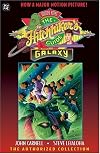
The edition contains the full story of the first book in the Hitchhiker's series. An excellent adaptation to graphic novel format, the work was authorized and overseen by Douglas Adams. The depiction of the characters was exceptionally well done, as you'd expect, although the artist admitted to having some difficulty with Adams's specifications for Marvin. How do you depict that miasma of hopelessness and depression without facial features? He rose to the occasion. Marvin is monolithic, as show more Adams required, and yet extremely expressive within the range of emotions the character experiences.
Unfortunately, nobody took the opportunity of a new edition to edit the text to reflect the truly Vogonesque nature of the poetry of Sarah Binks, the Sweet Songstress of Saskatchewan: a fictional character who would fit right in among the top three worst poets of the universe and has the advantage of a large published oeuvre... as does William Topaz McGonagall, who really lived and sincerely wrote Vogon-worthy poetry.
The artwork really enhances the text, except in the case of the excerpts from that eponymous, fictional, work The Hitchhiker's Guide to the Galaxy. The colourist definitely made the outtakes distinctive, but at the cost of making the text completely illegible to any long-time fans of the book (or, heaven help them, of the radio series). You need beady young light-gathering eyes to read white text on a pale blue background!
No problem for the next generation of fans though, it's perfect for my grandchildren. show less
Unfortunately, nobody took the opportunity of a new edition to edit the text to reflect the truly Vogonesque nature of the poetry of Sarah Binks, the Sweet Songstress of Saskatchewan: a fictional character who would fit right in among the top three worst poets of the universe and has the advantage of a large published oeuvre... as does William Topaz McGonagall, who really lived and sincerely wrote Vogon-worthy poetry.
The artwork really enhances the text, except in the case of the excerpts from that eponymous, fictional, work The Hitchhiker's Guide to the Galaxy. The colourist definitely made the outtakes distinctive, but at the cost of making the text completely illegible to any long-time fans of the book (or, heaven help them, of the radio series). You need beady young light-gathering eyes to read white text on a pale blue background!
No problem for the next generation of fans though, it's perfect for my grandchildren. show less
Arthur Dent stars in The Hitchhiker's Guide to the Galaxy as the only human left once the Earth is dissolved in order to clear the way for a new intergalactic highway, saved by his not-so-human friend Ford Prefect. Arthur and Ford hitchhike through various spacecraft and planets in the hours directly following Earth's destruction, with the help of a book, "The Hitchhiker's Guide to the Galaxy."
I enjoyed reading this novel. However, Douglas Adams has a tendency to go off on tangents about show more somewhat unrelated topics. Often I had to go back a few paragraphs and reread to figure out how we had gotten on the current subject. This did impede my comprehension of the novel, as well as slowed down my reading considerably.
Despite the slightly confusing manner in which this book was written, The Hitchhiker's Guide to the Galaxy is a must-read for all fantasy lovers. It is very relatable because Arthur is just a normal human being who happens to be saved from the end of world. The readers view his struggle to accept not only the fact that his home planet is gone, but also the presence of other life forms within the universe, and the improbability of many of the situations he faces.
My only other comment on this novel is that the ending felt unfinished, but this is only the first of the series. I can't wait to read more! show less
I enjoyed reading this novel. However, Douglas Adams has a tendency to go off on tangents about show more somewhat unrelated topics. Often I had to go back a few paragraphs and reread to figure out how we had gotten on the current subject. This did impede my comprehension of the novel, as well as slowed down my reading considerably.
Despite the slightly confusing manner in which this book was written, The Hitchhiker's Guide to the Galaxy is a must-read for all fantasy lovers. It is very relatable because Arthur is just a normal human being who happens to be saved from the end of world. The readers view his struggle to accept not only the fact that his home planet is gone, but also the presence of other life forms within the universe, and the improbability of many of the situations he faces.
My only other comment on this novel is that the ending felt unfinished, but this is only the first of the series. I can't wait to read more! show less
Douglas Adams’ The Hitchhiker’s Guide to the Galaxy: The Authorized Collection is a graphic novel treatment of Douglas Adams’ iconic work, adapted from the novel by John Carnell and illustrated by Steve Leialoha, and first published in 1991.
The Hitchhiker’s Guide to the Galaxy started out as a radio serial broadcast on the BBC in the mid-1970’s. The script was adapted as a novel, which has in turn been adapted as a television series (1981), graphic novel, and movie (2005). The show more story follows the adventures of a hapless Earthman named Arthur Dent and his extraterrestrial friend, Ford Prefect, who escape from the Earth moments before it is to be vapourized to make way for a hyperspatial express route. They manage to escape almost certain death by hitchhiking a ride from the very alien spaceship responsible for the earth’s destruction.
This adaptation, which was authorized and approved by Douglas Adams, is very faithful to the original, with about 70% of the text of the graphic novel copied directly from the novel. The illustrations portray the protagonists as young adults, rather than the more middle-aged characters of the television series and movie, which is a little jarring for aficionados of the older works, but makes the story more relevant for the young audience for which this adaptation is intended. The illustrations are very effective in adding flow and action to a work that depends very heavily on language and word play, and the illustrator has created a strong visual distinction between the artwork for the storyline and the artwork meant to portray the Guide entries.
This graphic novel introduces a whole new generation to the popular series. It is especially appropriate for ages 12 to 16, but will also be appreciated by adult fans of graphic novels and of the Hitchhiker’s Guide to the Galaxy novels. show less
The Hitchhiker’s Guide to the Galaxy started out as a radio serial broadcast on the BBC in the mid-1970’s. The script was adapted as a novel, which has in turn been adapted as a television series (1981), graphic novel, and movie (2005). The show more story follows the adventures of a hapless Earthman named Arthur Dent and his extraterrestrial friend, Ford Prefect, who escape from the Earth moments before it is to be vapourized to make way for a hyperspatial express route. They manage to escape almost certain death by hitchhiking a ride from the very alien spaceship responsible for the earth’s destruction.
This adaptation, which was authorized and approved by Douglas Adams, is very faithful to the original, with about 70% of the text of the graphic novel copied directly from the novel. The illustrations portray the protagonists as young adults, rather than the more middle-aged characters of the television series and movie, which is a little jarring for aficionados of the older works, but makes the story more relevant for the young audience for which this adaptation is intended. The illustrations are very effective in adding flow and action to a work that depends very heavily on language and word play, and the illustrator has created a strong visual distinction between the artwork for the storyline and the artwork meant to portray the Guide entries.
This graphic novel introduces a whole new generation to the popular series. It is especially appropriate for ages 12 to 16, but will also be appreciated by adult fans of graphic novels and of the Hitchhiker’s Guide to the Galaxy novels. show less
Lists
You May Also Like


Associated Authors
Statistics
- Works
- 25
- Also by
- 2
- Members
- 350
- Popularity
- #68,328
- Rating
- 3.7
- Reviews
- 5
- ISBNs
- 68
- Languages
- 1