
Stephen Webb (1) (1963–)
Author of If the Universe Is Teeming with Aliens … Where Is Everybody?: Fifty Solutions to the Fermi Paradox and the Problem of Extraterrestrial Life
For other authors named Stephen Webb, see the disambiguation page.
About the Author
Image credit: Stephen Webb [credit: University of Portsmouth]
Works by Stephen Webb
If the Universe Is Teeming with Aliens … Where Is Everybody?: Fifty Solutions to the Fermi Paradox and the Problem of Extraterrestrial Life (2002) 277 copies, 7 reviews
If the Universe Is Teeming with Aliens ... WHERE IS EVERYBODY?: Seventy-Five Solutions to the Fermi Paradox and the Problem of Extraterrestrial Life (Science and Fiction) (2015) 84 copies, 2 reviews
Out of This World: Colliding Universes, Branes, Strings, and Other Wild Ideas of Modern Physics (2004) 74 copies, 2 reviews
New Eyes on the Universe: Twelve Cosmic Mysteries and the Tools We Need to Solve Them (Springer Praxis Books / Popular Astronomy) (2012) 7 copies
Tagged
Common Knowledge
- Birthdate
- 1963-02-25
- Gender
- male
- Education
- University of Manchester
University of Bristol - Occupations
- physicist
learning technologist - Organizations
- University of Portsmouth
Loughborough University
Open University
Northumbria University - Nationality
- UK
- Associated Place (for map)
- UK
Members
Reviews
If the universe is teeming with aliens...where is everybody? : fifty solutions to the Fermi paradox and the problem of e by Stephen Webb
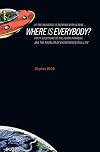
In the (COVID-19 free!) summer of 1950, physicist Enrico Fermi was discussing the possibility of extraterrestrial intelligence over lunch. He asked "where is everybody?" In a universe so old and large, other intelligences than ours should have arisen long ago, and they should be here now, on our planet and in our skies, starting from before we evolved. We see no fundamental physical reason why we humans could not expand into and settle our galaxy in 1-100 million years. That's a long time by show more human standards, but only 1% or so the age of the universe. If we could do it, why haven't others done it already? They've had plenty of time. At least, their radio communications should be everywhere we look.
Author Webb starts with brief introductions to Enrico Fermi, to the idea of paradox, and to the Fermi Paradox itself. Fermi is probably the most distinguished of those 20th century physicists whom most people haven't heard of, known for cutting to the heart of an issue.
Seven decades on, there's still no resolution to the paradox. Webb presents fifty possible solutions drawn from the literature people have produced since then, sorted into three categories.
First, "They Are Here" - or were here on Earth in the past. He starts with Leo Szilard's joke answer, "they are here and they call themselves Hungarians," referring to the many brilliant emigres from Hungary in the US at mid-century, including Edward Teller and John von Neumann. Webb disposes of flying-saucer theories, and considers that we might be in some sort of zoo or planetarium. Some of these ideas are more testable than you might guess.
The second general category is "They Exist But Have Not Yet Communicated." They're out there, but we haven't found their signal yet. Here he discusses interstellar probes, radio/optical communication, and possible reasons why they might not try to communicate, or travel, or carry out engineering on a scale visible over light years. The problem here is that any explanation along these lines must apply to all of the millions of intelligent species we like to think share our galaxy. If just one species develops technology and decides to spread out, they should have been here long ago.
Science fiction writers have mostly been aware of the paradox since the 1980s at the latest. Most of the proposed solutions in these first two categories can be matched with one or another SF story. In particular, solution number 28, "They Hit the Singularity" has been popular. Maybe we will make our selves smarter by genetic engineering or by building intelligent computers, and then sublime in some unknown sense, leaving the world behind. Webb points out that this solution has the same flaw as many of the others - if it doesn't apply in every single instance, we're still left with the paradox.
Also popular is solution number 27, that intelligent species inevitably self-destruct. Check today's news and make your own estimate here, but remember that the solution has to apply to presumably millions of species. Will they all be selfishly stupid?
The third category is "They Do Not Exist." Webb discusses all the scientific reasons why Earth, Earthly life, or humans might be unique, at least out to great distances in the universe. Maybe we needed rare features of the Earth-Moon system, or the solar system. We seem to have come along when most of the Earth's era of habitability has passed, and we may be the only one of 50 billion species in Earth's history with the right sort of intelligence - the ability to build radio telescopes.
Here, the book, published in 2002, is sometimes out of date. Webb wonders whether rocky planets like ours might be rare. Progress in finding extrasolar planets means we now know that they are fairly common. Webb also dismisses the cognitive abilities of other animals; would be interesting to see what Peter Watts would think about that.
Webb's last solution is his own. He goes through the various inputs into estimates of the prevalence of intelligence, and decides that we are indeed alone. If we come to an end then intelligence, at least technologically-capable intelligence, ends everywhere.
For me, that's maybe not a bad idea to keep in mind amid political unrest and pandemics. The stakes are higher than we may think. show less
Author Webb starts with brief introductions to Enrico Fermi, to the idea of paradox, and to the Fermi Paradox itself. Fermi is probably the most distinguished of those 20th century physicists whom most people haven't heard of, known for cutting to the heart of an issue.
Seven decades on, there's still no resolution to the paradox. Webb presents fifty possible solutions drawn from the literature people have produced since then, sorted into three categories.
First, "They Are Here" - or were here on Earth in the past. He starts with Leo Szilard's joke answer, "they are here and they call themselves Hungarians," referring to the many brilliant emigres from Hungary in the US at mid-century, including Edward Teller and John von Neumann. Webb disposes of flying-saucer theories, and considers that we might be in some sort of zoo or planetarium. Some of these ideas are more testable than you might guess.
The second general category is "They Exist But Have Not Yet Communicated." They're out there, but we haven't found their signal yet. Here he discusses interstellar probes, radio/optical communication, and possible reasons why they might not try to communicate, or travel, or carry out engineering on a scale visible over light years. The problem here is that any explanation along these lines must apply to all of the millions of intelligent species we like to think share our galaxy. If just one species develops technology and decides to spread out, they should have been here long ago.
Science fiction writers have mostly been aware of the paradox since the 1980s at the latest. Most of the proposed solutions in these first two categories can be matched with one or another SF story. In particular, solution number 28, "They Hit the Singularity" has been popular. Maybe we will make our selves smarter by genetic engineering or by building intelligent computers, and then sublime in some unknown sense, leaving the world behind. Webb points out that this solution has the same flaw as many of the others - if it doesn't apply in every single instance, we're still left with the paradox.
Also popular is solution number 27, that intelligent species inevitably self-destruct. Check today's news and make your own estimate here, but remember that the solution has to apply to presumably millions of species. Will they all be selfishly stupid?
The third category is "They Do Not Exist." Webb discusses all the scientific reasons why Earth, Earthly life, or humans might be unique, at least out to great distances in the universe. Maybe we needed rare features of the Earth-Moon system, or the solar system. We seem to have come along when most of the Earth's era of habitability has passed, and we may be the only one of 50 billion species in Earth's history with the right sort of intelligence - the ability to build radio telescopes.
Here, the book, published in 2002, is sometimes out of date. Webb wonders whether rocky planets like ours might be rare. Progress in finding extrasolar planets means we now know that they are fairly common. Webb also dismisses the cognitive abilities of other animals; would be interesting to see what Peter Watts would think about that.
Webb's last solution is his own. He goes through the various inputs into estimates of the prevalence of intelligence, and decides that we are indeed alone. If we come to an end then intelligence, at least technologically-capable intelligence, ends everywhere.
For me, that's maybe not a bad idea to keep in mind amid political unrest and pandemics. The stakes are higher than we may think. show less
If the Universe Is Teeming with Aliens ... WHERE IS EVERYBODY?: Fifty Solutions to the Fermi Paradox and the Problem of Extraterrestrial Life by Stephen Webb
The simple formulations of Fermi's paradox seem very compelling. There are countless stars in countless galaxies in the universe. We now know that planets are very common around those stars. We even have good reason to believe that the basic building blocks of life are abundant among those stars and planets. Surely, out there, what happened here on our planet has happened elsewhere -- the development of intelligent life and a technological civilization. In fact, there should be civilizations show more much older than our own, given the age of the universe and the age of the stars and galaxies in it. So why haven't we detected or even just stumbled upon any evidence of the existence of those civilizations? As Fermi said, "Where is everybody?"
Evidence could come in the form of anything from actual visitations to detection of artificial signals -- radio signals or other sorts. But, UFO enthusiasts and such aside, we have no solid evidence of any sort.
Webb is gripped by Fermi's question and discusses, usually briefly, 50 solutions -- 49, plus his own -- to the paradox.
The first set of solutions discuss the possibility that, in fact, extraterrestrial civilizations do exist and are in some sense "here", hiding or observing or the like. The second set explores the idea that they exist, but have not communicated or visited. And the third set discusses the possibility, depressing to some, that they just don't exist.
Many, many of the solutions could be books in and of themselves (and some have been). The price for the scope of Webb's discussion is the brevity of his treatment of each of the solutions. I have to admit I was growing a bit weary as I read through one after another, building up more and more unfinished answers.
But Webb's final chapter, his own solution, saved the day for me. What he does there is a kind of reversal of the famous Drake equation. The Drake equation purports to compute the number of likely civilizations, based on a relatively small set of factors -- rate of star formation, percentage of stars having planets, likelihood of life developing, etc. on up to the average lifetime of a civilization capable of communication. Compared to when Drake first formulated the equation in 1961, we know much more about the factors in the equation, both their values and the subvariables that complicate computing them. It's gotten messier, in a good way, and the Drake equation may seem out-dated, but there is plenty of room for optimism about the number of civilizations that should be out there.
What Webb does is take an estimate of the number of planets in our own galaxy and then apply a succession of filters to winnow that number down, eliminating percentages for planets that orbit too close to their stars, that orbit very short-lived stars, that may not have protective radiation belts like our own, or suitable atmospheres, and so on. He combines many of the factors he has discussed among the 49 previous solutions to arrive at a compelling argument that the lack of evidence for extraterrestrial civilizations isn't really so surprising at all -- what happened here, when you look in detail, isn't so likely to have happened elsewhere at all.
I have to say, I feel more strongly pulled toward that "pessimistic" conclusion after having read Webb's book. It's not that life seems improbable, but life with our peculiar characteristics -- the adaptation we call intelligence, the specific form our intelligence takes, our specific ways of communicating and making our presence known, the very things we are prepared to understand as signs of "intelligence" . . . All of these things, when each is considered by itself, seem fragile.
The universe no doubt contains unimaginable things -- a tremendous diversity of environments in which who knows what has developed or evolved. What has happened here may just be one thing that can happen in that immeasurable diversity -- there's nothing that compels nature to produce intelligent civilizations, no directionality that would favor or drive towards it. In that largest scheme of things, intelligent civilizations may be a blip (or two or three). If you want to look more on the optimistic side, that diversity may be more exciting to explore than the discovery of others like ourselves. show less
Evidence could come in the form of anything from actual visitations to detection of artificial signals -- radio signals or other sorts. But, UFO enthusiasts and such aside, we have no solid evidence of any sort.
Webb is gripped by Fermi's question and discusses, usually briefly, 50 solutions -- 49, plus his own -- to the paradox.
The first set of solutions discuss the possibility that, in fact, extraterrestrial civilizations do exist and are in some sense "here", hiding or observing or the like. The second set explores the idea that they exist, but have not communicated or visited. And the third set discusses the possibility, depressing to some, that they just don't exist.
Many, many of the solutions could be books in and of themselves (and some have been). The price for the scope of Webb's discussion is the brevity of his treatment of each of the solutions. I have to admit I was growing a bit weary as I read through one after another, building up more and more unfinished answers.
But Webb's final chapter, his own solution, saved the day for me. What he does there is a kind of reversal of the famous Drake equation. The Drake equation purports to compute the number of likely civilizations, based on a relatively small set of factors -- rate of star formation, percentage of stars having planets, likelihood of life developing, etc. on up to the average lifetime of a civilization capable of communication. Compared to when Drake first formulated the equation in 1961, we know much more about the factors in the equation, both their values and the subvariables that complicate computing them. It's gotten messier, in a good way, and the Drake equation may seem out-dated, but there is plenty of room for optimism about the number of civilizations that should be out there.
What Webb does is take an estimate of the number of planets in our own galaxy and then apply a succession of filters to winnow that number down, eliminating percentages for planets that orbit too close to their stars, that orbit very short-lived stars, that may not have protective radiation belts like our own, or suitable atmospheres, and so on. He combines many of the factors he has discussed among the 49 previous solutions to arrive at a compelling argument that the lack of evidence for extraterrestrial civilizations isn't really so surprising at all -- what happened here, when you look in detail, isn't so likely to have happened elsewhere at all.
I have to say, I feel more strongly pulled toward that "pessimistic" conclusion after having read Webb's book. It's not that life seems improbable, but life with our peculiar characteristics -- the adaptation we call intelligence, the specific form our intelligence takes, our specific ways of communicating and making our presence known, the very things we are prepared to understand as signs of "intelligence" . . . All of these things, when each is considered by itself, seem fragile.
The universe no doubt contains unimaginable things -- a tremendous diversity of environments in which who knows what has developed or evolved. What has happened here may just be one thing that can happen in that immeasurable diversity -- there's nothing that compels nature to produce intelligent civilizations, no directionality that would favor or drive towards it. In that largest scheme of things, intelligent civilizations may be a blip (or two or three). If you want to look more on the optimistic side, that diversity may be more exciting to explore than the discovery of others like ourselves. show less
If the Universe Is Teeming with Aliens ... WHERE IS EVERYBODY?: Fifty Solutions to the Fermi Paradox and the Problem of Extraterrestrial Life by Stephen Webb
Point a decent-sized radio antenna at any part of the sky, or just look up at it all on a cloudless night: not a trace of aliens - doesn't that strike you as odd?
It struck physicist Enrico Fermi as very odd: if the laws of nature are universal, working in the same way all over the galaxy, and have produced the Earth, life (and us) here, then they should have produced Earths (and 'us') everywhere. Worse, our solar system may be more than four billion years old, but the Universe itself show more is more than thirteen billion - so there should have been Earths out there with their versions of us for aeons already. Yet here we are, apparently alone. This has become known as the Fermi Paradox - in Fermi's own words, 'Where is everybody?' - and the more we learn, the more mystifying it becomes: the Search for ExtraTerrestrial Intelligence programme has been running for decades now, without detecting even a single stray signal, while at the same time the latest space probes are discovering new planets by the truck-load.
In fact, this isn't a full-blown paradox at all, just a flat contradiction between what, on the one hand, we believe to be the way the Universe works (its laws of nature, science as a rationale, reason itself for that matter) and, on the other, the Universe we seem to be living in. One of these must be incomplete or even wrong in some way. Perhaps the former; to give just one example, perhaps there are unknown phenomena at work, vast cataclysms which periodically sterilize the entire cosmos and set the clock of life back to zero each time - if that were the case then we would, in a sense, be the first. Or maybe it's the latter: Fermi's 'everybody' are all out there, but for some reason don't want us to know that.
This book is a compendium of fifty possible explanations of that sort, from the stolidly scientific to the wildly speculative - and flawed: many contain assumptions about alien psychology for instance (just one alien civilization behaving differently from the rest would flood the galaxy with radio transmissions or speeding spaceships). It's a thorough round-up which also reminded me just how odd all this is; any way you look at it, that silent sky may be the single most important fact our civilization has. show less
It struck physicist Enrico Fermi as very odd: if the laws of nature are universal, working in the same way all over the galaxy, and have produced the Earth, life (and us) here, then they should have produced Earths (and 'us') everywhere. Worse, our solar system may be more than four billion years old, but the Universe itself show more is more than thirteen billion - so there should have been Earths out there with their versions of us for aeons already. Yet here we are, apparently alone. This has become known as the Fermi Paradox - in Fermi's own words, 'Where is everybody?' - and the more we learn, the more mystifying it becomes: the Search for ExtraTerrestrial Intelligence programme has been running for decades now, without detecting even a single stray signal, while at the same time the latest space probes are discovering new planets by the truck-load.
In fact, this isn't a full-blown paradox at all, just a flat contradiction between what, on the one hand, we believe to be the way the Universe works (its laws of nature, science as a rationale, reason itself for that matter) and, on the other, the Universe we seem to be living in. One of these must be incomplete or even wrong in some way. Perhaps the former; to give just one example, perhaps there are unknown phenomena at work, vast cataclysms which periodically sterilize the entire cosmos and set the clock of life back to zero each time - if that were the case then we would, in a sense, be the first. Or maybe it's the latter: Fermi's 'everybody' are all out there, but for some reason don't want us to know that.
This book is a compendium of fifty possible explanations of that sort, from the stolidly scientific to the wildly speculative - and flawed: many contain assumptions about alien psychology for instance (just one alien civilization behaving differently from the rest would flood the galaxy with radio transmissions or speeding spaceships). It's a thorough round-up which also reminded me just how odd all this is; any way you look at it, that silent sky may be the single most important fact our civilization has. show less
If the Universe Is Teeming with Aliens ... WHERE IS EVERYBODY?: Seventy-Five Solutions to the Fermi Paradox and the Problem of Extraterrestrial Life (Science and Fiction) by Stephen Webb

Although I have known about the Fermi paradox for a long time, it was quite recently it grew in importance for me when I got interested in existential risks or threats against the whole humanity. Maybe, I thought, the answer to the Fermi paradox is that all advanced civilizations obliterate themselves with some advanced physical experiment? Well, that is one of the solutions Webb discusses in this book with 75 solutions (the first edition has 50 solutions and the new edition has 75).
After show more some brief discussion about Fermi and the origin of the paradox and the so called Drake equation, the solutions are grouped into three parts: 1. They Are (or Were) Here, 2. They Exist, But We Have Yet to See or Hear from Them and 3. They Don’t Exist.
He doesn't give a lot of credence to solutions which argue aliens are already here (and for most of them rightfully so), so it is quite a bit sorter than the other two sections with only ten chapters.
The second tier of solutions are those where the aliens do exist, but we haven't observed them. Many of these solutions are more akin to science fiction than science. But it is a fun walk-through on Dyson spheres, colonizing patterns, the Kardashev scale, whether highly advanced aliens would be more likely to hang out near the center of the galaxy using all the energy there or rather be in the most cold regions to make possible the maximum efficiency for calculations, etc. Some of these solutions are quite extraordinary, but it makes for a great read.
And the third set of solutions all argue (intelligent) aliens doesn't exist or at least are very rare. Here Webb leave the science fiction and go to science. Habitable zones for planets, the importance of our moon to keep the earth stable, the development of life and a few of the big hurdles on the way to a species which can ponder where the aliens are and more is discussed. As a non-scientist I thought it was both quite easy to follow Webb's explanations and very rewarding.
For anyone interested in the Fermi paradox I can't think of a better place to start than this book. Highly recommended! show less
After show more some brief discussion about Fermi and the origin of the paradox and the so called Drake equation, the solutions are grouped into three parts: 1. They Are (or Were) Here, 2. They Exist, But We Have Yet to See or Hear from Them and 3. They Don’t Exist.
He doesn't give a lot of credence to solutions which argue aliens are already here (and for most of them rightfully so), so it is quite a bit sorter than the other two sections with only ten chapters.
The second tier of solutions are those where the aliens do exist, but we haven't observed them. Many of these solutions are more akin to science fiction than science. But it is a fun walk-through on Dyson spheres, colonizing patterns, the Kardashev scale, whether highly advanced aliens would be more likely to hang out near the center of the galaxy using all the energy there or rather be in the most cold regions to make possible the maximum efficiency for calculations, etc. Some of these solutions are quite extraordinary, but it makes for a great read.
And the third set of solutions all argue (intelligent) aliens doesn't exist or at least are very rare. Here Webb leave the science fiction and go to science. Habitable zones for planets, the importance of our moon to keep the earth stable, the development of life and a few of the big hurdles on the way to a species which can ponder where the aliens are and more is discussed. As a non-scientist I thought it was both quite easy to follow Webb's explanations and very rewarding.
For anyone interested in the Fermi paradox I can't think of a better place to start than this book. Highly recommended! show less
Lists
Awards

You May Also Like


Associated Authors
Statistics
- Works
- 10
- Members
- 481
- Popularity
- #51,316
- Rating
- 4.1
- Reviews
- 13
- ISBNs
- 45
- Languages
- 6
- Favorited
- 2