
Peter Ward (1) (1949–)
Author of Gorgon: Paleontology, Obsession, and the Greatest Catastrophe in Earth's History
For other authors named Peter Ward, see the disambiguation page.
Peter Ward (1) has been aliased into Peter D. Ward.
Works by Peter Ward
Works have been aliased into Peter D. Ward.
Gorgon: Paleontology, Obsession, and the Greatest Catastrophe in Earth's History (2004) 312 copies, 6 reviews
A New History of Life: The Radical New Discoveries about the Origins and Evolution of Life on Earth (2015) 172 copies, 4 reviews
Life as We Do Not Know It: The NASA Search for (and Synthesis of) Alien Life (2005) 132 copies, 5 reviews
Lamarck's Revenge: How Epigenetics Is Revolutionizing Our Understanding of Evolution's Past and Present (2018) 62 copies, 15 reviews
Tagged
Common Knowledge
- Canonical name
- Ward, Peter
- Legal name
- Ward, Peter Douglas
- Birthdate
- 1949-12-05
- Gender
- male
- Occupations
- paleontologist
professor (Biology, Earth and Space Sciences)
non-fiction author - Organizations
- California Academy of Sciences (Fellow ∙ 1984)
University of Washington - Short biography
- Peter D. Ward, Ph.D., is a paleontologist and professor of Geological Sciences at the University of Washington in Seattle. He is currently examining the nature of the Cretaceous-Tertiary extinction event with studies in France and Spain involving detailed field work that concentrates on ammonites and bivalves. Ward is also researching speciation patterns and ecology of the living cephalopods Nautilus and Sepia and examining the stratigraphic history of West Coast Cretaceous basins through detailed biostratigraphy and basin analysis. He is author of On Methuselah's Trail: Living Fossils and the Great Extinctions and The Natural History of Nautilus.
- Nationality
- USA
- Birthplace
- Seattle, Washington, USA
- Associated Place (for map)
- Washington, USA
Members
Reviews
Author Peter Ward has the answer for every paleontological question: oxygen. In this book, he marches through geological time from the late Precambrian to the Holocene, explaining just about every evolutionary radiation or extinction in terms of atmospheric oxygen concentration (with an occasional nod to carbon dioxide concentration, sea level air pressure, sea level, and climate). Ward presents us with a long series of hypotheses based on oxygen levels, such as:
“Hypothesis 2.1: Reduced show more levels of oxygen stimulate higher rates of disparity (the diversity of body plans) than do high levels of oxygen.”
And
“Hypothesis 8.1: The initial dinosaur body plan of bipedalism evolved as a response to low oxygen levels in the middle Triassic. With a bipedal stance the first dinosaurs overcame the respiratory limitations imposed by Carrier’s Constraint. The Triassic oxygen low thus triggered the origin of dinosaurs through the formation of this new body plan.”
And
“Hypothesis 9.5: The crab’s body plan evolved for multiple reasons but one was that it increased respiratory efficiency by putting the gills in an enclosed space under the cephalothorax (the head-thorax) and then evolving a pump to move water over the now enclosed gills.”
Interestingly, every one of Ward’s hypothesis turns out to be confirmed when compared to a chart of oxygen levels through time.
So how does one go about measuring paleoatmospheric oxygen concentration? Well, that’s the trick – Ward doesn’t measure anything. The convincing-looking chart of oxygen level versus time is not based on measured oxygen levels, or even proxies for oxygen levels (such as the mineralogy of paleosoils). Instead, this is the output of a series of computer programs – GEOCARB, GEOCARB II, GEOCARB III, and GEOCARBSULF – that estimate oxygen concentration based on assumed past geological conditions – how much sulfide-containing rock was subaerially exposed to oxidation by tectonics, how much was subducted to be re-emitted as hydrogen sulfide (and then oxidized) during volcanism, and how much organic carbon (coal, oil shale, etc.) is buried before it could be oxidized. That doesn’t sound at all familiar, does it? An elaborate computer model used to predict (or, in this cast, postdict) atmospheric conditions? In short, what Ward is doing here is drawing conclusions far beyond what the model(s) justify.
Now that I’ve got through jumping on Dr. Ward with both feet, I have to backtrack. There is paleontological and mineralogical evidence that the Earth’s atmosphere had a different composition in the geological past. In particular, the existence of 50-pound scorpions, spiders with a 36-inch leg span, and 2-foot long cockroaches in the Carboniferous suggests something quite different from modern conditions. Arachnids have a pretty inefficient gas exchange system, and insects are even worse – thus it’s fairly certain that oxygen concentration – or at least oxygen partial pressure – was substantially higher then. (The Carboniferous would be a bad place for time-travelers uncomfortable around creepy-crawlys. I would sign up for the trip in a heartbeat, of course – but I think I’d probably bring a shotgun and a lot of DDT) . Similarly, evidence continues to accumulate that the atmosphere and oceans were strongly affected by whatever caused the PT extinction event – runaway global warming due to atmospheric methane or massive hydrogen sulfide releases from the oceans or a combination thereof.
Historical geology has had to be dragged kicking and screaming away from the idea of rigid uniformitarianism – the belief that Earth processes have always been exactly the same as they are now, and have always acted on a human time scale. Alfred Wegener was the first to make a dent here, with continental drift. Wegener’s details about continental drift were mostly wrong – the idea that the mechanism was some sort of arm-waving “polar flight”, and the belief that the whole process had stopped in the Pleistocene – but the big picture was correct. Similarly, although I suspect Dr. Ward is drawing way too many conclusions from computer models, the overall idea – that atmospheric and oceanic gas concentrations and partial pressures could have been different in the past and that this would have substantial impact on earth and life history – is likely correct, and Ward deserves credit for drawing attention to it. show less
“Hypothesis 2.1: Reduced show more levels of oxygen stimulate higher rates of disparity (the diversity of body plans) than do high levels of oxygen.”
And
“Hypothesis 8.1: The initial dinosaur body plan of bipedalism evolved as a response to low oxygen levels in the middle Triassic. With a bipedal stance the first dinosaurs overcame the respiratory limitations imposed by Carrier’s Constraint. The Triassic oxygen low thus triggered the origin of dinosaurs through the formation of this new body plan.”
And
“Hypothesis 9.5: The crab’s body plan evolved for multiple reasons but one was that it increased respiratory efficiency by putting the gills in an enclosed space under the cephalothorax (the head-thorax) and then evolving a pump to move water over the now enclosed gills.”
Interestingly, every one of Ward’s hypothesis turns out to be confirmed when compared to a chart of oxygen levels through time.
So how does one go about measuring paleoatmospheric oxygen concentration? Well, that’s the trick – Ward doesn’t measure anything. The convincing-looking chart of oxygen level versus time is not based on measured oxygen levels, or even proxies for oxygen levels (such as the mineralogy of paleosoils). Instead, this is the output of a series of computer programs – GEOCARB, GEOCARB II, GEOCARB III, and GEOCARBSULF – that estimate oxygen concentration based on assumed past geological conditions – how much sulfide-containing rock was subaerially exposed to oxidation by tectonics, how much was subducted to be re-emitted as hydrogen sulfide (and then oxidized) during volcanism, and how much organic carbon (coal, oil shale, etc.) is buried before it could be oxidized. That doesn’t sound at all familiar, does it? An elaborate computer model used to predict (or, in this cast, postdict) atmospheric conditions? In short, what Ward is doing here is drawing conclusions far beyond what the model(s) justify.
Now that I’ve got through jumping on Dr. Ward with both feet, I have to backtrack. There is paleontological and mineralogical evidence that the Earth’s atmosphere had a different composition in the geological past. In particular, the existence of 50-pound scorpions, spiders with a 36-inch leg span, and 2-foot long cockroaches in the Carboniferous suggests something quite different from modern conditions. Arachnids have a pretty inefficient gas exchange system, and insects are even worse – thus it’s fairly certain that oxygen concentration – or at least oxygen partial pressure – was substantially higher then. (The Carboniferous would be a bad place for time-travelers uncomfortable around creepy-crawlys. I would sign up for the trip in a heartbeat, of course – but I think I’d probably bring a shotgun and a lot of DDT) . Similarly, evidence continues to accumulate that the atmosphere and oceans were strongly affected by whatever caused the PT extinction event – runaway global warming due to atmospheric methane or massive hydrogen sulfide releases from the oceans or a combination thereof.
Historical geology has had to be dragged kicking and screaming away from the idea of rigid uniformitarianism – the belief that Earth processes have always been exactly the same as they are now, and have always acted on a human time scale. Alfred Wegener was the first to make a dent here, with continental drift. Wegener’s details about continental drift were mostly wrong – the idea that the mechanism was some sort of arm-waving “polar flight”, and the belief that the whole process had stopped in the Pleistocene – but the big picture was correct. Similarly, although I suspect Dr. Ward is drawing way too many conclusions from computer models, the overall idea – that atmospheric and oceanic gas concentrations and partial pressures could have been different in the past and that this would have substantial impact on earth and life history – is likely correct, and Ward deserves credit for drawing attention to it. show less
Lamarck's Revenge: How Epigenetics Is Revolutionizing Our Understanding of Evolution's Past and Present by Peter Ward

This book reminds me of a hyperactive puppy, always going off at full speed, yapping after something.
A brief overview of the concept of epigenetics: All of us, of course, have have DNA, and that DNA is organized into genes. These genes are the mechanism of heredity, and determine how our cells operate and reproduce. But not all genes are active all the time -- an eye cell, for instance, doesn't need the genetic instructions for beating that a heart cell needs. So, in an eye cell, show more heart-related genes are mostly turned off. In any case, because chromosomes come in pairs, we have two copies of most genes, and often we use only one of the two.
Epigenetics is what determines which genes are on and which are off. There are several mechanisms, described in the book, that can turn genes on and off. Environmental factors generally decide which genes are enabled and disabled this way. Epigenetic change does not allow an organism to change its DNA, but it allows it to change which DNA is activated. And, under certain circumstances, these mechanisms can be inherited, so that children activate the same genes that their parents did.
Epigenetics is a new field, and there is no question but that it it revolutionizing our understanding of biology. Nor that, under the right circumstances, epigenetic change affects the evolutionary success of creatures -- and that epigenetic inheritance means that, under certain limited circumstances, acquired characteristics can be inherited.
This is the origin of the book's title. The first theory of evolution, Lamarck's, was that acquired characteristics were inherited, and that this acquisition of characteristics led to the development of new species. So author Peter Ward is claiming that epigenetics is forcing us to develop a new, Lamarckian, view of evolution.
To which I can only say, "Down, boy!"
Will there be a Lamarckian element to our future understanding of evolution? Yes, probably -- a small one. But the key word is small.
There are several reasons for this. Let's start with a really obvious point: Why was Mendelian inheritance -- inheritance by genes, without epigenetic influence -- discovered a century before epigenetic inheritance? Because there is a lot more of it, and it's more important. Why is that? Because of point #2: Epigenetic changes can only affect genes that are already there. No amount of epigenetic influence can create anything. Take an example: I have blue eyes. Why do I have blue eyes? Because I have two blue eye genes and no brown eye genes. Ward can methylate my genes till he is, um, blue in the face, and I'm still going to have blue eyes, because those are the only genes I have.
And, third, even if one has two different genes, that doesn't mean that epigenetic factors can automatically operate on them.
Let's take a very real example: Blood types. The types of our blood (A, B, O, AB) are genetically determined. The four types are so old that we share them with chimpanzees -- they predate humanity. This is known as "polymorphism." Often there is advantage, to a population, in having multiple different genes all active at the same time. It seems to be so with blood types -- type O blood provides some limited protection against malaria, but it increases susceptibility to cholera, while type A protects somewhat against cholera while leaving its carrier more susceptible to malaria. So having people with multiple blood types around means that, in a plague situation, there is usually someone around who is relatively immune to care for the sick or, in the worst case situation, to survive the epidemic.
OK, now think about this: If you're in an environment where there is risk of either malaria or cholera, wouldn't it be great if you could change your blood type depending on which disease is more prevalent? Sounds great, doesn't it?
Doesn't happen. People don't change blood types. This even though it would appear that it would be a tremendous survival advantage. Why doesn't it happen? Because epigenetic change can only happen in limited circumstances.
This book simply goes too far -- throwing shade on Darwin, almost ignoring Mendel and Hugo de Vries and the people who discovered genetic manipulation, completely ignoring Trivers and Smith and the mathematical geneticists. Epigenetics evolution is not a replacement to genetic evolution; it is a refinement, as Einsteinean gravity was a refinement of Newtonian gravity (under ordinary circumstances, the two are the same).
In service of this revolution that isn't, Ward gets very sloppy. For example, he treats Lamarck as some sort of lost martyr. That's really not true. Yes, Lamarckian evolution was soon consigned to the dustbin where it belongs. But most scientists I know have respect for Lamarck, who was brilliantly wrong. Brilliantly wrong is not always bad -- it leads people to see things as they ought to be seen. Even if Lamarckian evolution doesn't happen, it gave us the idea that species change over time, which gave us Darwinism. Lamarck, to those who know, is not a laughing-stock; he was a man who pointed out a real problem that he couldn't solve. Often knowing the problem is more important than the solution.
In service of his obsession, Ward is often so sloppy as to be simply wrong. I found so many errors in the early pages that I eventually stopped marking them. Examples:
Page xi -- (fossilized) "ammonites [are] themselves descendants of the still-living pearly nautilus." Something that died out millions of years ago is not descended from something that is alive today! Ammonites may have been descended from something that lived millions of years ago from which the modern pearly nautilus is descended, and that ancient thing may have been much like the modern pearly nautilus, but the ammonites are not descendants of the creature of today. This is not pedantry; this is a fundamental error in genealogy.
Page xiii -- "Darwinian theory posits that genes are fixed." Darwin never heard of genes! Mendel discovered them, De Vries re-discovered and made them known in the wide world. It is true that modern genetic theory posits that genes only change via mutation, but that isn't even close to the same thing.
Page 19 -- "Buffon anticipated Charles Darwin in... the innate understanding of the dangers of unfettered population growth in any 'species.'" Darwin didn't come up with that idea; Malthus did. Ward does not mention Malthus for another 17 pages, completely distorting the history.
Page 47 claims to be about Gould and punctuated equilibrium. But what Ward describes is allotropic speciation -- that is, two populations separated by an impassible barrier which gradually evolve into separate species. But allotropic speciation is not punctuated equilibrium; separate populations may evolve into separate species simply due to genetic drift. Even punctuated equilibrium cannot be proved; if (to take Ward's own example from page xi) modern pearly nautilus closely resemble a creature that was alive millions of years ago, we can't prove they were the same species, because we don't have any of the millions-of-year-dead creatures to try to breed with the modern ones!
Page 65fff makes a number of claims about epigenetic change -- but the changes described are mostly behavioral changes, not actual phenotypic changes. Behavior, as any psychologist or teacher can tell you, is learned -- it doesn't have to be programmed into the genes to be changed.
I'm sure that's more examples than you wanted. I don't want to entirely condemn this book; it's important that we realize just how big a deal epigenetics is. And there is good information in here that I had not known (e.g. about the three methods of gene activation) But over-selling the field does not do a service. This particular yappy little dog seems to have led us into a great big pile of something stinky. show less
A brief overview of the concept of epigenetics: All of us, of course, have have DNA, and that DNA is organized into genes. These genes are the mechanism of heredity, and determine how our cells operate and reproduce. But not all genes are active all the time -- an eye cell, for instance, doesn't need the genetic instructions for beating that a heart cell needs. So, in an eye cell, show more heart-related genes are mostly turned off. In any case, because chromosomes come in pairs, we have two copies of most genes, and often we use only one of the two.
Epigenetics is what determines which genes are on and which are off. There are several mechanisms, described in the book, that can turn genes on and off. Environmental factors generally decide which genes are enabled and disabled this way. Epigenetic change does not allow an organism to change its DNA, but it allows it to change which DNA is activated. And, under certain circumstances, these mechanisms can be inherited, so that children activate the same genes that their parents did.
Epigenetics is a new field, and there is no question but that it it revolutionizing our understanding of biology. Nor that, under the right circumstances, epigenetic change affects the evolutionary success of creatures -- and that epigenetic inheritance means that, under certain limited circumstances, acquired characteristics can be inherited.
This is the origin of the book's title. The first theory of evolution, Lamarck's, was that acquired characteristics were inherited, and that this acquisition of characteristics led to the development of new species. So author Peter Ward is claiming that epigenetics is forcing us to develop a new, Lamarckian, view of evolution.
To which I can only say, "Down, boy!"
Will there be a Lamarckian element to our future understanding of evolution? Yes, probably -- a small one. But the key word is small.
There are several reasons for this. Let's start with a really obvious point: Why was Mendelian inheritance -- inheritance by genes, without epigenetic influence -- discovered a century before epigenetic inheritance? Because there is a lot more of it, and it's more important. Why is that? Because of point #2: Epigenetic changes can only affect genes that are already there. No amount of epigenetic influence can create anything. Take an example: I have blue eyes. Why do I have blue eyes? Because I have two blue eye genes and no brown eye genes. Ward can methylate my genes till he is, um, blue in the face, and I'm still going to have blue eyes, because those are the only genes I have.
And, third, even if one has two different genes, that doesn't mean that epigenetic factors can automatically operate on them.
Let's take a very real example: Blood types. The types of our blood (A, B, O, AB) are genetically determined. The four types are so old that we share them with chimpanzees -- they predate humanity. This is known as "polymorphism." Often there is advantage, to a population, in having multiple different genes all active at the same time. It seems to be so with blood types -- type O blood provides some limited protection against malaria, but it increases susceptibility to cholera, while type A protects somewhat against cholera while leaving its carrier more susceptible to malaria. So having people with multiple blood types around means that, in a plague situation, there is usually someone around who is relatively immune to care for the sick or, in the worst case situation, to survive the epidemic.
OK, now think about this: If you're in an environment where there is risk of either malaria or cholera, wouldn't it be great if you could change your blood type depending on which disease is more prevalent? Sounds great, doesn't it?
Doesn't happen. People don't change blood types. This even though it would appear that it would be a tremendous survival advantage. Why doesn't it happen? Because epigenetic change can only happen in limited circumstances.
This book simply goes too far -- throwing shade on Darwin, almost ignoring Mendel and Hugo de Vries and the people who discovered genetic manipulation, completely ignoring Trivers and Smith and the mathematical geneticists. Epigenetics evolution is not a replacement to genetic evolution; it is a refinement, as Einsteinean gravity was a refinement of Newtonian gravity (under ordinary circumstances, the two are the same).
In service of this revolution that isn't, Ward gets very sloppy. For example, he treats Lamarck as some sort of lost martyr. That's really not true. Yes, Lamarckian evolution was soon consigned to the dustbin where it belongs. But most scientists I know have respect for Lamarck, who was brilliantly wrong. Brilliantly wrong is not always bad -- it leads people to see things as they ought to be seen. Even if Lamarckian evolution doesn't happen, it gave us the idea that species change over time, which gave us Darwinism. Lamarck, to those who know, is not a laughing-stock; he was a man who pointed out a real problem that he couldn't solve. Often knowing the problem is more important than the solution.
In service of his obsession, Ward is often so sloppy as to be simply wrong. I found so many errors in the early pages that I eventually stopped marking them. Examples:
Page xi -- (fossilized) "ammonites [are] themselves descendants of the still-living pearly nautilus." Something that died out millions of years ago is not descended from something that is alive today! Ammonites may have been descended from something that lived millions of years ago from which the modern pearly nautilus is descended, and that ancient thing may have been much like the modern pearly nautilus, but the ammonites are not descendants of the creature of today. This is not pedantry; this is a fundamental error in genealogy.
Page xiii -- "Darwinian theory posits that genes are fixed." Darwin never heard of genes! Mendel discovered them, De Vries re-discovered and made them known in the wide world. It is true that modern genetic theory posits that genes only change via mutation, but that isn't even close to the same thing.
Page 19 -- "Buffon anticipated Charles Darwin in... the innate understanding of the dangers of unfettered population growth in any 'species.'" Darwin didn't come up with that idea; Malthus did. Ward does not mention Malthus for another 17 pages, completely distorting the history.
Page 47 claims to be about Gould and punctuated equilibrium. But what Ward describes is allotropic speciation -- that is, two populations separated by an impassible barrier which gradually evolve into separate species. But allotropic speciation is not punctuated equilibrium; separate populations may evolve into separate species simply due to genetic drift. Even punctuated equilibrium cannot be proved; if (to take Ward's own example from page xi) modern pearly nautilus closely resemble a creature that was alive millions of years ago, we can't prove they were the same species, because we don't have any of the millions-of-year-dead creatures to try to breed with the modern ones!
Page 65fff makes a number of claims about epigenetic change -- but the changes described are mostly behavioral changes, not actual phenotypic changes. Behavior, as any psychologist or teacher can tell you, is learned -- it doesn't have to be programmed into the genes to be changed.
I'm sure that's more examples than you wanted. I don't want to entirely condemn this book; it's important that we realize just how big a deal epigenetics is. And there is good information in here that I had not known (e.g. about the three methods of gene activation) But over-selling the field does not do a service. This particular yappy little dog seems to have led us into a great big pile of something stinky. show less
 This review was written for LibraryThing Early Reviewers.
Lamarck's Revenge: How Epigenetics Is Revolutionizing Our Understanding of Evolution's Past and Present by Peter Ward
Review of: Lamarck’s Revenge: How Epigenetics is Revolutionizing Our Understanding of Evolution’s Past and Present, by Peter Ward
by Stan Prager (6-19-20)
If you have studied evolution inside or outside of the classroom, you have no doubt encountered the figure of Jean-Baptiste Lamarck and the discredited notion of the inheritance of acquired characteristics attributed to him known as “Lamarckism.” This has most famously been represented in the example of giraffes straining to reach show more fruit on ever-higher branches, which results in the development of longer necks over succeeding generations. Never mind that Lamarck did not develop this concept—and while he echoed it, it remained only a tiny part of the greater body of his work—he was yet doomed to have it unfortunately cling to his legacy ever since. This is most regrettable, because Lamarck—who died three decades before Charles Darwin shook the spiritual and scientific world with his 1859 publication of On the Origin of Species—was actually a true pioneer in the field of evolutionary biology that recognized there were forces at work that put organisms on an ineluctable road to greater complexity. It was Darwin who identified this force as “natural selection,” and Lamarck was not only denied credit for his contributions to the field, but otherwise maligned and ridiculed.
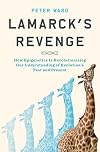
But even if he did not invent the idea, what if Lamarck was right all along to believe, at least in part, that acquired characteristics can be passed along transgenerationally after all—perhaps not on the kind of macro scale manifested by giraffe necks, but in other more subtle yet no less critical components to the principles of evolution? That is the subject of Lamarck’s Revenge: How Epigenetics is Revolutionizing Our Understanding of Evolution’s Past and Present, by the noted paleontologist Peter Ward. The book’s cover naturally showcases a series of illustrated giraffes with ever-lengthening necks! Ward is an enthusiast for the relatively new, still developing—and controversial—science of epigenetics, which advances the hypothesis that certain circumstances can trigger markers that can be transmitted from parent to child by changing the gene expression without altering the primary structure of the DNA itself. Let’s imagine a Holocaust survivor, for instance: can the trauma of Auschwitz cut so deep that the devastating psychological impact of that horrific experience will be passed on to his children, and his children’s children?
This is heady stuff, of course. We should pause for the uninitiated and explain the nature of Darwinian natural selection—the key mechanism of the Theory of Evolution—in its simplest terms. The key to survival for all organizations is adaptation. Random mutations occur over time, and if one of those mutations turns out to be better adapted to the environment, it is more likely to reproduce and thus pass along its genes to its offspring. Over time, through “gradualism,” this can lead to the rise of new species. Complexity breeds complexity, and that is the road traveled by all organisms that has led from the simplest prokaryote unicellular organism—the 3.5-billion-year-old photosynthetic cyanobacteria—to modern homo sapiens sapiens. This is, of course, a very, very long game; so long in fact that Darwin—who lived in a time when the age of the earth was vastly underestimated—fretted that there was not enough time for evolution as he envisioned it to occur. Advances in geology later determined that the earth was about 4.5 billion years old, which solved that problem, but still left other aspects of evolution unexplained by gradualism alone. The brilliant Stephen Jay Gould (along with Niles Eldredge) came along in 1972 and proposed that rather than gradualism most evolution more likely occurred through what he called “punctuated equilibrium,” often triggered by a catastrophic change in the environment. Debate has raged ever since, but it may well be that evolution is guided by forces of both gradualism and punctuated equilibrium. But could there still be other forces at work?
Transgenerational epigenetic inheritance represents another so-called force and is at the cutting edge of research in evolutionary biology today. But has the hypothesis of epigenetics been demonstrated to be truly plausible? And the answer to that is—maybe. In other words, there does seem to be studies that support transgenerational epigenetic inheritance, most famously—as detailed in Lamarck’s Revenge—in what has been dubbed the “Dutch Hunger Winter Syndrome,” that saw children born during a famine smaller than those born before the famine, and with a later, greater risk of glucose intolerance, conditions then passed down to successive generations. On the other hand, the evidence for epigenetics has not been as firmly established as some proponents, such as Ward, might have us believe.
Lamarck’s Revenge is a very well-written and accessible scientific account of epigenetics for a popular audience, and while I have read enough evolutionary science to follow Ward’s arguments with some competence, I remain a layperson who can hardly endorse or counter his claims. The body of the narrative is comprised of Ward’s repeated examples of what he identifies as holes in traditional evolutionary biology that can only be explained by epigenetics. Is he right? I simply lack the expertise to say. I should note that I received this book as part of an “Early Reviewers” program, so I felt a responsibility to read it cover-to-cover, although my own interest lapsed as it moved beyond my own depth in the realm of evolutionary biology.
I should note that this is all breaking news, and as we appraise it we should be mindful of how those on the fringes of evangelicalism, categorically opposed to the science of human evolution, will cling to any debate over mechanisms in natural selection to proclaim it all a sham sponsored by Satan—who has littered the earth with fossils to deceive us—to challenge the truth of the “Garden of Eden” related in the Book of Genesis. Once dubbed “Creationists,” they have since rebranded themselves in association with the pseudoscience of so-called “Intelligent Design,” which somehow remains part of the curriculum at select accredited universities. Science is self-correcting. These folks are not, so don’t ever let yourself be distracted by their fictional supernatural narrative. Evolution—whether through gradualism and/or punctuated equilibrium and/or epigenetics—remains central to both modern biology and modern medicine, and that is not the least bit controversial among scientific professionals. But if you want to find out more about the implications of epigenetics for human evolution, then I recommend that you pick up Lamarck’s Revenge and challenge yourself to learn more!
Note: While you are at it, if you want to learn more about 3.5-billion-year-old photosynthetic cyanobacteria, I highly recommend this:
Review of: Cradle of Life: The Discovery of Earth’s Earliest Fossils, by J. William Schopf
Review of: Lamarck’s Revenge: How Epigenetics is Revolutionizing Our Understanding of Evolution’s Past and Present, by Peter Ward https://regarp.com/2020/06/19/review-of-lamarcks-revenge-how-epigenetics-is-revo... show less
by Stan Prager (6-19-20)
If you have studied evolution inside or outside of the classroom, you have no doubt encountered the figure of Jean-Baptiste Lamarck and the discredited notion of the inheritance of acquired characteristics attributed to him known as “Lamarckism.” This has most famously been represented in the example of giraffes straining to reach show more fruit on ever-higher branches, which results in the development of longer necks over succeeding generations. Never mind that Lamarck did not develop this concept—and while he echoed it, it remained only a tiny part of the greater body of his work—he was yet doomed to have it unfortunately cling to his legacy ever since. This is most regrettable, because Lamarck—who died three decades before Charles Darwin shook the spiritual and scientific world with his 1859 publication of On the Origin of Species—was actually a true pioneer in the field of evolutionary biology that recognized there were forces at work that put organisms on an ineluctable road to greater complexity. It was Darwin who identified this force as “natural selection,” and Lamarck was not only denied credit for his contributions to the field, but otherwise maligned and ridiculed.
But even if he did not invent the idea, what if Lamarck was right all along to believe, at least in part, that acquired characteristics can be passed along transgenerationally after all—perhaps not on the kind of macro scale manifested by giraffe necks, but in other more subtle yet no less critical components to the principles of evolution? That is the subject of Lamarck’s Revenge: How Epigenetics is Revolutionizing Our Understanding of Evolution’s Past and Present, by the noted paleontologist Peter Ward. The book’s cover naturally showcases a series of illustrated giraffes with ever-lengthening necks! Ward is an enthusiast for the relatively new, still developing—and controversial—science of epigenetics, which advances the hypothesis that certain circumstances can trigger markers that can be transmitted from parent to child by changing the gene expression without altering the primary structure of the DNA itself. Let’s imagine a Holocaust survivor, for instance: can the trauma of Auschwitz cut so deep that the devastating psychological impact of that horrific experience will be passed on to his children, and his children’s children?
This is heady stuff, of course. We should pause for the uninitiated and explain the nature of Darwinian natural selection—the key mechanism of the Theory of Evolution—in its simplest terms. The key to survival for all organizations is adaptation. Random mutations occur over time, and if one of those mutations turns out to be better adapted to the environment, it is more likely to reproduce and thus pass along its genes to its offspring. Over time, through “gradualism,” this can lead to the rise of new species. Complexity breeds complexity, and that is the road traveled by all organisms that has led from the simplest prokaryote unicellular organism—the 3.5-billion-year-old photosynthetic cyanobacteria—to modern homo sapiens sapiens. This is, of course, a very, very long game; so long in fact that Darwin—who lived in a time when the age of the earth was vastly underestimated—fretted that there was not enough time for evolution as he envisioned it to occur. Advances in geology later determined that the earth was about 4.5 billion years old, which solved that problem, but still left other aspects of evolution unexplained by gradualism alone. The brilliant Stephen Jay Gould (along with Niles Eldredge) came along in 1972 and proposed that rather than gradualism most evolution more likely occurred through what he called “punctuated equilibrium,” often triggered by a catastrophic change in the environment. Debate has raged ever since, but it may well be that evolution is guided by forces of both gradualism and punctuated equilibrium. But could there still be other forces at work?
Transgenerational epigenetic inheritance represents another so-called force and is at the cutting edge of research in evolutionary biology today. But has the hypothesis of epigenetics been demonstrated to be truly plausible? And the answer to that is—maybe. In other words, there does seem to be studies that support transgenerational epigenetic inheritance, most famously—as detailed in Lamarck’s Revenge—in what has been dubbed the “Dutch Hunger Winter Syndrome,” that saw children born during a famine smaller than those born before the famine, and with a later, greater risk of glucose intolerance, conditions then passed down to successive generations. On the other hand, the evidence for epigenetics has not been as firmly established as some proponents, such as Ward, might have us believe.
Lamarck’s Revenge is a very well-written and accessible scientific account of epigenetics for a popular audience, and while I have read enough evolutionary science to follow Ward’s arguments with some competence, I remain a layperson who can hardly endorse or counter his claims. The body of the narrative is comprised of Ward’s repeated examples of what he identifies as holes in traditional evolutionary biology that can only be explained by epigenetics. Is he right? I simply lack the expertise to say. I should note that I received this book as part of an “Early Reviewers” program, so I felt a responsibility to read it cover-to-cover, although my own interest lapsed as it moved beyond my own depth in the realm of evolutionary biology.
I should note that this is all breaking news, and as we appraise it we should be mindful of how those on the fringes of evangelicalism, categorically opposed to the science of human evolution, will cling to any debate over mechanisms in natural selection to proclaim it all a sham sponsored by Satan—who has littered the earth with fossils to deceive us—to challenge the truth of the “Garden of Eden” related in the Book of Genesis. Once dubbed “Creationists,” they have since rebranded themselves in association with the pseudoscience of so-called “Intelligent Design,” which somehow remains part of the curriculum at select accredited universities. Science is self-correcting. These folks are not, so don’t ever let yourself be distracted by their fictional supernatural narrative. Evolution—whether through gradualism and/or punctuated equilibrium and/or epigenetics—remains central to both modern biology and modern medicine, and that is not the least bit controversial among scientific professionals. But if you want to find out more about the implications of epigenetics for human evolution, then I recommend that you pick up Lamarck’s Revenge and challenge yourself to learn more!
Note: While you are at it, if you want to learn more about 3.5-billion-year-old photosynthetic cyanobacteria, I highly recommend this:
Review of: Cradle of Life: The Discovery of Earth’s Earliest Fossils, by J. William Schopf
Review of: Lamarck’s Revenge: How Epigenetics is Revolutionizing Our Understanding of Evolution’s Past and Present, by Peter Ward https://regarp.com/2020/06/19/review-of-lamarcks-revenge-how-epigenetics-is-revo... show less
This review was written for LibraryThing Early Reviewers.Lamarck's Revenge: How Epigenetics Is Revolutionizing Our Understanding of Evolution's Past and Present by Peter Ward
With the wonders of CRISPR in the news almost daily, one should welcome a book that explains some of the more difficult and harrowing aspects of epigenetics for those of us not in the lab or on the cutting edge of evolutionary biology. This is not that book. It seems more of a one-sided diatribe against a thoughtfully nuanced Darwinian theory than an engaged scientific elaboration of a counter Lamarckian perspective. It is, however, very well-written to the point of being charming - a danger show more in itself. I look forward to reading scientific reviews of this in serious journals to see if my intellect and intuition are still intact after the stresses of my habitat. show less
This review was written for LibraryThing Early Reviewers.Awards


You May Also Like
Associated Authors
Statistics
- Works
- 9
- Members
- 1,078
- Popularity
- #23,855
- Rating
- 3.6
- Reviews
- 38
- ISBNs
- 154
- Languages
- 7
- Favorited
- 4
