
Andrew Cockburn (1) (1947–)
Author of Kill Chain: The Rise of the High-Tech Assassins
For other authors named Andrew Cockburn, see the disambiguation page.
Works by Andrew Cockburn
Dangerous Liaison: The Inside Story of the U.S.-Israeli Covert Relationship (1991) 106 copies, 2 reviews
Associated Works
Tagged
Common Knowledge
- Legal name
- Cockburn, Andrew Myles
- Other names
- COCKBURN, Andrew Myles
COCKBURN, Andrew - Birthdate
- 1947-01-07
- Gender
- male
- Education
- University of Oxford (Worcester College)
Glenalmond College, Perthshire, Scotland, UK - Occupations
- journalist
- Relationships
- Cockburn, Leslie (wife)
Cockburn, Claud (father)
Cockburn, Alexander (brother)
Cockburn, Patrick (brother)
Caudwell, Sarah (half-sister)
Cockburn, Patricia (mother) - Nationality
- Ireland
USA - Birthplace
- London, England, UK
- Places of residence
- County Cork, Ireland
Washington, D.C., USA
Members
Reviews
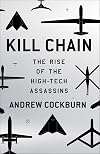
In “Kill Chain: The Rise of the High-Tech Assassins”, author Andrew Cockburn provides a cogent counter argument to the belief that our military drones are typically deployed with near absolute precision. He explains that the technology isn't nearly as good as we'd imagined, and individuals "flying" and "targeting" aren't seeing things on the ground as clearly as advertised.
Bad intelligence often leads to killing the wrong party. To the eyes in the sky, any male 13 years old and above, show more or any male carrying an AK-47 is a terrorist. But in that part of the world, going out without a weapon is like going out without your wallet in the U.S. So in post event analysis, even if the wrong party is killed, after-bombing review still classifies the targeted individuals "terrorists" because they often can find a weapon in the debris. So accuracy counts and civilian deaths are often distorted.
Cockburn goes on to show the limits of targeting High Value Individuals. In more cases than not, it is often counterproductive. It often compared to "Mowing the Lawn". When some terrorist leaders appear to rise among the followers, they can be identified and mowed down, but new leaders just grow back. And they’re usually younger, more militant, less disciplined, and more "macho", making the situation worse. This is especially true if collateral damage is involved in the initial strike. Over ten years ago, Donald Rumsfeld asked ‘Are we capturing, killing or deterring and dissuading more terrorists every day than the madrassas and the radical clerics are recruiting, training and deploying against us?” Cockburn makes the point that the drone program appears to make the answer to Rumsfeld’s question a big “no”. The constant deployment of drone’s just makes that many more terrorists, and it has become one of the greatest recruiting tool for the terrorists.
The question of drone use under International Law is also touched upon. But as Cockburn mentions,
International Law evolves as countries violate it. Targeted assassinations by Israel following the Munich Olympics massacre were initially condemned, but now it has become something of a common practice. Gradually, as practices evolve, what was once forbidden becomes accepted under International Law.
Cockburn also details the expense and waste associated with the program. As is true in other Pentagon program, even drones the military doesn't want, can't use, and don't work get funded by some influential congressman or senator. Talk about wasteful spending.
This book may pair well with Thomas Jefferson School of Law Professor Marjorie Cohn's recent book "Drones and Targeted Killing: Legal, Moral, and Geopolitical Issues", which I plan on reading soon. show less
Bad intelligence often leads to killing the wrong party. To the eyes in the sky, any male 13 years old and above, show more or any male carrying an AK-47 is a terrorist. But in that part of the world, going out without a weapon is like going out without your wallet in the U.S. So in post event analysis, even if the wrong party is killed, after-bombing review still classifies the targeted individuals "terrorists" because they often can find a weapon in the debris. So accuracy counts and civilian deaths are often distorted.
Cockburn goes on to show the limits of targeting High Value Individuals. In more cases than not, it is often counterproductive. It often compared to "Mowing the Lawn". When some terrorist leaders appear to rise among the followers, they can be identified and mowed down, but new leaders just grow back. And they’re usually younger, more militant, less disciplined, and more "macho", making the situation worse. This is especially true if collateral damage is involved in the initial strike. Over ten years ago, Donald Rumsfeld asked ‘Are we capturing, killing or deterring and dissuading more terrorists every day than the madrassas and the radical clerics are recruiting, training and deploying against us?” Cockburn makes the point that the drone program appears to make the answer to Rumsfeld’s question a big “no”. The constant deployment of drone’s just makes that many more terrorists, and it has become one of the greatest recruiting tool for the terrorists.
The question of drone use under International Law is also touched upon. But as Cockburn mentions,
International Law evolves as countries violate it. Targeted assassinations by Israel following the Munich Olympics massacre were initially condemned, but now it has become something of a common practice. Gradually, as practices evolve, what was once forbidden becomes accepted under International Law.
Cockburn also details the expense and waste associated with the program. As is true in other Pentagon program, even drones the military doesn't want, can't use, and don't work get funded by some influential congressman or senator. Talk about wasteful spending.
This book may pair well with Thomas Jefferson School of Law Professor Marjorie Cohn's recent book "Drones and Targeted Killing: Legal, Moral, and Geopolitical Issues", which I plan on reading soon. show less

If you read enough about the Dirty Wars in Central America in the 1980s and the arms trading scheme that became known as 'Iran Contra' you will find Israelis appear many times on the periphery, yet the Congressional report mentioned Israel in less than 5% of the 400+ page report.
The real meat of this book is exploring how the USA responded to political pressure and Congressional bans on support to the South and Central American dictatorships (and also Apartheid South Africa) by employing show more Israel as a proxy to supply them as well as provide security training for them, which they were all too happy to oblige in order to expand and deepen military and political ties and develop mutual dependency.
Earlier chapters trace through the initially contentious but increasingly friendly relations on intelligence matters, but it is the proxy aid to third parties and the Nuclear weapons development program that are the most important parts.
NB: the book has recently come back into the spotlight because Leslie Cockburn is running for Congress, defenders of Israeli government policy and violence accuse her of being an anti-Semitic 'Israel hater' and cite this book as proof. Yet they don't quote any contentious paragraphs or sentences in it. show less
The real meat of this book is exploring how the USA responded to political pressure and Congressional bans on support to the South and Central American dictatorships (and also Apartheid South Africa) by employing show more Israel as a proxy to supply them as well as provide security training for them, which they were all too happy to oblige in order to expand and deepen military and political ties and develop mutual dependency.
Earlier chapters trace through the initially contentious but increasingly friendly relations on intelligence matters, but it is the proxy aid to third parties and the Nuclear weapons development program that are the most important parts.
NB: the book has recently come back into the spotlight because Leslie Cockburn is running for Congress, defenders of Israeli government policy and violence accuse her of being an anti-Semitic 'Israel hater' and cite this book as proof. Yet they don't quote any contentious paragraphs or sentences in it. show less
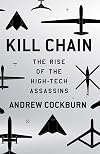
Andrew Cockburn's forthcoming book, Kill Chain: Drones and the Rise of the High-Tech Assassins (Henry Holt and Company) challenges every American to rethink the structure of our defense establishment and the way we allocate public funds. In fact, Cockburn addresses far more than the evolution of drones into the controversial “targeted killing” programs.
What makes Cockburn's book so compelling is his dispassionate laying out of facts and figures beside the inflated claims made by the show more defense industry and the carefully crafted statements and reports from uniformed and civilian security officials. Although his title and subtitle imply he will tell the story of military drones, Cockburn investigates and exposes broader issues, chiefly our military's reliance on expensive, complex technologies not capable or robust enough to play a consistently useful role in warfare; the connections between high ranking military and civilian officials and the defense contractors; and the efficacy, or more accurately the lack of efficacy, of contemporary U.S. command and control regimes.
This book would be a must read on these grounds alone, but there is more. Ever since William Greider published Fortress America in 1998, the extent of what President Eisenhower famously described as the military-industrial complex has been public knowledge; moreover, Greider and Cockburn after him have made it abundantly clear that Eisenhower should have left the draft phrasing, “military-congressional-industrial complex”, stand in his delivered speech. Defense contractors carefully site bits and pieces of each project across a wide range of Congressional districts to insure that a large number of Senators and Representatives will support funding for weapons and command and control systems that bring jobs to their constituents. If that were not enough, Cockburn describes the now sordidly familiar spectacle of defense contractors hiring family members of elected officials as consultants and advisers; this on top of the revolving door for senior military personnel who can retire on Friday and turn up in civilian clothes the following Monday to lobby Congress and the Defense Department for funding for their new employers, defense industry firms whose products they know because, as military officers, they worked on specifications, development, testing and deployment of those products. This is corruption by any standard.
As the ad pitchmen say, “and there's more!” Cockburn details the way overpriced and expensive weapons, surveillance and communication systems have displaced cheaper, more effective alternatives. Technologies supposed to give field commanders comprehensive real time information about conflicts actually increase the fog of war and remove control from commanders on the spot. Our government is spending a lot of our money for defense technologies that do not work very well. In fact, the use of drones for surveillance and targeting, given the limited capabilities these machines actually possess (as opposed to the claims made by their manufacturers and their purchasers in the military and the Central Intelligence Agency), is immoral. Drone strikes have repeatedly been ordered on human beings without any clear evidence that the “targets” are in fact terrorists or any threat at all to the United States and its interests.
In short, Kill Chain documents the failures of our military and surveillance to achieve the goals set ffor them, and the consequences: taxpayer money wasted on Pentagon programs that cost lives instead of on domestic programs that help people live dignified lives; corruption in our military and political establishments; and arrogant, senseless assassinations around the world. This is something we should all read, and then hold our civilian and military leaders and ourselves accountable. show less
What makes Cockburn's book so compelling is his dispassionate laying out of facts and figures beside the inflated claims made by the show more defense industry and the carefully crafted statements and reports from uniformed and civilian security officials. Although his title and subtitle imply he will tell the story of military drones, Cockburn investigates and exposes broader issues, chiefly our military's reliance on expensive, complex technologies not capable or robust enough to play a consistently useful role in warfare; the connections between high ranking military and civilian officials and the defense contractors; and the efficacy, or more accurately the lack of efficacy, of contemporary U.S. command and control regimes.
This book would be a must read on these grounds alone, but there is more. Ever since William Greider published Fortress America in 1998, the extent of what President Eisenhower famously described as the military-industrial complex has been public knowledge; moreover, Greider and Cockburn after him have made it abundantly clear that Eisenhower should have left the draft phrasing, “military-congressional-industrial complex”, stand in his delivered speech. Defense contractors carefully site bits and pieces of each project across a wide range of Congressional districts to insure that a large number of Senators and Representatives will support funding for weapons and command and control systems that bring jobs to their constituents. If that were not enough, Cockburn describes the now sordidly familiar spectacle of defense contractors hiring family members of elected officials as consultants and advisers; this on top of the revolving door for senior military personnel who can retire on Friday and turn up in civilian clothes the following Monday to lobby Congress and the Defense Department for funding for their new employers, defense industry firms whose products they know because, as military officers, they worked on specifications, development, testing and deployment of those products. This is corruption by any standard.
As the ad pitchmen say, “and there's more!” Cockburn details the way overpriced and expensive weapons, surveillance and communication systems have displaced cheaper, more effective alternatives. Technologies supposed to give field commanders comprehensive real time information about conflicts actually increase the fog of war and remove control from commanders on the spot. Our government is spending a lot of our money for defense technologies that do not work very well. In fact, the use of drones for surveillance and targeting, given the limited capabilities these machines actually possess (as opposed to the claims made by their manufacturers and their purchasers in the military and the Central Intelligence Agency), is immoral. Drone strikes have repeatedly been ordered on human beings without any clear evidence that the “targets” are in fact terrorists or any threat at all to the United States and its interests.
In short, Kill Chain documents the failures of our military and surveillance to achieve the goals set ffor them, and the consequences: taxpayer money wasted on Pentagon programs that cost lives instead of on domestic programs that help people live dignified lives; corruption in our military and political establishments; and arrogant, senseless assassinations around the world. This is something we should all read, and then hold our civilian and military leaders and ourselves accountable. show less
 This review was written for LibraryThing Early Reviewers.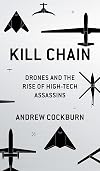
From David's slingshot against Goliath to the arrows of Agincourt, distance killing has always existed in the history of warfare.
The proposition of Andrew Cockburn is to review how the lastingness of the electronic age and the exponential power of computer data analysis change the battlefield in the U.S. army. There is something Kubrickian in the literary style of Mr. Cockburn if one could compare it to that master of the 7th art. It is because his fact finding on the command structure show more demonstrates an overarching reliance and fondness for technological capabilities over human assets. It does remind of Kubrick's treatment of the WWI Generals in its 1957 "Paths of Glory" and how they were micro-managing a muddy trench war from the refined décor of rococo castles in the rear. It is therefore when his narration describes high command individuals shut in their computer room looking relentlessly at white and black dots on screens to let loose orders to their field commanders that his vitriolic irony is at his best. Mr. Cockburn does not describe how a General recently fell victim to a Taliban attack because it is not the subject of this book.
Thus Cockburn's "Kill Chain" is as much a study in power distance as it is a bitter criticism of what Eisenhower best described as a complex that interlaced defense manufacturers, branches of the government and university research. The jaundice that permeates his well documented work comes in part from how liberally and in relative secrecy, succeeding administrations are subjected to a decision system that shells out billions of dollars to programs that include electronic tools and weapons which efficiency is at best controversial. For Mr. Cockburn, the efforts that were made to bring oversight to this system are still insufficient and he feels clearly that the American public is cheated.
Then Cockburn addresses the ethics of giving the ever growing program "Predator" drone, lethal capabilities thus giving David's slingshot a range never attained before in the history of war. Pointedly he notes that this distance brings an unprecedented dehumanization of the enemy reduced to binary sprinkles on some monitor half a continent, one ocean, one sea and two deserts away from their target.
Now the reader faces the fact that the aim of the use of weapons in war should lead to a result similar to that of Lenin's famous hammer; crushing the enemy. It will be disputed that blunders caused by such distance killing bring disturbing moral imports. Would these be lifted by an even more precise strike and better screen resolution? I did not find the answer in the book but it does bring plenty of questions. show less
The proposition of Andrew Cockburn is to review how the lastingness of the electronic age and the exponential power of computer data analysis change the battlefield in the U.S. army. There is something Kubrickian in the literary style of Mr. Cockburn if one could compare it to that master of the 7th art. It is because his fact finding on the command structure show more demonstrates an overarching reliance and fondness for technological capabilities over human assets. It does remind of Kubrick's treatment of the WWI Generals in its 1957 "Paths of Glory" and how they were micro-managing a muddy trench war from the refined décor of rococo castles in the rear. It is therefore when his narration describes high command individuals shut in their computer room looking relentlessly at white and black dots on screens to let loose orders to their field commanders that his vitriolic irony is at his best. Mr. Cockburn does not describe how a General recently fell victim to a Taliban attack because it is not the subject of this book.
Thus Cockburn's "Kill Chain" is as much a study in power distance as it is a bitter criticism of what Eisenhower best described as a complex that interlaced defense manufacturers, branches of the government and university research. The jaundice that permeates his well documented work comes in part from how liberally and in relative secrecy, succeeding administrations are subjected to a decision system that shells out billions of dollars to programs that include electronic tools and weapons which efficiency is at best controversial. For Mr. Cockburn, the efforts that were made to bring oversight to this system are still insufficient and he feels clearly that the American public is cheated.
Then Cockburn addresses the ethics of giving the ever growing program "Predator" drone, lethal capabilities thus giving David's slingshot a range never attained before in the history of war. Pointedly he notes that this distance brings an unprecedented dehumanization of the enemy reduced to binary sprinkles on some monitor half a continent, one ocean, one sea and two deserts away from their target.
Now the reader faces the fact that the aim of the use of weapons in war should lead to a result similar to that of Lenin's famous hammer; crushing the enemy. It will be disputed that blunders caused by such distance killing bring disturbing moral imports. Would these be lifted by an even more precise strike and better screen resolution? I did not find the answer in the book but it does bring plenty of questions. show less
This review was written for LibraryThing Early Reviewers.Lists
Awards


You May Also Like


Associated Authors
Statistics
- Works
- 12
- Also by
- 1
- Members
- 820
- Popularity
- #31,113
- Rating
- 3.6
- Reviews
- 25
- ISBNs
- 54
- Languages
- 4
- Favorited
- 1
