
Oliver Wendell Holmes (1) (1809–1894)
Author of The Autocrat of the Breakfast Table
For other authors named Oliver Wendell Holmes, see the disambiguation page.
Oliver Wendell Holmes (1) has been aliased into Oliver Wendell Holmes, Sr..
Series
Works by Oliver Wendell Holmes
Works have been aliased into Oliver Wendell Holmes, Sr..
The one hoss shay,: With its companion poems How the old horse won the bet & The broomstick train, (2015) 19 copies, 1 review
The Breakfast-Table Series: The Autocrat Of The Breakfast-Table, The Professor At The Breakfast- Table; The Poet At The Breakfast-Table (2007) 18 copies
DOROTHY Q., Together with A Ballad of the Boston Tea Party & Grandmother's Story of Bunker Hill Battle (2007) 9 copies
Mechanism: In Thought and Morals 5 copies
Opals from Holmes 4 copies
The psychiatric novels of Oliver Wendell Holmes; abridgment, introduction and psychiatric annotations (2012) 4 copies
THE AUTOCRAT OF THE BREAKFAST-TABLE [with] THE POET OF THE BREAKFAST-TABLE [with] THE PROFESSOR AT THE BREAKFAST-TABLE [with] OVER THE TEACUPS. (1891) 3 copies
Iron Gate & Other Poems 1ST Edition 3 copies
Astraea : The balance of illusions : a poem delivered before the Phi Beta Kappa Society of Yale College, August 14, 1850 (1850) 3 copies
Pearls From Holmes 2 copies
Songs of many seasons, 1862-1874 2 copies
An Introductory Lecture, Delivered at the Massachusetts Medical College, November 3, 1847 (Classic Reprint) (2017) 1 copy
Widger's Quotations from the Project Gutenberg Editions of the Works of Oliver W. Holmes, Sr. 1 copy
Holmes Leaflets: Poems And Prose Passages From The Works Of Oliver Wendell Holmes (1881) (2010) 1 copy
The Broomstick Train 1 copy
Modern Classics; Selections From the Breakfast Table Series, and Pages From an Old Volume of Life (1883) 1 copy
Dead, Yet Living: An Address Delivered At Keene, New Hampshire, Memorial Day, May 30, 1884 (1884) (2009) 1 copy
Urania: a rhymed lesson 1 copy
Oliver Wendell Holmes papers 1 copy
An Excerpt from a Speech 1 copy
Holmes' Early Poems 1 copy
Holmes's Works 1 copy
POEMS BY OLIVER WENDELL HOLMES AND JAMES RUSSELL LOWELL (AMERICAN AUTHORS IN PROSE AND POETRY) 1 copy
The Complete Writings of Oliver Wendell Holmes, Autocrat Edition. Volume VI. The Guardian Angel. 1 copy
The Complete Writings of Oliver Wendell Holmes, Autocrat Edition. Volume VII. A Mortal Antipathy. 1 copy
Associated Works
Works have been aliased into Oliver Wendell Holmes, Sr..
The Illustrated Treasury of Children's Literature, Volumes 1-2 (1955) — Contributor — 523 copies, 4 reviews
The Glorious American Essay: One Hundred Essays from Colonial Times to the Present (2020) — Contributor — 119 copies
The Best American Humorous Short Stories [edited by Alexander Jessup] (1920) — Contributor — 78 copies, 1 review
Buzz Words: Poems About Insects (Everyman's Library Pocket Poets Series) (2021) — Contributor — 56 copies
Out of the Best Books: An Anthology of Literature, Vol. 5: Community Responsibility (1969) — Contributor — 30 copies
Out of the Best Books: An Anthology of Literature, Vol. 4: The World Around Us (1968) — Contributor — 28 copies
American Literature: The Makers and the Making (In Two Volumes) (1973) — Contributor, some editions — 25 copies
Tagged
Common Knowledge
- Other names
- Holmes Sr., Oliver Wendell
- Birthdate
- 1809-08-29
- Date of death
- 1894-10-07
- Gender
- male
- Education
- Phillips Academy (1825)
Harvard College - Occupations
- poet
- Organizations
- Metaphysical Club
- Nationality
- USA
- Birthplace
- Cambridge, Massachusetts, USA
- Place of death
- Cambridge, Massachusetts, USA
- Burial location
- Mount Auburn Cemetery, Cambridge, Massachusetts, USA
Members
Reviews
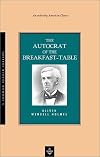
Oliver Wendell Holmes' The Autocrat of the Breakfast-Table was first published serially in The Atlantic Monthly in 1857, and in book form a year later. It is less a novel than a collection of short, idiosyncratic musings disguised as breakfast-table discussions (lectures might be a more accurate description) between the eponymous autocrat and his (semi-captive) audience - the other boarders at his lodging-house in Boston.
Since there's not really much plot to discuss, I thought I'd pick out a show more few portions of the book that either struck me as interesting or made me laugh. Holmes' wit remains sharp, but I suspect some references and allusions have been lost, dulled by the changes a century and a half have wrought in the American psyche. Nonetheless, there is much to enjoy in this little book.
The autocrat dislikes puns and wordplay (except, of course, when he wants to employ such tactics himself). "A pun," he writes, "does not commonly justify a blow in return. But if a blow were to be given for such cause, and death ensued, the jury would be judges both of the facts and of the pun, and might, if the latter were of an aggravated character, return a verdict of justifiable homicide."
Holmes develops the concept of a "literary tea-pot," sort of a reading intern:
"Society is a strong solution of books. It draws the virtue out of what is best worth reading, as hot water draws the strength of tea-leaves. If I were a prince, I would hire or buy a private literary tea-pot, in which I would steep all the leaves of new books that promised well. ... You understand me; I would have a person whose sole business should be to read day and night, and talk to me whenever I wanted him to. I know the man I would have: a quick-witted, out-spoken, incisive fellow; knows history, or at any rate has a shelf full of books about it, which he can use handily, and the same of all useful arts and sciences; knows all the common plots of plays and novels, and the stock company of characters that are continually coming in on new costume; can give you a criticism of an octavo in an epithet and a wink, and you can depend on it; cares for nobody except for the virtue there is in what he says; delights in taking off big wigs and professional gowns, and in the disembalming and unbandaging of all literary mummies. ... In short, he is one of those men that know everything except how to make a living."
The musings seldom tend toward natural history, but Holmes' disquisition on elm trees in the tenth chapter is one of the sections I like most of all. It helped, perhaps, that I read this section just a few hours after discovering a survivor elm on Mount Auburn Street in Cambridge - a tree that possibly (if only barely) might have been a young sapling when Holmes himself walked those very streets.
Likewise, the essays only rarely refer to actual contemporary events, but Holmes does take to task those engaged in the wholesale rearrangement of Boston's cemeteries for the sake of symmetry: "... the upright stones have been shuffled about like chessman, and nothing short of the Day of Judgment will tell whose dust lies beneath any of those records, meant by affection to mark one small spot as sacred to some cherished memory. Shame! shame! shame! - that is all I can say. ... epitaphs were never famous for truth, but the old reproach of "Here lies" never had such a wholesale illustration as in these outraged burial-places, where the stone does lie above and the bones do not lie beneath."
An example of nineteenth century literary Boston brahminism at its finest, Holmes' jottings have retained most of their punch; Autocrat can still amuse, provoke, and chide its reader today, just as it did 150 years ago.
http://philobiblos.blogspot.com/2007/06/book-review-autocrat-of-breakfast-table.... show less
Since there's not really much plot to discuss, I thought I'd pick out a show more few portions of the book that either struck me as interesting or made me laugh. Holmes' wit remains sharp, but I suspect some references and allusions have been lost, dulled by the changes a century and a half have wrought in the American psyche. Nonetheless, there is much to enjoy in this little book.
The autocrat dislikes puns and wordplay (except, of course, when he wants to employ such tactics himself). "A pun," he writes, "does not commonly justify a blow in return. But if a blow were to be given for such cause, and death ensued, the jury would be judges both of the facts and of the pun, and might, if the latter were of an aggravated character, return a verdict of justifiable homicide."
Holmes develops the concept of a "literary tea-pot," sort of a reading intern:
"Society is a strong solution of books. It draws the virtue out of what is best worth reading, as hot water draws the strength of tea-leaves. If I were a prince, I would hire or buy a private literary tea-pot, in which I would steep all the leaves of new books that promised well. ... You understand me; I would have a person whose sole business should be to read day and night, and talk to me whenever I wanted him to. I know the man I would have: a quick-witted, out-spoken, incisive fellow; knows history, or at any rate has a shelf full of books about it, which he can use handily, and the same of all useful arts and sciences; knows all the common plots of plays and novels, and the stock company of characters that are continually coming in on new costume; can give you a criticism of an octavo in an epithet and a wink, and you can depend on it; cares for nobody except for the virtue there is in what he says; delights in taking off big wigs and professional gowns, and in the disembalming and unbandaging of all literary mummies. ... In short, he is one of those men that know everything except how to make a living."
The musings seldom tend toward natural history, but Holmes' disquisition on elm trees in the tenth chapter is one of the sections I like most of all. It helped, perhaps, that I read this section just a few hours after discovering a survivor elm on Mount Auburn Street in Cambridge - a tree that possibly (if only barely) might have been a young sapling when Holmes himself walked those very streets.
Likewise, the essays only rarely refer to actual contemporary events, but Holmes does take to task those engaged in the wholesale rearrangement of Boston's cemeteries for the sake of symmetry: "... the upright stones have been shuffled about like chessman, and nothing short of the Day of Judgment will tell whose dust lies beneath any of those records, meant by affection to mark one small spot as sacred to some cherished memory. Shame! shame! shame! - that is all I can say. ... epitaphs were never famous for truth, but the old reproach of "Here lies" never had such a wholesale illustration as in these outraged burial-places, where the stone does lie above and the bones do not lie beneath."
An example of nineteenth century literary Boston brahminism at its finest, Holmes' jottings have retained most of their punch; Autocrat can still amuse, provoke, and chide its reader today, just as it did 150 years ago.
http://philobiblos.blogspot.com/2007/06/book-review-autocrat-of-breakfast-table.... show less

This little book took me some time to read. At first, I thought I might write down some of the quotes from it, but soon I realised that each page had a memorable quote and I decided to leave the possibility that I will remember this book should any of the various quotes be needed again in the future. I daresay at this I shall fail but if I put it to memory that there are many important quotes in this work, I may well recover some of its hidden gems. I found Oliver Wendell Holmes to read like show more that other three-named American, Ralph Waldo Emerson, although less of a "Churchman", rather than a divinity address he had a divinity student at the boarding house table. This book was originally written as a series of articles for The Atlantic Monthly first written in 1857 with the first serial of this book appearing in its first edition. The work lends itself to being read in a stop-start fashion, as if it were meant to be serialised, and there is so much packed into so few sentences that it takes some time to absorb the sheer depth of wit, meaning, humour, learnedness, and intellect on display. The interspersed poetry had me wonder at times why poetry is so "on the nose" these days (Random House does not accept manuscripts of poetry, and recently, a quote on the movie The Big Short: "The truth is like poetry. And everyone fucking hates poetry"). I think we miss something as a result. But not so in Holmes' time. Nevertheless, this took a long time to digest, even though it is not a difficult read. show less

In a year's worth of columns for the nascent Atlantic Monthly, an orator holds forth on shoes, ships, and sealing wax over a series of boarding-house breakfasts. His audience, among the clatter of silverware and tea cups, is alternately impressed and skeptical at his assertions.

I was enormously disappointed in this book. If the narrator is indeed an autocrat, I'm all for revolution and bringing up the guillotine. Turgid and leaden in its delivery, not particularly funny, nor particularly wise. In short, the autocrat is a windy bore. Not recommended.
Lists
Awards


You May Also Like
Associated Authors
Statistics
- Works
- 110
- Also by
- 20
- Members
- 2,013
- Popularity
- #12,784
- Rating
- 3.8
- Reviews
- 21
- ISBNs
- 406
- Languages
- 3
- Favorited
- 1


