
Julie Smith (1) (1944–)
Author of New Orleans Mourning
For other authors named Julie Smith, see the disambiguation page.
About the Author
Mystery author Julie Smith was born in Savannah, Georgia in 1944. She graduated from the University of Mississippi with a degree in journalism. After graduation, she moved to New Orleans and wrote features for the New Orleans Times-Picayune. After a year, she moved to San Francisco and got a job at show more the San Francisco Chronicle. Fourteen years later, she left to form a freelance writing firm called Invisible Ink with two other women. In 1982, her first novel, Death Turns a Trick, was published. Since becoming a full-time author, she has written over twenty novels including the ones in the Rebecca Schwartz Mystery series, the Paul McDonald Mystery series, the Skip Langdon Mystery series, and the Talba Wallis series. Her novel, New Orleans Mourning, won the 1991 Edgar Allen Poe Award for best novel. (Bowker Author Biography) show less
Image credit: www.casamysterioso.com/juliesbio.htm
Series
Works by Julie Smith
Blue Murder Collection 6 copies
Deadly Allies - Silk Strands 1 copy
Associated Works
A Confederacy of Crime: New Stories of Southern-Style Mystery (2001) — Contributor — 40 copies, 1 review
Unusual Suspects: A New Anthology of Crime Stories from Black Lizard (1996) — Contributor — 39 copies, 1 review
Drop Dead Crime: Mystery and Suspense from the Leading Ladies of Murder (2019) — Contributor — 8 copies
Tagged
Common Knowledge
- Other names
- Arthur, Red Q.
- Birthdate
- 1944-11-25
- Gender
- female
- Education
- University of Mississippi
- Occupations
- author (mysteries)
reporter (newspaper)
writer
journalist - Nationality
- USA
- Birthplace
- Annapolis, Maryland, USA
- Places of residence
- Savannah, Georgia, USA
New Orleans, Louisiana, USA - Associated Place (for map)
- USA
Members
Reviews
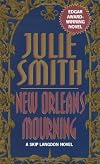
[b:New Orleans Mourning|170341|New Orleans Mourning (Skip Langdon Novels (Paperback))|Julie Smith|http://photo.goodreads.com/books/1172376934s/170341.jpg|3193389] is one of the relatively rare Edgar Best Novel winners that I had already read, shortly after its publication. I've gone on to read all Smith's New Orleans books; for some reason, I didn't get into her earlier San Francisco-based series.
Rereading the first book in a long-running series is a bit like reconnecting with an old friend, show more but it's also a bit like time travel. In this first book, Skip Langdon, Smith's protagonist, is still feeling her way as a police officer and as an adult woman. She has a lot of unresolved issues and so do most of the other major characters in the book -- and some very similar issues, at that. Mention is made that Skip has been reading Tennessee Williams, and Williams's theme of dysfunctional Southern families is on nearly every page of [b:New Orleans Mourning|170341|New Orleans Mourning (Skip Langdon Novels (Paperback))|Julie Smith|http://photo.goodreads.com/books/1172376934s/170341.jpg|3193389].
Skip, who has only recently realized that a cop is what she wants to be when she grows up, is still a uniformed beat cop, detailed to crowd control at the big Mardi Gras Parade on Mardi Gras (Shrove Tuesday) itself. As daughter to a social-climbing doctor and his wife, she knows most of upper-crust N.O., and as she watches the float of Chauncey St. Amant, an acquaintance who's this year's Rex (King of Carnival), she is stunned to see someone in a Dolly Parton costume shoot him dead from a balcony. When her superiors realize she has entree into this world, she's assigned to help with the investigation.
Smith uses changing points of view skillfully to portray the passions, personalities and problems of the St. Amant family and the family friend, Tolliver Albert, from whose balcony the shot was fired. Of course, the family were all at the exclusive Boston Club waiting for the parade -- or were they? Skip's investigation takes her from the mansions of the rich to the most squalid of New Orleans' slums. In the end, she is not sure whether or not justice has been served.
[b:New Orleans Mourning|170341|New Orleans Mourning (Skip Langdon Novels (Paperback))|Julie Smith|http://photo.goodreads.com/books/1172376934s/170341.jpg|3193389] made me think of the novels of [a:Donna Leon|16290|Donna Leon|http://photo.goodreads.com/authors/1208207578p2/16290.jpg], set in Venice, Italy -- a similar city in some ways, strongly influenced by and often menaced by water, with its own language and customs, its Carnival, and its civic corruption. Like those in most of Leon's books, the ending of [b:New Orleans Mourning|170341|New Orleans Mourning (Skip Langdon Novels (Paperback))|Julie Smith|http://photo.goodreads.com/books/1172376934s/170341.jpg|3193389] is somewhat unsatisfying, but sadly believable.
I recommend this highly to anyone who hasn't yet discovered Smith's series. It's only the daunting state of my TBR shelves that's keeping me from going back to reread the whole series. show less
Rereading the first book in a long-running series is a bit like reconnecting with an old friend, show more but it's also a bit like time travel. In this first book, Skip Langdon, Smith's protagonist, is still feeling her way as a police officer and as an adult woman. She has a lot of unresolved issues and so do most of the other major characters in the book -- and some very similar issues, at that. Mention is made that Skip has been reading Tennessee Williams, and Williams's theme of dysfunctional Southern families is on nearly every page of [b:New Orleans Mourning|170341|New Orleans Mourning (Skip Langdon Novels (Paperback))|Julie Smith|http://photo.goodreads.com/books/1172376934s/170341.jpg|3193389].
Skip, who has only recently realized that a cop is what she wants to be when she grows up, is still a uniformed beat cop, detailed to crowd control at the big Mardi Gras Parade on Mardi Gras (Shrove Tuesday) itself. As daughter to a social-climbing doctor and his wife, she knows most of upper-crust N.O., and as she watches the float of Chauncey St. Amant, an acquaintance who's this year's Rex (King of Carnival), she is stunned to see someone in a Dolly Parton costume shoot him dead from a balcony. When her superiors realize she has entree into this world, she's assigned to help with the investigation.
Smith uses changing points of view skillfully to portray the passions, personalities and problems of the St. Amant family and the family friend, Tolliver Albert, from whose balcony the shot was fired. Of course, the family were all at the exclusive Boston Club waiting for the parade -- or were they? Skip's investigation takes her from the mansions of the rich to the most squalid of New Orleans' slums. In the end, she is not sure whether or not justice has been served.
[b:New Orleans Mourning|170341|New Orleans Mourning (Skip Langdon Novels (Paperback))|Julie Smith|http://photo.goodreads.com/books/1172376934s/170341.jpg|3193389] made me think of the novels of [a:Donna Leon|16290|Donna Leon|http://photo.goodreads.com/authors/1208207578p2/16290.jpg], set in Venice, Italy -- a similar city in some ways, strongly influenced by and often menaced by water, with its own language and customs, its Carnival, and its civic corruption. Like those in most of Leon's books, the ending of [b:New Orleans Mourning|170341|New Orleans Mourning (Skip Langdon Novels (Paperback))|Julie Smith|http://photo.goodreads.com/books/1172376934s/170341.jpg|3193389] is somewhat unsatisfying, but sadly believable.
I recommend this highly to anyone who hasn't yet discovered Smith's series. It's only the daunting state of my TBR shelves that's keeping me from going back to reread the whole series. show less
By now, this series of Noir stories is getting close to 100 books. This is the first I have read. I was a little hesitant to pick it up, given that the idea of “classic noir” to me means noir writing from the classic days starting in the 1930s. Some of the stories in this collection go much farther back, the first a very short story by Armand Lanusse from 1843.
All of the stories take place in and around New Orleans — there’s even a crime map style illustration, showing the stories’ show more primary locations. The working definition of “noir” is, as you might think from the reach back into the nineteenth century, broad. Several of those early stories are particularly concerned with untenable racial relationships in old New Orleans — lives that can’t go forward, as in Grace King’s “The Little Convent Girl”, because the structure of racial relationships close in around them to cripple them.
That feeling of inevitable doom is often at the heart of noir stories, and I think that’s the common element that draws these stories together. They don’t all share that hard-beaten urban feel we associate with noir — they aren’t stories that take place in city bars at night. They aren’t all full of lives shaped by crimes that dig a whole the characters can’t dig out of. But they do have the background music of fate carrying the stories forward to endings that are unhappy but that draw our empathy.
The book is divided into three sets of stories, by the dates of their writing. The first four are those stories going back to the 1800s, including, along with the stories by Lanusse and Grace King, ones by Kate Chopin and O. Henry.
The second set goes from the 1940s through to the beginnings of contemporary noir in the late 1970s. This also includes some authors whose fame is not necessarily noirish — Eudora Welty and Tennessee Williams are the authors of the first two of the five in this set.
The last is contemporary noir, beginning with Ellen Gilchrist’s 1978 story, “Rich”, and including well-known current writers like James Lee Burke.
The New Orleans feel in the stories is supplied by the neighborhoods, the bars and clubs, the peculiar racial history of New Orleans — not the history framed by agricultural slavery but the complex structures of urban society that, so far as I know, are unique to New Orleans’ history — and the music and cultural life of New Orleans. It’s a very different noir than the noir of New York City.
I think the book works. Like I said, I had some hesitations about it. So long as you don’t require your noir pure and pulpy, you’re free to focus on the uniqueness of New Orleans life, and the very good writing in bite-sized pieces by some great writers. show less
All of the stories take place in and around New Orleans — there’s even a crime map style illustration, showing the stories’ show more primary locations. The working definition of “noir” is, as you might think from the reach back into the nineteenth century, broad. Several of those early stories are particularly concerned with untenable racial relationships in old New Orleans — lives that can’t go forward, as in Grace King’s “The Little Convent Girl”, because the structure of racial relationships close in around them to cripple them.
That feeling of inevitable doom is often at the heart of noir stories, and I think that’s the common element that draws these stories together. They don’t all share that hard-beaten urban feel we associate with noir — they aren’t stories that take place in city bars at night. They aren’t all full of lives shaped by crimes that dig a whole the characters can’t dig out of. But they do have the background music of fate carrying the stories forward to endings that are unhappy but that draw our empathy.
The book is divided into three sets of stories, by the dates of their writing. The first four are those stories going back to the 1800s, including, along with the stories by Lanusse and Grace King, ones by Kate Chopin and O. Henry.
The second set goes from the 1940s through to the beginnings of contemporary noir in the late 1970s. This also includes some authors whose fame is not necessarily noirish — Eudora Welty and Tennessee Williams are the authors of the first two of the five in this set.
The last is contemporary noir, beginning with Ellen Gilchrist’s 1978 story, “Rich”, and including well-known current writers like James Lee Burke.
The New Orleans feel in the stories is supplied by the neighborhoods, the bars and clubs, the peculiar racial history of New Orleans — not the history framed by agricultural slavery but the complex structures of urban society that, so far as I know, are unique to New Orleans’ history — and the music and cultural life of New Orleans. It’s a very different noir than the noir of New York City.
I think the book works. Like I said, I had some hesitations about it. So long as you don’t require your noir pure and pulpy, you’re free to focus on the uniqueness of New Orleans life, and the very good writing in bite-sized pieces by some great writers. show less
New Orleans Noir: The Classics is the eleventh book from the Akashic Books noir series that I have read and enjoyed since late 2009. But, as indicated by a quick count of the books listed inside the cover of this one, that is just the tip of the iceberg. If I counted correctly, 75 of the short story collections have now been published and another 18 are being prepared for publication.
New Orleans Noir, as indicated by its subtitle, mines the historical treasure trove of previously published show more fiction set within the confines of New Orleans. With only one exception, the book’s 18 stories are presented in chronological order, beginning with an Armand Lanusse story from 1843 and ending with one by Maurice Carlos Ruffin from 2012. The stories are further subdivided into three sections, each part titled in a way that characterizes the New Orleans of that day.
“Part 1: The Awakening” is comprised of four stories written between 1843 and 1899 and includes contributions from Kate Chopin and O. Henry. “Part II: Sweet Bird of Youth” adds five more stories, including ones by Eudora Welty and Tennessee Williams, and the book’s third, and longest, section adds another nine stories and is called “The Thanatos Syndrome.” This third section includes the work of writers familiar to today’s short story readers such as James Lee Burke, Ellen Gilchrist, Ace Atkins, and Nevada Barr.
As in any short story compilation, some of the stories will appeal to individual readers more than others, but I suspect that there is something here for just about everyone, no matter the style and content they prefer. My own favorites from the collection demonstrate, I think, the varied nature of the stories included. There is Kate Chopin’s “The Story of an Hour” (1894), at just four pages one of the shortest of all, that tells a story that Alfred Hitchcock could easily have used in his television series seventy years later. And there is Shirley Ann Grau’s 1955 story, “Miss Yellow Eyes,” which at thirty-six pages is one of the longest in the book. “Miss Yellow Eyes” tells the tragic (noir in every sense of the word) story of a young black woman planning to move to Oregon with her soldier fiancé where they can easily pass for white – before the Korean War interrupts their plans.
Another favorite is “Ritual Murder” (1978) by Tom Dent, a New Orleans-born writer who would die in 1998 at age sixty-six. This one is presented in script form, including stage directions, and strives to come to grips with the black-on-black violence that Dent aregues is akin to “group suicide.” Of the more recent stories, my favorite is Ace Atkins’s 2010 story “Last Fair Deal Gone Down.” Atkins so perfectly captures the elements of noir fiction in this one that it is perhaps my favorite story of the entire collection.
Bottom Line: New Orleans Noir: The Classics is another fine addition to one of the best short story series being published today. Don’t miss this one. show less
New Orleans Noir, as indicated by its subtitle, mines the historical treasure trove of previously published show more fiction set within the confines of New Orleans. With only one exception, the book’s 18 stories are presented in chronological order, beginning with an Armand Lanusse story from 1843 and ending with one by Maurice Carlos Ruffin from 2012. The stories are further subdivided into three sections, each part titled in a way that characterizes the New Orleans of that day.
“Part 1: The Awakening” is comprised of four stories written between 1843 and 1899 and includes contributions from Kate Chopin and O. Henry. “Part II: Sweet Bird of Youth” adds five more stories, including ones by Eudora Welty and Tennessee Williams, and the book’s third, and longest, section adds another nine stories and is called “The Thanatos Syndrome.” This third section includes the work of writers familiar to today’s short story readers such as James Lee Burke, Ellen Gilchrist, Ace Atkins, and Nevada Barr.
As in any short story compilation, some of the stories will appeal to individual readers more than others, but I suspect that there is something here for just about everyone, no matter the style and content they prefer. My own favorites from the collection demonstrate, I think, the varied nature of the stories included. There is Kate Chopin’s “The Story of an Hour” (1894), at just four pages one of the shortest of all, that tells a story that Alfred Hitchcock could easily have used in his television series seventy years later. And there is Shirley Ann Grau’s 1955 story, “Miss Yellow Eyes,” which at thirty-six pages is one of the longest in the book. “Miss Yellow Eyes” tells the tragic (noir in every sense of the word) story of a young black woman planning to move to Oregon with her soldier fiancé where they can easily pass for white – before the Korean War interrupts their plans.
Another favorite is “Ritual Murder” (1978) by Tom Dent, a New Orleans-born writer who would die in 1998 at age sixty-six. This one is presented in script form, including stage directions, and strives to come to grips with the black-on-black violence that Dent aregues is akin to “group suicide.” Of the more recent stories, my favorite is Ace Atkins’s 2010 story “Last Fair Deal Gone Down.” Atkins so perfectly captures the elements of noir fiction in this one that it is perhaps my favorite story of the entire collection.
Bottom Line: New Orleans Noir: The Classics is another fine addition to one of the best short story series being published today. Don’t miss this one. show less
 This review was written for LibraryThing Early Reviewers.
Apart from the notion, as the anthology title would have you believe, that these stories are “classics” (they’re not; they’re simply reprints), “noir” (there are very few of your typical hard-boiled, cynical, noir-ish characters to be found), and related to New Orleans in some way (some of the writerly connections are tenuous at best, and several of the stories offer only the barest trace of a New Orleans setting), this is an enjoyable collection of mostly good and even a couple show more of great stories. My favorite by a long stretch is James Lee Burke’s masterful “Jesus Out to Sea.” One of the reasons I like reading anthologies is the satisfaction of finding an interesting writer I was previously unfamiliar with; I will definitely be seeking out more of Burke’s work. Other stories I was impressed by: Nevada Barr’s “GDMFSOB,” Maurice Carlos Ruffin’s “Pie Man,” and Tennessee Williams’s notorious, if something short of classic, “Desire and the Black Masseur.” show less
This review was written for LibraryThing Early Reviewers.Lists
Awards


You May Also Like


Associated Authors
Statistics
- Works
- 69
- Also by
- 24
- Members
- 6,016
- Popularity
- #4,093
- Rating
- 3.5
- Reviews
- 115
- ISBNs
- 210
- Languages
- 9
- Favorited
- 5

