
Sarah Rose (1)
Author of For All the Tea in China: How England Stole the World's Favorite Drink and Changed History
For other authors named Sarah Rose, see the disambiguation page.
Works by Sarah Rose
For All the Tea in China: How England Stole the World's Favorite Drink and Changed History (2009) 766 copies, 33 reviews
D-Day Girls: The Spies Who Armed the Resistance, Sabotaged the Nazis, and Helped Win World War II (2019) 615 copies, 27 reviews
Tagged
Common Knowledge
- Gender
- female
- Education
- Harvard University
University of Chicago - Occupations
- journalist
- Agent
- Larry Weissman
Sascha Alper - Nationality
- USA
- Birthplace
- Chicago, Illinois, USA
- Places of residence
- New York, New York, USA
- Associated Place (for map)
- USA
Members
Reviews
D-Day girls : the spies who armed the resistance, sabotaged the Nazis, and helped win World War II by Sarah Rose

In the midst of my May Re-Reading Binge, I did manage to finish one new book, and it’s one I’ve been trying to get from my libraries for the last year, at least.
D-Day Girls chronicles the experiences of some of the first women who joined the British war effort in WWII as spies and collaborators with the French Resistance.
Unfortunately, it wasn’t quite all I’d hoped. Part of the reason might have been the audio format. While the author gave a solid performance, she reads aloud the show more same way I do, and I don’t like the way I read aloud, because I’m trying to add life to the words and I suck at it. I’m not saying Sarah Rose sucks, but it definitely seemed as though she wasn’t totally comfortable doing it, either. The book’s narrative also jumps around a lot between people, times and places, something I can take in stride when I read, but when I listen, becomes a lot more challenging.
What definitely hurt my rating of this book was the fact that I’d already read/listened to A Woman of No Importance by Sonia Purnell, which chronicles the life of Virginia Hall, another woman who served Great Britain, and then the US, organising and running French Resistance. Purnell covers a few of the other players, but only as they were connected to Virginia Hall, and her time jumps were far less frequent, making it an easier book for me to fall into and one that affected me deeply.
Those two caveats aside, the book is a worthwhile read and Rose’s dedication to her subject comes through clearly in her writing. These women meant something to her beyond being historical subjects, and her efforts to bring them to life for the reader (or listener) shine through, audio or not. While Virginia Hall made it through the war relatively unscathed, these women were not so fortunate, and what they experienced and persevered through (especially Odette), made me want to go fetal in a corner and rock.
Books like this are widely considered Pop History, but I’ve never thought that was an insult; books like these are as important as the academically important History Books, because they remind us that history isn’t just about the wars and the battles and the generals who fought them. It’s about the cultures and societies and people who live through them, and Pop History books about women remind us that women have been stepping up, getting it done, and often giving their lives in the effort, long before Feminism became A Thing, and they’ve been doing it in spite of mens’ efforts to hold them back. That’s what I love about the women of historical importance: they never asked for permission or validation, they just did what needed to be done. And I love these books for bringing them out of obscurity.
I have many heroes of both genders, but almost without exception, the women who are my heroines are the ones that stepped up and led by example, and the D-Day Girls join their ranks. show less
D-Day Girls chronicles the experiences of some of the first women who joined the British war effort in WWII as spies and collaborators with the French Resistance.
Unfortunately, it wasn’t quite all I’d hoped. Part of the reason might have been the audio format. While the author gave a solid performance, she reads aloud the show more same way I do, and I don’t like the way I read aloud, because I’m trying to add life to the words and I suck at it. I’m not saying Sarah Rose sucks, but it definitely seemed as though she wasn’t totally comfortable doing it, either. The book’s narrative also jumps around a lot between people, times and places, something I can take in stride when I read, but when I listen, becomes a lot more challenging.
What definitely hurt my rating of this book was the fact that I’d already read/listened to A Woman of No Importance by Sonia Purnell, which chronicles the life of Virginia Hall, another woman who served Great Britain, and then the US, organising and running French Resistance. Purnell covers a few of the other players, but only as they were connected to Virginia Hall, and her time jumps were far less frequent, making it an easier book for me to fall into and one that affected me deeply.
Those two caveats aside, the book is a worthwhile read and Rose’s dedication to her subject comes through clearly in her writing. These women meant something to her beyond being historical subjects, and her efforts to bring them to life for the reader (or listener) shine through, audio or not. While Virginia Hall made it through the war relatively unscathed, these women were not so fortunate, and what they experienced and persevered through (especially Odette), made me want to go fetal in a corner and rock.
Books like this are widely considered Pop History, but I’ve never thought that was an insult; books like these are as important as the academically important History Books, because they remind us that history isn’t just about the wars and the battles and the generals who fought them. It’s about the cultures and societies and people who live through them, and Pop History books about women remind us that women have been stepping up, getting it done, and often giving their lives in the effort, long before Feminism became A Thing, and they’ve been doing it in spite of mens’ efforts to hold them back. That’s what I love about the women of historical importance: they never asked for permission or validation, they just did what needed to be done. And I love these books for bringing them out of obscurity.
I have many heroes of both genders, but almost without exception, the women who are my heroines are the ones that stepped up and led by example, and the D-Day Girls join their ranks. show less
For All the Tea in China: How England Stole the World's Favorite Drink and Changed History by Sarah Rose
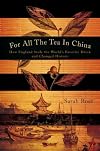
Combine Wicked Plants, Salt, and Simon Winchester-like writing, and you will come up with a book like For All the Tea in China. This is a entertaining, if quick, read of botanical espionage and tells both how tea became a staple of England social customs and how it fueled the colonializing British Empire. By stealing plants and seeds from China and transplanting tea to India, the British shifted the balance of trade, furthered scientific methods along the way, and ultimately altered show more geopolitical landscapes and economies. It is also a story of the pluck and courage of explorers such as Robert Fortune who disguised himself as a mandarin and was one of the first Europeans to travel in and out of China's interior. Though there are occasional gaps in weaving the narrative, if you are like me and don't have the time or inclination to read more in-depth titles on the subject, then you won't be disappointed. show less
D-Day Girls: The Spies Who Armed the Resistance, Sabotaged the Nazis, and Helped Win World War II by Sarah Rose

This is a very readable history of the women who were recruited into the Firm, the name attached to Churchill's Special Operations Executive,and the training they went through before being dropped into France by parachute, boat or plane. Their role was to organize an underground resistance to the Germans by training French men & women in weapons use, sabotage, radio and signaling skills and how to keep themselves and their activities secrete from the Nazis and the Vichy French.
Many of these show more agents were arrested and tortured with some being turned by the Gestapo to be counter agents for the Nazis. This in turn led to many other agents being arrested to the point in1943 that the Resistance structure was almost completely wiped out. Only the persistence and clever efforts of some of the women kept the movement viable. General Eisenhower acknowledged that their efforts probably was the equivalent of 15 Divisions and shorten the war by six months.
All the incidents covered in this book have been verified by research in available documents. show less
Many of these show more agents were arrested and tortured with some being turned by the Gestapo to be counter agents for the Nazis. This in turn led to many other agents being arrested to the point in1943 that the Resistance structure was almost completely wiped out. Only the persistence and clever efforts of some of the women kept the movement viable. General Eisenhower acknowledged that their efforts probably was the equivalent of 15 Divisions and shorten the war by six months.
All the incidents covered in this book have been verified by research in available documents. show less
For All the Tea in China: How England Stole the World's Favorite Drink and Changed History by Sarah Rose

A compelling account of how a Scottish botanist, Robert Fortune, stole the secret of tea cultivation from China, laying the foundation for Indian (and other) tea plantations that were able to undercut and supplant Chinese supply. Not only did he expose the dangerous method of adding iron ferro cyanide to the tea leaves, to provide the desired colour to green tea, but he proved that green and black tea are produced from the same species of bush. Then, starting in 1848, Fortune arranged for show more the transfer of thousands of (notoriously delicate) seedlings from China to India, along with a number of experienced Chinese tea growers, who were able to train Indian workers. Sarah Rose makes best use of somewhat scanty original material (as Fortune’s widow destroyed many of his papers/letters), to highlight Fortune’s tortuous travels, while explaining the geo-political importance of the opium for tea trade and the fundamental changes in trade that resulted from Fortune’s ‘industrial espionage’. show less
Lists
Awards

You May Also Like


Associated Authors
Statistics
- Works
- 2
- Members
- 1,381
- Popularity
- #18,623
- Rating
- 3.6
- Reviews
- 60
- ISBNs
- 43
- Languages
- 6