
Mary McCarthy (1) (1912–1989)
Author of The Group
For other authors named Mary McCarthy, see the disambiguation page.
Mary McCarthy (1) has been aliased into Mary McCarthy.
Series
Works by Mary McCarthy
Works have been aliased into Mary McCarthy.
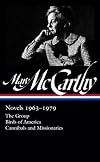
Mary McCarthy: Novels 1963-1979 (LOA #291): The Group / Birds of America / Cannibals and Missionaries (Library of America Mary McCarthy Edition) (2017) 69 copies, 1 review
Mary McCarthy: The Complete Fiction: A Library of America Boxed Set (The Library of America) (2017) 14 copies
Mary McCarthy's Collected Memoirs: Memories of a Catholic Girlhood, How I Grew, and Intellectual Memoirs (2013) 11 copies
The Collected Essays Volume One: Occasional Prose, The Writing on the Wall, and Ideas and the Novel (2018) 4 copies
The Collected Essays Volume Two: Mary McCarthy's Theatre Chronicles, 1937–1962 and On the Contrary (2018) 2 copies
Cruel and Barbarous Treatment 2 copies
A Charmed Life [abridged] 1 copy
La Traviata 1 copy
Associated Works
Works have been aliased into Mary McCarthy.
Drinking, Smoking and Screwing: Great Writers on Good Times (1994) — Contributor — 353 copies, 5 reviews
Reporting Vietnam: American Journalism 1959-1969, Volume 1 (1998) — Contributor — 345 copies, 3 reviews
Without Marx or Jesus; the new American Revolution has begun (1970) — Afterword, some editions — 197 copies, 1 review
First Fiction: An Anthology of the First Published Stories by Famous Writers (1994) — Contributor — 194 copies, 1 review
The Norton Anthology of American Literature, Volume 2: 1865 to Present (1979) — Contributor, some editions — 135 copies
Writing Women's Lives: An Anthology of Autobiographical Narratives by Twentieth-Century American Women Writers (1994) — Contributor — 128 copies, 3 reviews
The Glorious American Essay: One Hundred Essays from Colonial Times to the Present (2020) — Contributor — 116 copies
Writing New York: A Literary Anthology (Expanded 10th-Anniversary Edition) (2008) — Contributor — 101 copies, 1 review
Women's Magazines, 1940-1960: Gender Roles and the Popular Press (1998) — Contributor — 95 copies, 1 review
Take My Advice: Letters to the Next Generation from People Who Know a Thing or Two (2002) — Contributor — 50 copies
Published and Perished: Memoria, Eulogies, and Remembrances of American Writers (2002) — Contributor — 41 copies, 1 review
The Company They Kept, Volume Two: Writers on Unforgettable Friendships (2011) — Contributor — 25 copies
Fifty Years of the American Short Story from the O. Henry Awards 1919-1970 (1970) — Contributor — 17 copies, 1 review
Resistance: A Radical Social and Political History of the Lower East Side (2006) — Contributor — 17 copies
Contemporary Short Stories: Representative Selections, Volume 3 — Contributor — 6 copies
Fifty Years of the American Short Story from the O. Henry Awards 1919-1970, Volume 1 (1970) — Contributor — 3 copies
Moderne Amerikaanse verhalen — Contributor — 3 copies
Modern Short Stories — Contributor — 2 copies
Meesters der vertelkunst : zevenendertig verhalen uit de moderne wereldliteratuur (1975) — Contributor — 2 copies
Im Zeichen der Venus. Frauen schreiben erotische Geschichten ( Anthologie). (2001) — Contributor — 1 copy
Austin McQuinn: Ape Opera House & Selected Work 2000-2005 — Introduction — 1 copy
Tagged
Common Knowledge
- Legal name
- McCarthy, Mary Therese
- Birthdate
- 1912-06-21
- Date of death
- 1989-10-25
- Gender
- female
- Education
- Vassar College, Poughkeepsie, New York, USA
- Occupations
- romanschrijver
essayist
criticus - Relationships
- Wilson, Edmund
McCarthy, Kevin (brother) (3) - Short biography
- All works for Mary McCarthy, DOB 1912-06-21, were aliased into Mary Therese McCarthy as of 2011-02-21. For biographical information about this author, please see the main author page
- Cause of death
- Lung Cancer
- Nationality
- USA
- Birthplace
- Seattle, Washington, U.S.
- Places of residence
- Seattle, Washington, USA
Minneapolis, Minnesota, USA
Tacoma, Washington, USA
New York, New York, USA
Castine, Maine, USA
Paris, France - Place of death
- New York Presbyterian Hospital, New York, New York, USA
- Burial location
- Castine Cemetery, Castine, Maine, USA
- Associated Place (for map)
- USA
Members
Discussions
The Group by Mary McCarthy: Spoilers allowed in Girlybooks (May 2014)
Reviews
BIRDS OF AMERICA: (05-30-2021)
Mary McCarthy's work was new to me, and after doing the research for her in preparation for the American Authors Challenge, I thought reading her might be more challenging than enjoyable. I was, therefore, very pleasantly surprised to love the experience of reading her very 1960ish novel about an idealist young man grappling with the real world and his place in it. It isn't plot-driven, by any means, and it has a rather abrupt and ambiguous ending, which I think show more was almost inevitable given the novel's lack of direction; this is a character portrait, and an examination of many social issues still plaguing civilization today. There is not much of a story arc.
Peter Levi, discouraged from joining the Students for Civil Rights group headed to Mississippi on his college break in 1964, resolves to enjoy an unexpected summer idyll with his mother back in Rocky Port, a small New England town where they had spent a happy year "in the bosom of Nature" when he was 15. Predictably, he finds many things changed, and has that "you can't go home again" experience. The summer ends with a wickedly funny description of a house and garden tour, and a night spent in jail for civil disobedience, before Peter sails off to Europe for his junior year abroad, where opportunities for soul-searching and testing one’s ethical beliefs abound.
McCarthy's skill with the language, and her ability to put her finger on exactly the right questions carried the book for me. I do love "story" and navel-gazing ain't my thing, so once in a while the episodic nature of the narrative slowed me down, and Peter Levi's angsty moments got to be a bit much--I just wanted to give him a little shove toward reality, reminding him that he was not obliged to relieve all human suffering nor to find the ultimate answers to the big questions. Still, it was a very timely read in this 21st Century moment, as all the damned questions remain with us 60-odd years later: racism, anti-Semitism, homelessness, Nature v. Technology, the future of Democracy, pollution, poverty, privilege (which McCarthy called “advantages”), testy foreign relations, political shenanigans, military conflicts. These are all discussed or illustrated situationally in sharply drawn vignettes and encounters between Peter and an array of characters from ex-naval officers to Russian students with whom he interacts at home and in France or Italy. The only area in which McCarthy fails to exhibit a “modern” sensibility is in the matter of sexual orientation; there are a couple off-hand comments about “homosexual colonies” of tourists, and “foreign queers”, which set my teeth on edge. One came from the mouth of a character who clearly does not speak for the author, and by itself could have been taken as an indication of his prejudice; the other, sadly, came from Peter’s own head, and no excuse can be offered for him. Perhaps the most troubling thing about these tossed-off mentions of “deviant” individuals is that the author does not treat this as a subject worthy of any ethical discourse at all. Brief as they were, these references probably cost the novel a half star in my rating. show less
Mary McCarthy's work was new to me, and after doing the research for her in preparation for the American Authors Challenge, I thought reading her might be more challenging than enjoyable. I was, therefore, very pleasantly surprised to love the experience of reading her very 1960ish novel about an idealist young man grappling with the real world and his place in it. It isn't plot-driven, by any means, and it has a rather abrupt and ambiguous ending, which I think show more was almost inevitable given the novel's lack of direction; this is a character portrait, and an examination of many social issues still plaguing civilization today. There is not much of a story arc.
Peter Levi, discouraged from joining the Students for Civil Rights group headed to Mississippi on his college break in 1964, resolves to enjoy an unexpected summer idyll with his mother back in Rocky Port, a small New England town where they had spent a happy year "in the bosom of Nature" when he was 15. Predictably, he finds many things changed, and has that "you can't go home again" experience. The summer ends with a wickedly funny description of a house and garden tour, and a night spent in jail for civil disobedience, before Peter sails off to Europe for his junior year abroad, where opportunities for soul-searching and testing one’s ethical beliefs abound.
McCarthy's skill with the language, and her ability to put her finger on exactly the right questions carried the book for me. I do love "story" and navel-gazing ain't my thing, so once in a while the episodic nature of the narrative slowed me down, and Peter Levi's angsty moments got to be a bit much--I just wanted to give him a little shove toward reality, reminding him that he was not obliged to relieve all human suffering nor to find the ultimate answers to the big questions. Still, it was a very timely read in this 21st Century moment, as all the damned questions remain with us 60-odd years later: racism, anti-Semitism, homelessness, Nature v. Technology, the future of Democracy, pollution, poverty, privilege (which McCarthy called “advantages”), testy foreign relations, political shenanigans, military conflicts. These are all discussed or illustrated situationally in sharply drawn vignettes and encounters between Peter and an array of characters from ex-naval officers to Russian students with whom he interacts at home and in France or Italy. The only area in which McCarthy fails to exhibit a “modern” sensibility is in the matter of sexual orientation; there are a couple off-hand comments about “homosexual colonies” of tourists, and “foreign queers”, which set my teeth on edge. One came from the mouth of a character who clearly does not speak for the author, and by itself could have been taken as an indication of his prejudice; the other, sadly, came from Peter’s own head, and no excuse can be offered for him. Perhaps the most troubling thing about these tossed-off mentions of “deviant” individuals is that the author does not treat this as a subject worthy of any ethical discourse at all. Brief as they were, these references probably cost the novel a half star in my rating. show less
Mary McCarthy wrote each of these characters with such complexity and compassion that I couldn't help but identify intimately with every one. It was almost jarring to go to the next chapter and read a disparaging comment about what had just transpired with the character before--I wanted to rush to her defense, every time, until I was convinced to the perspective of this new woman. Ultimately, though, it was their fierce loyalty, even when they didn't understand each other, that won me over. show more I might have to purchase this one. show less
Read this for my Zoom book club. Rather, it was a reread—I think I first read it when I was in my early 20s, but so much of what makes it a really meaty novel just went right over my head. Which makes me marvel at how truly oblivious I must have been at that age, despite having been raised in a reasonably aware liberal household and living in NYC. I just wasn't a political animal, I guess, because the big themes she shifts around with her eight or so main characters—class and sexism, show more mainly, with a little anti-Semitism and racism thrown in—did not weigh in my mind at the time, as I remember.
This time around I found it all fascinating and horrifying, as well as an entertaining read, a slow burn of amusing, annoying, satirical, and then appalling—kind of a rear-view-mirror dystopia, published the year I was born and all the more unsettling for that intersection into my own time line. Especially given the recent Supreme Court rollback of Roe... it's not as far back in the rear-view mirror as I'd like it to be, these days.
Anyway, too much going on in the book (Vassar grads in the 1930s moving through young adulthood, trials both of the time and timeless, and some really awful men) to describe, but it's worth a read for sure. And it made for a very good book club discussion. show less
This time around I found it all fascinating and horrifying, as well as an entertaining read, a slow burn of amusing, annoying, satirical, and then appalling—kind of a rear-view-mirror dystopia, published the year I was born and all the more unsettling for that intersection into my own time line. Especially given the recent Supreme Court rollback of Roe... it's not as far back in the rear-view mirror as I'd like it to be, these days.
Anyway, too much going on in the book (Vassar grads in the 1930s moving through young adulthood, trials both of the time and timeless, and some really awful men) to describe, but it's worth a read for sure. And it made for a very good book club discussion. show less

The premise of The Group isn't very promising, on the face of it: an account of a bunch of overprivileged American young women (Vassar Class of '33) making the transition from student life to adulthood in New York City. It's the plot of every romantic comedy, and Virago have made sure you don't miss the point by commissioning the author of Sex and the city to write the introduction.
Except that - of course - whilst McCarthy draws heavily on the imagery, set-piece scenes and language of show more romantic comedy as well as its plot conventions (even to the extent of having a chapter written from the POV of an English Butler in an obvious Wodehouse-pastiche), there is no way that anyone could possibly mistake this for a conventional romantic comedy. A few pages into the book we are dropped into a detailed and decidedly unerotic description of a young woman's first experience of sexual intercourse, making it abundantly clear to the reader that we are as far away from Lady Chatterley as we are from Jill the reckless. And in case we might still have any delusions about that, we then get a whole chapter on the diaphragm. Later on in the book, McCarthy takes on other sensitive topics, including domestic violence, breast-feeding, rival theories of baby-care, the abuses of psychiatric medicine, Lesbianism (still determinedly large-L in McCarthy's day), and burial practices. This was all written at a time when battles over literary censorship were still raging in most English-speaking countries, and publishers were far from sure that you could get away with talking about such things in print (but they were always willing to try, knowing that controversial books sell like hot cakes...).
There's clearly a roman à clef aspect as well, since she draws quite heavily on her own life for subject-matter (even to the extent of giving one of the most unsympathetic characters the name and occupation of her own first husband...). And McCarthy makes no attempt to hide her left-wing political views, although she does poke a bit of fun at her former Trotskyist affiliation.
The fact that a book broke taboos in 1963 doesn't necessarily make it worth reading now. So what else does McCarthy have to offer? I got a lot of pleasure from her very precise, ironic use of language. She is constantly subverting the idiom of romance by slipping in some ostensibly harmless expression that actually turns the sense of the whole passage on its head. There are hundreds of examples in the text: one that particularly struck me is the scene where the horrible Harald has committed his perfectly sane wife to a mental hospital and spends the day wandering aimlessly around the city thinking about the enormity of what he's just done. Amongst other things, he visits the zoo and looks at "his ancestors, the apes". In context, you hardly notice it going past, but when you've read that you know exactly what to think of Harald and you're not in the least surprised that his conscience does not win out over his desire to get his wife out of the way. Maybe that sort of thing is more a columnist's trick than a building block for a big literary structure, but it does make sure you keep on reading attentively.
The other reason for reading the book today, and probably the important one, is for what it tells us about the way the dominant ideology defines roles for women. The characters in the book have been brought up to see themselves as the crème de la crème (to borrow a phrase from another fifties book about women in the thirties) of the coming generation in America. They have completed an education that should qualify them to go anywhere and do anything, and most of them have the kind of dynastic support and financial resources that ought to mean no door is closed to them. Some of them are the daughters of women who were prominent in the struggle for women's education and the vote. Most have left college with the idea of changing the world (as we all do...), yet by the end of the book, none of them seems to have retained enough belief in herself to achieve anything professionally: sooner or later they all end up measuring success or failure in terms of husbands, babies, furniture and designer clothes. The corollary of this should presumably be "if they can't manage it, what hope is there for working-class women?" - but it isn't really very evident from the book that any of the characters, or even the author, is really aware that working-class women exist (except for faintly comic black maidservants, and they seem to become invisible when off duty too). So I suspect that we might just be reading that into it. show less
Except that - of course - whilst McCarthy draws heavily on the imagery, set-piece scenes and language of show more romantic comedy as well as its plot conventions (even to the extent of having a chapter written from the POV of an English Butler in an obvious Wodehouse-pastiche), there is no way that anyone could possibly mistake this for a conventional romantic comedy. A few pages into the book we are dropped into a detailed and decidedly unerotic description of a young woman's first experience of sexual intercourse, making it abundantly clear to the reader that we are as far away from Lady Chatterley as we are from Jill the reckless. And in case we might still have any delusions about that, we then get a whole chapter on the diaphragm. Later on in the book, McCarthy takes on other sensitive topics, including domestic violence, breast-feeding, rival theories of baby-care, the abuses of psychiatric medicine, Lesbianism (still determinedly large-L in McCarthy's day), and burial practices. This was all written at a time when battles over literary censorship were still raging in most English-speaking countries, and publishers were far from sure that you could get away with talking about such things in print (but they were always willing to try, knowing that controversial books sell like hot cakes...).
There's clearly a roman à clef aspect as well, since she draws quite heavily on her own life for subject-matter (even to the extent of giving one of the most unsympathetic characters the name and occupation of her own first husband...). And McCarthy makes no attempt to hide her left-wing political views, although she does poke a bit of fun at her former Trotskyist affiliation.
The fact that a book broke taboos in 1963 doesn't necessarily make it worth reading now. So what else does McCarthy have to offer? I got a lot of pleasure from her very precise, ironic use of language. She is constantly subverting the idiom of romance by slipping in some ostensibly harmless expression that actually turns the sense of the whole passage on its head. There are hundreds of examples in the text: one that particularly struck me is the scene where the horrible Harald has committed his perfectly sane wife to a mental hospital and spends the day wandering aimlessly around the city thinking about the enormity of what he's just done. Amongst other things, he visits the zoo and looks at "his ancestors, the apes". In context, you hardly notice it going past, but when you've read that you know exactly what to think of Harald and you're not in the least surprised that his conscience does not win out over his desire to get his wife out of the way. Maybe that sort of thing is more a columnist's trick than a building block for a big literary structure, but it does make sure you keep on reading attentively.
The other reason for reading the book today, and probably the important one, is for what it tells us about the way the dominant ideology defines roles for women. The characters in the book have been brought up to see themselves as the crème de la crème (to borrow a phrase from another fifties book about women in the thirties) of the coming generation in America. They have completed an education that should qualify them to go anywhere and do anything, and most of them have the kind of dynastic support and financial resources that ought to mean no door is closed to them. Some of them are the daughters of women who were prominent in the struggle for women's education and the vote. Most have left college with the idea of changing the world (as we all do...), yet by the end of the book, none of them seems to have retained enough belief in herself to achieve anything professionally: sooner or later they all end up measuring success or failure in terms of husbands, babies, furniture and designer clothes. The corollary of this should presumably be "if they can't manage it, what hope is there for working-class women?" - but it isn't really very evident from the book that any of the characters, or even the author, is really aware that working-class women exist (except for faintly comic black maidservants, and they seem to become invisible when off duty too). So I suspect that we might just be reading that into it. show less
Lists
Awards


You May Also Like
Associated Authors
Statistics
- Works
- 43
- Also by
- 49
- Members
- 7,603
- Popularity
- #3,211
- Rating
- 3.7
- Reviews
- 107
- ISBNs
- 334
- Languages
- 13
- Favorited
- 19
