
Ian Douglas (1) (1950–)
Author of Earth Strike
For other authors named Ian Douglas, see the disambiguation page.
Ian Douglas (1) has been aliased into William H. Keith.
About the Author
Image credit: Ian Douglas
Series
Works by Ian Douglas
Works have been aliased into William H. Keith.
The Johnson Maneuver 4 copies
The Heritage Trilogy (Heritage Trilogy Series, Semper Mars, Luna Marine and Europa Strike) (2014) 4 copies
Światłość 1 copy
Associated Works
Works have been aliased into William H. Keith.
Tagged
Common Knowledge
Members
Reviews
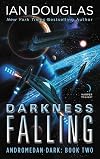
I have to admit I was a little disappointed in this one. I thought the first book in the series, Altered Starscape, set up a hugely promising, incredibly scaled space opera — colliding galaxies, alien civilizations, dark matter civilizations, . . . All of those things are still here, and the story is entertaining. I just think there’s more to the premise than has been mined. At least so far.
The story picks up with the Tellus Ad Astra (the colony ship Tellus still mated to the military show more tug Ad Astra) thrown billions of years into the future, when our Milky Way Galaxy is colliding with the neighboring Andromeda Galaxy. Grayson St. Clair is in charge of the Ad Astra, and while in a military situation, also in charge of the combined Tellus ad Astra, in a stressed relationship with its civilian leadership council. The civilian leader, Günter Adler, has been rendered insane by an interaction with the dark matter intelligence intruding from Andromeda.
St. Clair leads the Tellus Ad Astra through an encounter with an alliance of advanced civilizations, organized around what could be the descendants of Earth. That alliance is in conflict with the Andromedan Dark as well, and in fact comes to the defense of the Tellus ad Astra.
But the alliance, the “Cooperative”, also seeks the help of the Tellus Ad Astra leadership. Despite the unimaginable technical, and even military, superiority of the Cooperative, there is something they critically need that St. Clair and the humans aboard the Tellus Ad Astra can contribute.
The battle between the Andromedan Dark and the combination of the Cooperation and the Ad Astra is the dominant part of the story. And the course of the battle, in which friction develops the Cooperative and St. Clair, serves to develop some of the core themes of the book.
The huge scale and the imaginative aspects of the story’s setting are great. This is space opera at its grandest.
The characters, though, left me a little flat. St. Clair is the protagonist of the story, standing out well above all the other characters. The civilian leadership of the Tellus is composed of one-dimensional, conniving self-seekers. There’s very little to their characters beyond an amoral drive for power.
St. Clair has depth — conflicts and different impulses to sort out — but he’s alone among the leadong characters.
Interestingly, the one character besides St. Clair who has depth is his robot companion, Lisa. St. Clair has granted Lisa freedom to live an autonomous robotic life, no longer what amounts to a sex slave. She’s unprepared for the freedom St. Clair has given her, and she goes out in search of the reflective space and independent experiences that will help her begin to determine who she is and wants to be.
That theme of self-determination runs through much of the book. Lisa’s need for self-discovery is mirrored by the whole of Tellus Ad Astra. This is a population that no longer has a mission — the universe in which it had one, and in which it had a place in a larger human world, is gone. It needs new self-determination.
And it needs to invent that self-determination in the context of a hierarchy of alien civilizations where they don’t appear to be top dog.
There’s a lot going on here, and I do like the series. The one weakness, I think, is how thin the characters, other than St. Clair and Lisa, are. St. Clair is Buck Rogers, transported to the future and trying to save the galaxy from the forces of evil (or at least the apparent forces of evil). Lisa carries much of the background theme of self-determination and also brings it to the forefront of St. Clair’s thoughts and actions. It’s fun, and the setting gives it all a wondrous feel.
It may be that what I’m missing is ambiguity. The author (“Ian Douglas” is a pen-name) has a point he wants to make about freedom and self-determination. I think he may target his characters toward that point a bit too heavy-handedly. When authors want to make a point, sometimes I think their characters (ironically, given the theme here) lack the ambiguity and even autonomy that comes with depth and multi-dimensionality. show less
The story picks up with the Tellus Ad Astra (the colony ship Tellus still mated to the military show more tug Ad Astra) thrown billions of years into the future, when our Milky Way Galaxy is colliding with the neighboring Andromeda Galaxy. Grayson St. Clair is in charge of the Ad Astra, and while in a military situation, also in charge of the combined Tellus ad Astra, in a stressed relationship with its civilian leadership council. The civilian leader, Günter Adler, has been rendered insane by an interaction with the dark matter intelligence intruding from Andromeda.
St. Clair leads the Tellus Ad Astra through an encounter with an alliance of advanced civilizations, organized around what could be the descendants of Earth. That alliance is in conflict with the Andromedan Dark as well, and in fact comes to the defense of the Tellus ad Astra.
But the alliance, the “Cooperative”, also seeks the help of the Tellus Ad Astra leadership. Despite the unimaginable technical, and even military, superiority of the Cooperative, there is something they critically need that St. Clair and the humans aboard the Tellus Ad Astra can contribute.
The battle between the Andromedan Dark and the combination of the Cooperation and the Ad Astra is the dominant part of the story. And the course of the battle, in which friction develops the Cooperative and St. Clair, serves to develop some of the core themes of the book.
The huge scale and the imaginative aspects of the story’s setting are great. This is space opera at its grandest.
The characters, though, left me a little flat. St. Clair is the protagonist of the story, standing out well above all the other characters. The civilian leadership of the Tellus is composed of one-dimensional, conniving self-seekers. There’s very little to their characters beyond an amoral drive for power.
St. Clair has depth — conflicts and different impulses to sort out — but he’s alone among the leadong characters.
Interestingly, the one character besides St. Clair who has depth is his robot companion, Lisa. St. Clair has granted Lisa freedom to live an autonomous robotic life, no longer what amounts to a sex slave. She’s unprepared for the freedom St. Clair has given her, and she goes out in search of the reflective space and independent experiences that will help her begin to determine who she is and wants to be.
That theme of self-determination runs through much of the book. Lisa’s need for self-discovery is mirrored by the whole of Tellus Ad Astra. This is a population that no longer has a mission — the universe in which it had one, and in which it had a place in a larger human world, is gone. It needs new self-determination.
And it needs to invent that self-determination in the context of a hierarchy of alien civilizations where they don’t appear to be top dog.
There’s a lot going on here, and I do like the series. The one weakness, I think, is how thin the characters, other than St. Clair and Lisa, are. St. Clair is Buck Rogers, transported to the future and trying to save the galaxy from the forces of evil (or at least the apparent forces of evil). Lisa carries much of the background theme of self-determination and also brings it to the forefront of St. Clair’s thoughts and actions. It’s fun, and the setting gives it all a wondrous feel.
It may be that what I’m missing is ambiguity. The author (“Ian Douglas” is a pen-name) has a point he wants to make about freedom and self-determination. I think he may target his characters toward that point a bit too heavy-handedly. When authors want to make a point, sometimes I think their characters (ironically, given the theme here) lack the ambiguity and even autonomy that comes with depth and multi-dimensionality. show less
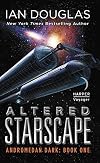
This is a big, big story. What’s bigger than a galaxy? Two galaxies! Colliding!!
I admit I’m a space opera junky. Expanding your imagination to take in a distant future, on a huge scale, with all sorts of speculative technologies, strange species, . . . what could be more fun?
Tellus ad Astra is a colossal colony ship, on a mission to join with the Coadunation, a MIlky Way Galaxy association of civilizations, in a conflict that representatives of Earth only vaguely comprehend. There show more appears to be much for Earth to gain, though, in technology and alliances.
But things don’t go well, and the Tellus ad Astra, in an attack on the Coadunation at the core of the Milky Way, is thrown ahead 4 billion years into the future, when the Milky Way and Andromeda galaxies are colliding.
Douglas throws two principal themes into the story at this point.
The stronger of the two is the confrontation between the crew of the ship and a spooky, powerful enemy, whose real nature is still being divulged toward the end of the book. Remember this is only Book One of the series.
Douglas loves speculative physics. The enemy, not just the enemy of the crew of the Tellus ad Astra, but of a new galactic association in this distant future, is multidimensional. “Multidimensional” in the sense that it can move through spatial (and potentially temporal) dimensions beyond our familiar experience of three spatial dimensions. Douglas uses two-dimensional metaphors to explain how this enemy can suddenly appear at intersections with our own dimensions, appearing out of nowhere and otherwise taking advantage of its multidimensionality in combat.
In fact, you’ll find many favorites from speculative physics and extraterrestrial intelligence all through the book. Dark matter and black holes have starring roles. But you’ll also find Dyson Spheres and Alderson Disks, speculations about the Fermi Paradox, not to mention standards like faster-than-light-travel. All fun, and, made even more fun by Douglas’s propensity to explain how the speculative technologies he introduces actually work. It’s a fun blend of hard science fiction with space opera.
And, with that first theme of galactic scale conflict, Douglas plays to another of his strengths — the details of military combat, again in a speculative universe of specialized attack ships, weapons, and military tactics.
The second big theme is one I found less compelling. Douglas pits the military commander of the voyage, Grayson St. Clair, against the civilian authority, Gunter Adler. St. Clair is the protagonist in the story. His position is strained. He is a military commander who finds himself having to extend what had been a short mission, under clear military authority, into a long-term exploration and survival mission. St. Clair maintains strong democratic sensibilities, challenging in the aftermath of a second American revolution that has taken place, with a renaissance of authoritarianism.
St. Clair’s opposite in the power struggle, Adler, is, to my mind, too caricatured — an arrogant egomaniac, little disturbed by anything approaching self-doubt, even in private. Okay, there are such people, but here it makes for a pretty one-sided conflict — one where the reader could have been exploring issues of power and authority, especially between the military and civilian spheres, but ends up just rooting for good and competent over vain and arrogant.
For myself, I tried to look past that theme to the bigger story, with its huge scale and imaginative future history of galactic conflict. And I think that works.
At the end, there’s no slow petering out. Douglas throws in a big surprise that recasts everything we’ve read up to that point and, of course, sets up the next part of the story. show less
I admit I’m a space opera junky. Expanding your imagination to take in a distant future, on a huge scale, with all sorts of speculative technologies, strange species, . . . what could be more fun?
Tellus ad Astra is a colossal colony ship, on a mission to join with the Coadunation, a MIlky Way Galaxy association of civilizations, in a conflict that representatives of Earth only vaguely comprehend. There show more appears to be much for Earth to gain, though, in technology and alliances.
But things don’t go well, and the Tellus ad Astra, in an attack on the Coadunation at the core of the Milky Way, is thrown ahead 4 billion years into the future, when the Milky Way and Andromeda galaxies are colliding.
Douglas throws two principal themes into the story at this point.
The stronger of the two is the confrontation between the crew of the ship and a spooky, powerful enemy, whose real nature is still being divulged toward the end of the book. Remember this is only Book One of the series.
Douglas loves speculative physics. The enemy, not just the enemy of the crew of the Tellus ad Astra, but of a new galactic association in this distant future, is multidimensional. “Multidimensional” in the sense that it can move through spatial (and potentially temporal) dimensions beyond our familiar experience of three spatial dimensions. Douglas uses two-dimensional metaphors to explain how this enemy can suddenly appear at intersections with our own dimensions, appearing out of nowhere and otherwise taking advantage of its multidimensionality in combat.
In fact, you’ll find many favorites from speculative physics and extraterrestrial intelligence all through the book. Dark matter and black holes have starring roles. But you’ll also find Dyson Spheres and Alderson Disks, speculations about the Fermi Paradox, not to mention standards like faster-than-light-travel. All fun, and, made even more fun by Douglas’s propensity to explain how the speculative technologies he introduces actually work. It’s a fun blend of hard science fiction with space opera.
And, with that first theme of galactic scale conflict, Douglas plays to another of his strengths — the details of military combat, again in a speculative universe of specialized attack ships, weapons, and military tactics.
The second big theme is one I found less compelling. Douglas pits the military commander of the voyage, Grayson St. Clair, against the civilian authority, Gunter Adler. St. Clair is the protagonist in the story. His position is strained. He is a military commander who finds himself having to extend what had been a short mission, under clear military authority, into a long-term exploration and survival mission. St. Clair maintains strong democratic sensibilities, challenging in the aftermath of a second American revolution that has taken place, with a renaissance of authoritarianism.
St. Clair’s opposite in the power struggle, Adler, is, to my mind, too caricatured — an arrogant egomaniac, little disturbed by anything approaching self-doubt, even in private. Okay, there are such people, but here it makes for a pretty one-sided conflict — one where the reader could have been exploring issues of power and authority, especially between the military and civilian spheres, but ends up just rooting for good and competent over vain and arrogant.
For myself, I tried to look past that theme to the bigger story, with its huge scale and imaginative future history of galactic conflict. And I think that works.
At the end, there’s no slow petering out. Douglas throws in a big surprise that recasts everything we’ve read up to that point and, of course, sets up the next part of the story. show less
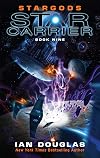
The last time I read about the main character, Trever Gray, he had just elevated his status in life from that of a squatter in the Manhatt Ruins of old New York to a starship fighter pilot. This uplift occurred in Earth Strike, Book 1 of the Star Carrier series. Stargods is the last book in that series. I regret not having read the intervening books as I truly like the storyline.
Trever Gray is now a space navy admiral in charge of the Star Carrier Group America. His closest friends are show more Alexander Koenig, the former president of USNA, the United States of North America, and Konstantin, a powerful AI located on the backside of the moon.
In Stargods, Earth’s civilization is bordering on the evolutionary edge of human ascension. Millions in Earth’s population are already talking about the singularity, a state of ascension where humans and AI intelligence become one in a virtual existence, as being inevitable. Like today, some are looking forward to the rapture while others are against it due to divergent personal beliefs.
The Sh’dar, an alien species fought against in a previous book, has already gone through transcendence. Not all Sh’dar ascended, however. In this book, Gray, on a secret mission authorized by Alexander Koenig, is sent to meet with the remaining Sh’dar to find out what physically happened when transcendence occurred, how it was achieved, and what were the resulting ramifications.
As with most space operas, space battles, won more by cleverness rather than the strength of armament, take place. Cleverness in battle results in the defeat of a war leaning alien race bent on the total annihilation of Earth. In addition to this alien threat, duplicity from Earth's political power elite wanting world domination threatens the current way of life.
The author, Ian Douglas, embodies USNA leadership with many of the same autocratic leanings as US current leadership and propaganda programs being generated by it to alter political facts. These references are not subtle and may anger those with extreme right leanings. Ian Douglas is either politically motivated or assumes that the Alt-Right does not read Space Opera Sci-Fi. If wrong, then he risks alienating some of his readerships.
The Star Carrier series is a great read that is not only action-packed Sci-Fi, but that also addresses human relationships and frailties. show less
Trever Gray is now a space navy admiral in charge of the Star Carrier Group America. His closest friends are show more Alexander Koenig, the former president of USNA, the United States of North America, and Konstantin, a powerful AI located on the backside of the moon.
In Stargods, Earth’s civilization is bordering on the evolutionary edge of human ascension. Millions in Earth’s population are already talking about the singularity, a state of ascension where humans and AI intelligence become one in a virtual existence, as being inevitable. Like today, some are looking forward to the rapture while others are against it due to divergent personal beliefs.
The Sh’dar, an alien species fought against in a previous book, has already gone through transcendence. Not all Sh’dar ascended, however. In this book, Gray, on a secret mission authorized by Alexander Koenig, is sent to meet with the remaining Sh’dar to find out what physically happened when transcendence occurred, how it was achieved, and what were the resulting ramifications.
As with most space operas, space battles, won more by cleverness rather than the strength of armament, take place. Cleverness in battle results in the defeat of a war leaning alien race bent on the total annihilation of Earth. In addition to this alien threat, duplicity from Earth's political power elite wanting world domination threatens the current way of life.
The author, Ian Douglas, embodies USNA leadership with many of the same autocratic leanings as US current leadership and propaganda programs being generated by it to alter political facts. These references are not subtle and may anger those with extreme right leanings. Ian Douglas is either politically motivated or assumes that the Alt-Right does not read Space Opera Sci-Fi. If wrong, then he risks alienating some of his readerships.
The Star Carrier series is a great read that is not only action-packed Sci-Fi, but that also addresses human relationships and frailties. show less
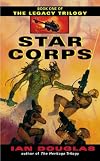
I'm not sure what it was about this book, but I just couldn't get into it. I tried for several days, reading 20-30 pages a day and just being bored and frustrated. Frankly, I thought the premise was dumb. I guess that's the basic problem for me. Somehow, somewhere along the way, humanity has discovered an alien species called the Ahanu that predates humanity and that came to Earth centuries ago, built the pyramids, possibly genetically coded humans and then took thousands of them off to show more their distant planet to serve and breed as slaves, for 10,000 years or more. How we discovered this and them is not mentioned, at least as far as I ever got in the book, because after 187 dreary pages, I've given up. Somehow, humans have made it to their planet and have been there for some years, archaeologists, scientists, diplomats, Marines, businessmen, etc., and these reptile-like creatures go insane at one point and attack the humans and apparently wipe them out, although most of their technology is prehistoric, except for one gigantic weapon that blows starships out of the sky. Earth has discovered this and is putting together a Marine task force of some 1300 Marines to go rescue any surviving humans and put down the alien rebellion and hopefully save the human slaves, as well as to stabilize the world for another starship of multinationals coming to form businesses and governments, etc. The catch? It's a 10 year trip -- one way. So each Marine has to make a 20 year commitment, not counting the two to four or more years they'll be on the alien planet. Okay, shoot me, but how frigging stupid is that??? Virtually all sci fi writers deal with FTL drives, hyperspace, interstellar drives, etc. Basically, it's possible to get to your destination light years away, in some cases, hundreds of light years away, in hours/days/weeks, not a freaking decade! Where's the science? If mankind has colonized the moon and Mars and can somehow already travel to this alien planet so that they've been there for five years working on stuff, that means that A) they went there 15 years ago and B) they should have the technology to invent FTL drives. Indeed, when the government is getting important Marines and scientists off Mars back to Earth, instead of it taking numerous weeks and months, they take special flights that take a few days, so they do have some technology available. So, what the hell? Is Douglas just a dumbshit writer? Can he not think of normal sci fi standards? Why make such an extreme scenario, one that's so outrageously unbelievable? It boggles the mind. And then to cap it off, for some reason, one American company is given a monopoly on everything on this alien planet and tells its potential partners it plans on shipping the slaves back to Earth to sell ... as slaves for a return on its investment. WTF? I bought this book cheap at a used bookstore, thank goodness, but because it had a pretty good rating and excellent reviews. Indeed, the reviews were so good, I bought the entire trilogy! Now I find that I don't want to read any of them. And I doubt I will. At least I didn't spend much on them. Stupid premise. And too many points of view, too many characters. Additionally, in terms of military sci fi, Douglas not only can't touch David Weber at all, he can't even touch Chris Bunch. Not recommended. show less
Lists
Awards

You May Also Like
Associated Authors
Statistics
- Works
- 36
- Also by
- 1
- Members
- 5,045
- Popularity
- #4,959
- Rating
- 3.5
- Reviews
- 80
- ISBNs
- 237
- Languages
- 3
- Favorited
- 4