
David Mark (2) (1973–)
Author of Going Dirty: The Art of Negative Campaigning
For other authors named David Mark, see the disambiguation page.
About the Author
David Mark is a senior editor for Politico.
Works by David Mark
Associated Works
Tagged
Common Knowledge
Members
Reviews
Dog Whistles, Walk-Backs, and Washington Handshakes: Decoding the Jargon, Slang, and Bluster of American Political Speech by Chuck McCutcheon
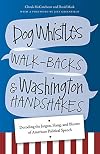
Dog Whistles, Walk-Backs, and Washington Handshakes: Decoding the Jargon, Slang, and Bluster of American Political Speech
By Chuck McCutcheon and David Mark
ForeEdge / University Press of New England
Reviewed by Karl Wolff
The eighteenth century satirist and moralist the Marquis de Sade began The 120 Days of Sodom with these words, "The extensive wars wherewith Louis XIV was burdened during his reign, while draining the State's treasury and exhausting the substance of the people, none the less show more contained the secret that led to the prosperity of a swarm of those bloodsuckers who are always on the watch for public calamities, which, instead of appeasing, they promote or invent so as, precisely, to be able to profit from them the more advantageously." If this hadn't come from French fiction, one could see it as an accurate description of the United States Congress, K Street lobbyists, and the Beltway media punditocracy. (Pundit being Greek for "dingbat.")
It should come as a surprise to exactly no one that politics anger people. It leaves people exasperated, bored, and frustrated. Part of this stems from the behavior of our elected representatives. Another part of this frustration has to do with the language they use. Dog Whistles, Walk-Backs, and Washington Handshakes: Decoding the Jargon, Slang, and Bluster of American Political Speech by Chuck McCutcheon and David Mark seeks to make plain what usually is not. And like related slang dictionaries, it becomes necessary to write new ones every few years, simply to catch up. Language changes over time, but slang and jargon change at a much faster rate. In the ensuing years, we have the seen the explosion of the Internet, YouTube, and social media. This has made incumbents and aspiring candidates hyper-conscious of gaffes. It has also made people more aware of where the money is coming from to fund these cash-bloated acts of public glad-handing.
McCutcheon and Mark, both veteran political reporters, have divided the book up into six sections: personality types, only-in-politics expressions, people, places, and things, the legislative process, campaigns and elections, and the media and scandals. The comprehensive overview gives the reader a wide range of words and expressions. The authors sought to limit the scope, throwing out words either too common or too jargony. There isn't a definition for cloture in here and the majority of terms are of recent vintage, although a few trace back to the nineteenth century. Despite my abhorrence of modern political reporting, I'm currently watching The West Wing on Netflix. Dog Whistles was useful on those occasions when the dialogue or plot mystified me. Making the legislative process entertaining presents a challenge to both fiction and non-fiction writers. Aaron Sorkin and Robert Caro can spin the everyday monotony of bill passage into high drama.
As a reader, Dog Whistles leaves me conflicted. I'm no fan of politics, especially the social media variety. Nothing is more insufferable than having your Facebook page smeared with an endless stream of daily outrages, endless scandals, and commonplace corruption. This is set against my love for language, languages, and the English language. Politics, like Hollywood and many other industries, has systemically degraded the English language. But unlike the perpetually outraged on social media, I understand the simple fact that language is not static. It reflects the times. What characterizes our particular time is a hyper-mediated, information-addicted, prurient-leaning but easily offended, social media aficionados who can't seem to get our eyes unglued from our smartphones. Every scandal is amplified, every microscopic gaffe is turned into a scandal, and the political class tries its hardest to stay relevant and hip.
I'm giving this a lower score, not for lack of craft, but due to its status as a dictionary for specialists. While I would recommend this highly to anyone purporting to be an "informed voter," it remains a challenge to actually derive pleasure from a book about political speech.
Out of 10/8.0, higher for political junkies, journalists, and voters.
http://www.cclapcenter.com/2015/07/book_review_dog_whistles_walk-.html show less
By Chuck McCutcheon and David Mark
ForeEdge / University Press of New England
Reviewed by Karl Wolff
The eighteenth century satirist and moralist the Marquis de Sade began The 120 Days of Sodom with these words, "The extensive wars wherewith Louis XIV was burdened during his reign, while draining the State's treasury and exhausting the substance of the people, none the less show more contained the secret that led to the prosperity of a swarm of those bloodsuckers who are always on the watch for public calamities, which, instead of appeasing, they promote or invent so as, precisely, to be able to profit from them the more advantageously." If this hadn't come from French fiction, one could see it as an accurate description of the United States Congress, K Street lobbyists, and the Beltway media punditocracy. (Pundit being Greek for "dingbat.")
It should come as a surprise to exactly no one that politics anger people. It leaves people exasperated, bored, and frustrated. Part of this stems from the behavior of our elected representatives. Another part of this frustration has to do with the language they use. Dog Whistles, Walk-Backs, and Washington Handshakes: Decoding the Jargon, Slang, and Bluster of American Political Speech by Chuck McCutcheon and David Mark seeks to make plain what usually is not. And like related slang dictionaries, it becomes necessary to write new ones every few years, simply to catch up. Language changes over time, but slang and jargon change at a much faster rate. In the ensuing years, we have the seen the explosion of the Internet, YouTube, and social media. This has made incumbents and aspiring candidates hyper-conscious of gaffes. It has also made people more aware of where the money is coming from to fund these cash-bloated acts of public glad-handing.
McCutcheon and Mark, both veteran political reporters, have divided the book up into six sections: personality types, only-in-politics expressions, people, places, and things, the legislative process, campaigns and elections, and the media and scandals. The comprehensive overview gives the reader a wide range of words and expressions. The authors sought to limit the scope, throwing out words either too common or too jargony. There isn't a definition for cloture in here and the majority of terms are of recent vintage, although a few trace back to the nineteenth century. Despite my abhorrence of modern political reporting, I'm currently watching The West Wing on Netflix. Dog Whistles was useful on those occasions when the dialogue or plot mystified me. Making the legislative process entertaining presents a challenge to both fiction and non-fiction writers. Aaron Sorkin and Robert Caro can spin the everyday monotony of bill passage into high drama.
As a reader, Dog Whistles leaves me conflicted. I'm no fan of politics, especially the social media variety. Nothing is more insufferable than having your Facebook page smeared with an endless stream of daily outrages, endless scandals, and commonplace corruption. This is set against my love for language, languages, and the English language. Politics, like Hollywood and many other industries, has systemically degraded the English language. But unlike the perpetually outraged on social media, I understand the simple fact that language is not static. It reflects the times. What characterizes our particular time is a hyper-mediated, information-addicted, prurient-leaning but easily offended, social media aficionados who can't seem to get our eyes unglued from our smartphones. Every scandal is amplified, every microscopic gaffe is turned into a scandal, and the political class tries its hardest to stay relevant and hip.
I'm giving this a lower score, not for lack of craft, but due to its status as a dictionary for specialists. While I would recommend this highly to anyone purporting to be an "informed voter," it remains a challenge to actually derive pleasure from a book about political speech.
Out of 10/8.0, higher for political junkies, journalists, and voters.
http://www.cclapcenter.com/2015/07/book_review_dog_whistles_walk-.html show less
 This review was written for LibraryThing Early Reviewers.
Dog Whistles, Walk-Backs, and Washington Handshakes: Decoding the Jargon, Slang, and Bluster of American Political Speech by Chuck McCutcheon

This is a comprehensive and non-partisan look at political terms, some familiar, some obscure, but all have been relevant at some point. Having the definitions separated into categories, rather than list them alphabetically is a nice touch as was having a real-life and current example for almost all. This is definitely a handy guide for the political junkie or linguists.
This review was written for LibraryThing Early Reviewers.Dog Whistles, Walk-Backs, and Washington Handshakes: Decoding the Jargon, Slang, and Bluster of American Political Speech by Chuck McCutcheon
While I don't agree with the forward or introduction that Washington language is impenetrable to outsiders (how did any of us learn language at all, if not through context), Dog Whistles, Walk-Backs, & Washington Handshakes does a good job of presenting the set phrases, slang, and jargon of U.S. politics. The entries are organized in alphabetical order within six broad themes and cross referenced as appropriate. The real beauty of the book is its nice mix of definition and real life examples show more of the phrases in action. Even readers who are familiar with the terms may not know where and how they originated, and McCutcheon and Mark present this background concisely and enjoyably. I recommend this book to anyone interested in the development of modern political vocabulary. show less
This review was written for LibraryThing Early Reviewers.Dog whistles, walk-backs, and Washington handshakes : decoding the jargon, slang, and bluster of American political speech by Chuck McCutcheon
Dog Whistles, Walk-Backs and Washington Handshakes; Decoding the Jargon, Slang and Bluster of American Political Speech is pure delight for the political junkie. That many words in the title may seem a bit much. But face it. Since politicians love to talk, it would follow that a book about their unique language has a long-winded title. Chuck McCutcheon and David Mack cover a range of linguistic terms the average person would not likely comprehend without reading the book.
This is a good book show more to keep close to the television remote that is used to switch back and forth between CSPAN and CSPAN2. In addition to defining inside the Washington beltway jargon, the compilation is highly entertaining. McCutcheon and Mack sprinkle definitive explanations with snippets of things that have happened in the District of Columbia over the years.
It would seem to be an appropriate read for anyone who might benefit from a crash course in Washington lingo. The book is strikingly non-partisan. Harsh criticism of politicians on the left is balanced with equal treatment of those on the right. It's difficult to perceive any political leanings that might be harbored by the authors. There doesn't seem to be any agenda here other than to expose silly speak. show less
This is a good book show more to keep close to the television remote that is used to switch back and forth between CSPAN and CSPAN2. In addition to defining inside the Washington beltway jargon, the compilation is highly entertaining. McCutcheon and Mack sprinkle definitive explanations with snippets of things that have happened in the District of Columbia over the years.
It would seem to be an appropriate read for anyone who might benefit from a crash course in Washington lingo. The book is strikingly non-partisan. Harsh criticism of politicians on the left is balanced with equal treatment of those on the right. It's difficult to perceive any political leanings that might be harbored by the authors. There doesn't seem to be any agenda here other than to expose silly speak. show less
This review was written for LibraryThing Early Reviewers.You May Also Like
Associated Authors
Statistics
- Works
- 4
- Also by
- 1
- Members
- 64
- Popularity
- #264,967
- Rating
- 4.2
- Reviews
- 10
- ISBNs
- 199
- Languages
- 4
