
Coretta Scott King (1927–2006)
Author of The Words of Martin Luther King, Jr.
About the Author
Writer and civil rights activist Coretta Scott King was born in Heiberger, Alabama, on April 27, 1927. She studied music at Antioch College and the New England Conservatory of Music. She married Martin Luther King, Jr. on June 18, 1953. Coretta Scott King taught and did fundraising for the civil show more rights movement. When her husband was killed in April, 1968, she took a more active role as a civil rights leader, beginning with her speech on Solidarity Day, June 19, 1968. King has devoted time to the Martin Luther King, Jr. Center for Nonviolent Social Change, where she has served as president and chief executive officer. She also established the Coretta Scott King Award in conjunction with the American Library Association to honor outstanding and inspirational contributions by an African American author and an African American illustrator. She published her memoir, My Life with Martin Luther King, Jr. in 1969. She died on January 31, 2006 at the age of 78. (Bowker Author Biography) show less
Image credit: Cropped from an image on U.S. Senator Olympia Snowe's website (2004)
Works by Coretta Scott King
I've Seen The Promised Land 3 copies
Male Writers 1 copy
Female Leaders 1 copy
Civil Rights Leaders 1 copy
Dare to Dream 1 copy
Associated Works
Where Do We Go from Here: Chaos or Community? (King Legacy) (1967) — Foreword — 859 copies, 14 reviews
I Have a Dream: Writings and Speeches That Changed the World (1992) — Foreword, some editions — 724 copies, 2 reviews
A Call to Conscience: The Landmark Speeches of Dr. Martin Luther King, Jr. (2001) 351 copies, 8 reviews
Muhammad Ali: Heavyweight Champion (Black Americans of Achievement) (1988) — Introduction — 49 copies
Jesse Jackson: Civil Rights Leader and Politician (Black Americans of Achievement) (1991) — Introduction — 29 copies
Reader's Digest Condensed Books: Battle of the April Storm / Heartsblood / Mornings at Seven / My life with Martin Luther King, Jr. (1970) — Author — 2 copies
ELLA FITZGERALD — Introduction — 1 copy
Tagged
Common Knowledge
- Other names
- Scott, Coretta
- Birthdate
- 1927-04-27
- Date of death
- 2006-04-30
- Gender
- female
- Education
- Antioch College
New England Conservatory of Music - Occupations
- author
activist - Organizations
- National Association for the Advancement of Colored People
Martin Luther King, Jr. Center for Nonviolent Social Change
Ebenezer Baptist Church - Awards and honors
- Congressional Gold Medal (2004)
Horace Mann Award (2004)
Gandhi Peace Prize (2004)
Coretta Scott King Award (named in her honor)
Coretta Scott King Young Women's Leadership Academy (named in her honor)
New England Conservatory of Music Outstanding Alumni Award - Relationships
- King, Martin Luther, Jr. (husband)
King, Yolanda (daughter)
King, Dexter Scott (son)
King, Bernice A. (daughter)
Farris, Christine King (sister-in-law)
King, Martin Luther, Sr. (father-in-law) (show all 7)
King, Martin Luther, III (son) - Short biography
- See King's biography in the online Encyclopedia of Alabama.
- Nationality
- USA
- Birthplace
- Heiberger, Alabama, USA
- Places of residence
- Heiberger, Alabama, USA (birth)
- Burial location
- Martin Luther King, Jr. Center, Atlanta, Georgia, USA
- Associated Place (for map)
- Alabama, USA
Members
Reviews
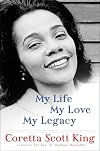
I have to say that this book was very eye-opening to me. I did not know about half the things that Mrs. King goes into with this memoir. I say it was very much like reading a history book in which you already know the names, places, and people, but it feels like you were there. I will say that the shifting timelines through me a bit here and there though. I like to read memoirs in a linear format since jumping around back and forth can be confusing. Also, some parts of this memoir at times show more felt unfinished. I wanted to go back and ask a question which of course I can't do.
"My Life, My Love, My Legacy" is Coretta Scott King's memoir. It talks about her childhood, her marriage to Martin Luther King, Jr., and all of her efforts to keep preaching his beliefs about non-violence being the way forward for African Americans in the United States. She also provides details into her friendships with some very powerful leaders in their own right (Indira Gandhi, Nelson Mandela, Betty Shabazz, and Myrlie Evers-Williams).
I think the book is a bit slow to start. When Coretta Scott King begins her tale of her childhood and her parents it definitely holds your attention. But I think that it ended up a bit garbled here and there just because of the time-line jumping. I also wish that we had heard more about her family throughout the book. We hear about her parents earlier on, but don't go back to them much until the very end of the book.
From there we go into Mrs. King's affinity for music. I honestly had no idea that she was an accomplished singer and had gone to school to train to become a classical singer. I also have to say it was eye-opening to read about her thoughts and feelings about the Civil Rights movement. It seems even now many of us don't know much about the women involved with the movement beyond Rosa Parks. I was surprised to see how heavily Coretta Scott King and other women were involved.
I also have to applaud her candor talking about how chauvinistic the Baptists were with regards to women leaders. She is upfront about it and also upfront about the sad fact that other countries in the world had elected women to the highest levels of government, yet the United States was (and still is) lacking in the regard.
I also love her for confronting the rumors of her husband's infidelity. I had heard a little here and there about J. Edgar Hoover's hatred of Dr. King, but when you read this book and read all of the things he got up to. Yeah...I am good with still not being a fan of that man.
Though the book jumps around, it does hit upon some dates of importance in the civil rights movement in the United States. We get to her Mrs. King's thoughts on women and African American men and women running for office, apartheid, and even her comments on whether James Earl Ray acted alone. Can I say though, I had no idea there was even a trial looking into the government's involvement in the assassination of Martin Luther King. When you read what Mrs. King presents I just shook my head. I can sadly believe it.
I also loved reading about her thoughts and opinions about other leaders she met like President Johnson, Carter, Nixon, Bush Sr., Kennedy, etc. I also felt for her for having to learn a lesson about publicly endorsing a presidential candidate at all due to some people taking it the wrong way and or being angry that she wasn't doing what they thought she should do.
And reading about the struggles to get the King Center up and running and the break that she had with the Southern Christian Leadership Conference and her thoughts on Reverend Jesse Jackson.
I loved reading this book since it reminded me of listening to an older aunt that just wants to give you some hard lessons about life and how one must go on even when you don't know if in the end you are going to be able to get to where you need to go.
The book then ends a bit abruptly and then goes into afterwords written by close friends of Mrs. King such as Maya Angelou, her daughter, and others. Some of these I found to be quite moving. She definitely touched a lot of people and I can't imagine the strength she had to go on and keep doing what she believed while also raising her children and dealing with being the widow of Dr. Martin Luther King. She astutely points out that she and the widows of other famous civil rights leaders at the time (Betty Shabazz and Myrlie Evers-Williams) had to deal with so many people's opinions about what they should do and how to act.
I do have to say that reading this book showed me definitely how far the United States has come as a country that seemed apathetic to the concept of civil rights in the 1950s and 1960s. However, it definitely shows me how much further we still have to go. show less
"My Life, My Love, My Legacy" is Coretta Scott King's memoir. It talks about her childhood, her marriage to Martin Luther King, Jr., and all of her efforts to keep preaching his beliefs about non-violence being the way forward for African Americans in the United States. She also provides details into her friendships with some very powerful leaders in their own right (Indira Gandhi, Nelson Mandela, Betty Shabazz, and Myrlie Evers-Williams).
I think the book is a bit slow to start. When Coretta Scott King begins her tale of her childhood and her parents it definitely holds your attention. But I think that it ended up a bit garbled here and there just because of the time-line jumping. I also wish that we had heard more about her family throughout the book. We hear about her parents earlier on, but don't go back to them much until the very end of the book.
From there we go into Mrs. King's affinity for music. I honestly had no idea that she was an accomplished singer and had gone to school to train to become a classical singer. I also have to say it was eye-opening to read about her thoughts and feelings about the Civil Rights movement. It seems even now many of us don't know much about the women involved with the movement beyond Rosa Parks. I was surprised to see how heavily Coretta Scott King and other women were involved.
I also have to applaud her candor talking about how chauvinistic the Baptists were with regards to women leaders. She is upfront about it and also upfront about the sad fact that other countries in the world had elected women to the highest levels of government, yet the United States was (and still is) lacking in the regard.
I also love her for confronting the rumors of her husband's infidelity. I had heard a little here and there about J. Edgar Hoover's hatred of Dr. King, but when you read this book and read all of the things he got up to. Yeah...I am good with still not being a fan of that man.
Though the book jumps around, it does hit upon some dates of importance in the civil rights movement in the United States. We get to her Mrs. King's thoughts on women and African American men and women running for office, apartheid, and even her comments on whether James Earl Ray acted alone. Can I say though, I had no idea there was even a trial looking into the government's involvement in the assassination of Martin Luther King. When you read what Mrs. King presents I just shook my head. I can sadly believe it.
I also loved reading about her thoughts and opinions about other leaders she met like President Johnson, Carter, Nixon, Bush Sr., Kennedy, etc. I also felt for her for having to learn a lesson about publicly endorsing a presidential candidate at all due to some people taking it the wrong way and or being angry that she wasn't doing what they thought she should do.
And reading about the struggles to get the King Center up and running and the break that she had with the Southern Christian Leadership Conference and her thoughts on Reverend Jesse Jackson.
I loved reading this book since it reminded me of listening to an older aunt that just wants to give you some hard lessons about life and how one must go on even when you don't know if in the end you are going to be able to get to where you need to go.
The book then ends a bit abruptly and then goes into afterwords written by close friends of Mrs. King such as Maya Angelou, her daughter, and others. Some of these I found to be quite moving. She definitely touched a lot of people and I can't imagine the strength she had to go on and keep doing what she believed while also raising her children and dealing with being the widow of Dr. Martin Luther King. She astutely points out that she and the widows of other famous civil rights leaders at the time (Betty Shabazz and Myrlie Evers-Williams) had to deal with so many people's opinions about what they should do and how to act.
I do have to say that reading this book showed me definitely how far the United States has come as a country that seemed apathetic to the concept of civil rights in the 1950s and 1960s. However, it definitely shows me how much further we still have to go. show less
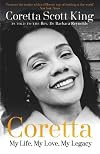
After watching Tom Hank's series 1968: The Year That Changed America, I realised that the only fact I knew about Coretta Scott King was that she was Martin Luther King's wife and then widow. As she states in her memoirs, that 'Makes me sound like the attachments that come with my vacuum cleaner'. And I didn't even know the truth about her marriage, believing the rumours about MLK that Coretta insisted were started by J Edgar Hoover out of jealousy. In her view, she and Martin had a happy show more marriage and were 'emotional twins' for fourteen years.
I was absolutely blown away by this biography, which is told in Coretta's voice but written by Dr Barbara Reynolds after Mrs King's death in 2006 ('There are some things in this book I believe she did not want said in her lifetime'). She was such an amazing, strong, determined, intelligent and inspired woman, who felt her own calling but joined with her husband to support his larger role as a civil rights leader and 'president of black America' in the 1950s and 1960s. I learned so much about them both, to be honest - I didn't know that MLK was awarded the Nobel Peace Prize in 1964 or survived a near fatal knife attack ('If Martin had sneezed, he would have died'). When JFK was assassinated in 1963, King said 'This is exactly what's going to happen to me', and started living and working like every day might be his last.
I think it's right that Coretta finally got to have her say. They were partners when they were married, although she is quick to point out the chauvinism of the era that reduced her to a stay at home wife ('such a waste of a woman's creativity, talent and energy'), but she really came into her own after his assassination in 1968. Like Jackie Kennedy, Coretta kept her husband's memory alive, but she also went one step further, establishing the King Centre to promote King's principles of nonviolence, and campaigned tirelessly to have his birthday made a national holiday (Stevie Wonder's song 'Happy Birthday' was written in honour of MLK). She has also been a diplomat and a delegate in her own right, travelling to South Africa during Apartheid, and was accused of betraying the civil rights cause by Jesse Jackson - 'I really consider myself a human rights activist', she explains.
'I have a purpose. I have a mission, and I have carried it out on the world stage.'
Covering every subject from her marriage ('I never said he was perfect') and her role in the Montgomery bus boycott, to losing her husband to a government assassin's bullet and learning to continue their shared vision of the 'Beloved Community' alone, with all the ugly racism in between (sadly not a lot has changed), everyone should read Coretta's memoirs and learn more about two of the most noble figures in modern Black American history. show less
I was absolutely blown away by this biography, which is told in Coretta's voice but written by Dr Barbara Reynolds after Mrs King's death in 2006 ('There are some things in this book I believe she did not want said in her lifetime'). She was such an amazing, strong, determined, intelligent and inspired woman, who felt her own calling but joined with her husband to support his larger role as a civil rights leader and 'president of black America' in the 1950s and 1960s. I learned so much about them both, to be honest - I didn't know that MLK was awarded the Nobel Peace Prize in 1964 or survived a near fatal knife attack ('If Martin had sneezed, he would have died'). When JFK was assassinated in 1963, King said 'This is exactly what's going to happen to me', and started living and working like every day might be his last.
I think it's right that Coretta finally got to have her say. They were partners when they were married, although she is quick to point out the chauvinism of the era that reduced her to a stay at home wife ('such a waste of a woman's creativity, talent and energy'), but she really came into her own after his assassination in 1968. Like Jackie Kennedy, Coretta kept her husband's memory alive, but she also went one step further, establishing the King Centre to promote King's principles of nonviolence, and campaigned tirelessly to have his birthday made a national holiday (Stevie Wonder's song 'Happy Birthday' was written in honour of MLK). She has also been a diplomat and a delegate in her own right, travelling to South Africa during Apartheid, and was accused of betraying the civil rights cause by Jesse Jackson - 'I really consider myself a human rights activist', she explains.
'I have a purpose. I have a mission, and I have carried it out on the world stage.'
Covering every subject from her marriage ('I never said he was perfect') and her role in the Montgomery bus boycott, to losing her husband to a government assassin's bullet and learning to continue their shared vision of the 'Beloved Community' alone, with all the ugly racism in between (sadly not a lot has changed), everyone should read Coretta's memoirs and learn more about two of the most noble figures in modern Black American history. show less
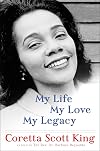
My Life, My Love, My Legacy is a wonderful read. It was transcribed by Reverend Dr. Barbara Reynolds based on her notes and recordings of Coretta since they first met in 1975. Coretta states "Most people who have followed my career from afar, or even given me a second thought, know me as Mrs. King: the wife of, the widow of, the mother of, the leader of." "In one sense, I don't mind that at all. I'm proud to have been a wife, a single parent, and a leader. But I am more than a label. I am show more also Coretta."
The book allowed us to see a more human side to Coretta, rather than a list of her qualities and accomplishments. It felt like you were hearing things straight from her, bonding, and seeing all the sides to her. She was a remarkable woman. We all know the highlights of hers and Martin's lives. This book allowed me to see all the tiny moments that lead up to the revolutionary changes they made. It showed where her strength came from, her love for her family, her parents devotion to her and her siblings. The drive behind her to not settle for the status quo and to break down barriers, one tiny roadblock at a time. Martin was a strong man and she was an even stronger force behind him. He claimed "Coretta proved to be that type of wife with qualities to make a husband when he could have been so easily broken". I believe this is a must read for all. It is a beautifully captured memoir of a life that was not always easy, but was wonderful all the same. Coretta is an admirable woman with unyielding faith, racial pride and perseverance. I am thankful I was fortunate enough to learn her story. show less
The book allowed us to see a more human side to Coretta, rather than a list of her qualities and accomplishments. It felt like you were hearing things straight from her, bonding, and seeing all the sides to her. She was a remarkable woman. We all know the highlights of hers and Martin's lives. This book allowed me to see all the tiny moments that lead up to the revolutionary changes they made. It showed where her strength came from, her love for her family, her parents devotion to her and her siblings. The drive behind her to not settle for the status quo and to break down barriers, one tiny roadblock at a time. Martin was a strong man and she was an even stronger force behind him. He claimed "Coretta proved to be that type of wife with qualities to make a husband when he could have been so easily broken". I believe this is a must read for all. It is a beautifully captured memoir of a life that was not always easy, but was wonderful all the same. Coretta is an admirable woman with unyielding faith, racial pride and perseverance. I am thankful I was fortunate enough to learn her story. show less
 This review was written for LibraryThing Early Reviewers.
This autobiography is simply wonderful. Coretta King, wife of Reverend Dr. Martin Luther King has told her memoir to Reverend Dr. Barbara Reynolds who has skillfully written this book. Whether you are reading about her earlier years when she meets Martin, her love, or the many years of their working together to raise a family and lead a non violent campaign to overcome racial prejudice not only in the South but throughout America, you will understand the sacrifices this couple made to show more achieve their goals. A poignant story, especially for those of us who remember these trying times and the brutal shooting of Dr. King, it is so interesting to read this important history from Mrs. Kings perspective. Be sure to get this book, particularly for your children or grandchildren since they may not realize what those times were like! show less
This review was written for LibraryThing Early Reviewers.Lists
Awards


You May Also Like


Associated Authors
Statistics
- Works
- 18
- Also by
- 31
- Members
- 1,104
- Popularity
- #23,284
- Rating
- 4.3
- Reviews
- 27
- ISBNs
- 46
- Languages
- 5
- Favorited
- 1
