
Alexander Luria (1907–1977)
Author of The Mind of a Mnemonist: A Little Book about a Vast Memory
About the Author
Works by Alexander Luria
The Man with a Shattered World: The History of a Brain Wound (1971) — Author — 241 copies, 3 reviews
Speech and the Development of Mental Processes in the Child: An Experimental Investigation (Penguin papers in education) (1971) — Author — 33 copies
Psicologia y pedagogia / Psychology and Pedagogy (Basica De Bolsillo) (Spanish Edition) (2001) — Contributor — 8 copies
Traumatic Aphasia: Its Syndromes, Psychology and Treatment (Janua Linguarum Series Major No 5) (1970) 4 copies
Lenguaje y desarrollo intelectual en el nino (Psicología y etología) (Spanish Edition) (1987) 3 copies
Základy neuropsychológie 2 copies
Neuropsicologia e neurolinguistica 2 copies
The mentally retarded child : essays based on a study of the pecularities of the higher nervous functioning of child-oligophrenics (2014) 2 copies
Working Brain 2 copies
The Making of Mind 2 copies
Γνωστική ανάπτυξη 2 copies
" Osnovy neĭropsikhologii". 1 copy
Traumatic Aphasia 1 copy
Neuropsychology of memory 1 copy
Associated Works
Tagged
Common Knowledge
- Canonical name
- Luria, Alexander
- Legal name
- Лурия, Александр Романович
- Other names
- Luria, Aleksandr Romanovich
Luria, A. R. - Birthdate
- 1907-07-14
- Date of death
- 1977-08-14
- Gender
- male
- Education
- Kazan State University
Kharkov Medical Institute
1st Moscow Medical Institute - Occupations
- psychologist
neuroscientist - Nationality
- USSR
Russia - Birthplace
- Kazan, Russian Empire
- Places of residence
- Moscow, Russia, USSR
- Place of death
- Moscow, Russia, USSR
- Associated Place (for map)
- Russia, USSR
Members
Reviews
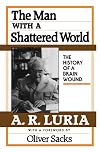
Although I read little non fiction in general, one exception has been the work of Oliver Sacks, whose writing I enjoy, and whose topics are almost always entertaining and engaging. I picked up "The Man with a Shattered World" largely because Sacks wrote the introduction, and because it sounded as though it would be a nice companion to "The Man Who Mistook His Wife for a Hat" and other works already in my library.
I was not disappointed. "The Man with a Shattered World" is one of two show more biographies published at the end of A. R. Luria's distinguished career as a neuropsychologist. The book tells the story of Zazetsky, a soldier in the Second World War whose brain injury instantly transformed him from a bright young man on the verge of finishing his engineering degree to an illiterate unable to perform any meaningful work or even hold a simple conversation.
Zazetsky discovered that he was still able to write by rote (although reading even his own writing was a tortuous process), and was able to chronicle his injury and its effects. Although he never recovered as fully as he hoped, Zazetsky struggled to improve himself in what ways he could and did make some small progress. Given that he initially could not even recognize the Cyrillic alphabet and at his best could barely read more than two words at a time, the fact that he was able to write over 3,000 pages of journal entries over the course of 30 years is as inspiring as the moon landing.
Between the numerous journal entries, Luria intersperses observations, brain science, and other narrative details. He provides the structure that Zazetsky himself could not, but with a light hand, so that the journal entries themselves shine through. This combination of subjective detail (from Zazetsky) and objective detail (from Luria) is what makes the book so enjoyable and comprehensible.
A very good read, both informative and inspiring. I look forward to picking up a copy of the other biography ("The Mnemonist") at some point in my travels. show less
I was not disappointed. "The Man with a Shattered World" is one of two show more biographies published at the end of A. R. Luria's distinguished career as a neuropsychologist. The book tells the story of Zazetsky, a soldier in the Second World War whose brain injury instantly transformed him from a bright young man on the verge of finishing his engineering degree to an illiterate unable to perform any meaningful work or even hold a simple conversation.
Zazetsky discovered that he was still able to write by rote (although reading even his own writing was a tortuous process), and was able to chronicle his injury and its effects. Although he never recovered as fully as he hoped, Zazetsky struggled to improve himself in what ways he could and did make some small progress. Given that he initially could not even recognize the Cyrillic alphabet and at his best could barely read more than two words at a time, the fact that he was able to write over 3,000 pages of journal entries over the course of 30 years is as inspiring as the moon landing.
Between the numerous journal entries, Luria intersperses observations, brain science, and other narrative details. He provides the structure that Zazetsky himself could not, but with a light hand, so that the journal entries themselves shine through. This combination of subjective detail (from Zazetsky) and objective detail (from Luria) is what makes the book so enjoyable and comprehensible.
A very good read, both informative and inspiring. I look forward to picking up a copy of the other biography ("The Mnemonist") at some point in my travels. show less
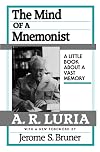
For the sheer vastness of one man's mind...: If you ever would want an absorbing eye-opener into the the mind of the great(est) mnemonist Shereshevsky (popularly 'S'), I recommend Prof. Luria's book. It is absorbing, and is a beautifully written work and one can but wonder about S and his mind, and how Luria brought out to the world the man and his extensive mental faculties. I am at loss of words to describe the book, for a few hundred words cannot describe the vastness of S's mind, but show more hats off to Luria, I enjoyed (and still do enjoy)the book from cover to cover. show less
It's always embarrassing when I'm the one who "doesn't get it." I admire and actually cherish Luria's considerable contributions to the field of psychology, but as a read, I just couldn't get into this. Of course, I finished it, but aside from moments of interest when Luria described the way a mind saturated with synesthesia works, I found it rather dull. A case study that lacked the interest of, say, and Oliver Sacks case study. And of course Sacks stands on Luria's shoulders; yet I simply show more couldn't get engaged in the book, despite my admiration for the author and his contributions. show less
The Mind of a Mnemonist: A Little Book about a Vast Memory, With a New Foreword by Jerome S. Bruner by Aleksandr R. Luria
An engrossing and excellent account of a man with a phenomenal memory. Referred to throughout the book as S., Luria recounts his astonishment at this man and his talents. Of course, S. has problems that bother him only, namely forgetting, but he does pretty well for all that.
Luria is introduced to S. in the 1920s and follows him for around 17 years or so. There seemed to be no limitations to his memory capacity, so Luria became bored with that sort of thing, and began asking how he did these show more things, and what his methods were.
S., whose name is never disclosed, was a synesthete. He had a marvelous visual memory and saw everything in images. Though this may be seen as a good thing in some cases, S. did not have a filter to determine what was important and relevant. He remembered everything that he was told. S. also did not have any way to visualize vague things like ideas and concepts. Words suggested images and these got him lost in such things as poetry. So initially he would take walks and use the memory palace method in his mind. Once he became a mnemonist, he needed a better way to recall things, so he started to make a visual shorthand.
In any case, this book was a quick read and quite enjoyable. show less
Luria is introduced to S. in the 1920s and follows him for around 17 years or so. There seemed to be no limitations to his memory capacity, so Luria became bored with that sort of thing, and began asking how he did these show more things, and what his methods were.
S., whose name is never disclosed, was a synesthete. He had a marvelous visual memory and saw everything in images. Though this may be seen as a good thing in some cases, S. did not have a filter to determine what was important and relevant. He remembered everything that he was told. S. also did not have any way to visualize vague things like ideas and concepts. Words suggested images and these got him lost in such things as poetry. So initially he would take walks and use the memory palace method in his mind. Once he became a mnemonist, he needed a better way to recall things, so he started to make a visual shorthand.
In any case, this book was a quick read and quite enjoyable. show less
Lists
Awards


You May Also Like


Associated Authors
Statistics
- Works
- 67
- Also by
- 1
- Members
- 1,289
- Popularity
- #19,896
- Rating
- 3.9
- Reviews
- 16
- ISBNs
- 108
- Languages
- 12
- Favorited
- 2