
Gillen D'Arcy Wood
Author of Tambora. The Eruption that Changed the World
About the Author
Gillen D'Arcy Wood is professor of environmental humanities at the University of Illinois, Urbana-Champaign, where he serves as associate director of the Institute for Sustainability, Energy, and the Environment. He is the author of Tambora: The Eruption That Changed the World (Princeton).
Works by Gillen D'Arcy Wood
Land of Wondrous Cold: The Race to Discover Antarctica and Unlock the Secrets of Its Ice (2020) 59 copies, 4 reviews
Romanticism and Music Culture in Britain, 1770–1840: Virtue and Virtuosity (Cambridge Studies in Romanticism, Series Number 82) (2010) 6 copies
A Tale of Two Cities 4 copies
Associated Works
Tagged
Common Knowledge
- Other names
- Wood, Gillen
- Birthdate
- 1968-08-21
- Gender
- male
- Education
- Monash University
Columbia University (Ph.D ∙ 2000) - Occupations
- professor (of English)
- Organizations
- University of Illinois
- Relationships
- Wood, D'Arcy (father)
- Nationality
- Australie
- Birthplace
- Australia
- Associated Place (for map)
- Australia
Members
Reviews
Land of wondrous cold : the race to discover Antarctica and unlock the secrets of its ice by Gillen D'Arcy Wood
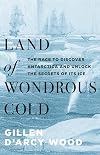
It's hard to believe with our state-of-the-art global mapping technology today that the confirmed existence of Antarctica has been known for fewer than 200 years. People had long thought that there must be a large continent located in the southernmost reaches of the globe in order to provide a balance to the sheer amount of land in the north. And it turns out they were right, but not for those reasons. This book documents the endeavors of three countries — France, United Kingdom, United show more States — each of which sent a fleet of ships south in the early 1840s, competing to be the first nation to land on Antarctica and claim the territory for itself.
I delight in accounts of exploration, so I found this book fascinating. A word of advice to the next reader: have your map/phone/Google at the ready, because you'll want to look up all the islands, passages, seas, land features, etc. mentioned. In addition to the central narrative, Wood inserts lots of interesting asides about Antarctic history, fauna, weather and more. I was especially amazed by the account of peoples native to Tierra del Fuego, who are sadly no longer with us but somehow managed to live in "-40°C temperatures without firewood in animal skin tents." The last chapter is chilling (no pun intended). It's kind of amusing how three countries raced to be the first to lay eyes on Antarctica, only, once they had positively verified it was there, went home and twiddled their thumbs for the next half century or so. show less
I delight in accounts of exploration, so I found this book fascinating. A word of advice to the next reader: have your map/phone/Google at the ready, because you'll want to look up all the islands, passages, seas, land features, etc. mentioned. In addition to the central narrative, Wood inserts lots of interesting asides about Antarctic history, fauna, weather and more. I was especially amazed by the account of peoples native to Tierra del Fuego, who are sadly no longer with us but somehow managed to live in "-40°C temperatures without firewood in animal skin tents." The last chapter is chilling (no pun intended). It's kind of amusing how three countries raced to be the first to lay eyes on Antarctica, only, once they had positively verified it was there, went home and twiddled their thumbs for the next half century or so. show less
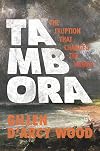
I often hear that it's difficult to tie specific weather events to climate change. But here, Wood makes a very persuasive case that uses both hard data and romantic poetry to posit the eruption of Tambora as one of the definitive events of the 19th Century. Even though no one at the time understood how the volcano was affecting their lives, no one who lived then remained untouched by the short-term climate change it imposed across the globe. A comprehensive, easy-to-understand look at one of show more the most overlooked important events in history. show less
Father's Day (and birthdays and Christmases) are such wonderful excuses for giving books (and gift certificates for books). I just finished reading one of my gifts, Tambora by Gillen D'Arcy Wood. Mt. Tambora was a volcano on Sumbawa Island in the East Indies which experienced a massive eruption in 1815. So what does that have to do with an ensuing cholera pandemic, expansion of the Chinese opium trade, devastation of Ireland by typhus, exploration of polar waters by British sea captains, the show more writing of Frankenstein by Mary Shelley, the U.S. financial panic of 1819 and the impoverishment of Thomas Jefferson? Wood's book is not so much about the geological aspects of volcanology as it is the effects of such massive cataclysms on the earth's climate and the impact of such climate changes on human affairs and indeed on human existence. The book is an informative mixture of science and history, and, if you've never heard of the year that New Englanders labeled “1800-and-froze-to-death,” you just might find this book as educational as I did.
Wood's book is admittedly one that is giving me pause before assessing the number of stars that I give it. For its educational and informative content, and especially for giving me quite a bit of history of which I had no previous knowledge, I do not hesitate to give it five stars. However, I found the overall tone and "feeling" of the text somewhat less than inspirational; it is certainly not plodding or didactic, but I kept looking for the author's excitement in his topic to burst through, but for that I waited almost to the very end. For what is said then, five stars; for the way in which it is said, four. show less
Wood's book is admittedly one that is giving me pause before assessing the number of stars that I give it. For its educational and informative content, and especially for giving me quite a bit of history of which I had no previous knowledge, I do not hesitate to give it five stars. However, I found the overall tone and "feeling" of the text somewhat less than inspirational; it is certainly not plodding or didactic, but I kept looking for the author's excitement in his topic to burst through, but for that I waited almost to the very end. For what is said then, five stars; for the way in which it is said, four. show less
In 1815 Mount Tambora, located in what was then known as The Dutch East Indies, exploded with such ferocity that it's phreatic eruptions continued for the next three years. Estimates of the people that were killed directly by the explosion are still debated. However, there is no doubt that the global effect, in the years to come, took 10's of thousands of lives. Tambora, located on a peninsula, dumped her lava into the sea and was reduced in height by nearly two-thirds.
The meat of this book show more is not the volcano, but the climate change that occurred over the three years following the explosion. I found Gillen D'Arcy Wood's research and writing easy for the layman to follow-but there was still a little too much science for my taste. What I enjoyed most was Wood's references to the great writers (Mary and Percy Shelly, Lord Byron) and painters of the time period, who he uses as "tour guides" through events that occurred globally over the next 3 years.
Recommend for anyone who has an interest in volcanology or climate change-or anyone interested in the poetry and writing of the period and how Tambora effected it. show less
The meat of this book show more is not the volcano, but the climate change that occurred over the three years following the explosion. I found Gillen D'Arcy Wood's research and writing easy for the layman to follow-but there was still a little too much science for my taste. What I enjoyed most was Wood's references to the great writers (Mary and Percy Shelly, Lord Byron) and painters of the time period, who he uses as "tour guides" through events that occurred globally over the next 3 years.
Recommend for anyone who has an interest in volcanology or climate change-or anyone interested in the poetry and writing of the period and how Tambora effected it. show less
Lists
You May Also Like


Associated Authors
Statistics
- Works
- 9
- Also by
- 2
- Members
- 287
- Popularity
- #81,378
- Rating
- 3.7
- Reviews
- 12
- ISBNs
- 19
- Languages
- 2

