

Douglas Hofstadter
Author of Gödel, Escher, Bach: An Eternal Golden Braid
About the Author
Douglas Hofstadter is College of Arts and Sciences Professor of Cognitive Science at Indiana University
Works by Douglas Hofstadter
The Mind's I: Fantasies and Reflections on Self and Soul (1981) — Composer; Contributor; Preface — 3,010 copies, 24 reviews
Fluid Concepts And Creative Analogies: Computer Models Of The Fundamental Mechanisms Of Thought (1995) 862 copies, 4 reviews
That Mad Ache: A Novel/Translator, Trader: An Essay (2009) — Translator, Essay on translation — 105 copies, 2 reviews
The Tumult of Inner Voices or What Is the Meaning of the Word 'I'? (Grace A. Tanner Lecture in Human Values, 1982) (1982) 12 copies
Rhapsody on a theme by Clément Marot: The Grace A. Tanner lecture in human values delivered at Southern Utah Universit (1996) 6 copies
"Shakespeare's plays weren't written by him, but by someone else of the same name": An essay on intensionality and frame (1982) 3 copies
Literatura na świecie 1988/10 2 copies
The Lais of Marie de France 1 copy
Associated Works
Masters of Deception: Escher, Dalí & the Artists of Optical Illusion (2004) — Foreword — 632 copies, 12 reviews
The Butterfly in the Quantum World: The story of the most fascinating quantum fractal (Iop Concise Physics) (2016) — Contributor — 4 copies
Le débat 47 (novembre/decembre 1987). Une Nouvelle science de l'esprit (1987) — Contributor — 1 copy
Tagged
Common Knowledge
- Canonical name
- Hofstadter, Douglas
- Legal name
- Hofstadter, Douglas Richard
- Birthdate
- 1945-02-15
- Gender
- male
- Education
- Stanford University (BS | Mathematics | 1965)
University of Oregon (MS | Physics | 1972)
University of Oregon (PhD | Physics | 1975) - Occupations
- author
professor
columnist
composer
mathematician
computer scientist - Organizations
- Indiana University
University of Michigan
Scientific American - Awards and honors
- George Pólya Award (1983)
American Book Award (Science ∙ 1980)
American Academy of Arts and Sciences (2009)
American Philosophical Society (2009)
Royal Society of Sciences in Uppsala (2010)
Pulitzer Prize (1980) - Relationships
- Hofstadter, Robert (father)
- Nationality
- USA
- Birthplace
- New York, New York, USA
- Places of residence
- New York, New York, USA
Bloomington, Indiana, USA
Ann Arbor, Michigan, USA - Map Location
- Indiana, USA
Members
Discussions
Godel, Escher, Bach in Book talk (August 2009)
Group Read of Godel, Escher, Bach? in Philosophy and Theory (July 2009)
Reviews

Can human thought processes be emulated artificially? This is very much a "how" question and Hofstadter explores it as such, looking for the most promising way forward. He believes it lies in the study of self-reference and tackles this from multiple angles across a variety of disciplines (music, art, mathematics, computer programming, molecular biology, etc.), on the theory that without self-reference you can't arrive at self-awareness and full consciousness or actual thinking. He makes the show more discussion a fascinating one in how ably he ties things together that I wouldn't have thought had much in common.
Jumping to the end, much of the concluding chapters demonstrate the extremely complicated and multi-layered processes that emerge when you break down even the most simple mental processes in humans, demonstrating how very difficult it is to emulate these processes artificially. Hofstadter seems wedded to the idea that artificial intelligence means closely emulating human thought and how it is arrived at. Getting to the same (or improved) results by any different means doesn't seem to count as true AI in his opinion. He tries to prognosticate what artificial intelligence will and will not be capable of in future and you could say that he still isn't wrong, pointing to his own definition. The AI that he envisions is not GenAI like ChatGPT but something that still lies well beyond us, a computer that really does think (and feel?) the same independent way that a person does, and consequently has many of our same flaws as well. Whether computer science today or in future sees any utility in trying to realize the AI of Hofstadter's vision is doubtful. To me it seems fair to weigh his 1979 vision against the direction things are actually going in 2026 and say that he has already missed the mark in several respects, all stemming from his missing the "why" that industrial science has actually been motivated by.
What we are popularly defining as AI today is function-oriented, and possibly all it will ever be. While it can be increasingly made to look and sound human, it will never "think" because that isn't its objective. This book remains brilliant for its wonderfully entertaining way of exploring the possibility of something beyond that - like Commander Data from Star Trek - which perhaps some niche areas of AI study are still pursuing, and how they might get there. show less
Jumping to the end, much of the concluding chapters demonstrate the extremely complicated and multi-layered processes that emerge when you break down even the most simple mental processes in humans, demonstrating how very difficult it is to emulate these processes artificially. Hofstadter seems wedded to the idea that artificial intelligence means closely emulating human thought and how it is arrived at. Getting to the same (or improved) results by any different means doesn't seem to count as true AI in his opinion. He tries to prognosticate what artificial intelligence will and will not be capable of in future and you could say that he still isn't wrong, pointing to his own definition. The AI that he envisions is not GenAI like ChatGPT but something that still lies well beyond us, a computer that really does think (and feel?) the same independent way that a person does, and consequently has many of our same flaws as well. Whether computer science today or in future sees any utility in trying to realize the AI of Hofstadter's vision is doubtful. To me it seems fair to weigh his 1979 vision against the direction things are actually going in 2026 and say that he has already missed the mark in several respects, all stemming from his missing the "why" that industrial science has actually been motivated by.
What we are popularly defining as AI today is function-oriented, and possibly all it will ever be. While it can be increasingly made to look and sound human, it will never "think" because that isn't its objective. This book remains brilliant for its wonderfully entertaining way of exploring the possibility of something beyond that - like Commander Data from Star Trek - which perhaps some niche areas of AI study are still pursuing, and how they might get there. show less

"Help. My mind has bent, and now I cannot unbend it!"
That was me after I finished reading Godel, Escher, Bach. This book, which is about, well, everything, takes the reader on a journey through mathematics, music, and art, and gives it a little twist just to keep one on one's mental toes.
A major theme is recursion, or self-referencing. If you're at all familiar with any of the GEBs, you'll see this in Godel's Incompleteness Theorem, Escher's Drawing Hands, and Bach's Crab Canon. Other show more mathematicians, artists, and musicians are introduced as well, providing more on this Eternal Golden Braid.
Not only does Hofstadter give us so much on logical themes, but he also gives the reader some puzzles too, particularly some that require multiple steps (though the answers are right in front of the reader's face at times).
This book is a must read for one who considers oneself a student of mathematics, art, or even music, or who has a strong admiration for most of these things. I suppose computer scientists could read it too.
Nevertheless, this is a great book, and a challenge, but definitely worth the read. show less
That was me after I finished reading Godel, Escher, Bach. This book, which is about, well, everything, takes the reader on a journey through mathematics, music, and art, and gives it a little twist just to keep one on one's mental toes.
A major theme is recursion, or self-referencing. If you're at all familiar with any of the GEBs, you'll see this in Godel's Incompleteness Theorem, Escher's Drawing Hands, and Bach's Crab Canon. Other show more mathematicians, artists, and musicians are introduced as well, providing more on this Eternal Golden Braid.
Not only does Hofstadter give us so much on logical themes, but he also gives the reader some puzzles too, particularly some that require multiple steps (though the answers are right in front of the reader's face at times).
This book is a must read for one who considers oneself a student of mathematics, art, or even music, or who has a strong admiration for most of these things. I suppose computer scientists could read it too.
Nevertheless, this is a great book, and a challenge, but definitely worth the read. show less
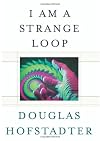
Not as dense or rich as [b:Gödel, Escher, Bach: An Eternal Golden Braid|24113|Gödel, Escher, Bach An Eternal Golden Braid|Douglas R. Hofstadter|https://d.gr-assets.com/books/1314739489s/24113.jpg|850076] and more focused on the "scientific" side of things without all the wonderful digressions (you have to read GEB to understand). Still Hofstadter plays enough mind games to make the going entertaining and challenging.
Basically an argument for the nature of consciousness that all but proves show more Descartes' proposition. But Hofstadter presents a pretty convincing argument for his theories on why I think I am I.
The one place where he goes out on thin ice is the persistence of "selves" after death via the symbols in other peoples' minds. It seems a bit of wishful thinking on Hofstadter's part as he ruminates on his wife's sudden death. Since he doesn't believe in a persistent "soul" he yearns for some sort of lifelike afterimage of the departed. It doesn't hold water.
My sorry little review gives no idea of the depth or richness of this book. Suffice it to say that I think Hofstadter is on to the nature of consciousness and he presents it in a lively yet challenging way.
Anyway, I am a self-referent loop that talks about itself. You gotta read it. show less
Basically an argument for the nature of consciousness that all but proves show more Descartes' proposition. But Hofstadter presents a pretty convincing argument for his theories on why I think I am I.
The one place where he goes out on thin ice is the persistence of "selves" after death via the symbols in other peoples' minds. It seems a bit of wishful thinking on Hofstadter's part as he ruminates on his wife's sudden death. Since he doesn't believe in a persistent "soul" he yearns for some sort of lifelike afterimage of the departed. It doesn't hold water.
My sorry little review gives no idea of the depth or richness of this book. Suffice it to say that I think Hofstadter is on to the nature of consciousness and he presents it in a lively yet challenging way.
Anyway, I am a self-referent loop that talks about itself. You gotta read it. show less
Douglas Hofstadter is, well, a bit loopy--but this book is a nice statement of his notion of selfhood and personal identity. He nicely locates consciousness in the self-referential symbol processing of the brain, and offers some very plausible analogies to explain just what being conscious might involve. But I'm ultimately unconvinced that he can dispel the evident gap between the "I" and the brain. For example, Hofstadter writes: 'The dance of symbols in the brain has to be perceived at show more that level [the level of symbols, rather than neurons:] for it to constitute consciousness.' And then, on the same page, he criticizes opponents: 'In other words, people seeking the "reader" for configurations of activated symbols...refuse to call that internal churning "consciousness" because now they want the symbols themselves to be perceived.' Is there a perceiver, or not? And if so, where is it located? That's the crucial question--how to avoid the infinite regress wherein an "I" is kicked endlessly upwards through levels of abstraction-- and he seems to be sidestepping it. But there's certainly a lot of interesting discussion here, and a lot of original thinking. The notes and bibliography are excellent guides to further reading. show less
Lists
Metaphors, etc. (1)
Unread books (1)
Awards


You May Also Like


Associated Authors
Statistics
- Works
- 28
- Also by
- 13
- Members
- 23,018
- Popularity
- #919
- Rating
- 4.1
- Reviews
- 254
- ISBNs
- 146
- Languages
- 17
- Favorited
- 113

