
Alexander Calder (1898–1976)
Author of Selected Fables of Jean de la Fontaine with 48 illustrations
About the Author
Image credit: Carl Van Vechten (1947)
Works by Alexander Calder
Selected Fables of Jean de la Fontaine with 48 illustrations (1668) — Illustrator — 555 copies, 7 reviews
Calder: The Paris Years, 1926-1933 [cat. exp., New York, Whitney Museum of American Art; Paris, Centre Pompidou, 2008] (2008) 44 copies
Calder: a retrospective [cat. exp., Solomon R. Guggenheim Museum, New York, Nov 1964-Jan 1965; Musée National d'Art Moderne, Paris, 1965] (1964) 21 copies
Calder, From Model to Monument [cat. exp., PaceWildenstein Gallery, Feb 3 to March 4, 2006] (2005) 19 copies
Calder, gouaches: 1942 - 1976 [cat. exp., PaceWildenstein Gallery, Sept 22 - Oct 21, 2006] (2006) 16 copies
A salute to Alexander Calder; sculpture, watercolors and drawings, prints, illustrated books, and jewelry in the collection of the Museum of Modern Art (1970) 13 copies
Motion-Emotion: The Art of Alexander Calder [exhibition] O'Hara Gallery, 21 October - 4 December 1999 (1999) 10 copies
Alexander Calder: Sculpture of the nineteen thirties [cat. exp., Whitney Museum of American Art, Nov 14, 1987 to Jan 17, 1988] (1987) 9 copies
Alexander Calder: The 50's : November 9-December 29, 1995, January 19-February 17, 1996 (1995) 7 copies
Alexander Calder Standing Mobiles [cat. exp., M. Knoedler & Co., Dec 4, 1980 - Jan 2, 1981] (1980) 7 copies
Alexander Calder : sculpture of the 1970s : [cat. exp., M. Knoedler & Co., Oct 4-Nov 2, 1978] (1978) 6 copies
Alexander Calder (cat. exp., Amsterdam Stedelijk Museum 15. 5. - 22. 6. 1959, Hamburg Kunsthalle 17. 7. - 30. 8. 1959) (1998) 5 copies
Calder : [cat. exp., Paris, Musee D'Art Moderne de la ville de Paris, jui-6 oct 1996] (1996) 5 copies
Alexander Calder: Small Scale 3 copies
Calder. 2 copies
Fish Pull-Toy 2 copies
Alexander Calder, Fernand Leger : [cat. exp., M. Knoelder & Co., October 4-27, 1979] (1979) 2 copies
Alexander Calder, a retrospective exhibition, work from 1925 to 1974, October 26 to December 8, 1974 (1974) 2 copies
Calder : recent mobiles and circus gouaches : [cat. exp., New York, Perls Galleries, Oct. 14-Nov. 15, 1975] (1975) 2 copies
Calder : 1898-1976 retrospective, [cat. exp., Linssen Gallery, December 1987-January 1988] (1987) 2 copies
Alexander Calder Circus Drawings, Wire Sculpture and Toys: November 24 to December 13, 1964 (1990) 2 copies
Calder: Mobiles, stabiles, gouaches, bijoux : Musée Picasso, Château Grimaldi, Antibes, 2 juillet-27 septembre 1993 (1993) 2 copies
Alexander Calder: teatro de encuentros [cat. exp., La Boca, Buenos Aires, 08 sep de 2018 - 27 ene de 2019] (2015) 2 copies
The Bicentennial tapestries 2 copies
Calder : febrer-març, 1989 1 copy
Calder : sculture, grafica : [cat. exp., Galleria Pieter Coray, Lugano, [26 ott - 24 nov 1979] 1 copy
The Stars 1 copy
Calder calendar, 1981 1 copy
Alexander Calder, mobiles, Fernand Léger, peintures : Galerie Louis Carré & Cie : 13 octobre-26 novembre 1988 (1988) 1 copy
calder escultures 1 copy
Calder Calendar 1 copy
Red Polygons 1 copy
Sumac V (painted metal) 1 copy
Calder's Universe 1 copy
UN & D'AUTRES CHIFFRES : AVEC ALEXANDER CALDER -PREMIERS PAS AVEC LES GRANDS ART (ACTIVITE) (2017) 1 copy
Calder A Retrospective Exposition the Guggenheim et Musee Nation d'Art Moderne, Paris Etc. (1964) 1 copy
Calder [Cover Title: Wire Sculpture By Calder]. Selections from the Permanent Collection of the Whitney Museum of American Art (1984) 1 copy
Calder, el sol rojo 1 copy
Calder's Calders : selected works from the artist's collection : May 3-8 June 1985, The Pace Gallery 1 copy
Calder : gouaches 1942-1976 1 copy
SCRITTI E CONVERSAZIONI 1 copy
Calder - the painter 1 copy
Associated Works
Theories of Modern Art: A Source Book by Artists and Critics (1968) — Contributor — 855 copies, 5 reviews
Fables of Aesop According to Sir Roger L'Estrange, with Fifty Drawings by Alexander Calder (1967) — Illustrator, some editions — 161 copies, 1 review
Alexander Calder: performing sculpture {catalogue Tate Modern 2015-2016} (2015) — Artist — 46 copies
Tagged
Common Knowledge
- Birthdate
- 1898-07-22
- Date of death
- 1976-11-11
- Gender
- male
- Education
- Stevens Institute of Technology
Art Students League of New York - Occupations
- sculptor
engineer - Organizations
- American Academy of Arts and Letters (Art, 1960)
- Awards and honors
- Presidential Medal of Freedom (1977)
- Relationships
- Calder, A. Stirling (father)
- Nationality
- USA
- Birthplace
- Lawnton, Pennsylvania, USA
- Places of residence
- New York, New York, USA
- Place of death
- New York, New York, USA
- Associated Place (for map)
- New York, USA
Members
Reviews
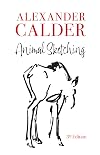
Alexander Calder, the renowned sculptor and inventor of mobiles, here brings his characteristic simplicity of line and spirit of movement to the art of animal sketching. The purpose of the book is to help the student to draw animals as he or she sees them. Noting and practicing the way Mr. Calder captures the emotions and attitudes of animals in a few quick lines, the student can quickly obtain a lasting groundwork in animal sketching that will before long become second nature.
These show more full-body sketches and enlarged details, in rapid, expressive brush-and-ink, of animals from the farm, the zoo, wildlife, and the home, in characteristic poses and movements, reveal both the action and portrait aspects of the art. There are 12 sketches of horses in action (drawing wagon or plough, racing, etc.); 10 drawings of cats, luxuriously asleep or alertly watchful, stretching or crouching; 14 drawings of dogs (many different breeds) in a variety of poses &; lying down, sleeping, sitting, running, sniffing the air, feeding puppies; 11 drawings of lions and other big cats, pacing, lying down, or crouching; 7 sketches of monkeys, jumping and gesticulating; 23 drawings of deer, stooping, sitting, running, etc.; 27 drawings of birds of many different species &; owls sitting, ducks waddling, etc.; and 18 sketches of cows grazing, sitting, swishing tails, and feeding calves. Also included are drawings of seals, elephants, squirrels, kangaroos, and a bear.
Because of the simplicity of Mr. Calder's approach to sketching, this book can easily be used by even the youngest of students. There are no difficult techniques to master here, no roundabout methods of construction, but just an insistence on drawing things as the student sees them, with undogmatic (and delightful) assistance from an undisputed master of the simple expressive line. It is unlikely that there is any more pleasant way to study such a fundamental branch of pictorial art.
Unabridged and unaltered republication of third (1929) edition. show less
These show more full-body sketches and enlarged details, in rapid, expressive brush-and-ink, of animals from the farm, the zoo, wildlife, and the home, in characteristic poses and movements, reveal both the action and portrait aspects of the art. There are 12 sketches of horses in action (drawing wagon or plough, racing, etc.); 10 drawings of cats, luxuriously asleep or alertly watchful, stretching or crouching; 14 drawings of dogs (many different breeds) in a variety of poses &; lying down, sleeping, sitting, running, sniffing the air, feeding puppies; 11 drawings of lions and other big cats, pacing, lying down, or crouching; 7 sketches of monkeys, jumping and gesticulating; 23 drawings of deer, stooping, sitting, running, etc.; 27 drawings of birds of many different species &; owls sitting, ducks waddling, etc.; and 18 sketches of cows grazing, sitting, swishing tails, and feeding calves. Also included are drawings of seals, elephants, squirrels, kangaroos, and a bear.
Because of the simplicity of Mr. Calder's approach to sketching, this book can easily be used by even the youngest of students. There are no difficult techniques to master here, no roundabout methods of construction, but just an insistence on drawing things as the student sees them, with undogmatic (and delightful) assistance from an undisputed master of the simple expressive line. It is unlikely that there is any more pleasant way to study such a fundamental branch of pictorial art.
Unabridged and unaltered republication of third (1929) edition. show less

This review applies to the Viking edition of selected fables, translated by James Michie with an introduction by Geoffrey Grigson and the illustrations of J. J. Grandville (from an 1842 Paris edition). Grandville's illustrations may well be the best part of the book. La Fontaine's verse retellings of ancient fables (mostly of Aesop and Phaedrus) may lose something in the translation, but mostly didn't make for particularly pleasant reading: the verse comes through as somewhat stilted. show more Nonetheless, it was neat to see the versions of these stories that La Fontaine's contemporary readers would have known and learned. show less

I borrowed this to read before (or instead of) attending the local museum exhibit. I was hoping I could learn and see enough so that I could spend less (covid) time at the exhibit or maybe even feel okay skipping it. After reading it I think it served its purpose.
It's dense text heavy in the first parts of the book. I struggled to read it even though much of it was interesting. I liked that family members participated.
The art shown in the latter long part of the book was good. I’ve always show more been a huge Calder fan and like Picasso’s art too. When seeing so many of their pieces side by side I was shocked at seeing how similar they often were.
I liked the art, appreciated the included photos and source material. The story behind the exhibit is interesting, but if it wasn’t pandemic times I’d have preferred to read the shorter written pieces at the exhibit, going through in a more leisurely manner than I’m now willing to do. I still plan to go to the exhibit but if it won’t be the end of the world if I decide I don’t feel safe to do so, including leaving when I get there and seeing what “50% capacity” looks like. Last autumn I went to the Frida Kahlo exhibit at the same museum and I went through really quickly because “25% capacity” ended up being too many people for me to feel comfortable. show less
It's dense text heavy in the first parts of the book. I struggled to read it even though much of it was interesting. I liked that family members participated.
The art shown in the latter long part of the book was good. I’ve always show more been a huge Calder fan and like Picasso’s art too. When seeing so many of their pieces side by side I was shocked at seeing how similar they often were.
I liked the art, appreciated the included photos and source material. The story behind the exhibit is interesting, but if it wasn’t pandemic times I’d have preferred to read the shorter written pieces at the exhibit, going through in a more leisurely manner than I’m now willing to do. I still plan to go to the exhibit but if it won’t be the end of the world if I decide I don’t feel safe to do so, including leaving when I get there and seeing what “50% capacity” looks like. Last autumn I went to the Frida Kahlo exhibit at the same museum and I went through really quickly because “25% capacity” ended up being too many people for me to feel comfortable. show less
Jean de la Fontaine is a must-read for anyone interested in folktales and fables throughout history.
The 17th-century poet took various tales from Aesop, Greek myth, and various other sources and set them to verse. Here, they appear in English translation. While the presentation of the stories and their social commentary is witty; I didn't find the 'poetry' of the language to be that engaging - the rhyme could be distracting, and the phrasing was often clunky. I don't know if this has to do show more with the original or the translation; I suspect a combination of both.
For French poems in translation; I tend to prefer a side-by-side presentation - even if one understands little of the original language, one can read to get an idea of the sound and rhythm of the original. However, I'm sure the originals are available freely online, for those motivated to look them up.
The selected fables presented here (apparently, the book includes about half of de la Fontaine's fabulist output) are prefaced by a very nice academic essay on the author, which really helps place the writing in context. There are also liberal endnotes mentioning the source (if known), and references found in each fable. I might've preferred if the notes relating to each story were found adjacent to the relevant section, but overall, this was fine.
A recommended volume.
I received a copy of this title through NetGalley. Thanks to NetGalley and Oxford University Press. show less
The 17th-century poet took various tales from Aesop, Greek myth, and various other sources and set them to verse. Here, they appear in English translation. While the presentation of the stories and their social commentary is witty; I didn't find the 'poetry' of the language to be that engaging - the rhyme could be distracting, and the phrasing was often clunky. I don't know if this has to do show more with the original or the translation; I suspect a combination of both.
For French poems in translation; I tend to prefer a side-by-side presentation - even if one understands little of the original language, one can read to get an idea of the sound and rhythm of the original. However, I'm sure the originals are available freely online, for those motivated to look them up.
The selected fables presented here (apparently, the book includes about half of de la Fontaine's fabulist output) are prefaced by a very nice academic essay on the author, which really helps place the writing in context. There are also liberal endnotes mentioning the source (if known), and references found in each fable. I might've preferred if the notes relating to each story were found adjacent to the relevant section, but overall, this was fine.
A recommended volume.
I received a copy of this title through NetGalley. Thanks to NetGalley and Oxford University Press. show less
You May Also Like


Associated Authors
Statistics
- Works
- 153
- Also by
- 6
- Members
- 1,561
- Popularity
- #16,516
- Rating
- 3.8
- Reviews
- 11
- ISBNs
- 144
- Languages
- 7