
Otto Carius (1922–2015)
Author of Tigers in the Mud: The Combat Career of German Panzer Commander Otto Carius
About the Author
Otto Carius was a German tank commander during World War II. He became a pharmacist after the war and died in 2015.
Works by Otto Carius
Tigers in the Mud: The Combat Career of German Panzer Commander Otto Carius (1960) 332 copies, 9 reviews
Tagged
Common Knowledge
- Canonical name
- Carius, Otto
- Birthdate
- 1922-05-17
- Date of death
- 2015-01-24
- Gender
- male
- Education
- Heidelberg University
- Occupations
- tank commander
pharmacist - Nationality
- Germany
- Birthplace
- Zweibrücken, Rheinland-Pfalz, Germany
- Place of death
- Herschweiler-Pettersheim, Rheinland-Pfalz, Deutschland
- Associated Place (for map)
- Rheinland-Pfalz, Germany
Members
Reviews
Tigers in the Mud: The Combat Career of German Panzer Commander Otto Carius (Stackpole Military History Series) by Otto Carius
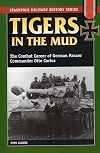
Not my usual fare, but I picked this up after getting hooked on the World of Tanks Blitz game.
There are a lot of interesting tidbits about what life was like for tankers on the Eastern Front, but it's not what I hoping for. It stands in complete contrast to [b:A Bloody War: 1939-1945|11280993|A Bloody War 1939-1945|Hal Lawrence|https://s.gr-assets.com/assets/nophoto/book/50x75-a91bf249278a81aabab721ef782c4a74.png|16208189], which I read years ago and still remember fondly.
Some details are show more very vivid and memorable. Picture them falling asleep in the tank, and waking up with their hair frozen into the frost on the inside of the tank. Or his friend that slipped on the ice in front of a moving tank. The meeting with Himmler and the generals discussing arming the Croats to fight the Serbs. The authour's opinion of Russian and American fighting abilities.
Some are much more mundane. They spent more time towing broken tanks than you'd ever imagine.
But there are several factors here that end up making it less than I hoped for.
First up, I suspect the translation was done by someone less than ideal. It's very stilted and awkward in many places, and I can't help but think it reads better in the original.
Secondly, the authour obviously had a couple of axes to grind here.
He spends a lot of time defending the regular German soldier against what he feels is persecution by everyone outside the armed forces. I can only imagine the lot of a German soldier post war, and thus I understand a bit why he's doing it, but it doesn't read well.
The authour also, quite honestly, comes across as a cold, arrogant know-it-all.
Let me be clear here. If anybody has the claim to talk about WWII tank warfare with authority, this guy is it, period, end of discussion. His track record (pun intended) is almost without equal.
On the other hand, he spends half the book talking about which commanders he liked, and which ones he ignored. I can't help but think his level of independence would never be tolerated in almost any other situation.
He mentions often how he always spent time with the men rather than off apart from them, but he mentions only a handful by name. Apparently they all loved him, but it's hard to tell if it was reciprocated. Any officer mentioned gets much more press than the people I'm assuming he spent time with day in and out. The last tank loss he describes where he's commanding on foot and the tank is destroyed is so cold as to be inhuman.
Many things, including pretty much every battle, are described very dryly, with no personal details. We moved here, took this position, destroyed that many tanks. It's impossible to tell in many places whether the authour was even present at any given place in the recital. He's commanding, so the royal 'we' makes sense I suppose, but it ends up so distant it's not lifelike. The spots where it becomes personal are the best parts of the book, and they are few and far between.
There is a bunch of 'end matter' in this edition, over a third of the book is reproduced records of the time, often not written by the authour at all. It's also pretty dry, with a few exceptions.
The section written by the mechanics is fascinating when you read between the lines - you can picture those poor guys attempting to fix these behemoths under fire in the middle of nowhere and running into problems they can't control.
The whole book is a fascinating glimpse into what happened, but I'm left wishing I could see more. show less
There are a lot of interesting tidbits about what life was like for tankers on the Eastern Front, but it's not what I hoping for. It stands in complete contrast to [b:A Bloody War: 1939-1945|11280993|A Bloody War 1939-1945|Hal Lawrence|https://s.gr-assets.com/assets/nophoto/book/50x75-a91bf249278a81aabab721ef782c4a74.png|16208189], which I read years ago and still remember fondly.
Some details are show more very vivid and memorable. Picture them falling asleep in the tank, and waking up with their hair frozen into the frost on the inside of the tank. Or his friend that slipped on the ice in front of a moving tank. The meeting with Himmler and the generals discussing arming the Croats to fight the Serbs. The authour's opinion of Russian and American fighting abilities.
Some are much more mundane. They spent more time towing broken tanks than you'd ever imagine.
But there are several factors here that end up making it less than I hoped for.
First up, I suspect the translation was done by someone less than ideal. It's very stilted and awkward in many places, and I can't help but think it reads better in the original.
Secondly, the authour obviously had a couple of axes to grind here.
He spends a lot of time defending the regular German soldier against what he feels is persecution by everyone outside the armed forces. I can only imagine the lot of a German soldier post war, and thus I understand a bit why he's doing it, but it doesn't read well.
The authour also, quite honestly, comes across as a cold, arrogant know-it-all.
Let me be clear here. If anybody has the claim to talk about WWII tank warfare with authority, this guy is it, period, end of discussion. His track record (pun intended) is almost without equal.
On the other hand, he spends half the book talking about which commanders he liked, and which ones he ignored. I can't help but think his level of independence would never be tolerated in almost any other situation.
He mentions often how he always spent time with the men rather than off apart from them, but he mentions only a handful by name. Apparently they all loved him, but it's hard to tell if it was reciprocated. Any officer mentioned gets much more press than the people I'm assuming he spent time with day in and out. The last tank loss he describes where he's commanding on foot and the tank is destroyed is so cold as to be inhuman.
Many things, including pretty much every battle, are described very dryly, with no personal details. We moved here, took this position, destroyed that many tanks. It's impossible to tell in many places whether the authour was even present at any given place in the recital. He's commanding, so the royal 'we' makes sense I suppose, but it ends up so distant it's not lifelike. The spots where it becomes personal are the best parts of the book, and they are few and far between.
There is a bunch of 'end matter' in this edition, over a third of the book is reproduced records of the time, often not written by the authour at all. It's also pretty dry, with a few exceptions.
The section written by the mechanics is fascinating when you read between the lines - you can picture those poor guys attempting to fix these behemoths under fire in the middle of nowhere and running into problems they can't control.
The whole book is a fascinating glimpse into what happened, but I'm left wishing I could see more. show less
Tigers in the Mud: The Combat Career of German Panzer Commander Otto Carius (Stackpole Military History Series) by Otto Carius
Jawohl! Basically a war diary - is interesting to see life from a war grunt's view but this guy didn't think all that much about his situation. I guess that in itself is telling, as I'd guess most veterans didn't delve into the mysteries of "why the heck are we doing this?!?". So, given that this is mostly a diary of one man's trail thru the german military machine, that is interesting, just not _super_ interesting.
Good audiobook narrator
Good audiobook narrator

Enjoyed the book a lot. At times incredibly gripping and inspiring. Learned a little more about German Armored tactics. Interesting stuff. I do feel like the author had a good sense of humor but that some of that was lost in the translation. Would a better translation help? I'll leave that to my bilingual friends.
Tigers in the Mud: The Combat Career of German Panzer Commander Otto Carius (Stackpole Military History Series) by Otto Carius
Otto Carius was one of the most successful Panzerkommandanten ever to take a Tiger tank into battle, destroying some 150 tanks and being decorated with the Oakleaves to the Knights Cross. Stackpole are to be heartily congratulated for this cheap paperback edition of a long-out-print Fedorowicz classic. It is a classic of Eastern Front literature and a marvellous account of Panzer warfare. When World War II broke out Carius had volunteered for 104th Infantry Placement Battalion in May of show more 1940. Following training, he was assigned to the 21st Panzer Regiment and experienced his first battle as a loader on a Panzer 38(t) during the "Barbarossa" operation in June of 1941. After about a year of war experience on the Eastern Front, Carius was accepted in an Officer Candidate Course and following its completion, was assigned to the 502nd Heavy Tank Battalion in April of 1943. Equipped with the new Tiger tanks, he was assigned as a tank commander to the 2nd Company of 502nd Tank Battalion. That summer, the 2nd Company was deployed to the Russian Leningrad Front and took part in several operations in that area. During that time, 502nd Tank Battalion was ordered to reinforce the front along with 11th SS Freiwillige Panzergrenadier Division "Nordland" at Narva Bridgehead. During one of his engagements, Carius destroyed four Soviet SU-85s and successfully withdrew without losses. In June of 1944, the company was transferred to Dunaburg (Daugavpils in Latvia) to defend the city from a concentrated Russian offensive. In the July of 1944, Russians outflanked the German defensive lines via the motorways west of Minsk and Borissov to Witebsk (same route was used by Germans in 1941). By using tanks in vast numbers, Soviets intended to divide the German occupied territory into small salients and then take port city of Riga. Since Riga is situated at the mouth of Dvina River, Dunaburg was an important strategic point for both Germans and Russians.
On July 22 of 1944, 1st Lieutenant Otto Carius with his company of eight (early and mid production) Tigers advanced towards village of Malinava (northern suburb of Dunaburg) in order to halt the Russian advance. 1st Lieutenant Otto Carius and 1st Lieutenant Albert Kerscher (one of the most decorated commanders of sPzAbt 502) took a Kubelwagen in order to check if the village was already occupied by Russians. They discovered that village of Malinava was already occupied by the enemy. Carius recognized that the Russian tanks in the village were only advance troops waiting for the main force to arrive. He decided to recapture the village before the arrival of reinforcements. Carius returned to his company for briefing and explained his plan to take the village. He decided to attack the village using only two tanks because there was only one road leading to the village and rushing all of his Tigers would be dangerous. Six Tigers remained in the reserve while Carius and Kerscher's Tigers moved towards the village of Malinava. Speed was the essence of Carius' strategy and it was decisive to upset Russians and immobilize their tanks.
When Carius' Tiger No.217 was about to enter the village, two T-34/85 tanks were observed rotating their turrets. At this moment, Kerscher's Tiger No.213, which followed Carius at about 150m, fired and knocked them out. Also for the first time, Otto Carius encountered Russian's latest JS-1 (or possibly JS-2) heavy tank. Its silhouette was somewhat similar to the German King Tiger and Carius was confused at first but after hesitating a bit, he fired and JS-1 burst into flames. Afterwards, Otto Carius recalls that the entire battle did not last more than 20 minutes. In such a short time, Carius and Kerscher's Tigers knocked out 17 Russian tanks including the new JS-1. Although the Russians were attacked by suprise, Carius' quick and accurate recognition of the situation and the excellent tactics used were the main factors in the outcome. Carius' achievement at Malinava is perhaps as equally outstanding as Michael Wittmann's achievement at Villers-Bocage.
In November of 1943, Otto Carius destroyed 10 Soviet T-34/76 tanks at distances as close as 50 meters. In August of 1944, Otto Carius was transferred to Paderborn to the newly created schwere Panzerjager Abteilung 512 and received the command of the 2nd company. sPzJagAbt 512 was equipped with powerful Jagdtigers, armed with 128mm Pak 44 L/55 gun. Carius commanded the 2nd company, which was training at Senne Camp near Paderborn and at Dollersheim near Vienna. On March 8th of 1945, without finishing its training, 2nd company was directed to the frontline near Siegburg. It then took part in the defence of the River Rhine and eventually surrendered to the US Army on April 15th of 1945.
All of this is related in great detail with marvellous accounts of what it was to fight, live & die in the Tiger tank. The book is completed with the reprinting of period newspaper articles, both in the orginal German and in translated form.
Highly recommended. show less
On July 22 of 1944, 1st Lieutenant Otto Carius with his company of eight (early and mid production) Tigers advanced towards village of Malinava (northern suburb of Dunaburg) in order to halt the Russian advance. 1st Lieutenant Otto Carius and 1st Lieutenant Albert Kerscher (one of the most decorated commanders of sPzAbt 502) took a Kubelwagen in order to check if the village was already occupied by Russians. They discovered that village of Malinava was already occupied by the enemy. Carius recognized that the Russian tanks in the village were only advance troops waiting for the main force to arrive. He decided to recapture the village before the arrival of reinforcements. Carius returned to his company for briefing and explained his plan to take the village. He decided to attack the village using only two tanks because there was only one road leading to the village and rushing all of his Tigers would be dangerous. Six Tigers remained in the reserve while Carius and Kerscher's Tigers moved towards the village of Malinava. Speed was the essence of Carius' strategy and it was decisive to upset Russians and immobilize their tanks.
When Carius' Tiger No.217 was about to enter the village, two T-34/85 tanks were observed rotating their turrets. At this moment, Kerscher's Tiger No.213, which followed Carius at about 150m, fired and knocked them out. Also for the first time, Otto Carius encountered Russian's latest JS-1 (or possibly JS-2) heavy tank. Its silhouette was somewhat similar to the German King Tiger and Carius was confused at first but after hesitating a bit, he fired and JS-1 burst into flames. Afterwards, Otto Carius recalls that the entire battle did not last more than 20 minutes. In such a short time, Carius and Kerscher's Tigers knocked out 17 Russian tanks including the new JS-1. Although the Russians were attacked by suprise, Carius' quick and accurate recognition of the situation and the excellent tactics used were the main factors in the outcome. Carius' achievement at Malinava is perhaps as equally outstanding as Michael Wittmann's achievement at Villers-Bocage.
In November of 1943, Otto Carius destroyed 10 Soviet T-34/76 tanks at distances as close as 50 meters. In August of 1944, Otto Carius was transferred to Paderborn to the newly created schwere Panzerjager Abteilung 512 and received the command of the 2nd company. sPzJagAbt 512 was equipped with powerful Jagdtigers, armed with 128mm Pak 44 L/55 gun. Carius commanded the 2nd company, which was training at Senne Camp near Paderborn and at Dollersheim near Vienna. On March 8th of 1945, without finishing its training, 2nd company was directed to the frontline near Siegburg. It then took part in the defence of the River Rhine and eventually surrendered to the US Army on April 15th of 1945.
All of this is related in great detail with marvellous accounts of what it was to fight, live & die in the Tiger tank. The book is completed with the reprinting of period newspaper articles, both in the orginal German and in translated form.
Highly recommended. show less
You May Also Like


Associated Authors
Statistics
- Works
- 2
- Members
- 333
- Popularity
- #71,380
- Rating
- 3.8
- Reviews
- 9
- ISBNs
- 24
- Languages
- 8