

Agnes de Mille (1905–1993)
Author of Dance to the Piper
About the Author
Image credit: Courtesy of the NYPL Digital Gallery (image use requires permission from the New York Public Library)
Works by Agnes de Mille
Book of the dance 2 copies
L'Ame de la Danse 1 copy
Speak with me, Dance with Me 1 copy
Russian journals 1 copy
The dance in America 1 copy
Who was Henry George? 1 copy
America Dances 1 copy
Walter Prude 1 copy
Associated Works
Tagged
Common Knowledge
- Canonical name
- de Mille, Agnes
- Birthdate
- 1905-09-18
- Date of death
- 1993-10-07
- Gender
- female
- Education
- University of California, Los Angeles
- Occupations
- choreographer
dance historian
dancer
biographer
memoirist - Organizations
- American Academy of Arts and Letters (American Honorary, 1992)
American Ballet Theatre - Awards and honors
- National Medal of Arts (1986)
Kennedy Center Honors (1980) - Relationships
- De Mille, Cecil B. (uncle)
- Short biography
- Agnes de Mille (or DeMille) was born to a theatrical family in New York City. Her father William de Mille was a playwright and film producer. His brother was Cecil B. DeMille, who became a famous movie director. The family moved to Hollywood when she was a child. In her teens, Agnes saw performances of Anna Pavlova and the Ballets Russes with Vaslav Nijinsky, as well as American dance pioneers Isadora Duncan and Ruth St. Denis. She enrolled in ballet classes in Hollywood, and also attended the University of California, Los Angeles (UCLA), from which she graduated with honors at age 19. Her mother supported her desire for a dance career and took her New York City, where she performed with the Grand Street Follies and studied modern dance with Martha Graham. In 1932, she went to Europe and performed recitals of her work in London, Paris, and Copenhagen. Marie Rambert invited her to join the Ballet Club in London, where she worked with Frederick Ashton and Anthony Tudor. With the outbreak of World War II, she returned to live in New York permanently. In 1940, for the first season of Ballet Theatre (now American Ballet Theatre), of which she was a charter member, she choreographed "Black Ritual" to Darius Milhaud's Creation du Monde. Her big breakthrough as a choreographer came in 1942 with her ballet "Rodeo" with an original score by Aaron Copland. It's still one of her best-known ballets, along with "Fall River Legend" (1948). She went on to have a successful and pioneering career as a choreographer of Broadway musicals, making the dance an integral part of the story. She also wrote numerous books, including memoirs and an autobiography, And Promenade Home (1958). She was known as a tireless advocate and spokesperson for dance and for federal support for the arts.
- Nationality
- USA
- Birthplace
- New York, New York, USA
- Places of residence
- London, England, UK
- Place of death
- New York, New York, USA
- Associated Place (for map)
- New York, USA
Members
Reviews
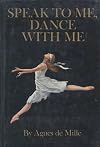
Speak to Me, Dance with Me is a memoir by famed dancer and choreographer Agnes de Mille. The book covers the years 1933 through 1935, when de Mille, an American, was struggling to make her name as a dancer and dance designer in England. I found that a very interesting world, time and place to learn about. I'm not really that interested in dance and dance history, to be honest, but I am interested in the creative process and in human nature, and both are on vivid display in this book. It is show more interesting that many of the key dance/ballet troupes in England at that time were led by women.
But when it came to theatrical or concert productions, usually men had the money and made the decisions. de Mille chronicles the ways in which her struggles to gain support among important men (and even women) were affected by the fact that she was not deemed glamorous enough. At one point de Mille has it explained to her that the reason two particular producers had lost interest in her as an artist was that she was not well dressed enough at rehearsals.
Finally, her uncle, the famous movie director Cecil B. de Mille, calls her to Hollywood to create and perform in a dance number for his production of Cleopatra. The experience is a horror for Agnes, as her uncle wants something artistically vulgar, Agnes refuses to go along, and she is ousted from the production. The following passages explain de Milles' frustration:
Mim {a dance troupe leader in London and de Mille's teacher and employer} later asked, "Whatever made you think you could collaborate with this kind of taste?" He was my uncle who had excited me all my life and I thought I could. I believe had I been a man I would have been given a second chance. Men give men second chances, never women, except as an act of courtship. Cecil liked a show of spirit in a girl, but only as a gambit in flirtation; he liked sauciness, the devout preparation for his attention and then the taunting. That was high coquetry. One could say "no" if one was irresistibly gotten up. I've seen his daughter and my sister tease jewels out of him. But I met him eyeball to eyeball in football regalia and said like any man, "I won't budge. My soul forbids it."
My work marched on its own feet. But not very far, alas! I should have been able simply to dress better and to flirt. It was not simple. To me it was basic.
Mary Austin, the writer, had once said to me, "In all the history of art I have never heard of a man helping a woman because of the quality of her talent, not once. If they helped, they were seduced into helping the woman first and, if needs must, secondly the talent. Men's talents are, of course, something else."
I don't want to convey the idea that this book is a feminist polemic. It is about the struggles of an artist to gain a foothold in a tough, tough world where she doesn't quite fit in. The narrative is helped enormously by de Mille's considerable talent as a writer. Also, I should say, a second theme of the memoir (second but not secondary) is de Mille's relationship with a young man named Ramon, paralyzed from the waist down since his early teens but beautiful, articulate and sensitive. Great company for a struggling artist in need of cheering, in other words.
Because of the circles de Mille is moving in (and the family she comes from), there are many friendships and encounters (leading to sometimes fascinating written portraits) of famous people of the day. Gertrude Lawrence, Cole Porter, Elizabeth Bowen and George Bernard Shaw all play roles in de Mille's story to a greater or lesser degree.
Later, de Mille gained considerable fame and success, particularly for her choreography on Broadway hits like Oklahoma and Brigadoon. But this book is about the early years of struggle, and that later success is only alluded to in passing once or twice.
I picked this book up basically at random from the shelf of my used bookstore and it opened up a world I had never really thought to explore at all. That's one of the very best things about reading, for me. show less
But when it came to theatrical or concert productions, usually men had the money and made the decisions. de Mille chronicles the ways in which her struggles to gain support among important men (and even women) were affected by the fact that she was not deemed glamorous enough. At one point de Mille has it explained to her that the reason two particular producers had lost interest in her as an artist was that she was not well dressed enough at rehearsals.
Finally, her uncle, the famous movie director Cecil B. de Mille, calls her to Hollywood to create and perform in a dance number for his production of Cleopatra. The experience is a horror for Agnes, as her uncle wants something artistically vulgar, Agnes refuses to go along, and she is ousted from the production. The following passages explain de Milles' frustration:
Mim {a dance troupe leader in London and de Mille's teacher and employer} later asked, "Whatever made you think you could collaborate with this kind of taste?" He was my uncle who had excited me all my life and I thought I could. I believe had I been a man I would have been given a second chance. Men give men second chances, never women, except as an act of courtship. Cecil liked a show of spirit in a girl, but only as a gambit in flirtation; he liked sauciness, the devout preparation for his attention and then the taunting. That was high coquetry. One could say "no" if one was irresistibly gotten up. I've seen his daughter and my sister tease jewels out of him. But I met him eyeball to eyeball in football regalia and said like any man, "I won't budge. My soul forbids it."
My work marched on its own feet. But not very far, alas! I should have been able simply to dress better and to flirt. It was not simple. To me it was basic.
Mary Austin, the writer, had once said to me, "In all the history of art I have never heard of a man helping a woman because of the quality of her talent, not once. If they helped, they were seduced into helping the woman first and, if needs must, secondly the talent. Men's talents are, of course, something else."
I don't want to convey the idea that this book is a feminist polemic. It is about the struggles of an artist to gain a foothold in a tough, tough world where she doesn't quite fit in. The narrative is helped enormously by de Mille's considerable talent as a writer. Also, I should say, a second theme of the memoir (second but not secondary) is de Mille's relationship with a young man named Ramon, paralyzed from the waist down since his early teens but beautiful, articulate and sensitive. Great company for a struggling artist in need of cheering, in other words.
Because of the circles de Mille is moving in (and the family she comes from), there are many friendships and encounters (leading to sometimes fascinating written portraits) of famous people of the day. Gertrude Lawrence, Cole Porter, Elizabeth Bowen and George Bernard Shaw all play roles in de Mille's story to a greater or lesser degree.
Later, de Mille gained considerable fame and success, particularly for her choreography on Broadway hits like Oklahoma and Brigadoon. But this book is about the early years of struggle, and that later success is only alluded to in passing once or twice.
I picked this book up basically at random from the shelf of my used bookstore and it opened up a world I had never really thought to explore at all. That's one of the very best things about reading, for me. show less

As of 7/20/09 this fabulous book is still available at http://abebooks.com for $1.00 -in my opinion this is one of the most truly interesting and accessible biographies of a major figure in American modern dance-written by an "insider" who became a famous choreographer in her own right. As this book, and her many others prove, Agnes de Mille wrote just as beautifully as she choreographed. If you ever danced under the direction of a "diva", you'll relate to the story she tells of her years show more with Martha, and very possibly gain greater insight into the mind-set of those like her who truly need to believe they are genius-incarnate! show less

The great Agnes deMille gives us an overview of the famous murders (with lots of pictures), and then a behind the scenes look at mounting an original American ballet - Fall River Legend. Horrifying, fascinating, recommended.

Interesting tale of how she created a ballet by making sense of a famous ax murderer.
Lists
Awards


You May Also Like


Associated Authors
Statistics
- Works
- 28
- Also by
- 1
- Members
- 508
- Popularity
- #48,805
- Rating
- 3.9
- Reviews
- 8
- ISBNs
- 25
- Favorited
- 2
