
Martha Freeman
Author of Who Is Stealing the 12 Days of Christmas?
About the Author
Image credit: https://www.teachingbooks.net/tb.cgi?aid=4644
Series
Works by Martha Freeman
Always, Rachel: The Letters of Rachel Carson and Dorothy Freeman, 1952-1964, The Story of a Remarkable Friendship (1995) — Editor — 111 copies
LA MIA MAMMA È UNA BOMBA 1 copy
Kitty vs. Christmas 1 copy
Tagged
Common Knowledge
- Gender
- female
- Occupations
- reporter
teacher - Nationality
- USA (birth)
- Places of residence
- Philadelphia, Pennsylvania, USA
- Associated Place (for map)
- Pennsylvania, USA
Members
Discussions
Found: I can’t name this book in Name that Book (July 2023)
Reviews

American children's author Martha Freeman and Korean illustrator Violet (Jung Ah) Kim pair up in this cheerful picture-book guide to participating in one of the fundamental activities of American democracy: the protest march. The narrator lists the things a young marcher will need to bring with them, gives advice on how to get to a march and how to conduct oneself while marching, and concludes with the instruction to be ready. One will want, inevitably, to march again...
As someone who show more participated in my first march at the age of thirteen - I went with church friends, rather than with my parents - I appreciated Freeman's positive, upbeat take on childhood involvement in protest. I like to see books which encourage young people to get involved as citizens, and I particularly like that Freeman models good behavior for such activities. Protests are often, by their very nature, chaotic and full of conflict, so I appreciate the fact that Freeman emphasizes peaceful protest activities, and that she discusses how to behave toward those who hold different views, and aren't happy to see the protesters. One wishes today's marchers, on whichever side, and for whatever cause, followed her advice. Recommended to anyone looking for children's books which address political involvement and activism for young people. show less
As someone who show more participated in my first march at the age of thirteen - I went with church friends, rather than with my parents - I appreciated Freeman's positive, upbeat take on childhood involvement in protest. I like to see books which encourage young people to get involved as citizens, and I particularly like that Freeman models good behavior for such activities. Protests are often, by their very nature, chaotic and full of conflict, so I appreciate the fact that Freeman emphasizes peaceful protest activities, and that she discusses how to behave toward those who hold different views, and aren't happy to see the protesters. One wishes today's marchers, on whichever side, and for whatever cause, followed her advice. Recommended to anyone looking for children's books which address political involvement and activism for young people. show less

The mice at the Cherry Street Children's Home have an unusual fixation: they are devoted art collectors. The little mouse-sized pictures with the conveniently sticky backs that Matron keeps on her desk are irresistible, and Art Thief is a prestigious position in the mouse community. Mary Mouse is the first female to hold the post after her husband, the previous Art Thief, fell victim to an unfortunate on-the-job accident involving the resident feline. When Mary seems about to suffer a show more similar fate, she is rescued by one of the girls at the Home -- but in the process, she is seen, not just by that one girl, but by other humans, who schedule a visit from the dreaded Exterminator. The Cherry Street mice will have to move . . . and Mary, the one who brought this disaster down upon them, will be left behind. It's basically a death sentence for Mary, except that the orphans are involved in their own drama, one that Mary will find herself involved in because of Caro, her sympathetic human rescuer.
This book takes a lot of inspiration from Stuart Little, and reads like a mid-century children's classic. It's just the sort of book I would have liked when I was eight or nine, and I hope it will find an audience of similarly enthusiastic young readers today. The characters (both mouse and orphan) are delightful, and there's just the right amount of action and adventure to keep the plot moving along. It does start with a rather traumatic mouse death (Mary's husband's encounter with the cat), but readers who can get past that will find a lot to like in this story.
I don't usually comment on book covers, but I feel this one does a particularly poor job of making the book attractive to young readers. The girl on the front looks no older than six (Caro is supposed to be ten), and the cream background and the cream nightgown make the whole thing look washed out. I expect better from an artist of David McPhail's caliber. show less
This book takes a lot of inspiration from Stuart Little, and reads like a mid-century children's classic. It's just the sort of book I would have liked when I was eight or nine, and I hope it will find an audience of similarly enthusiastic young readers today. The characters (both mouse and orphan) are delightful, and there's just the right amount of action and adventure to keep the plot moving along. It does start with a rather traumatic mouse death (Mary's husband's encounter with the cat), but readers who can get past that will find a lot to like in this story.
I don't usually comment on book covers, but I feel this one does a particularly poor job of making the book attractive to young readers. The girl on the front looks no older than six (Caro is supposed to be ten), and the cream background and the cream nightgown make the whole thing look washed out. I expect better from an artist of David McPhail's caliber. show less

Alex and Yasmeen may have sworn off solving mysteries, but their previous success in solving two earlier ones along with their appearance on the cover of College Springs Magazine makes it hard to make everyone know they are serious.
On Memorial Day there is the Saucersburg 5-K race followed by a baseball game between Uncle Sam's Lawn Care of College Springs and Belletoona Pets & Fish. Coach Banner is the owner/sponsor/coach of the Uncle Sam's Lawn Care team, and also dresses up as Uncle Sam show more to lead off the runners in the 5-K while riding his decked out bike. When Coach Banner goes over to the Porta-Potties to change to his costume and never shows up, a mystery is born.
There are clues, but are they true? Many don't seem to add up or even lead to a possible solution. A ransom letter that arrives after the Coach is found? Picking through bags of trash and finding trash. Pollution from lawn chemicals affecting waterways.
Along the way Alex and Yasmeen learn about chemical pollution that can affect areas that are not necessarily close by. Due to the presentation Alex has to do for his Decade Project, he learns about Vietnam and the war in the 1960s from neighbours who were there. And that Memorial Day is not just a day of picnics, 5-K races and baseball games.
The story goes at a good clip and the solution was not what I expected. I did enjoy this like I did in a previous book titled "Who Stole Halloween?". I will definitely read more of Freeman's work as I come across it. show less
On Memorial Day there is the Saucersburg 5-K race followed by a baseball game between Uncle Sam's Lawn Care of College Springs and Belletoona Pets & Fish. Coach Banner is the owner/sponsor/coach of the Uncle Sam's Lawn Care team, and also dresses up as Uncle Sam show more to lead off the runners in the 5-K while riding his decked out bike. When Coach Banner goes over to the Porta-Potties to change to his costume and never shows up, a mystery is born.
There are clues, but are they true? Many don't seem to add up or even lead to a possible solution. A ransom letter that arrives after the Coach is found? Picking through bags of trash and finding trash. Pollution from lawn chemicals affecting waterways.
Along the way Alex and Yasmeen learn about chemical pollution that can affect areas that are not necessarily close by. Due to the presentation Alex has to do for his Decade Project, he learns about Vietnam and the war in the 1960s from neighbours who were there. And that Memorial Day is not just a day of picnics, 5-K races and baseball games.
The story goes at a good clip and the solution was not what I expected. I did enjoy this like I did in a previous book titled "Who Stole Halloween?". I will definitely read more of Freeman's work as I come across it. show less
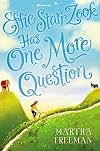
A fun, light-hearted mystery. Effie is a bold girl who knows what she wants and goes after it. Budding reporters, follow Effie's questioning lead and accepting philosophy. Bookstore owner Pendleton Odbody is an inspiring and wise friend.
Awards


You May Also Like


Associated Authors
Statistics
- Works
- 41
- Members
- 2,876
- Popularity
- #8,907
- Rating
- 3.6
- Reviews
- 29
- ISBNs
- 150
- Languages
- 4