
Sakurako Gokurakuin
Author of Aquarian Age: Juvenile Orion, Volume 1
About the Author
Disambiguation Notice:
Sakura Ashika is a pen name of Sakurako Gokurakuin.
Series
Works by Sakurako Gokurakuin
Sekirei (2-in-1 Edition), volume 3: Whether You Get Me Or Not Depends Entirely On You. Show Me You're A Man! (2018) 18 copies
Kategorie: Stvůry 1 1 copy
Kategorie: Stvůry 4 1 copy
Sekirei Vol. 7 1 copy
Sekirei Vol. 17 1 copy
Sekirei Vol. 15 1 copy
Sekirei, Vol. 14 1 copy
Sekirei, Vol. 13 1 copy
Sekirei, Vol. 12 1 copy
Sekirei Vol. 8 1 copy
Sekirei Vol. 9 1 copy
Kategorie: Stvůry 3 1 copy
Sekirei Vol. 6 1 copy
Sekirei Vol. 3 1 copy
Huan's odd of hyuk - - Returner Figure 1 (Young Jump Comics) (2010) ISBN: 4088778936 [Japanese Import] (2010) 1 copy
Sekirei, Vol. 18 1 copy
Kategorie: Stvůry 2 1 copy
Sekirei Vol. 16 1 copy
Tagged
Common Knowledge
Members
Reviews

If you'll remember, I hated the live action Aquarian Age: Juvenile Orion movie. It looked awful, it was confusing, it completely skipped out on its own climactic battle, and then it just ended. I was curious to see how well the manga would work for me, and whether it would make more sense than the movie.
As it turns out, the live action movie and the manga only have a few similarities. However, like the movie, this first volume of the manga jumps back and forth between a lot of different show more characters. There are Kaname and Naoya, two friends. Kaname has weird dreams and back pains, and there are hints, early on, that Naoya isn't a normal teenage boy. There's Tsukasa, a gentle teen with amnesia, and Tomonori (I called him Nakaura in my review of the movie, but I'm switching to his given name now), who is both a priest (I guess?) and the mathematics teacher at the school everyone goes to. Mana is a teen who has recently transferred to the school – she desperately wants to find and reconnect with Kaname, who was both her childhood friend and her savior. Isshin is the oldest of the students. He develops a crush on Mana the instant he meets her, which is unfortunate, since she seems to be completely fixated on Kaname (who keeps telling her to leave him be).
This world has five factions, plus the mind breakers. The factions are: Arayashiki (Asian magic), WIZ-DOM (Western priests), Darklore (the guys with black wings), E.G.O. (humans, mostly girls and women, with special powers), and the Erasers (alien beings with white angel wings).
If I'm interpreting things correctly, mind breakers are able to act as the masters of members of these various factions, allowing them full access to their powers so that they can use them in battle. In this volume, Naoya suspects Mana of being a mind breaker, so he attacks her in an effort to force her to reveal her powers. Kaname jumps in to protect her, accidentally revealing that he is a member of the Darklore faction. Meanwhile, there's some stuff with Tomonori, who seems to consider Darklore to be his enemy, and Tsukasa, who secretly has the ability to grow white wings where his ears should be.
Basically, this first volume of the manga series was just as choppy and busy as the live action movie. On the plus side, it made slightly more sense. I especially appreciated the extras, which included a 10-page explanation of the trading card game on which this series was based. In the card game, players are the mind breakers, and they control cards belonging to each of the various factions. I still thought the manga was way too busy and confusing, but suddenly the reason for it all made much more sense. It was busy and confusing because it was trying to incorporate the rules and features of a complex trading card game.
I didn't care for the characters any more than the setup. In most cases, I didn't get to see them enough to care much about them. Naoya looked like a villain, until the moment he and everyone else decided he wasn't. Mana was a naive klutz whose actions didn't always have anything to do with what was going on around her. For example, the instant Kaname came on scene, she forgot that she was scared and that Naoya was trying to kill her (with magic, even!) - reuniting with her childhood best friend was far more important. She later tried to explain this away by saying that she had known about Kaname's wings for years and was therefore already used to weirdness, but...no. I just didn't buy it.
I can put up with a lot in a manga if it at least has nice artwork. Gokurakuin's artwork wasn't terrible, but some things definitely looked odd. At times, characters' heads were positioned too low on their necks, and there were more than a few funky hands.
If my coworker hadn't lent me the whole series, I'd probably be giving up after this first volume. It was better than the live action movie, but that's not really saying much.
Extras:
Three pages of a comic-style author's afterword, a one-page preview of the next volume, a little over a page of translator's notes, a chart detailing the ways in which characters refer to each other (for example, Mana vs. Kirihara-san vs. Kirihara), 10 pages of information about the trading card game, and two pages showing off some Juvenile Orion merchandise.
(Original review, with read-alikes and watch-alikes, posted on A Library Girl's Familiar Diversions.) show less
As it turns out, the live action movie and the manga only have a few similarities. However, like the movie, this first volume of the manga jumps back and forth between a lot of different show more characters. There are Kaname and Naoya, two friends. Kaname has weird dreams and back pains, and there are hints, early on, that Naoya isn't a normal teenage boy. There's Tsukasa, a gentle teen with amnesia, and Tomonori (I called him Nakaura in my review of the movie, but I'm switching to his given name now), who is both a priest (I guess?) and the mathematics teacher at the school everyone goes to. Mana is a teen who has recently transferred to the school – she desperately wants to find and reconnect with Kaname, who was both her childhood friend and her savior. Isshin is the oldest of the students. He develops a crush on Mana the instant he meets her, which is unfortunate, since she seems to be completely fixated on Kaname (who keeps telling her to leave him be).
This world has five factions, plus the mind breakers. The factions are: Arayashiki (Asian magic), WIZ-DOM (Western priests), Darklore (the guys with black wings), E.G.O. (humans, mostly girls and women, with special powers), and the Erasers (alien beings with white angel wings).
If I'm interpreting things correctly, mind breakers are able to act as the masters of members of these various factions, allowing them full access to their powers so that they can use them in battle. In this volume, Naoya suspects Mana of being a mind breaker, so he attacks her in an effort to force her to reveal her powers. Kaname jumps in to protect her, accidentally revealing that he is a member of the Darklore faction. Meanwhile, there's some stuff with Tomonori, who seems to consider Darklore to be his enemy, and Tsukasa, who secretly has the ability to grow white wings where his ears should be.
Basically, this first volume of the manga series was just as choppy and busy as the live action movie. On the plus side, it made slightly more sense. I especially appreciated the extras, which included a 10-page explanation of the trading card game on which this series was based. In the card game, players are the mind breakers, and they control cards belonging to each of the various factions. I still thought the manga was way too busy and confusing, but suddenly the reason for it all made much more sense. It was busy and confusing because it was trying to incorporate the rules and features of a complex trading card game.
I didn't care for the characters any more than the setup. In most cases, I didn't get to see them enough to care much about them. Naoya looked like a villain, until the moment he and everyone else decided he wasn't. Mana was a naive klutz whose actions didn't always have anything to do with what was going on around her. For example, the instant Kaname came on scene, she forgot that she was scared and that Naoya was trying to kill her (with magic, even!) - reuniting with her childhood best friend was far more important. She later tried to explain this away by saying that she had known about Kaname's wings for years and was therefore already used to weirdness, but...no. I just didn't buy it.
I can put up with a lot in a manga if it at least has nice artwork. Gokurakuin's artwork wasn't terrible, but some things definitely looked odd. At times, characters' heads were positioned too low on their necks, and there were more than a few funky hands.
If my coworker hadn't lent me the whole series, I'd probably be giving up after this first volume. It was better than the live action movie, but that's not really saying much.
Extras:
Three pages of a comic-style author's afterword, a one-page preview of the next volume, a little over a page of translator's notes, a chart detailing the ways in which characters refer to each other (for example, Mana vs. Kirihara-san vs. Kirihara), 10 pages of information about the trading card game, and two pages showing off some Juvenile Orion merchandise.
(Original review, with read-alikes and watch-alikes, posted on A Library Girl's Familiar Diversions.) show less
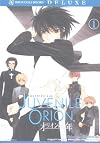
Aquarian Age is interesting and engaging: the series would be perfect for the shounen-lover. The art is pretty much what you'd expect, and the story progresses fairly easily. I wasn't overly drawn to any of its characters personally, but I usually don't read shonen so I shouldn't judge.
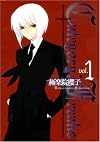
This review was originally written for the website ListerX.com, which is now defunct. It can also be found on my blog, The Graphic Librarian.
Cover
The simplistic cover, while beautifully gothic, does little to convey the graphic contents found within. Nevertheless, the single image of Asagi Nanami works wonderfully. Black, white, and red has always been a winning combination of colors, and this cover is no exception. The font is decidedly Old English in style, but is still easily legible and show more the decision to underlay a copy of the title vertically in the background was a good design choice. However, one would think that words other than a repeat of the title would have done more to enhance the cover's atmosphere. The back cover is just as sparse as the front and features Tokiko, a rather abnormal member of the investigatory team (although she doesn't look it in her lolita-esque dress and cute bunny-eared hat.) The blurb is written in the same font used on the front for the title, but even miniaturized, it's still very easy to read.
Artwork
Despite the very adult subject matter in areas of this manga, I can really only describe the artwork as adorable. This style works really well for the female characters, but not quite as well for the males. That's not to say that they're ugly, but even the more mature male characters have a prepubescent feel to them that isn't really to my tastes. Sakurako's backgrounds are, for the most part, very bland, using little more than gradients with some occasional stippling and/or speed lines. Of course, that doesn't mean the manga-ka can't do backgrounds when he/she wants to, there are actually several beautifully drawn backdrops spaced throughout the story. I suppose somewhere along the line the decision was made to keep the backgrounds to a minimum because they weren't that important to the story. . . and they really aren't. It does make the art style feel sparse in my opinion, but it doesn't really detract at all from the story. The action sequences, while nothing spectacular, are well-drawn and easy to follow from panel to panel. There aren't any places where things become difficult to understand, which is, of course, always a plus for me.
Plot
**Possible Spoilers Warning**
The plot is setup in the typical episodic style. Each story focuses on a group of paranormal investigators who are more than what they seem. Their main goal is to hunt "Freaks" - monsters, spirits and demons intent on causing harm to human kind. At least three of the group's members are what's known as Stands - the natural enemy of Freaks, according to the manga. Stands have powers which they use to do battle with the Freaks. The main character from the front cover, Asagi Nanami, has powers which remind me a lot of Alucard's from Hellsing - you know, that weird black mass full of eyes and teeth. Then there's Tokiko who's diet consists solely of Freaks - she gets the cutest expressions on her face when she's hungry. The final stand is a woman named Yahiro, but her powers, while obviously strong, remain vague. There are also two humans in the group, Amano Naoki, who seems to handle the business end of things and Mahime Yoshino, a young girl whose reasons for being there aren't exactly clear, although she seems to have a strange connection to Yahiro.
The actual story exists in five different acts with each act pertaining to a different kind of Freak. It's hard to say too much about the individual stories without giving too much away. The first story deals with a Freak who's causing workplace accidents. The second case involves young maids who are disappearing from a manor house. (Just a warning - this particular story is graphically explicit!) The third incident deals with the mystery surrounding young women who are being attacked by a giant teddy bear. In the fourth act young men become the targets of a Freak connected to a "Love" telephone hotline. We also meet Ayu in this act, a young man who seems to have more than brotherly feelings towards Amano. The final extra act focuses on a haunted high school and a ghost who doesn't allow any of the girls to wear their hair long.
Despite the rather comedic air that most of these acts seem to possess, the stories are actually treated with an almost disturbing seriousness. While there are some intentionally funny moments, the overall feel of the plot is very dark - dark enough that it definitely deserves it's 18+ horror genre rating.
Content Warnings
Language = Yes, but fairly mild stuff.
Violence = Yes; at least two of the acts contain bloody and/or gory elements.
Nudity = Yes; there is full frontal female nudity and suggested male nudity in at least 2 acts.
Sexual Situations = Yes; the 2nd act is very explicit and the 4th act involves some suggested scenes.
Ratings
Cover - 8/10 - Simple with some pleasing design elements. Very eye-catching.
Artwork - 8/10 - Simplistically elegant. Not usually my style, but it works nicely.
Plot - 7/10 - Doesn't leave me instantly craving more, but the characters & their situations are intriguing.
Overall - 7/10 - Despite some predictability, this manga shows a lot of promise for future volumes. show less
Cover
The simplistic cover, while beautifully gothic, does little to convey the graphic contents found within. Nevertheless, the single image of Asagi Nanami works wonderfully. Black, white, and red has always been a winning combination of colors, and this cover is no exception. The font is decidedly Old English in style, but is still easily legible and show more the decision to underlay a copy of the title vertically in the background was a good design choice. However, one would think that words other than a repeat of the title would have done more to enhance the cover's atmosphere. The back cover is just as sparse as the front and features Tokiko, a rather abnormal member of the investigatory team (although she doesn't look it in her lolita-esque dress and cute bunny-eared hat.) The blurb is written in the same font used on the front for the title, but even miniaturized, it's still very easy to read.
Artwork
Despite the very adult subject matter in areas of this manga, I can really only describe the artwork as adorable. This style works really well for the female characters, but not quite as well for the males. That's not to say that they're ugly, but even the more mature male characters have a prepubescent feel to them that isn't really to my tastes. Sakurako's backgrounds are, for the most part, very bland, using little more than gradients with some occasional stippling and/or speed lines. Of course, that doesn't mean the manga-ka can't do backgrounds when he/she wants to, there are actually several beautifully drawn backdrops spaced throughout the story. I suppose somewhere along the line the decision was made to keep the backgrounds to a minimum because they weren't that important to the story. . . and they really aren't. It does make the art style feel sparse in my opinion, but it doesn't really detract at all from the story. The action sequences, while nothing spectacular, are well-drawn and easy to follow from panel to panel. There aren't any places where things become difficult to understand, which is, of course, always a plus for me.
Plot
**Possible Spoilers Warning**
The plot is setup in the typical episodic style. Each story focuses on a group of paranormal investigators who are more than what they seem. Their main goal is to hunt "Freaks" - monsters, spirits and demons intent on causing harm to human kind. At least three of the group's members are what's known as Stands - the natural enemy of Freaks, according to the manga. Stands have powers which they use to do battle with the Freaks. The main character from the front cover, Asagi Nanami, has powers which remind me a lot of Alucard's from Hellsing - you know, that weird black mass full of eyes and teeth. Then there's Tokiko who's diet consists solely of Freaks - she gets the cutest expressions on her face when she's hungry. The final stand is a woman named Yahiro, but her powers, while obviously strong, remain vague. There are also two humans in the group, Amano Naoki, who seems to handle the business end of things and Mahime Yoshino, a young girl whose reasons for being there aren't exactly clear, although she seems to have a strange connection to Yahiro.
The actual story exists in five different acts with each act pertaining to a different kind of Freak. It's hard to say too much about the individual stories without giving too much away. The first story deals with a Freak who's causing workplace accidents. The second case involves young maids who are disappearing from a manor house. (Just a warning - this particular story is graphically explicit!) The third incident deals with the mystery surrounding young women who are being attacked by a giant teddy bear. In the fourth act young men become the targets of a Freak connected to a "Love" telephone hotline. We also meet Ayu in this act, a young man who seems to have more than brotherly feelings towards Amano. The final extra act focuses on a haunted high school and a ghost who doesn't allow any of the girls to wear their hair long.
Despite the rather comedic air that most of these acts seem to possess, the stories are actually treated with an almost disturbing seriousness. While there are some intentionally funny moments, the overall feel of the plot is very dark - dark enough that it definitely deserves it's 18+ horror genre rating.
Content Warnings
Language = Yes, but fairly mild stuff.
Violence = Yes; at least two of the acts contain bloody and/or gory elements.
Nudity = Yes; there is full frontal female nudity and suggested male nudity in at least 2 acts.
Sexual Situations = Yes; the 2nd act is very explicit and the 4th act involves some suggested scenes.
Ratings
Cover - 8/10 - Simple with some pleasing design elements. Very eye-catching.
Artwork - 8/10 - Simplistically elegant. Not usually my style, but it works nicely.
Plot - 7/10 - Doesn't leave me instantly craving more, but the characters & their situations are intriguing.
Overall - 7/10 - Despite some predictability, this manga shows a lot of promise for future volumes. show less

This review was originally written for the website ListerX.com, which is now defunct. It can also be found on my blog, The Graphic Librarian.
Cover
Artistically, this cover is immediately eye-catching. Although a bit more subdued than V.01, the same color combination of various shades of red, black, and white works just as well. However, because the image itself is a bit more active, the cover's text makes things almost too busy. Fortunately, the gorgeous image of Izumi is likely to keep show more wandering eyes from focusing on the text for too long. There's also an annoyingly orange parental advisory label in the lower left hand corner, but it doesn't take up too much room and is probably a necessary addition for less observant parents. Although I don't see why a sticker wouldn't have worked just as well. One of the things I like best about Dr. Master's covers is the lack of clutter in regards to things like barcodes, logos, advisories, etc. They do an excellent job of keeping the manga's cover simple and the art as visible as possible.
Artwork
Being a big fan of manga-ka who put a lot of detail into their work, I still can't make myself completely enjoy Sakurako's illustrations. Stylistically, there's absolutely nothing wrong with it. The characters are excellently drawn with body proportions slightly enhanced to please the eye and the action sequences are fast-paced and easy to follow. Facial expressions for all the characters are subtle when they need to be and fully expressive exactly where expected. Sakurako really knows how to make a character look utterly evil. Another thing that really stuck out in this volume were the costume designs. A handful of new characters are added in this volume, each with their own unique outfits. What really grabs me about them is that they have the same simplified style as the rest of the artwork, and yet they still somehow manage to look intricate and well-designed. So, while I'm not personally a fan of the art in this series, the artist nevertheless knows her stuff. In technique and design she's definitely skilled, but stylistically the illustrations just aren't to my tastes.
Plot
**Possible Spoilers Warning**
At first I was worried that this was going to be yet another volume of episodic chapters with very little actually connection between them. However, I was pleasantly surprised. While things start out with an unrelated story, they quickly turn into a full-scale plot. In addition to the continuous plot line the reader is also introduced to a variety of new characters. In fact, while reading this volume, V.01 began to seem more like a prequel to V.02 rather than a companion. Asagi and his agents have discovered a Freak that can create living dolls, dolls which can be used (or abused) in any way the owner desires. They've been on the hunt for her for quite awhile, but it's not until some of her creations gain sentience and start "taking back" their "brothers and sisters" that things get serious. Not only are they absorbing the dolls, they're killing their owners - and anyone else who happens to be around at the time. Meanwhile Asagi finds himself at odds with their creator and despite his considerable powers, he's finding it difficult to stop her. The Freak becomes obsessed with destroying him and will do so by any means necessary, even if it has to take out all of Asagi's friends along the way. Throughout all of this the dolls continue to be collected until finally there's only one left. Asagi plans to destroy this last creation himself, seeing it as nothing more than another Freak. However, when he learns of the situation behind the doll's creation, he has a change of heart. But will Asagi and his team be enough to stop the doll's siblings from consuming their "brother"? And how far will he be willing to go to stop the crazed trio? Would he truly be willing to sacrifice his pact to never shed blood again?
Content Warnings
Language = I've been told I'm desensitized to this sort of thing. However, as far as I can tell, there really is very little foul language used.
Violence = Yes - dismembered body parts and exploding heads abound - not for the weak of heart (or stomach.)
Nudity = Yes - Full frontal female nudity. And on that note, a warning - several of the nude characters are dolls, many of which have the appearance of prepubescent girls.
Sexual Situations = Yes - most prominent is a lesbian scene between a woman and her doll, but there are some het scenes, as well.
Ratings
Cover - 7.5/10 - While not quite as attractive as V.01, this cover definitely catches and holds the eye, just as any good cover should.
Artwork - 6/10 - The simplistic style still isn't to my liking, but the manga-ka obviously knows her stuff.
Plot - 7/10 - Ah Ha! The emergence of an actual continuous story line - definitely worth reading to find out more.
Overall - 7/10 - Things are definitely getting more interesting, and I love the relationships between the various characters. show less
Cover
Artistically, this cover is immediately eye-catching. Although a bit more subdued than V.01, the same color combination of various shades of red, black, and white works just as well. However, because the image itself is a bit more active, the cover's text makes things almost too busy. Fortunately, the gorgeous image of Izumi is likely to keep show more wandering eyes from focusing on the text for too long. There's also an annoyingly orange parental advisory label in the lower left hand corner, but it doesn't take up too much room and is probably a necessary addition for less observant parents. Although I don't see why a sticker wouldn't have worked just as well. One of the things I like best about Dr. Master's covers is the lack of clutter in regards to things like barcodes, logos, advisories, etc. They do an excellent job of keeping the manga's cover simple and the art as visible as possible.
Artwork
Being a big fan of manga-ka who put a lot of detail into their work, I still can't make myself completely enjoy Sakurako's illustrations. Stylistically, there's absolutely nothing wrong with it. The characters are excellently drawn with body proportions slightly enhanced to please the eye and the action sequences are fast-paced and easy to follow. Facial expressions for all the characters are subtle when they need to be and fully expressive exactly where expected. Sakurako really knows how to make a character look utterly evil. Another thing that really stuck out in this volume were the costume designs. A handful of new characters are added in this volume, each with their own unique outfits. What really grabs me about them is that they have the same simplified style as the rest of the artwork, and yet they still somehow manage to look intricate and well-designed. So, while I'm not personally a fan of the art in this series, the artist nevertheless knows her stuff. In technique and design she's definitely skilled, but stylistically the illustrations just aren't to my tastes.
Plot
**Possible Spoilers Warning**
At first I was worried that this was going to be yet another volume of episodic chapters with very little actually connection between them. However, I was pleasantly surprised. While things start out with an unrelated story, they quickly turn into a full-scale plot. In addition to the continuous plot line the reader is also introduced to a variety of new characters. In fact, while reading this volume, V.01 began to seem more like a prequel to V.02 rather than a companion. Asagi and his agents have discovered a Freak that can create living dolls, dolls which can be used (or abused) in any way the owner desires. They've been on the hunt for her for quite awhile, but it's not until some of her creations gain sentience and start "taking back" their "brothers and sisters" that things get serious. Not only are they absorbing the dolls, they're killing their owners - and anyone else who happens to be around at the time. Meanwhile Asagi finds himself at odds with their creator and despite his considerable powers, he's finding it difficult to stop her. The Freak becomes obsessed with destroying him and will do so by any means necessary, even if it has to take out all of Asagi's friends along the way. Throughout all of this the dolls continue to be collected until finally there's only one left. Asagi plans to destroy this last creation himself, seeing it as nothing more than another Freak. However, when he learns of the situation behind the doll's creation, he has a change of heart. But will Asagi and his team be enough to stop the doll's siblings from consuming their "brother"? And how far will he be willing to go to stop the crazed trio? Would he truly be willing to sacrifice his pact to never shed blood again?
Content Warnings
Language = I've been told I'm desensitized to this sort of thing. However, as far as I can tell, there really is very little foul language used.
Violence = Yes - dismembered body parts and exploding heads abound - not for the weak of heart (or stomach.)
Nudity = Yes - Full frontal female nudity. And on that note, a warning - several of the nude characters are dolls, many of which have the appearance of prepubescent girls.
Sexual Situations = Yes - most prominent is a lesbian scene between a woman and her doll, but there are some het scenes, as well.
Ratings
Cover - 7.5/10 - While not quite as attractive as V.01, this cover definitely catches and holds the eye, just as any good cover should.
Artwork - 6/10 - The simplistic style still isn't to my liking, but the manga-ka obviously knows her stuff.
Plot - 7/10 - Ah Ha! The emergence of an actual continuous story line - definitely worth reading to find out more.
Overall - 7/10 - Things are definitely getting more interesting, and I love the relationships between the various characters. show less
You May Also Like


Associated Authors
Statistics
- Works
- 81
- Members
- 1,529
- Popularity
- #16,828
- Rating
- 3.8
- Reviews
- 6
- ISBNs
- 75
- Languages
- 4
- Favorited
- 1