
D. A. Carson
Author of An Introduction to the New Testament
About the Author
D. A. Carson (PhD, University of Cambridge) is research professor of New Testament at Trinity Evangelical Divinity School in Deerfield, Illinois, and is the author or editor of more than fifty books, including The God Who Is There and How Long, O Lord? He is one of the founders of The Gospel show more Coalition and an active guest lecturer in academic and church settings around the world. show less
Series
Works by D. A. Carson
The Gospel according to John (The Pillar New Testament Commentary (PNTC)) (1991) 2,215 copies, 7 reviews
The Cross and Christian Ministry: Leadership Lessons from 1 Corinthians (1993) 1,518 copies, 4 reviews
For the Love of God: A Daily Companion for Discovering the Treasures of God's Word (Volumes 1&2) (1998) 561 copies, 2 reviews
Jesus' Sermon on the Mount: And his Confrontation with the World: An Exposition of Matthew 5-10 (1999) 534 copies, 2 reviews
The Pastor as Scholar and the Scholar as Pastor: Reflections on Life and Ministry (2011) — Author — 530 copies, 3 reviews
NIV Zondervan Study Bible, Hardcover: Built on the Truth of Scripture and Centered on the Gospel Message (2015) 483 copies, 2 reviews
Divine Sovereignty and Human Responsibility: Biblical Perspective in Tension (1994) 460 copies, 3 reviews
The Farewell Discourse and Final Prayer of Jesus: An Exposition of John 14-17 (1980) 426 copies, 1 review
From Sabbath to Lord's Day: A Biblical, Historical and Theological Investigation (1905) 383 copies, 1 review
Jesus the Son of God: A Christological Title Often Overlooked, Sometimes Misunderstood, and Currently Disputed (2012) 264 copies, 4 reviews
The Scriptures Testify About Me: Jesus and the Gospel in the Old Testament (2013) 254 copies, 1 review
The Gospel as Center: Renewing Our Faith and Reforming Our Ministry Practices (2012) 234 copies, 1 review
Justification and Variegated Nomism, Volume 1: The Complexities of Second Temple Judaism (2001) 221 copies, 1 review
Entrusted with the Gospel: Pastoral Expositions of 2 Timothy by John Piper, Philip Ryken, Mark Driscoll, K. Edward Copeland, Bryan Chapell, J. Ligon Duncan (2010) — Editor — 165 copies, 1 review
The Gospel and the Modern World: A Theological Vision for the Church (The Gospel Coalition) (2023) 51 copies
It Is Written: Scripture Citing Scripture: Essays in Honour of Barnabas Lindars, SSF (1988) — Editor; Contributor — 31 copies
Biblical Greek Language and Linguistics: Open Questions in Current Research (Journal for the Study of the New Testament. Supplement Series, 80) (1993) — Editor — 24 copies
O Deus Presente: Encontrando Seu Lugar na História de Deus (Portuguese Edition) (2016) 20 copies, 1 review
O Evangelho no Centro: Renovando nossa fé e reformando nossa prática ministerial (Portuguese Edition) (2016) 13 copies
Um Chamado A Reforma Espiritual 7 copies
Memoires d'un pasteur ordinaire: La vie et les reflexions de Tom Carson (French Edition) (2013) 5 copies
Reading the Letters 5 copies
Le Christ et la culture (Christ and Culture Revisited): Une évaluation de la pensée de H. Richard Niebuhr sur la culture (French Edition) (2017) 4 copies
Coração de crente 3 copies
O Discurso de Despedida e a Ultima Oracao de Jesus - Exposicao de Joao 14-17 (Em Portugues do Brasil) (2019) 3 copies
Can We Know the Truth? 3 copies
Themelios: Volume 1, No. 2, Spring 1976 — Editor — 3 copies
D.A Carson Sermon Library 3 copies
Themelios: Volume 13, No. 3, April/May 1988 — Editor — 2 copies
Themelios: Volume 43, No. 2, August 2018 — Editor — 2 copies
SEBTS Dr. Donald A. Carson 2/9/2000 2 copies
Um Modelo de Maturidade Cristã. Exposição de 2 Coríntios 10-13 (Em Portuguese do Brasil) (2017) 2 copies
Evolution and the Bible 2 copies
NIV Biblical Theology Study Bible: Follow God’s Redemptive Plan as It Unfolds throughout Scripture — Author — 1 copy
Christian Leaders and Money 1 copy
Characteristics of Spiritual Leaders Part 2 (Part 2 of 6 in the Paul Speaks to Pastors Series) 1 copy
Characteristics of Spiritual Leaders Part 1 (Part 1 of 6 in the Paul Speaks to Pastors Series) 1 copy
Trinity Journal 1 copy
不宽容的信仰 1 copy
再思解經錯謬 1 copy
DUMNEZEU ȘI CULTURA 1 copy
Jesus and His Friends 1 copy
Donald Arthur Carson 1 copy
The Bible and Theology 1 copy
神的故事,你的故事 1 copy
Praying With Paul 1 copy
Comentário Bíblico Vida Nova 1 copy
Themelios: Volumes 1 - 42 1 copy
Por amor a Deus 1 copy
Med korset i fokus 1 copy
Themelios 42.1 1 copy
On Disputable Matters 1 copy
Yeni Antlasma'ya Giris 1 copy
Eski Antlasma'ya Genel Bakis 1 copy
Sermon Archive (553 sermons) 1 copy
Sonship 1 copy
Associated Works
The Case for Christ: A Journalist's Personal Investigation of the Evidence for Jesus (1998) — Contributor, some editions — 10,535 copies, 97 reviews
The Deliberate Church: Building Your Ministry on the Gospel (2021) — Foreword — 2,100 copies, 12 reviews
The Expositor's Bible commentary : Matthew, Mark, Luke, with the New international version of the Holy Bible (Expositor's Bible commentary, Vol.8) (1984) — Contributor, some editions — 1,259 copies, 4 reviews
For the Fame of God's Name: Essays in Honor of John Piper (2010) — Contributor — 599 copies, 1 review
Don't Call It a Comeback: The Old Faith for a New Day (The Gospel Coalition) (2011) — Foreword — 367 copies
The Glory of the Atonement: Biblical, Theological & Practical Perspectives (2004) — Contributor — 336 copies, 2 reviews
Preach the Word: Essays on Expository Preaching: In Honor of R. Kent Hughes (2007) — Contributor — 302 copies, 1 review
A Christian’s Pocket Guide to Loving The Old Testament: One Book, One God, One Story (Pocket Guides) (2015) — Afterword — 218 copies, 2 reviews
The Trials of Theology: Becoming a 'Proven Worker' in a Dangerous Business (2010) — Contributor — 199 copies, 2 reviews
Only One Way?: Reaffirming the Exclusive Truth Claims of Christianity (2007) — Contributor — 166 copies
Cross: Unrivaled Christ, Unstoppable Gospel, Unreached Peoples, Unending Joy (2015) — Contributor — 104 copies
What We Have Heard from the Beginning: The Past, Present and Future of Johannine Studies (2007) — Contributor — 54 copies
Nelson's Introduction to the Christian Faith/a Contemporary Handbook of What Christians Believe and Why (1995) — Contributor — 35 copies
The Spirit and Christ in the New Testament and Christian Theology: Essays in Honor of Max Turner (2012) — Contributor — 26 copies, 1 review
Tagged
Common Knowledge
- Legal name
- Carson, Donald Arthur
- Other names
- the DON
Don Carson
D. A. Carson - Birthdate
- 1946-12-21
- Gender
- male
- Education
- University of Cambridge (PhD - New Testament)
Central Baptist Seminary (MDiv)
McGill University (BS - Chemistry and Mathematics) - Occupations
- professor
minister
researcher - Organizations
- Gospel Coalition
Alliance of Confessing Evangelicals
Studiorum Novi Testamenti Societas
Trinity Evangelical Divinity School - Relationships
- Wheildon, Joy (wife)
- Nationality
- Canada
- Birthplace
- Montréal, Québec, Canada
- Places of residence
- Libertyville, Illinois, USA
- Associated Place (for map)
- Canada
Members
Reviews
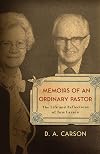
This book was such an utter surprise to me. I picked it up because 1) it was on sale and 2) who doesn't love D.A. Carson? Honestly, my expectations were minimal; the idea of a pastoral biography of a little-known pastor written by his son didn't particularly appeal to me.
Boy, was I wrong!
This book was an orchestra of grace in my heart in a season when I desperately needed it. Tom Carson is a church planter that we never heard of, but one we should know. His story represents untold thousands show more who labor in the vineyard of the Lord season after season with little or no accolades and minimal visible success. Honestly, he is the pastoral "everyman." I think this book ought to be required reading in every seminary; it will crush the romantic and unrealistic notions of rapid church growth and mega-church pastoral appointments that lurk in the corners of every seminarians' heart. Tom Carson was, in a word, faithful. What a joyful and beautiful tribute D.A. Carson offers his father. He manages to avoid hagiography, telling us about his father's struggles and personal dark night of the soul.
Thank you Dr. Carson. Your tribute to your father lifted me in a time when I desperately needed it! show less
Boy, was I wrong!
This book was an orchestra of grace in my heart in a season when I desperately needed it. Tom Carson is a church planter that we never heard of, but one we should know. His story represents untold thousands show more who labor in the vineyard of the Lord season after season with little or no accolades and minimal visible success. Honestly, he is the pastoral "everyman." I think this book ought to be required reading in every seminary; it will crush the romantic and unrealistic notions of rapid church growth and mega-church pastoral appointments that lurk in the corners of every seminarians' heart. Tom Carson was, in a word, faithful. What a joyful and beautiful tribute D.A. Carson offers his father. He manages to avoid hagiography, telling us about his father's struggles and personal dark night of the soul.
Thank you Dr. Carson. Your tribute to your father lifted me in a time when I desperately needed it! show less
I read this meticulously over three years and loved every single minute of it. Previously, I’ve not been an avid fan of Bible commentaries. You can often find yourself following someone else’s furrow. But after reading Carson’s masterful accompaniment to what is my favourite book of the entire (Protestant) canon of scripture, I’m determined to make it a habit.
I discovered Carson’s work through the excellent Best Commentaries website. If you, like me, are overwhelmed by the choices show more out there, this is a great place to start. You know you’re in for a treat when you see the rating on there: Carson’s commentary gets a solid 100% rating. He comes pretty close with my own rating below.
It’s not hard to see why. The work is a wonderful balance. Alongside technical information that is as deep as the average pulpit scholar needs to go is a wonderful devotional thread that shows that, for Carson, the text isn’t just a text but a gateway to understanding the God he loves.
This is really important. What we don’t want in a commentary is someone simply in love with the text. That the writer understands why John wrote his masterpiece is vitally important to helping you both as a Gospel and commentary reader to grasp the point of it all. As John himself writes:
but these are written so that you may believe that Jesus is the Christ, the Son of God, and that by believing you may have life in his name.
John 20 v. 31
Carson doesn’t shy away from the difficult questions that John’s gospel throws up. If the beginning of chapter 8 is almost definitely not original, where did it come from and what does it mean for the the rest of the work? Was chapter 21 actually written by John? In fact, was any of it written by the apostle at all?
All these and many more are covered comprehensively by Carson. For each, he provides an overview of the range of scholaraly opinion, insights into the original Greek, historical, cultural and social data and the whole thing is written in a really accessible style that only very occasionally wanders off into areas of scholarship where the layman feels a little lost. It’s a masterpiece that any thinking Christian would do well to have read and keep to hand for years to come. show less
I discovered Carson’s work through the excellent Best Commentaries website. If you, like me, are overwhelmed by the choices show more out there, this is a great place to start. You know you’re in for a treat when you see the rating on there: Carson’s commentary gets a solid 100% rating. He comes pretty close with my own rating below.
It’s not hard to see why. The work is a wonderful balance. Alongside technical information that is as deep as the average pulpit scholar needs to go is a wonderful devotional thread that shows that, for Carson, the text isn’t just a text but a gateway to understanding the God he loves.
This is really important. What we don’t want in a commentary is someone simply in love with the text. That the writer understands why John wrote his masterpiece is vitally important to helping you both as a Gospel and commentary reader to grasp the point of it all. As John himself writes:
but these are written so that you may believe that Jesus is the Christ, the Son of God, and that by believing you may have life in his name.
John 20 v. 31
Carson doesn’t shy away from the difficult questions that John’s gospel throws up. If the beginning of chapter 8 is almost definitely not original, where did it come from and what does it mean for the the rest of the work? Was chapter 21 actually written by John? In fact, was any of it written by the apostle at all?
All these and many more are covered comprehensively by Carson. For each, he provides an overview of the range of scholaraly opinion, insights into the original Greek, historical, cultural and social data and the whole thing is written in a really accessible style that only very occasionally wanders off into areas of scholarship where the layman feels a little lost. It’s a masterpiece that any thinking Christian would do well to have read and keep to hand for years to come. show less
In 2007, Tim Keller and D.A. Carson formed The Gospel Coalition. The members of the council (from various denominations and theological traditions) came together and wrote a preamble, a statement of faith, and a theological vision for ministry. These foundation documents were then unpacked at the request of various local churches and ministry organizations and published in booklets. The Gospel as Center is the compilation of those booklets, written by the various members of the Gospel show more Coalition’s council.
The Gospel as Center represents the best of what the public has come to expect from Keller and Carson – intensely theological, doctrinally sound, and immensely helpful. The contributions of other notable pastors and scholars – Richard Phillips, Mike Bullmore, Andrew Davis, Reddit Andrews III, Colin Smith, Bryan Chapell, Sandy Wilson, Philip Ryken, Kevin DeYoung, Stephen Um, Tim Savage, Thabiti Anyabwile, Ligon Duncan, and Sam Storms – give even more creditability and weight to the work. For those curious on gaining doctrinal insight to the young, Reformed movement in modern Evangelicalism, one could scarcely find a better resource.
My critique has little to do with the substance of the book, but rather centers on the potential misuse thereof. The book itself has the potential to withstand the test of time as a clarion call to “make central what Jesus himself establishes as central” (21). For some time I have asked which scholars and pastors in our day will be read by the generations to follow. In my opinion, this book is a compilation of many of those authors.
The difficulties involved in gathering leaders from so many different theological traditions and uniting under a singular banner, I feel, is both under and overestimated at times. In one sense, we should be able to unite on the substance of the gospel – “the necessity of the new birth, justification by faith alone, the atonement through propitiation and the substitutionary death of Christ“(11). And yet in another sense, there are significant theological distinctions that are represented by the various denominational backgrounds, and no council or synod will erase centuries of difference and discord.
Perhaps the most obvious example of this dissonance is represented in the only dually-authored chapter in the book (apart from the opening chapter penned by Carson and Keller) – Baptism and the Lord’s Supper. Though the chapter sought to zero in on the aspects agreed upon between Anyabwile (a Baptist) and Duncan (a Presbyterian), the differences between these two perspectives – especially in regards to baptism (creedo or paedo) – are not minor. Students of Reformation history know to what great lengths these different interpretations have been defended – even to the point of persecution and execution. While Anyabwile and Duncan represent the unity we can come to, they also represent what I believe limits the potential use of this statement of faith.
“We are united by the conviction that what unites us – the doctrinal core components of the gospel – is far more important than what divides us… That conviction differentiates us from those who believe that there is no gospel to preach apart from the distinctions of their tradition. They do not think that their denominational distinctives are “secondary” (13).
My primary concern with The Gospel as Center, is that local churches have begun to request permission from The Gospel Coalition to adopt and use their statement of faith. The width of this convictional statement serves multiple denominations and theological traditions well, but doesn’t provide the distinctive elements that local churches require. After all, no local church can be both paedo-baptist and creedo-baptist, and no one on either side of the discussion is apathetic in regards to their position. The decision to leave both options open is virtually a necessity for The Gospel Coalition, but would be devastating for any particular local church.
With that caveat, I can fully endorse The Gospel as Center as a robust statement of faith that has the intent and ability to unite various denominations and theological traditions under the banner of Gospel Centrality. The book as a book, is full of rich theological discussion and gives an exemplar picture of modern Reformed Confessional Evangelicalism. show less
The Gospel as Center represents the best of what the public has come to expect from Keller and Carson – intensely theological, doctrinally sound, and immensely helpful. The contributions of other notable pastors and scholars – Richard Phillips, Mike Bullmore, Andrew Davis, Reddit Andrews III, Colin Smith, Bryan Chapell, Sandy Wilson, Philip Ryken, Kevin DeYoung, Stephen Um, Tim Savage, Thabiti Anyabwile, Ligon Duncan, and Sam Storms – give even more creditability and weight to the work. For those curious on gaining doctrinal insight to the young, Reformed movement in modern Evangelicalism, one could scarcely find a better resource.
My critique has little to do with the substance of the book, but rather centers on the potential misuse thereof. The book itself has the potential to withstand the test of time as a clarion call to “make central what Jesus himself establishes as central” (21). For some time I have asked which scholars and pastors in our day will be read by the generations to follow. In my opinion, this book is a compilation of many of those authors.
The difficulties involved in gathering leaders from so many different theological traditions and uniting under a singular banner, I feel, is both under and overestimated at times. In one sense, we should be able to unite on the substance of the gospel – “the necessity of the new birth, justification by faith alone, the atonement through propitiation and the substitutionary death of Christ“(11). And yet in another sense, there are significant theological distinctions that are represented by the various denominational backgrounds, and no council or synod will erase centuries of difference and discord.
Perhaps the most obvious example of this dissonance is represented in the only dually-authored chapter in the book (apart from the opening chapter penned by Carson and Keller) – Baptism and the Lord’s Supper. Though the chapter sought to zero in on the aspects agreed upon between Anyabwile (a Baptist) and Duncan (a Presbyterian), the differences between these two perspectives – especially in regards to baptism (creedo or paedo) – are not minor. Students of Reformation history know to what great lengths these different interpretations have been defended – even to the point of persecution and execution. While Anyabwile and Duncan represent the unity we can come to, they also represent what I believe limits the potential use of this statement of faith.
“We are united by the conviction that what unites us – the doctrinal core components of the gospel – is far more important than what divides us… That conviction differentiates us from those who believe that there is no gospel to preach apart from the distinctions of their tradition. They do not think that their denominational distinctives are “secondary” (13).
My primary concern with The Gospel as Center, is that local churches have begun to request permission from The Gospel Coalition to adopt and use their statement of faith. The width of this convictional statement serves multiple denominations and theological traditions well, but doesn’t provide the distinctive elements that local churches require. After all, no local church can be both paedo-baptist and creedo-baptist, and no one on either side of the discussion is apathetic in regards to their position. The decision to leave both options open is virtually a necessity for The Gospel Coalition, but would be devastating for any particular local church.
With that caveat, I can fully endorse The Gospel as Center as a robust statement of faith that has the intent and ability to unite various denominations and theological traditions under the banner of Gospel Centrality. The book as a book, is full of rich theological discussion and gives an exemplar picture of modern Reformed Confessional Evangelicalism. show less
Carson helpfully distinguishes between tolerance as recognizing the existence of other views, and not seeking to remove them by force or legislation, and tolerance as accepting other views. He points out how pluralism and postmodernism have helped us slide from the first definition to the second, with the result being that rather than that which protects other virtues, tolerance is the supreme virtue, and a failure to embrace tolerance as acceptance is now seen as intolerance, and this a show more social and culture menace.
He fills the book with examples of the second form of tolerance run amok, with the practical outworking of such tolerance being manifest intolerance.
He closes the book with a call to return to the first definition, with ten words on how Christians especially can seek to do so.
Carson leans heavily on evangelical sources, which will weaken the effect of the book for some, but I found this volume to be clarifying and helpful.
I received an advance copy of this book through the LibraryThing Early Reviewers Program. show less
He fills the book with examples of the second form of tolerance run amok, with the practical outworking of such tolerance being manifest intolerance.
He closes the book with a call to return to the first definition, with ten words on how Christians especially can seek to do so.
Carson leans heavily on evangelical sources, which will weaken the effect of the book for some, but I found this volume to be clarifying and helpful.
I received an advance copy of this book through the LibraryThing Early Reviewers Program. show less
 This review was written for LibraryThing Early Reviewers.
Lists
Awards

You May Also Like


Associated Authors
Statistics
- Works
- 206
- Also by
- 19
- Members
- 43,013
- Popularity
- #396
- Rating
- 4.1
- Reviews
- 187
- ISBNs
- 493
- Languages
- 13
- Favorited
- 81


