
A. J. Muste (1885–1967)
Author of Of holy disobedience
About the Author
Works by A. J. Muste
What Would Pacifists Have Done About Hitler? A Discussion Of War, Dictators And Pacifism (2007) 3 copies, 1 review
Which Party for the American Worker? 2 copies
Associated Works
War No More: Three Centuries of American Antiwar and Peace Writing (2016) — Contributor — 109 copies, 2 reviews
In the Teeth of War: Photographic Documentary of the March 26th, 1966, New York City Demonstration Against the War in Vietnam (1966) — Contributor — 6 copies
Tagged
Common Knowledge
- Legal name
- Muste, Abraham Johannes
- Birthdate
- 1885-01-08
- Date of death
- 1967-02-11
- Gender
- male
- Education
- Hope College (BA|1905)
New Brunswick Theological Seminary (1909)
Union Theological Seminary (BDiv, magna cum laude|1913) - Occupations
- socialist
minister - Organizations
- Reformed Church in America
Religious Society of Friends
Fellowship of Reconciliation - Nationality
- USA (naturalized)
- Birthplace
- Zierikzee, Netherlands (birth)
- Places of residence
- Zierikzee, Netherlands (birth)
- Associated Place (for map)
- Zierikzee, Netherlands
Members
Reviews
What Would Pacifists Have Done About Hitler? A Discussion Of War, Dictators And Pacifism by A. J. Muste
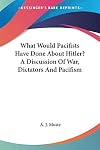
How do you stop a mad dog dictator? By shooting him and his followers? This pamphlet argues that violence has not solved the problem in the past. Has in fact backfired against us.
Decent people are many and mad dogs are few. Then why do so many decent people follow mad dog dictators? Because of the “awful habit of obedience,” says Muste, who calls for civil disobedience on a grand scale. Nonviolent resistance along Gandhian lines.
This pamphlet is more about prevention than cure, but does show more mention Hitler and “the difficulties which the Nazis had with the Resistance, often mainly nonviolent, in France, the Low Countries, Denmark, Norway.” Muste suggests what pacifists might have done about Hitler, but does not guarantee results. Who could?
He discusses various provocations of the Western world that breed desperation and extremism in others: expansionism, economic imbalances, and the “defense complex.” And calls for global co-operation, humanitarian aid, “all out friendliness,” good will, wealth sharing.
Muste likes to reverse positions, to show that the perceived enemy is really not so very different from us. Suppose he did what we do? How would we like it? This pamphlet is an exhortation to think, not fight, our way out of our conflicts. To recognize the law of cause and effect. To have the courage to act unilaterally, in the expectation that the other guy will notice and respond in kind. Muste argues that our armaments are not protecting us, that they are increasing tensions and making things worse. That dismantling them would make us safer.
This pamphlet is a bit dated in its concern with Stalinism and the Cold War, but its principles still apply. It offers sane and sensible solutions that look a lot like the Golden Rule, but don’t expect to see them put into play any time soon. They would require courage, imagination, wisdom, selflessness, far beyond what we are accustomed to seeing in our decision makers, who would think Muste’s program impractical, even naïve. But if his program could somehow be implemented, peace just might break out. How practical would that be?
Notice that I am calling this a pamphlet. It is described as a 48 page book, but is in fact a 19 page pamphlet posing as a book. show less
Decent people are many and mad dogs are few. Then why do so many decent people follow mad dog dictators? Because of the “awful habit of obedience,” says Muste, who calls for civil disobedience on a grand scale. Nonviolent resistance along Gandhian lines.
This pamphlet is more about prevention than cure, but does show more mention Hitler and “the difficulties which the Nazis had with the Resistance, often mainly nonviolent, in France, the Low Countries, Denmark, Norway.” Muste suggests what pacifists might have done about Hitler, but does not guarantee results. Who could?
He discusses various provocations of the Western world that breed desperation and extremism in others: expansionism, economic imbalances, and the “defense complex.” And calls for global co-operation, humanitarian aid, “all out friendliness,” good will, wealth sharing.
Muste likes to reverse positions, to show that the perceived enemy is really not so very different from us. Suppose he did what we do? How would we like it? This pamphlet is an exhortation to think, not fight, our way out of our conflicts. To recognize the law of cause and effect. To have the courage to act unilaterally, in the expectation that the other guy will notice and respond in kind. Muste argues that our armaments are not protecting us, that they are increasing tensions and making things worse. That dismantling them would make us safer.
This pamphlet is a bit dated in its concern with Stalinism and the Cold War, but its principles still apply. It offers sane and sensible solutions that look a lot like the Golden Rule, but don’t expect to see them put into play any time soon. They would require courage, imagination, wisdom, selflessness, far beyond what we are accustomed to seeing in our decision makers, who would think Muste’s program impractical, even naïve. But if his program could somehow be implemented, peace just might break out. How practical would that be?
Notice that I am calling this a pamphlet. It is described as a 48 page book, but is in fact a 19 page pamphlet posing as a book. show less

Essential essays by an extraordinary yet little-known (to most people) American: A.J. Muste, radical pacifist, political organizer, Dutch Reformed minister, and pragmatic philosopher.
Muste did not espouse a pallid, weak pacifism. His pacifism was fiery and impassioned, one that was solidly built on the recognition that peace is not possible without social justice. A Gandhi of America, he deserves to be read and remembered. This reissue makes it possible.
"The problem after a war is the show more victor. He thinks he has just proved that war and violence will pay. Who will now teach him a lesson?" (A.J. Muste, 1941) show less
Muste did not espouse a pallid, weak pacifism. His pacifism was fiery and impassioned, one that was solidly built on the recognition that peace is not possible without social justice. A Gandhi of America, he deserves to be read and remembered. This reissue makes it possible.
"The problem after a war is the show more victor. He thinks he has just proved that war and violence will pay. Who will now teach him a lesson?" (A.J. Muste, 1941) show less

This is an interpretation of pacifism, not merely as a political device, but as a way of living in society. It is particularly valuable in its description of pacifism as a strategem of political and social reform as over against revolutionary violence.

On conscientious objection to serving in the military forces, and the various choices of what to do instead, by a great pacifist. Clear, wise, eloquent, and still as relevant as ever.
You May Also Like


Associated Authors
Statistics
- Works
- 21
- Also by
- 3
- Members
- 296
- Popularity
- #79,167
- Rating
- 4.0
- Reviews
- 18
- ISBNs
- 15
- Favorited
- 1