
Gary L. Francione
Author of Introduction to Animal Rights: Your Child or the Dog?
About the Author
Gary L. Francione is Board of Governors Distinguished Professor of Law at Rutgers University and visiting professor of philosophy at the University of Lincoln (UK). He is the author of many books, including Animals as Persons: Essays on the Abolition of Animal Exploitation (Columbia, 2008).
Image credit: Gary L. Francione
Works by Gary L. Francione
Associated Works
Tagged
Common Knowledge
- Birthdate
- 1954
- Gender
- male
- Occupations
- Professeur de Droit à la Rutgers University School of Law
- Nationality
- USA
- Associated Place (for map)
- USA
Members
Reviews
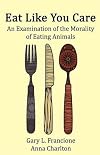
'a choice to impose suffering in the absence of necessity violates what we claim to be the moral principle that we all accept.'
Here's a blunt statement to make but then again, if you accept the moral principle to which the authors are referring to here, and which is one of the key premises of their book (namely, that animals matter morally at all) then it's a statement that deserves serious consideration.
The world, of course, isn't 'black vs white' but full of grey areas. When it comes to show more animals, for instance, we must admit that many among us are quite frankly downright hypocritical; claiming on the one hand to care about them (when not "loving them") while, on the other hand, finding nothing morally wrong -let alone to question!- in eating them and/ or their related products (e.g. dairy). This cognitive dissonance is baffling to say the least; so baffling, in fact, that many omnivores among us can get very defensive when confronted with it. Well, that's too bad because, if you really care about animals indeed, said cognitive dissonance must be everything but left unconfronted. So what about it?
This book has its strengths. It also has its weaknesses.
On the strong side, it's very short and doesn't get bogged down into unnecessary debates as to whether animals can feel pain or not; whether they deserve any moral consideration or not. The authors presuppose that they do, and they presuppose that you do too (if you don't, then skip it -it's not a read for you). On the strong side still, they address some of the commonest arguments made against not eating animals and dairies, and ranging from health concerns to various moral quandaries. I for one, who, before reading this book had been a vegetarian for about 2-3 years, has now been convinced by it to give up my dairies, as I wasn't fully aware of the links between the dairy industry and the meat industry.
On the weak side, though, the authors fall into a common pitfall of their own: being your typical self-righteous, preachy, "either/ or and nothing in between" vegans. Now (again) I for one, as a vegetarian so far, surely appreciate their argumentation and appreciate it so much that it convinced me to work on becoming a vegan. However, I found myself more than once disliking their dismissive tone; for example, when it comes to plants intelligence, an idea that they mock as being unscientific. This is being grossly ignorant. We have, in fact, plenty of scientific evidence that plants display very complex behaviours (some requiring making choice; acting upon memory; avoiding being harmed etc.) and so eating plants may not be as beholding the high moral ground as it sounds. It was once considered downright silly and laughable to even consider animals (including fishes) to have an Umwelt of their own (for fishes, many -including some vegetarians!- still consider it so); our current views of plants might be exposed as being no different in years to come... Most importantly, though, I found such tone to be potentially alienating; a common attitude during such debates. After all, many vegetarians started as pescatarians (I did); used to eat meat before becoming so (I did); and turned vegans only after far more questioning and consideration when it comes to their own moral compass (as I am currently doing). The point is: it's a very personal journey, and there is no need to be condescending and preachy about it. Educating is not judging; yet I felt that the authors were far too often over-judgemental.
Nevertheless, in the end I still recommend this book. If you consider dogfighting, bullfighting, and/ or the abuse of pets (the examples given by the authors themselves) to be nothing but unnecessary cruelty, then why on earth don't you consider how our meat and dairies are produced to be so too? It's no less cruel. It's no less unnecessary. show less
Here's a blunt statement to make but then again, if you accept the moral principle to which the authors are referring to here, and which is one of the key premises of their book (namely, that animals matter morally at all) then it's a statement that deserves serious consideration.
The world, of course, isn't 'black vs white' but full of grey areas. When it comes to show more animals, for instance, we must admit that many among us are quite frankly downright hypocritical; claiming on the one hand to care about them (when not "loving them") while, on the other hand, finding nothing morally wrong -let alone to question!- in eating them and/ or their related products (e.g. dairy). This cognitive dissonance is baffling to say the least; so baffling, in fact, that many omnivores among us can get very defensive when confronted with it. Well, that's too bad because, if you really care about animals indeed, said cognitive dissonance must be everything but left unconfronted. So what about it?
This book has its strengths. It also has its weaknesses.
On the strong side, it's very short and doesn't get bogged down into unnecessary debates as to whether animals can feel pain or not; whether they deserve any moral consideration or not. The authors presuppose that they do, and they presuppose that you do too (if you don't, then skip it -it's not a read for you). On the strong side still, they address some of the commonest arguments made against not eating animals and dairies, and ranging from health concerns to various moral quandaries. I for one, who, before reading this book had been a vegetarian for about 2-3 years, has now been convinced by it to give up my dairies, as I wasn't fully aware of the links between the dairy industry and the meat industry.
On the weak side, though, the authors fall into a common pitfall of their own: being your typical self-righteous, preachy, "either/ or and nothing in between" vegans. Now (again) I for one, as a vegetarian so far, surely appreciate their argumentation and appreciate it so much that it convinced me to work on becoming a vegan. However, I found myself more than once disliking their dismissive tone; for example, when it comes to plants intelligence, an idea that they mock as being unscientific. This is being grossly ignorant. We have, in fact, plenty of scientific evidence that plants display very complex behaviours (some requiring making choice; acting upon memory; avoiding being harmed etc.) and so eating plants may not be as beholding the high moral ground as it sounds. It was once considered downright silly and laughable to even consider animals (including fishes) to have an Umwelt of their own (for fishes, many -including some vegetarians!- still consider it so); our current views of plants might be exposed as being no different in years to come... Most importantly, though, I found such tone to be potentially alienating; a common attitude during such debates. After all, many vegetarians started as pescatarians (I did); used to eat meat before becoming so (I did); and turned vegans only after far more questioning and consideration when it comes to their own moral compass (as I am currently doing). The point is: it's a very personal journey, and there is no need to be condescending and preachy about it. Educating is not judging; yet I felt that the authors were far too often over-judgemental.
Nevertheless, in the end I still recommend this book. If you consider dogfighting, bullfighting, and/ or the abuse of pets (the examples given by the authors themselves) to be nothing but unnecessary cruelty, then why on earth don't you consider how our meat and dairies are produced to be so too? It's no less cruel. It's no less unnecessary. show less
This is a short, critical, morally sound and instructive book. It's teachy, not preachy, and is based on two principles:
1) Humans have a moral obligation not to impose unnecessary suffering on animals. 2) Animals matter morally, but humans matter more.
I, a vegetarian since six years, got angry while reading this book. Angry at myself and at the meat, dairy and egg industry. Some of the findings in this book are details that I already knew, some are daunting and shocking but all are easily show more found (and verified), for instance that over 100 million male chicks are killed each year, because they are biologically unable to lay eggs, and other information shocked me because I didn't know of it, e.g. the vast amounts of grain that animals are fed in order to eat them or their produce, in relation to how many people can be fed using that very same grain instead - while not leading to the systematic torture of animals, ruin of water sources and our bodies in the process.
The authors make a very stable case for how eating animals and animal products is not equal, morally speaking, to torturing animals for enjoyment; and yes, they actually don't preach as they do this, but use logical arguments that anyone can follow.
A vegan way of life is - naturally - suggested by the authors, who give tips on how to go about this, in an easy and most palatable way.
All in all: short, highly recommendable and natural for all humans. show less
1) Humans have a moral obligation not to impose unnecessary suffering on animals. 2) Animals matter morally, but humans matter more.
I, a vegetarian since six years, got angry while reading this book. Angry at myself and at the meat, dairy and egg industry. Some of the findings in this book are details that I already knew, some are daunting and shocking but all are easily show more found (and verified), for instance that over 100 million male chicks are killed each year, because they are biologically unable to lay eggs, and other information shocked me because I didn't know of it, e.g. the vast amounts of grain that animals are fed in order to eat them or their produce, in relation to how many people can be fed using that very same grain instead - while not leading to the systematic torture of animals, ruin of water sources and our bodies in the process.
The authors make a very stable case for how eating animals and animal products is not equal, morally speaking, to torturing animals for enjoyment; and yes, they actually don't preach as they do this, but use logical arguments that anyone can follow.
A vegan way of life is - naturally - suggested by the authors, who give tips on how to go about this, in an easy and most palatable way.
All in all: short, highly recommendable and natural for all humans. show less
Library building planning can quickly begin to feel overwhelming - even if only a modest remodel is anticipated. Whatever your library type, whatever the scale of the building, you will find something useful in this volume.
It is full of thought-provoking questions and live-saving reminders that will help your planning committee stay on task and consider all sides of the problem.
It is full of thought-provoking questions and live-saving reminders that will help your planning committee stay on task and consider all sides of the problem.
Dr. Francione's philosophical framework ("ideology") is compelling, clear, consistent. He provides a very solid casing in which to arrange one's thinking about animal ethics. His writing is severely redundant, though perhaps because the evidence he marshals to demonstrate the attitudes of the "new welfarists" are so repetitive (not due to any fault of his own).
Lists
You May Also Like


Associated Authors
Statistics
- Works
- 15
- Also by
- 1
- Members
- 439
- Popularity
- #55,771
- Rating
- 4.3
- Reviews
- 8
- ISBNs
- 32
- Languages
- 6
- Favorited
- 2