
Ann Love
Author of The Kids Book of the Night Sky
About the Author
Ann Love and Jane Drake are the authors of several bestselling non-fiction books for children. They live in southern Ontario, Canada
Image credit: via Kids Can Press
Works by Ann Love
Talking Tails : The Incredible Connection Between People and Their Pets (2010) 45 copies, 23 reviews
The Far North 3 copies
Associated Works
Tagged
Common Knowledge
- Gender
- female
Members
Reviews
I feel like the author has never worked with children. I teach K-8 and cannot think of a single student this book would be decent for. The sentence structure is simplistic and sounds condescending, but much of the word choice is appropriate only for high-school level students ("neutralize" "helical" "exposure").
Text features are minimal. No charts or graphs. No photos (only crude, cartoony illustrations). No captions (because the illustrations were all very generalized - two people shaking show more hands, a nurse hovering over a patient, etc...). It didn't "bold" or "italicise" any important terminology or glossary words to draw your attention. The glossary itself was hidden at the back (this is fine in books for adults, but in books for students, you want the glossaries in each chapter) and only covered random terminology ("allergy" and "ancestor" are included but not "prion," "lance" or "diagnose"?!). Writers, do children everywhere a favor. Read DK Eyewitness books. Lots of them. Notice how much detail they're able to shove into the book? Not just through text, but glossaries, illustrations, photographs, quotes, text format, maps, sidebars...THIS is what you should be emulating if you want students to a) learn b) enjoy informational texts c) become comprehensive readers.
It also advances the myth that "Ring Around the Rosie" is a poem about the Black Plague (despite no mention of the poem anywhere until the 1790s). The book claims "historians" believe that the poem is about the Black Death, but doesn't cite this claim in any way (indeed, the book doesn't cite anything - way to show students what scholarly work looks like) and goes on to say that the poem was written in the Middle Ages - again, despite being unmentioned until the 1790s and the first actual written record of it occurring nearly half a century later. This urban legend regarding the origins of the poem doesn't even come about until the 1940s (at the earliest). The only people that believe this any longer are those who read every urban legend that pops up in their Facebook feed...
Finally, despite its title, the book doesn't really offer any explanations as to why pandemics are the reason people are alive. It glosses over much about pandemics being the cause of much of science and medicine's advancements. It doesn't really mention genetic mutations that allowed certain peoples and genetic lines to better survive diseases and therefore outbreaks. Everything in the book seems to indicate that we're alive greatly in spite of pandemics - not because of them. show less
Text features are minimal. No charts or graphs. No photos (only crude, cartoony illustrations). No captions (because the illustrations were all very generalized - two people shaking show more hands, a nurse hovering over a patient, etc...). It didn't "bold" or "italicise" any important terminology or glossary words to draw your attention. The glossary itself was hidden at the back (this is fine in books for adults, but in books for students, you want the glossaries in each chapter) and only covered random terminology ("allergy" and "ancestor" are included but not "prion," "lance" or "diagnose"?!). Writers, do children everywhere a favor. Read DK Eyewitness books. Lots of them. Notice how much detail they're able to shove into the book? Not just through text, but glossaries, illustrations, photographs, quotes, text format, maps, sidebars...THIS is what you should be emulating if you want students to a) learn b) enjoy informational texts c) become comprehensive readers.
It also advances the myth that "Ring Around the Rosie" is a poem about the Black Plague (despite no mention of the poem anywhere until the 1790s). The book claims "historians" believe that the poem is about the Black Death, but doesn't cite this claim in any way (indeed, the book doesn't cite anything - way to show students what scholarly work looks like) and goes on to say that the poem was written in the Middle Ages - again, despite being unmentioned until the 1790s and the first actual written record of it occurring nearly half a century later. This urban legend regarding the origins of the poem doesn't even come about until the 1940s (at the earliest). The only people that believe this any longer are those who read every urban legend that pops up in their Facebook feed...
Finally, despite its title, the book doesn't really offer any explanations as to why pandemics are the reason people are alive. It glosses over much about pandemics being the cause of much of science and medicine's advancements. It doesn't really mention genetic mutations that allowed certain peoples and genetic lines to better survive diseases and therefore outbreaks. Everything in the book seems to indicate that we're alive greatly in spite of pandemics - not because of them. show less
 This review was written for LibraryThing Early Reviewers.
I quite like this young-adult non-fiction book. Pandemic Survival: It's Why You're Alive by Ann Love & John Drake is a sensible mix of the science and history of mass disease. The book covers the scientific basics of epidemiology and then examines some of the most famous outbreaks of diseases such as The Black Death, Yellow Fever, Small Pox, Cholera, Typhoid, Syphilis, the Spanish Flu and so on. These historical examinations are grouped by historical periods (such as the Middle Ages, the Age show more of Discovery, and the Industrial Age) with several interesting sub-chapters within each. There is also a discussion of modern understandings of the Ancient plagues as well as an ongoing explanation of the evolving medical understanding of the causes and treatments of mass illness. The book ends with Modern Times with 20th/ 21st Century diseases and some foreshadowing of where and how epidemics might occur in the future.
In short, the book packs a ton of history and science into an appealing package. While there is a lot of text, it is well-written and well-organized. The artwork is colourful, amusing, and reminiscent of that found in the Horrible History series (illustrated by Bill Slavin, well-known for Stanley's Party). I will enjoy putting this book into the hands of someone who loves zombie movies; Pandemic Survival would take that fictional interest and provide an entertaining non-fiction counterpoint. show less
In short, the book packs a ton of history and science into an appealing package. While there is a lot of text, it is well-written and well-organized. The artwork is colourful, amusing, and reminiscent of that found in the Horrible History series (illustrated by Bill Slavin, well-known for Stanley's Party). I will enjoy putting this book into the hands of someone who loves zombie movies; Pandemic Survival would take that fictional interest and provide an entertaining non-fiction counterpoint. show less
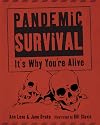
This review was written for LibraryThing Early Reviewers.Why would a kid want to read a book like this, with a big red cover and two skulls illustrated on the front? Precisely because it has two skulls on the front and promises to offer up some factoids that will gross out your friends and horrify grownups. The astute child will also figure out that there is a fair bit of science and history wound up in humankind’s struggle with pandemics.
Authors Love and Drake have put together a remarkably detailed and engaging account of different pandemics show more here. A reader can find here the story of the major illnesses that have plagued the populace: leprosy, black death, bubonic plague, smallpox, yellow fever, cholera, tuberculosis, Spanish flu, polio, and AIDs. It makes a person glad to live in these times. Though we haven’t conquered all these diseases, sanitation and medication have gone a long way towards reducing the number of people who suffer from these horrific diseases.
The book also covers some lesser-known illnesses such as the English Sweat and a strange disease which led people to “dance.”
Though I’ve read a fair amount of fiction set during the plague years, I still ran across things I hadn’t known before, and which added context and a deeper historical understanding. Who knew that Mongolian marmots first carried The Black Death? Mongolians wisely steered clear of a dying colony. The Chinese skinned them and sold the furs, spreading the disease to the rest of Eurasia. And now I know that black cats were considered unlucky because they came from the East, where the plague originated.
The book also chronicles the slow, halting steps people took towards understanding what caused these pandemics and how they spread. I almost wanted to pound my head in desperation at the resistance to new ideas like germ theory and handwashing. It’s a lesson we can take in the current world, as the medical establishment can still be resistant to ideas that don’t fit an established paradigm.
The books is designed for kid appeal with cartoon-like color illustrations and lots of sidebars and personal examples that break up the text.
It also apparently has the purpose of being sort of a health education book , with a section of lifestyle choices such as smoking, eating disorders (is that a “lifestyle choice”?) and exposure to the sun. I’m not sure the consequences of these choices are usually what we think of as pandemics, but I’m willing to give them the benefit of the doubt.
All in all, this book has lively writing and interesting examples which will fascinate the child who is interested in the spooky, dramatic aspects of life as well as providing lots of facts and examples for the student who is writing a report on disease and health. show less
Authors Love and Drake have put together a remarkably detailed and engaging account of different pandemics show more here. A reader can find here the story of the major illnesses that have plagued the populace: leprosy, black death, bubonic plague, smallpox, yellow fever, cholera, tuberculosis, Spanish flu, polio, and AIDs. It makes a person glad to live in these times. Though we haven’t conquered all these diseases, sanitation and medication have gone a long way towards reducing the number of people who suffer from these horrific diseases.
The book also covers some lesser-known illnesses such as the English Sweat and a strange disease which led people to “dance.”
Though I’ve read a fair amount of fiction set during the plague years, I still ran across things I hadn’t known before, and which added context and a deeper historical understanding. Who knew that Mongolian marmots first carried The Black Death? Mongolians wisely steered clear of a dying colony. The Chinese skinned them and sold the furs, spreading the disease to the rest of Eurasia. And now I know that black cats were considered unlucky because they came from the East, where the plague originated.
The book also chronicles the slow, halting steps people took towards understanding what caused these pandemics and how they spread. I almost wanted to pound my head in desperation at the resistance to new ideas like germ theory and handwashing. It’s a lesson we can take in the current world, as the medical establishment can still be resistant to ideas that don’t fit an established paradigm.
The books is designed for kid appeal with cartoon-like color illustrations and lots of sidebars and personal examples that break up the text.
It also apparently has the purpose of being sort of a health education book , with a section of lifestyle choices such as smoking, eating disorders (is that a “lifestyle choice”?) and exposure to the sun. I’m not sure the consequences of these choices are usually what we think of as pandemics, but I’m willing to give them the benefit of the doubt.
All in all, this book has lively writing and interesting examples which will fascinate the child who is interested in the spooky, dramatic aspects of life as well as providing lots of facts and examples for the student who is writing a report on disease and health. show less
This review was written for LibraryThing Early Reviewers.As a public health nurse, I have covered a lot of this information in school and in my job but I did enjoy the way that it was presented. It seemed to be directed at youngish children, but had an awful lot of text for that age group. While very informative, I found it interesting that none of the information was attributed to any source and the credentials of the authors did not appear to extend beyond having lived through several of the diseases discussed.
This review was written for LibraryThing Early Reviewers.Awards


You May Also Like


Associated Authors
Statistics
- Works
- 25
- Also by
- 1
- Members
- 656
- Popularity
- #38,460
- Rating
- 3.8
- Reviews
- 40
- ISBNs
- 57
- Languages
- 1
