
Robert Greenberg (1) (1954–)
Author of How to Listen to and Understand Great Music
For other authors named Robert Greenberg, see the disambiguation page.
Series
Works by Robert Greenberg
The Life and Operas of Verdi 4 copies
The Great Courses Understanding the Fundamentals of Music Course Guidebook and 16 CD Digital Audio Disks (2007) 3 copies
Introduction and Early Life 2 copies
Russian Nationalism 1 copy
Introduction to Romanticism 1 copy
The Solo Concerto 1 copy
Leopold and the Grand Tour 1 copy
Operas in Vienna 1 copy
Life in Vienna 1 copy
Paris 1 copy
London 1 copy
Mahler the Conductor 1 copy
Passacaglia 1 copy
Maturity 1 copy
The First Masterworks 1 copy
A Career in Music 1 copy
Illness and Inspiration 1 copy
The Thaw 1 copy
Repression and Depression 1 copy
The Great Patriotic War 1 copy
Resurrection 1 copy
"Lady Macbeth" 1 copy
The Kid's Got Talent ! 1 copy
Let the Controversy Begin 1 copy
“My Great Friend” 1 copy
Concert Masterworks, part 1 1 copy
The Concerto 1 1 copy
“A Free Man” 1 copy
The Lutheran Church Cantata 1 copy
The Oratorio 1 copy
Baroque Opera, I and II 1 copy
Fugue 1 copy
The Madrigal 1 copy
The Renaissance Mass 1 copy
The Middle Ages 1 copy
Music as a Mirror 1 copy
Alma and Vienna 1 copy
The Wunderhorn Symphonies 1 copy
Introduction and Childhood 1 copy
Two Concerts, 1808 and 1824 1 copy
The Heroic Ideal 1 copy
Beethoven the Pianist 1 copy
The Immortal Beloved 1 copy
The Escape From Riga 1 copy
Associated Works
Teaching Company Sample CD: Great Ideas of Philosophy, and How to Listen To and Understand Great Music — Author, some editions — 1 copy
Tagged
Common Knowledge
- Birthdate
- 1954
- Gender
- male
- Education
- Princeton University
University of California, Berkeley (PhD|Music Composition) - Occupations
- professor
composer - Organizations
- San Francisco Performances
The Teaching Company - Nationality
- USA
- Associated Place (for map)
- USA
Members
Reviews

Every aspiring teacher should listen to this audio course to see how an instructor can add verve and excitement to a subject while imparting lots of interesting information and actually causing learning to take place. I can’t say enough about this enthusiastic, witty, knowledgable teacher and (therefore) about this course.
In a series of 48 lectures, Greenberg takes us on a tour of western music since the times of Ancient Greece to modern atonal music of the 20th Century. We learn how a show more musical composition is put together, and how to tell the difference among periods, styles, countries, and composers. Along the way he imparts biographical background on composers as well as the necessary vocabulary to talk about and understand it. In addition, as he moves forward chronologically, he shows how music progressed from form dictating meaning to meaning dictating form.
His primary emphasis is that music is a mirror of the times and places in which it originated, and that it reflects as well as helps define its origins. (Think of the Baroque music of the Renaissance versus the atonal chaotic sounds of modernity.). Thus he always provides a temporal context to the music he is discussing, showing how, for example, the changes of enlightenment had such a great impact on the nature of music, or Debussy complimented (only in an artistic sense) the Impressionist art movement.
On the subject of art, Greenberg points out that music indeed creates images just as oil paintings do, and explains how instrumental music can create different meaning and emotions just from the nature of the composition.
You would think 48 lectures would be a lot, but I was so sad when the course ended that I immediately signed up for his course on Bach.
Evaluation: I can’t imagine not enjoying Greenberg’s lectures whether you are “into” music or not. He is a treat to experience. show less
In a series of 48 lectures, Greenberg takes us on a tour of western music since the times of Ancient Greece to modern atonal music of the 20th Century. We learn how a show more musical composition is put together, and how to tell the difference among periods, styles, countries, and composers. Along the way he imparts biographical background on composers as well as the necessary vocabulary to talk about and understand it. In addition, as he moves forward chronologically, he shows how music progressed from form dictating meaning to meaning dictating form.
His primary emphasis is that music is a mirror of the times and places in which it originated, and that it reflects as well as helps define its origins. (Think of the Baroque music of the Renaissance versus the atonal chaotic sounds of modernity.). Thus he always provides a temporal context to the music he is discussing, showing how, for example, the changes of enlightenment had such a great impact on the nature of music, or Debussy complimented (only in an artistic sense) the Impressionist art movement.
On the subject of art, Greenberg points out that music indeed creates images just as oil paintings do, and explains how instrumental music can create different meaning and emotions just from the nature of the composition.
You would think 48 lectures would be a lot, but I was so sad when the course ended that I immediately signed up for his course on Bach.
Evaluation: I can’t imagine not enjoying Greenberg’s lectures whether you are “into” music or not. He is a treat to experience. show less
How to Listen to Great Music: A Guide to Its History, Culture, and Heart (The Great Courses) by Robert Greenberg
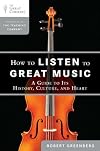
I listen to The Teaching Company's Great Courses on my commutes and with the exception of one on Native American Peoples to start this year, the rest have been concert music oriented. Greenberg has a ten artist series on the lives and music of great masters and the one I am finishing now, of the same title as this. It's a 48 lecture companion course and I highly recommend listening to it in parallel to reading this. Greenberg is energetic, entertaining and eminently knowledgeable. I can't show more begin to capture here even a fraction of the breadth he covers. There is depth, to be sure, but Greenberg masterfully surveys the monumental repertoire of modern western music from ancient Greece (yes! they've managed to reconstruct a couple of pieces from stele and pottery!) through medieval times through Baroque, Classical, Beethoven (per Greenberg, he sort of is in his own category), Romanticism and early 20th century modern composition.
He describes the language necessary to understand the music of the different periods in their context and he frames those periods with histories of the times and the composers he illustrates.
A few highlights:
Greenberg says that instrumental music is the ultimate abstract art. Plays or literature are bounded by the words in a language we understand. Painting is framed by two dimensions. Sculpture must occupy the three-dimensional space that contains it. The only dimension that instrumental music is contained by is time. And the Baroque era was when these concepts were developed:
"When we read a book or a poem, when we watch a play, we understand, at the very least, the language the author is using, and unless it’s Pynchon, Joyce, Gödel, or the lyrics to 'I Am the Walrus,' we usually understand what the writer is trying to say." When we hear instrumental music, we don't have the explicit language from the composer to describe what he/she is doing, or trying to convey. There might be a consensus, but it is still interpretation. Greenberg says "In vocal music, it’s the poetic structure of the words being set that almost invariably determines the form, the structure, of the piece of music that results." And "But instrumental music has no a priori literary structure on which to base its form; in instrumental music, form is the result of compositional processes: repetition, variation, contrast, and development."
To illustrate nuance in music, Greenberg gives an entertaining lengthy and exhilarating (intended) step by step, play by play, Harry Caray style accounting of a baseball double play, to which a foreign person unfamiliar with baseball asks, “What is double play?” Greenberg describes the structure (nine innings, two halves per inning, three outs per half) and intimates at the nuance (me: pitch, ball, hit, walk, strike, flyball, ball, hit by pitch, single, triple, fielder’s choice, ground rule double, etc...) Without a context, nuance cannot possibly be understood or appreciated. Without a sense of the large scale structure, we can’t understand the detail which makes things so interesting.
He describes the language necessary to understand the music of the different periods in their context and he frames those periods with histories of the times and the composers he illustrates.
Art does not shape its time; rather, the times shape the artist, who then gives voice to his time in his own special way. To understand an artist’s world and something of the artist herself are the first requisite steps to understanding the artist’s work, its style, and its meaning.I know somethings of music theory, but I'll need to visit this book and the lectures again to absorb the language further. Tonality, motivity, timbre, phrasing, melody, themes, recitative, aria...this book describes the concepts well, but the reader also needs to be a listener. At the least, find the music selections Greenberg uses.
A few highlights:
We would do well to avoid the notion that art is linear, and that , somehow, it just keeps getting better as we go along. Certainly, art— and for us, music— gets different as it goes along. Just as, certainly , the musical language itself—that is, the actual materials available to composers —has grown as we’ve moved toward the present day.This is important. As Surrealism is no better than Expressionism is no better than Impressionism is no better than purely representational art, Debussy, Stravinsky, Mahler are no better than Schumann, Chopin, Brahms, Liszt which are no better than Beethoven, Mozart, Bach. They are all great in their own ways and Greenberg tells us why.
Greenberg says that instrumental music is the ultimate abstract art. Plays or literature are bounded by the words in a language we understand. Painting is framed by two dimensions. Sculpture must occupy the three-dimensional space that contains it. The only dimension that instrumental music is contained by is time. And the Baroque era was when these concepts were developed:
An essential step in the emergence of instrumental music during the Baroque era was the development of instrumental musical forms.
[...]
One might think that when it comes to instrumental music, anything is possible; that a composer can sit down and just go with the inspirational flow and write whatever comes to mind. In actuality, the opposite is true: the abstract nature of instrumental music demands tremendous compositional discipline and rigor to create musical and expressive clarity and coherence in the absence of words.
"When we read a book or a poem, when we watch a play, we understand, at the very least, the language the author is using, and unless it’s Pynchon, Joyce, Gödel, or the lyrics to 'I Am the Walrus,' we usually understand what the writer is trying to say." When we hear instrumental music, we don't have the explicit language from the composer to describe what he/she is doing, or trying to convey. There might be a consensus, but it is still interpretation. Greenberg says "In vocal music, it’s the poetic structure of the words being set that almost invariably determines the form, the structure, of the piece of music that results." And "But instrumental music has no a priori literary structure on which to base its form; in instrumental music, form is the result of compositional processes: repetition, variation, contrast, and development."
To illustrate nuance in music, Greenberg gives an entertaining lengthy and exhilarating (intended) step by step, play by play, Harry Caray style accounting of a baseball double play, to which a foreign person unfamiliar with baseball asks, “What is double play?” Greenberg describes the structure (nine innings, two halves per inning, three outs per half) and intimates at the nuance (me: pitch, ball, hit, walk, strike, flyball, ball, hit by pitch, single, triple, fielder’s choice, ground rule double, etc...) Without a context, nuance cannot possibly be understood or appreciated. Without a sense of the large scale structure, we can’t understand the detail which makes things so interesting.
How many times have we heard a baseball announcer say, “I’ve been around this game for 40 years and I’ve never seen that happen!”? So, despite the formula nature of the structure, an infinity of nuance and detail can take place, but we can only understand it if we first understand the large scale context, the process, the form of the piece.Well, Greenberg talks about form in all the eras. And so much more.
...music—the most abstract of all of the arts—is capable of transmitting an unbelievable amount of expressive, historical, allegorical, metaphorical, metaphysical, and even philosophical information to us, provided that our antennae are up and pointed in the right direction. That is why we listen, constantly, to music. Yes, to be entertained and amused, but even more, to be thrilled: to be enlightened, edified, reminded of our humanity, and to experience that white hot jolt of wordless inner truth that is the special province of musical expression.Read this and go have a listen. show less
I listened to How to Listen to and Understand Great Music, 3rd Edition written and taught by Robert Greenberg. Greenberg studied at Princeton and UC-Berkley. I find him to be delightful with a great sense of humor. I think he would be a great teacher no matter the subject, if he had the passion for it.
This particular course began during the ancient world and ended with the early 20th century. Greenburg explained the greatest "invention" or movement of each time period with accompanying show more musical clips. My favorite unit was the Ancient Greeks. The Greek culture was humanistic. They believed music was able to create miracles and was omnipresent. Their belief in the power of music was so strong that they believed it could create moral character (Doctrine of Ethos).
To sum it up in Greenburg's words: "Concert halls and opera houses are not museums or mausoleums!" and........"One era's popular music is another era's concert music." show less
This particular course began during the ancient world and ended with the early 20th century. Greenburg explained the greatest "invention" or movement of each time period with accompanying show more musical clips. My favorite unit was the Ancient Greeks. The Greek culture was humanistic. They believed music was able to create miracles and was omnipresent. Their belief in the power of music was so strong that they believed it could create moral character (Doctrine of Ethos).
To sum it up in Greenburg's words: "Concert halls and opera houses are not museums or mausoleums!" and........"One era's popular music is another era's concert music." show less

Professor Greenberg has outdone himself. In all his Great Courses productions he is a superb lecturer -- learned; witty; blending music theory with history; delivering scholarship in a thoroughly popular, interesting, accessible way. Here he surpasses even his past excellence, with a survey of music that is truly outstanding and wide-ranging, but with the unifying theme of orchestral work and development. Listening to the lectures, and deftly interwoven musical interludes and snippets, I show more appreciated the works with even more richness and context. Prof. Greenberg's political and historic insights are especially brilliant, not just as scene-setting but as illuminating and informing the music itself. For instance, his two lectures on Shostakovitch encapsulate the history and psychology of ingrained totalitarian terror, and how it emerges in and shapes musical compositions. Prof. Greenberg's forays into music-theory and note-analysis are useful and informative even to this somewhat tin-eared amateur. This is one of the finest audio-books I have encountered, and I fervently recommend it. show less
Lists
You May Also Like


Associated Authors
Statistics
- Works
- 159
- Also by
- 1
- Members
- 2,099
- Popularity
- #12,261
- Rating
- 4.4
- Reviews
- 38
- ISBNs
- 187
- Languages
- 1
- Favorited
- 1