
Heidi Smith Hyde
Author of Mendel's Accordion
About the Author
Image credit: via Jewish Book Council
Works by Heidi Smith Hyde
La sucá de Shanghái 1 copy
Tagged
Common Knowledge
- Gender
- female
Members
Reviews

Newly arrived in America and desperate to find work to feed his family during the Great Depression, Pavel jumps at the chance to join the newly formed Civilian Conservation Corps. Together with Anatoly, another Russian Jewish immigrant, he finds himself in Idaho, planting trees. Although some of the other men in the Corps resist accepting them as Americans, Pavel and Anatoly do the best they can, learning new skills, and, together with fellow immigrant Giovanni, newly arrived from Italy, show more they learn the Star Spangled Banner. When the Fourth of July arrives, the new Americans are able to join with their fellows, in singing the national anthem, and Pavel realizes that he truly is a part of this great nation...
I liked almost everything about Pavel and the Tree Army, from its engaging story from author Heidi Smith Hyde, to its appealing artwork from illustrator Elisa Vavouri. As someone who participated in my own county's "Youth Conservation Corps" as an adolescent - it was a paid summer job, involving working in the county parks, clearing trails, building boardwalks, and taking educational field trips of an ecological nature - I have always greatly admired the Civilian Conservation Corps that FDR created during the dark days of the Great Depression. As a result, it was good to read a children's story about that subject. I also appreciated the narrative about being a newly arrived immigrant, and gaining a sense of investment and belonging through contributing to one's adopted country, as I sometimes feel that the opposite narrative and idea - that the adopted country owes one something - is the one I hear from many people today. The artwork is colorful and expressive, and ably complements the story, and a historical afterword gives more information about Jewish immigrants who participated in the Civilian Conservation Corps.
In short, I really enjoyed this one, and it might have been another four-star title for me, like Heide's Shanghai Sukkah, which I read earlier this year, and found excellent. Unfortunately, my enjoyment was somewhat soured by the regional stereotypes deployed by the author in her telling, and although this didn't ruin the story for me, it was certainly disturbing enough that I had to deduct a star. No one paying attention to the current state of American culture and politics can be blind to the increasing prejudice brought to bear against people from whole swathes of the country by their fellow citizens, either because they are "deplorables" from the south or the midwest, or the "elites" from the coasts and cities. The harm that this is doing to us simply cannot be overstated. I am just so sick of this canard, which I see embraced more and more by the people around me in the northeast, where I currently live, that their fellow citizens from these other regions are more prejudiced than they. I realize it may not have been Heide's intent (in fact, I suspect it was largely subconscious), but I had to wince, and then sigh in frustration, when the prejudiced bullies hail from places like Oklahoma and Louisiana, while the upstanding Homer of Maine is more accepting and kind. Give me patience!!! This is a minor point, and many might not even catch on to it, put it was sufficiently obnoxious that I deducted a star.
I still recommend Pavel and the Tree Army, as it has many excellent qualities, and I acknowledge that this one disturbing element, all by itself, is not so important. It's more that it partakes of a larger trend that is important, that captured my attention. show less
I liked almost everything about Pavel and the Tree Army, from its engaging story from author Heidi Smith Hyde, to its appealing artwork from illustrator Elisa Vavouri. As someone who participated in my own county's "Youth Conservation Corps" as an adolescent - it was a paid summer job, involving working in the county parks, clearing trails, building boardwalks, and taking educational field trips of an ecological nature - I have always greatly admired the Civilian Conservation Corps that FDR created during the dark days of the Great Depression. As a result, it was good to read a children's story about that subject. I also appreciated the narrative about being a newly arrived immigrant, and gaining a sense of investment and belonging through contributing to one's adopted country, as I sometimes feel that the opposite narrative and idea - that the adopted country owes one something - is the one I hear from many people today. The artwork is colorful and expressive, and ably complements the story, and a historical afterword gives more information about Jewish immigrants who participated in the Civilian Conservation Corps.
In short, I really enjoyed this one, and it might have been another four-star title for me, like Heide's Shanghai Sukkah, which I read earlier this year, and found excellent. Unfortunately, my enjoyment was somewhat soured by the regional stereotypes deployed by the author in her telling, and although this didn't ruin the story for me, it was certainly disturbing enough that I had to deduct a star. No one paying attention to the current state of American culture and politics can be blind to the increasing prejudice brought to bear against people from whole swathes of the country by their fellow citizens, either because they are "deplorables" from the south or the midwest, or the "elites" from the coasts and cities. The harm that this is doing to us simply cannot be overstated. I am just so sick of this canard, which I see embraced more and more by the people around me in the northeast, where I currently live, that their fellow citizens from these other regions are more prejudiced than they. I realize it may not have been Heide's intent (in fact, I suspect it was largely subconscious), but I had to wince, and then sigh in frustration, when the prejudiced bullies hail from places like Oklahoma and Louisiana, while the upstanding Homer of Maine is more accepting and kind. Give me patience!!! This is a minor point, and many might not even catch on to it, put it was sufficiently obnoxious that I deducted a star.
I still recommend Pavel and the Tree Army, as it has many excellent qualities, and I acknowledge that this one disturbing element, all by itself, is not so important. It's more that it partakes of a larger trend that is important, that captured my attention. show less

When Marcus and his family must leave Berlin in the years before World War II, the young Jewish boy mourns the loss of his home, and worries that he won't like his new life in Shanghai, where his family is headed. Although they are poor in this new place, and living in a crowded apartment building, Marcus soon adjusts, going to a newly established yeshiva, and making new friends. Amongst these is Liang, a young Chinese boy who aids Marcus and his Jewish peers, when they decide to build a show more Sukkah on the roof of their apartment building. Liang invited Marcus to join him in the local celebration of the Mid-Autumn Moon Festival, and gives him a riddle - "What adds light and warmth, even though you can't see it?" - the solution of which (friendship ) proves what is truly valuable, and makes the Shanghai Sukkah the most beautiful Marcus has ever seen...
I found myself tearing up as I read the conclusion of author Heidi Smith Hyde's story in Shanghai Sukkah, which explores the power of friendship across cultural and religious lines. Although aware of the refugee community that settled in Shanghai before and during World War II - Ed Young mentions how his family befriended and took in a Jewish refugee couple in his autobiographical The House Baba Built: An Artist's Childhood in China - this is the first story I have read that centers that experience. Author Heidi Smith Hyde, whose historical Hannukah tale, Emanuel and the Hanukkah Rescue, was set in Colonial Massachusetts, seems to have a passion for exploring lesser-known chapters of the Jewish experience. I'm so glad she penned Shanghai Sukkah, as it is a poignant and ultimately heartwarming tale, highlighting an aspect of history not always explored in American children's books. The accompanying artwork from Jing Jing Tsong is colorful and engaging, and a two-page afterword, complete with photographs, gives more information about the Jewish community in Shanghai. Recommended to anyone looking for children's stories featuring Jewish refugees in the WWII era, or the holidays of Sukkot and the Mid-Autumn Moon Festival. Also recommended to anyone seeking stories about the beauty of cross-cultural friendship. show less
I found myself tearing up as I read the conclusion of author Heidi Smith Hyde's story in Shanghai Sukkah, which explores the power of friendship across cultural and religious lines. Although aware of the refugee community that settled in Shanghai before and during World War II - Ed Young mentions how his family befriended and took in a Jewish refugee couple in his autobiographical The House Baba Built: An Artist's Childhood in China - this is the first story I have read that centers that experience. Author Heidi Smith Hyde, whose historical Hannukah tale, Emanuel and the Hanukkah Rescue, was set in Colonial Massachusetts, seems to have a passion for exploring lesser-known chapters of the Jewish experience. I'm so glad she penned Shanghai Sukkah, as it is a poignant and ultimately heartwarming tale, highlighting an aspect of history not always explored in American children's books. The accompanying artwork from Jing Jing Tsong is colorful and engaging, and a two-page afterword, complete with photographs, gives more information about the Jewish community in Shanghai. Recommended to anyone looking for children's stories featuring Jewish refugees in the WWII era, or the holidays of Sukkot and the Mid-Autumn Moon Festival. Also recommended to anyone seeking stories about the beauty of cross-cultural friendship. show less
I was most touched by the last page. It’s the author’s note that gives additional information about the Depression era Civilian Conservation Corps, and it pays particular attention to the Jewish immigrant men who participated.
I also enjoyed the historical fiction story. I think it gave a good feel for the Great Depression, the Conservation Corps program, and the immigrant experience. I appreciated how it fit in the national anthem The Star Spangled Banner and a Fourth of July Celebration show more at the end of the story. Pavel and a friend come from Russia and go via New York City to Idaho in order to work, and to “make America beautiful” and to provide for themselves and their families during the Great Depression.
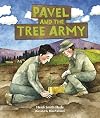
I liked a lot about the illustrations but had one main complaint and one minor one. The latter is that I don’t think this group of workers had been at the site in Idaho long enough for trees they’d planted to be so tall by Independence Day. When they first arrived the land in their vicinity looked as though it had no trees. My major problem, and I noticed it most on the cover, is for me there is something scary (horror story like) about the way people’s eyes are depicted. I noticed it a bit less as I read the story because I was able to focus on the story and there were detailed illustrations on most pages and I could concentrate on other parts of the pictures, but when I looked at people’s eyes they gave me the creeps. (probably just me?)
Overall, this is an uplifting and inspiring story, but bigotry against (and acceptance of) immigrants plays a role and the prejudice shown is upsetting. I would be happy to read this to the youngest children and answer any questions they have or offer explanations in an age appropriate way, but some adults might want to screen this book before sharing it with young children. Intolerance of and dislike of immigrants is unfortunately a topical and relevant subject and this book could be used as a springboard for discussion with school-aged children.
3-1/2 stars show less
I also enjoyed the historical fiction story. I think it gave a good feel for the Great Depression, the Conservation Corps program, and the immigrant experience. I appreciated how it fit in the national anthem The Star Spangled Banner and a Fourth of July Celebration show more at the end of the story. Pavel and a friend come from Russia and go via New York City to Idaho in order to work, and to “make America beautiful” and to provide for themselves and their families during the Great Depression.
I liked a lot about the illustrations but had one main complaint and one minor one. The latter is that I don’t think this group of workers had been at the site in Idaho long enough for trees they’d planted to be so tall by Independence Day. When they first arrived the land in their vicinity looked as though it had no trees. My major problem, and I noticed it most on the cover, is for me there is something scary (horror story like) about the way people’s eyes are depicted. I noticed it a bit less as I read the story because I was able to focus on the story and there were detailed illustrations on most pages and I could concentrate on other parts of the pictures, but when I looked at people’s eyes they gave me the creeps. (probably just me?)
Overall, this is an uplifting and inspiring story, but bigotry against (and acceptance of) immigrants plays a role and the prejudice shown is upsetting. I would be happy to read this to the youngest children and answer any questions they have or offer explanations in an age appropriate way, but some adults might want to screen this book before sharing it with young children. Intolerance of and dislike of immigrants is unfortunately a topical and relevant subject and this book could be used as a springboard for discussion with school-aged children.
3-1/2 stars show less

Elan, whose name meant "oak tree" in Hebrew and 'friendly' in Keres, was the son of a Jewish father and an Acoma Pueblo mother. In 1898, the year he turned thirteen, Elan celebrated his Bar Mitzvah in San Francisco, and then traveled with his parents to New Mexico, where he also participated in the traditional ceremony and Eagle Dance whereby young men became Acoma tribesmen. As his mother told him, he was the son of two proud nations, whose roots were like the oak...
Author Heidi Smith Hyde show more continues to impress in Elan, Son of Two Peoples, which is the fifth picture-book I have read from her. The narrative here is engaging, and the afterword gives more information about the true story which inspired the book. Apparently the character of Elan was a real person (it's not clear from the afterword if this was his actual name), the son of an Eastern European Jew named Solomon Bibo, who settled in New Mexico, became fluent in Keres, and married the granddaughter of an Acoma Pueblo chief. Although Bibo's wife converted to Judaism (as far as we know), and their children were raised Jewish, their eldest son did participate in the traditional Pueblo rites of passage. This fascinating background makes the story here all the more enjoyable, although I wish Hyde had given her sources, as I would love to learn more about Bibo, who was at one time a Pueblo governor, and who (according to the afterword) fought for Pueblo land rights. Leaving that aside, I thought this was an enjoyable tale in its own right, of a child with two great cultural heritages. The accompanying artwork from illustrator Mikela Prevost was just lovely, capturing the beauty of the world around Elan. I particularly liked the scene in which he dances in the Eagle Dance, as well as the one showing him on the train with his mother. Recommended to anyone looking for children's stories with a Jewish and/or Pueblo cultural background, or for tales about children with mixed cultural heritage. show less
Author Heidi Smith Hyde show more continues to impress in Elan, Son of Two Peoples, which is the fifth picture-book I have read from her. The narrative here is engaging, and the afterword gives more information about the true story which inspired the book. Apparently the character of Elan was a real person (it's not clear from the afterword if this was his actual name), the son of an Eastern European Jew named Solomon Bibo, who settled in New Mexico, became fluent in Keres, and married the granddaughter of an Acoma Pueblo chief. Although Bibo's wife converted to Judaism (as far as we know), and their children were raised Jewish, their eldest son did participate in the traditional Pueblo rites of passage. This fascinating background makes the story here all the more enjoyable, although I wish Hyde had given her sources, as I would love to learn more about Bibo, who was at one time a Pueblo governor, and who (according to the afterword) fought for Pueblo land rights. Leaving that aside, I thought this was an enjoyable tale in its own right, of a child with two great cultural heritages. The accompanying artwork from illustrator Mikela Prevost was just lovely, capturing the beauty of the world around Elan. I particularly liked the scene in which he dances in the Eagle Dance, as well as the one showing him on the train with his mother. Recommended to anyone looking for children's stories with a Jewish and/or Pueblo cultural background, or for tales about children with mixed cultural heritage. show less
Lists
Awards


You May Also Like


Associated Authors
Statistics
- Works
- 9
- Members
- 586
- Popularity
- #42,791
- Rating
- 4.0
- Reviews
- 15
- ISBNs
- 48
- Languages
- 1