
Michael Schur
Author of How to Be Perfect: The Correct Answer to Every Moral Question
About the Author
Series
Works by Michael Schur
How to Be Perfect: The Correct Answer to Every Moral Question (2022) — Narrator, some editions — 856 copies, 39 reviews
Brooklyn Nine-Nine: Season Five — Creator — 16 copies
Everything is Fine — Creator, Writer — 1 copy
Tahani Al-Jamil 1 copy
What We Owe To Each Other 1 copy
Jason Mendoza 1 copy
A Girl from Arizona, Pt. 2 1 copy
Nosedive [2016 Black Mirror TV episode] — Screenwriter — 1 copy
You've Changed, Man 1 copy
Tinker, Tailor, Demon, Spy 1 copy
Employee of the Bearimy 1 copy
A Chip Driver Mystery 1 copy
Help Is Other People 1 copy
Mondays, Am I Right? 1 copy
Chillaxing 1 copy
Whenever You're Ready 1 copy
A Girl from Arizona, Pt. 1 1 copy
Associated Works
Is Everyone Hanging Out Without Me? and Other Concerns (2011) — Narrator, some editions; Contributor — 4,908 copies, 243 reviews
Welcome to Pawnee: Stories of Friendship, Waffles, and Parks and Recreation (2024) — Contributor — 93 copies, 3 reviews
The Good Place and Philosophy: Everything is Forking Fine! (The Blackwell Philosophy and Pop Culture Series) (2020) — Foreword — 51 copies, 2 reviews
Tagged
Common Knowledge
- Legal name
- Schur, Michael Herbert
- Birthdate
- 1975-10-29
- Gender
- male
- Agent
- Richard Abate (3 Arts)
- Nationality
- USA
- Birthplace
- Ann Arbor, Michigan, USA
- Places of residence
- West Hartford, Connecticut, USA
- Associated Place (for map)
- USA
Members
Reviews

I am definitely not a theory kind of person, and always found philosophy (especially as told by Dead White Men) to be a pure theory kind of thing. Not my bag. So imagine my surprise at thoroughly enjoying the everloving shirt out of this book! Definitely worth a read, and not just if you loved the Good Place.

Michael Shur is the creator of The Good Place, a fantastic TV show, and almost certainly the world's only sitcom about moral philosophy. Unsurprisingly, this is a topic Shur himself is fascinated with, and in this volume he takes us through various approaches philosophers over the millennia have had to the questions of how humans should behave towards each other, what it means to be a good person, and whether you really need to put your shopping cart back where it belongs. Although it should show more probably be noted that a) it's hardly a comprehensive overview of the entire field of philosophy, b) he concentrates entirely on secular, rather than religious philosophy, and c) the emphasis is on Western philosophy, despite brief discussions of particular Buddhist philosopher and of the African concept of Ubuntu.
The approach here is simple and casual, taking ideas from people who wrote huge, dense, largely unreadable tomes, paring them down to some of their basics, and seeing what seems useful for us ordinary schmoes as we try to navigate this stupid and complicated thing called life without being complete jerks. Shur sees some merit in almost all of the philosophies he considers (Ayn Rand aside) and seems to regard them all as possible tools to pick and choose from in whatever situations they seem most appropriate in. His writing is clear, breezy, humorous, and pleasant, and much more interested in mulling over the questions than trying to dictate any hard and fast answers. I don't think I agreed one hundred percent with all his personal takes, but I find his approach in general very simpatico.
It's worth pointing out, by the way, just in case it's not clear, that the title is very tongue in cheek. This book will not only not teach you how to be perfect and get the answer to every moral question right, it's not even remotely going to try, because Shur recognizes that that's completely impossible, and not really the point, anyway.
Also worth noting is that although he does reference characters and ideas from The Good Place, because that show embodied a lot of the ideas he's discussing here, you don't need to have seen it to read the book. He also manages not to spoil anything from it, either, in case you want to go and watch it afterward. Fans of the show, though, will probably find it especially interesting and a nice little add-on to their viewing experience. If nothing else, having read the sections on Kant, I now completely understand why Chidi has a stomachache all the time. show less
The approach here is simple and casual, taking ideas from people who wrote huge, dense, largely unreadable tomes, paring them down to some of their basics, and seeing what seems useful for us ordinary schmoes as we try to navigate this stupid and complicated thing called life without being complete jerks. Shur sees some merit in almost all of the philosophies he considers (Ayn Rand aside) and seems to regard them all as possible tools to pick and choose from in whatever situations they seem most appropriate in. His writing is clear, breezy, humorous, and pleasant, and much more interested in mulling over the questions than trying to dictate any hard and fast answers. I don't think I agreed one hundred percent with all his personal takes, but I find his approach in general very simpatico.
It's worth pointing out, by the way, just in case it's not clear, that the title is very tongue in cheek. This book will not only not teach you how to be perfect and get the answer to every moral question right, it's not even remotely going to try, because Shur recognizes that that's completely impossible, and not really the point, anyway.
Also worth noting is that although he does reference characters and ideas from The Good Place, because that show embodied a lot of the ideas he's discussing here, you don't need to have seen it to read the book. He also manages not to spoil anything from it, either, in case you want to go and watch it afterward. Fans of the show, though, will probably find it especially interesting and a nice little add-on to their viewing experience. If nothing else, having read the sections on Kant, I now completely understand why Chidi has a stomachache all the time. show less
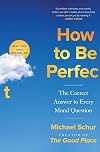
In many ways, How to Be Perfect is a distillation of what Michael Schur read and talked about while working on the TV show The Good Place—if you've already watched the show, many of the thinkers discussed here will be at least familiar as names mentioned on the show.
This makes the book a quick primer to philosophy (with a focus mostly on various strands of Western philosophy) and what it can tell us about what it means to be a good person. The tongue-in-cheek title is a clue to the wry show more approach—with a heavy sprinkle of Dad jokes—that Schur takes here, approached from what seems to be broadly a secular humanist approach. Schur's not trying to be comprehensive or definitive here, just to get the reader to think more and to be aware of the complexity of ethical dilemmas, and in that respect I think the book works very well. (Also because let's be honest: I am never going to read Kant.) show less
This makes the book a quick primer to philosophy (with a focus mostly on various strands of Western philosophy) and what it can tell us about what it means to be a good person. The tongue-in-cheek title is a clue to the wry show more approach—with a heavy sprinkle of Dad jokes—that Schur takes here, approached from what seems to be broadly a secular humanist approach. Schur's not trying to be comprehensive or definitive here, just to get the reader to think more and to be aware of the complexity of ethical dilemmas, and in that respect I think the book works very well. (Also because let's be honest: I am never going to read Kant.) show less
I had just finished watching The Good Place, which is an excellent show. Then I remembered this guy had just written a book that made the Goodreads nominees. So yes, I will pick it up.
If you read one book about moral philosophy in your lifetime, let it be this one. Basically, everything he learned from writing The Good Place, about philosophy and how we should act in ethical situations, is condensed into this volume. It’s a laymen’s guide to a very complicated topic, translating so us show more mere mortals can understand it. Plus humor. There aren’t footnotes on every single word. No “we have to define what ‘things’ are”.
It goes over various philosophical quandaries like the “trolley problem“, the “violinist“, being a “happiness pump” and so on. how each of the three major schools of philosophy would tell you how react to moral dilemmas–Aristotlean, kantism, and utilitarianism. Some philosophy purists might say he needs to condense certain parts or expand certain parts. But I think that is not his intended audience. His audience is people like me, who will never pick up a book of German abstract expressionism or a book without a picture on the cover. He’s trying to reach the Eleanor Shellstrops of the world before they get hit by a shopping cart.
I especially loved the chapter on how we can reconcile problematic artists from their art (e.g. Louis C.K., Woody Allen, Dave Chapelle, etc.). Fun fact: he came to the same conclusion that I did, which is that you essentially have to decide for yourself. If you owned the Harry Potter books before Rowling became a TERF, that’s not on the same level of “bad” as going to Harry Potter World and putting more money in J.K. Rowling’s pocket, which is not the same level as being a J.K. Rowling apologist.
Even if the information here wasn’t about an interesting and thick topic, I’d recommend it because this guy is a top-notch writer. He’s worked on three of my favorite recent TV shows (Parks and Rec, Brooklyn 99, The Good Place) and demonstrates he’s not just a yutz in a writer’s room. He thinks about stuff. He’s in this for more than the money–he wants to see humanity thrive. And philosophy is one of those things where A) everyone who came up with these ideas are dead and gone and have no idea how their rules should apply in a world where I have the sum total of human knowledge in my pocket B) has no right answer or even an answer that everyone can agree on. It’s like religion without the mythology. And these are the conclusions Schur provides–counter to the book’s title, no one expects us to be perfect. Just do the best you can. Fail better. show less
If you read one book about moral philosophy in your lifetime, let it be this one. Basically, everything he learned from writing The Good Place, about philosophy and how we should act in ethical situations, is condensed into this volume. It’s a laymen’s guide to a very complicated topic, translating so us show more mere mortals can understand it. Plus humor. There aren’t footnotes on every single word. No “we have to define what ‘things’ are”.
It goes over various philosophical quandaries like the “trolley problem“, the “violinist“, being a “happiness pump” and so on. how each of the three major schools of philosophy would tell you how react to moral dilemmas–Aristotlean, kantism, and utilitarianism. Some philosophy purists might say he needs to condense certain parts or expand certain parts. But I think that is not his intended audience. His audience is people like me, who will never pick up a book of German abstract expressionism or a book without a picture on the cover. He’s trying to reach the Eleanor Shellstrops of the world before they get hit by a shopping cart.
I especially loved the chapter on how we can reconcile problematic artists from their art (e.g. Louis C.K., Woody Allen, Dave Chapelle, etc.). Fun fact: he came to the same conclusion that I did, which is that you essentially have to decide for yourself. If you owned the Harry Potter books before Rowling became a TERF, that’s not on the same level of “bad” as going to Harry Potter World and putting more money in J.K. Rowling’s pocket, which is not the same level as being a J.K. Rowling apologist.
Even if the information here wasn’t about an interesting and thick topic, I’d recommend it because this guy is a top-notch writer. He’s worked on three of my favorite recent TV shows (Parks and Rec, Brooklyn 99, The Good Place) and demonstrates he’s not just a yutz in a writer’s room. He thinks about stuff. He’s in this for more than the money–he wants to see humanity thrive. And philosophy is one of those things where A) everyone who came up with these ideas are dead and gone and have no idea how their rules should apply in a world where I have the sum total of human knowledge in my pocket B) has no right answer or even an answer that everyone can agree on. It’s like religion without the mythology. And these are the conclusions Schur provides–counter to the book’s title, no one expects us to be perfect. Just do the best you can. Fail better. show less
Lists
Awards


You May Also Like


Associated Authors
Statistics
- Works
- 50
- Also by
- 5
- Members
- 1,560
- Popularity
- #16,523
- Rating
- 3.7
- Reviews
- 55
- ISBNs
- 27
- Languages
- 5