
Steve Perry (1) (1947–)
Author of Shadows of the Empire
For other authors named Steve Perry, see the disambiguation page.
About the Author
Image credit: starwars.wikia.com
Series
Works by Steve Perry
She's Not There 2 copies
The Case of the Wavy Black Dagger 2 copies
Tom Clancy's Net Force, 1-5 1 copy
Ýmparatorluk'un Gölgeleri 1 copy
The Hero Curse #1 1 copy
Just Ask 1 copy
Other Toys 1 copy
What the Dormouse Said 1 copy
Associated Works
Isaac Asimov's Science Fiction Magazine: Vol. 2, No. 2 [March-April 1978] (1978) — Contributor — 17 copies
The Magazine of Fantasy and Science Fiction August 1982, Vol. 63, No. 2 (1982) — Contributor — 15 copies
Pop the Clutch: Thrilling Tales of Rockabilly, Monsters, and Hot Rod Horror (2019) — Contributor — 9 copies
Isaac Asimov's Science Fiction Magazine: Vol. 6, No. 10 [October 1982] (1982) — Contributor — 9 copies
Tagged
Common Knowledge
- Legal name
- Perry, Steven Carl
- Other names
- Peel, Jesse
Flint, Dick - Birthdate
- 1947-08-31
- Gender
- male
- Occupations
- television writer
science fiction writer - Organizations
- Science Fiction and Fantasy Writers of America (SFWA)
The Animation Guild (Local 839)
Writers Guild of America (West) - Relationships
- Perry, S.D. (daughter)
- Nationality
- USA
- Birthplace
- Baton Rouge, Louisiana, USA
- Places of residence
- Portland, Oregon, USA
- Associated Place (for map)
- USA
Members
Reviews

I had almost been put off by many of the online reviews I read, the most prominent of which seemed to be exclusively negative, but ultimately "Indiana Jones vs. zombies" was too tempting a concept to ignore. And I'm glad I succumbed; I don't know if it was because of my lowered expectations, but I quite enjoyed Steve Perry's Indiana Jones and the Army of the Dead.
The book sees Indiana Jones in Haiti in the middle of World War Two, searching for a mythical black pearl which has voodoo power, show more and contending with not only German and Japanese rivals (having both was a bit of overkill, in my opinion) but with a powerful voodoo priest who can command an army of undead. These are classic 'voodoo' zombies rather than modern pop-culture 'Romero' zombies, and utilised fairly well as a threat.
If you wished, you could rattle off a whole number of flaws and gripes. It's quite a by-the-numbers story, there's little flair or ability to do the unexpected, and the character of Indiana Jones lacks the wit and charisma of his silver-screen embodiment. However, I've felt all of the tie-in novels struggle to capture the character of Indy, even the better ones, and I don't feel inclined to hold pulp like this to too high a standard. The idea for Indiana Jones was of course born from the memory of Saturday-afternoon adventure serials from the 1930s, and while Spielberg and Lucas and Ford and others had the talent to make that something special and lasting, I'm also happy enough with a routine adventure-serial. Adventure stories aren't really written any more, and survive mostly in shallow pools like franchise tie-ins or formula-driven thrillers, so I take what I can get. After all, isn't that "they don't make 'em like this anymore" feeling what draws us to the Indiana Jones franchise in the first place? While it's definitely lacking in areas, Indiana Jones and the Army of the Dead can be a fun amble for a reader with realistic expectations. show less
The book sees Indiana Jones in Haiti in the middle of World War Two, searching for a mythical black pearl which has voodoo power, show more and contending with not only German and Japanese rivals (having both was a bit of overkill, in my opinion) but with a powerful voodoo priest who can command an army of undead. These are classic 'voodoo' zombies rather than modern pop-culture 'Romero' zombies, and utilised fairly well as a threat.
If you wished, you could rattle off a whole number of flaws and gripes. It's quite a by-the-numbers story, there's little flair or ability to do the unexpected, and the character of Indiana Jones lacks the wit and charisma of his silver-screen embodiment. However, I've felt all of the tie-in novels struggle to capture the character of Indy, even the better ones, and I don't feel inclined to hold pulp like this to too high a standard. The idea for Indiana Jones was of course born from the memory of Saturday-afternoon adventure serials from the 1930s, and while Spielberg and Lucas and Ford and others had the talent to make that something special and lasting, I'm also happy enough with a routine adventure-serial. Adventure stories aren't really written any more, and survive mostly in shallow pools like franchise tie-ins or formula-driven thrillers, so I take what I can get. After all, isn't that "they don't make 'em like this anymore" feeling what draws us to the Indiana Jones franchise in the first place? While it's definitely lacking in areas, Indiana Jones and the Army of the Dead can be a fun amble for a reader with realistic expectations. show less

This review might turn out to be a little lengthy, and I don't want to keep readers in any suspense about my opinion of Conan the Indomitable. It is easily the worst Conan novel I've ever read.
In my other reviews, I've observed that the short story is the paradigmatic narrative form for Robert E. Howard's Conan, and with the vast number of novels about the character written by later authors, they have often developed new forms and styles, or used ones originating with their fellows, rather show more than attempting to work on the lines set down in Howard's one Conan novel. I have inferred a stylistic genealogy from Andrew Offutt to Robert Jordan to Roland Green, for example, while finding Karl Edward Wagner fairly faithful to Howard's original approach in the short stories. If Steve Perry had a model for his writing of this Conan yarn, I think it must have been the Marvel Comics Conan writings of Roy Thomas. Thomas, though, was often taking his plots from Howard's original stories (Conan and otherwise, following the lead of DeCamp and Carter), and he had the benefit of art from Barry Windsor-Smith and John Buscema.
An additional influence for Perry might have been some sort of 1980s fantasy role-playing game supplement, since the action of the novel literally precipitates Conan into a "dungeon" of the sort that was the stereotypical site of the action in such games. This environment--roughly at the intersection of the Hyborian realms of Corinthia, Zamora, and Brythunia, which are otherwise irrelevant to the story--is called the "Grotterium Negrotus," and is under the divided and competing regimes of a wizard and a witch, each of whom becomes magically convinced of the need to capture Conan. This subterranean political setup reminded me even more of the 21st-century board games Dungeon Lords and Dungeon Pets by Vlaada Chvátil! Parallel to the adventures of Conan and his accumulating band, the exotic monster species (cyclopes, giant worms, blood-bats, blind cave apes) dominated by the dungeon lords of this book find their collective will to revolution.
The cover of my copy (the trade paper edition that was the book's first issuance) has Kirk Reinert's art, which is both faithful to the story and perfectly hilarious, as it shows Conan confronting the vaguely-inhuman sorceress Chuntha (yes, that's her name), herself riding a giant worm whose open maw is an unmistakable vagina dentata. All of the chief villains in this story are conspicuously defined by their gender. As inferred from the sequence and difficulty of their overcoming, the greatest of these is the male wizard, followed by the impressively lascivious female witch, and least of all a fairly contemptible sorcerous gynander.
The tone throughout is predominantly comic, with obvious foreshadowings and mechanical parallels in the development of the plot. The style includes the sort of feigned archaicisms that you'll never find in a Robert E. Howard story. (He was more prone to an occasional anachronism, in fact.) It also includes "translations" of adages and idioms like, "One cannot make mushroom wine without crushing a few toadstools" (227), and features a character (I can hardly help thinking of him as an "NPC") who is under a curse compelling him to insult everyone he addresses, while his face is frozen in a smile.
Honestly, I cannot recommend this book to even the most indiscriminate of sword and sorcery readers. show less
In my other reviews, I've observed that the short story is the paradigmatic narrative form for Robert E. Howard's Conan, and with the vast number of novels about the character written by later authors, they have often developed new forms and styles, or used ones originating with their fellows, rather show more than attempting to work on the lines set down in Howard's one Conan novel. I have inferred a stylistic genealogy from Andrew Offutt to Robert Jordan to Roland Green, for example, while finding Karl Edward Wagner fairly faithful to Howard's original approach in the short stories. If Steve Perry had a model for his writing of this Conan yarn, I think it must have been the Marvel Comics Conan writings of Roy Thomas. Thomas, though, was often taking his plots from Howard's original stories (Conan and otherwise, following the lead of DeCamp and Carter), and he had the benefit of art from Barry Windsor-Smith and John Buscema.
An additional influence for Perry might have been some sort of 1980s fantasy role-playing game supplement, since the action of the novel literally precipitates Conan into a "dungeon" of the sort that was the stereotypical site of the action in such games. This environment--roughly at the intersection of the Hyborian realms of Corinthia, Zamora, and Brythunia, which are otherwise irrelevant to the story--is called the "Grotterium Negrotus," and is under the divided and competing regimes of a wizard and a witch, each of whom becomes magically convinced of the need to capture Conan. This subterranean political setup reminded me even more of the 21st-century board games Dungeon Lords and Dungeon Pets by Vlaada Chvátil! Parallel to the adventures of Conan and his accumulating band, the exotic monster species (cyclopes, giant worms, blood-bats, blind cave apes) dominated by the dungeon lords of this book find their collective will to revolution.
The cover of my copy (the trade paper edition that was the book's first issuance) has Kirk Reinert's art, which is both faithful to the story and perfectly hilarious, as it shows Conan confronting the vaguely-inhuman sorceress Chuntha (yes, that's her name), herself riding a giant worm whose open maw is an unmistakable vagina dentata. All of the chief villains in this story are conspicuously defined by their gender. As inferred from the sequence and difficulty of their overcoming, the greatest of these is the male wizard, followed by the impressively lascivious female witch, and least of all a fairly contemptible sorcerous gynander.
The tone throughout is predominantly comic, with obvious foreshadowings and mechanical parallels in the development of the plot. The style includes the sort of feigned archaicisms that you'll never find in a Robert E. Howard story. (He was more prone to an occasional anachronism, in fact.) It also includes "translations" of adages and idioms like, "One cannot make mushroom wine without crushing a few toadstools" (227), and features a character (I can hardly help thinking of him as an "NPC") who is under a curse compelling him to insult everyone he addresses, while his face is frozen in a smile.
Honestly, I cannot recommend this book to even the most indiscriminate of sword and sorcery readers. show less
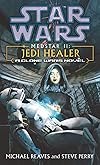
It is substantially better than its predecessor, in that major characters have arcs and the stakes are raised quite a bit. A decent novel taking place in a small corner of the Star Wars universe. There is a twist involving one very minor character, and I think a better novelist would have done more with it (perhaps not making it a twist but revealing it upfront and then drawing out the character's motivations).

My reactions to reading this book in 1995. Spoilers follow.
Another good book from Perry which, while self-contained, does a nice job of building on the events of its prequel, Spindoc. Venture Silk and Zia Relanj continue their romance, but Perry treats it realistically. He shows the conflicts inherent in a situation where ultra-competent secret agent Relanj jerks Silk out of his comfortable Spindoc life and drags him to a world where terrans are despised and where he has to depend on her for show more economic support. He has to contend with feelings of worthlessness not to mention sexual jealousy when Relanj has sex with other people while on assignment. Things are made worse when Terran Security tries to kidnap Zia for the immortality drug she has been administered.
Perry does a nice job of showing his characters developing. Zia starts to get tired of the sex, danger, and violence of the spy game while Silk shows an increasing attraction for it as well as developing real skill when he bests some pros. I liked the plot idea of arrogant Earth agent Colburn (who was constantly telling himself that he was the best of all agents) falling for Zia and thinking he could, after killing Silk, seduce her into loving him. His worldview is very self-centered. As a contrast, Silk realizes he was quite self-centered in his old, pre-Zia life when he was a “jerk” for being so callous to the deaths in the accidents he spun.
Perry creates some ingenious weapons and espionage technology and again demonstrates how a computer intensive, space traveling culture would effect the conduct of spy tradecraft. There are some nice bits – brief though – about studying martial arts and pistolcraft. Perry credits gun writer Massad Ayoob with information for the latter, and one of the two makes an historical blunder by having Wild Bill Hickok (Colburn is a student – a “serious” student – of western gunfighters) dying in Deadwood, Kansas. However, the rest of the information seems credible. Perry develops his story further with having the Forever Drug instilling telepathy in some people – including Zia who uses it against Colburn in the climax – and briefly hints (perhaps to be explored in more novels in the series) of the social consequences. show less
Another good book from Perry which, while self-contained, does a nice job of building on the events of its prequel, Spindoc. Venture Silk and Zia Relanj continue their romance, but Perry treats it realistically. He shows the conflicts inherent in a situation where ultra-competent secret agent Relanj jerks Silk out of his comfortable Spindoc life and drags him to a world where terrans are despised and where he has to depend on her for show more economic support. He has to contend with feelings of worthlessness not to mention sexual jealousy when Relanj has sex with other people while on assignment. Things are made worse when Terran Security tries to kidnap Zia for the immortality drug she has been administered.
Perry does a nice job of showing his characters developing. Zia starts to get tired of the sex, danger, and violence of the spy game while Silk shows an increasing attraction for it as well as developing real skill when he bests some pros. I liked the plot idea of arrogant Earth agent Colburn (who was constantly telling himself that he was the best of all agents) falling for Zia and thinking he could, after killing Silk, seduce her into loving him. His worldview is very self-centered. As a contrast, Silk realizes he was quite self-centered in his old, pre-Zia life when he was a “jerk” for being so callous to the deaths in the accidents he spun.
Perry creates some ingenious weapons and espionage technology and again demonstrates how a computer intensive, space traveling culture would effect the conduct of spy tradecraft. There are some nice bits – brief though – about studying martial arts and pistolcraft. Perry credits gun writer Massad Ayoob with information for the latter, and one of the two makes an historical blunder by having Wild Bill Hickok (Colburn is a student – a “serious” student – of western gunfighters) dying in Deadwood, Kansas. However, the rest of the information seems credible. Perry develops his story further with having the Forever Drug instilling telepathy in some people – including Zia who uses it against Colburn in the climax – and briefly hints (perhaps to be explored in more novels in the series) of the social consequences. show less
Lists
Awards

You May Also Like


Associated Authors
Statistics
- Works
- 92
- Also by
- 25
- Members
- 15,539
- Popularity
- #1,460
- Rating
- 3.5
- Reviews
- 152
- ISBNs
- 413
- Languages
- 18
- Favorited
- 5
