
Tim Berners-Lee
Author of Weaving the Web: The Original Design and Ultimate Destiny of the World Wide Web
About the Author
Tim Berners-Lee, inventor of the Web, is currently the director of the World Wide Web Consortium, the coordinating body for Web development, and he occupies the 3Com Founders chair at the MIT Laboratory for Computer Science. Recipient of numerous awards, he received the distinguished MacArthur show more Fellowship in 1998. He lives in Cambridge, MA. show less
Image credit: Credit: Jim Grisanzio, 1999
Series
Works by Tim Berners-Lee
Weaving the Web: The Original Design and Ultimate Destiny of the World Wide Web (1999) 841 copies, 12 reviews
L'architettura del nuovo web: dall'inventore della rete il progetto di una comunicazione democratica, interattiva e intercreativa (2001) 8 copies, 1 review
A Magna Carta for the Web 1 copy
Doctor Honoris Causa 2008 1 copy
Associated Works
Tagged
Common Knowledge
- Canonical name
- Berners-Lee, Tim
- Legal name
- Berners-Lee, Timothy John
- Birthdate
- 1955-06-08
- Gender
- male
- Education
- University of Oxford (Queen's College|Physics|1976)
- Occupations
- professor (Founders Chair, CSAIL, MIT)
director (Web Science Research Initiative) - Organizations
- Royal Society (Fellow)
Royal Academy of Engineering (Fellow)
Royal Society of Arts (Fellow)
British Computer Society (Distinguished Fellow)
World Wide Web Consortium
World Wide Web Foundation (show all 8)
National Academy of Sciences
Web Science Trust (Founding Director) - Awards and honors
- Order of the British Empire (Knight-Commander, 2004)
Order of Merit (2007)
Internet Hall of Fame (Innovator, 2012) - Relationships
- Berners-Lee, Mike (brother)
- Nationality
- UK
- Birthplace
- London, England, UK
- Associated Place (for map)
- England, UK
Members
Reviews

2026 book #18. 2025. I don't think I knew that 1 person invented the World Wide Web. Interesting in the beginning, he describes the early days. I know I was on the WWW maybe as early as 1993. The later parts of the book are more like policy statements about the future of the web.
Weaving the Web : the original design and ultimate destiny of the World Wide Web by its inventor by Tim Berners-Lee
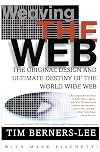
Berners-Lee writes a very fun and informative treatise on his experiences towards creating the Web as we utilize it today. The first nine chapters detail his background and history, up to his move to the United States. A lot of the material describing the internal workings of the CERN environment were absolutely compelling material. The rest of the book follows his work within the W3C, along with his long-range vision of the Web. While the book holds a time-frame of 1999/2000 - much of his show more observations still hold true today in 2013. show less
I love this quote from Tim Berners-Lee, the man responsible for the World Wide Web. He’s a low profile genius who never profited from his invention. I often think about him when i talk to my investment banking friends, or other people who are placing monetary gain over what really makes them happy. This is a quote from his book Weaving the Web which is a pretty good read if you’re interested in how the web came about, what the original thoughts were about it, and how it’s survived show more attempts by private industry (Microsoft, IBM, etc.) to control it.
People have sometimes asked me whether i am upset that i have not made a lot of money from the Web. In fact, I made some quite conscious decisions about which way to take my life. These I would not change - though i am making no comment on what i might do in the future. What does distress me, though, is how important a question it seems to be to some. This happens mostly in America, not Europe. What is maddening is the terrible notion that a person’s value depends on how important and financially successful they are, and that that is measured in terms of money. That suggests disrespect for the researchers across the globe developing ideas for the next leaps in science and technology. Core in my upbring was a value system that put monetary gain well in its place, behind things like doing what i really want to do. To use net worth as a criterion by which to judge people is to set our children’s sights on cash rather than on things that will actually make them happy. show less
People have sometimes asked me whether i am upset that i have not made a lot of money from the Web. In fact, I made some quite conscious decisions about which way to take my life. These I would not change - though i am making no comment on what i might do in the future. What does distress me, though, is how important a question it seems to be to some. This happens mostly in America, not Europe. What is maddening is the terrible notion that a person’s value depends on how important and financially successful they are, and that that is measured in terms of money. That suggests disrespect for the researchers across the globe developing ideas for the next leaps in science and technology. Core in my upbring was a value system that put monetary gain well in its place, behind things like doing what i really want to do. To use net worth as a criterion by which to judge people is to set our children’s sights on cash rather than on things that will actually make them happy. show less

PDFBE | Most of the Web's content today is designed for humans to read, not for computer programs to manipulate meaningfully. Computers can adeptly parse Web pages for layout and routine processing—here a header, there a link to another page—but in general, computers have no reliable way to process the semantics: this is the home page of the Hartman and Strauss Physio Clinic, this link goes to Dr. Hartman's curriculum vitae | The Semantic Web will bring structure to the meaningful show more content of Web pages, creating an environment where software agents roaming from page to page can readily carry out sophisticated tasks for users. Such an agent coming to the clinic's Web page will know not just that the page has keywords such as "treatment, medicine, physical, therapy" (as might be encoded today) but also that Dr. Hartman works at this clinic on Mondays, Wednesdays and Fridays and that the script takes adate range in yyyy-mm-dd format and returns appointment times. And it will "know" all this without needing artificial intelligence on the scale of 2001's Hal or Star Wars's C-3PO. Instead these semantics were encoded into the Web page when the clinic's office manager (who never took Comp Sci 101) massaged it into shape using off-the-shelf software for writing Semantic Web pages along with resources listed on the Physical Therapy Association's site | The Semantic Web will enable machines to COMPREHEND semantic documents and data, not human speech and writings. | https://www.sop.inria.fr/acacia/cours/essi2006/ScientificAmerican_FeatureArticle...
Contents
1. Introduction
2. Expressing Meaning
3. Knowledge Representation
-- http://www.sciam.com/article.cfm?articleid=00039D88-2C09-1CBF-B4A8809EC588EEDF
4. Ontologies
5. Agents
6. Evolution of Knowledge
-- http://www.sciam.com/article.cfm?articleid=0005DE0B-2C93-1CBF-B4A8809EC588EEDF
7. Further Information
Weaving the Web: The Original Design and
Ultimate Destiny of the World Wide Web by Its
Inventor.
Tim Berners-Lee, with Mark Fischetti. Harper San
Francisco, 1999.
An enhanced version of this article is on the
Scientific American Web site, with additional
material and links. World Wide Web Consortium (W3C): www.w3.org/
W3C Semantic Web Activity: www.w3.org/2001/sw/
An introduction to ontologies:
www.SemanticWeb.org/knowmarkup.html
Simple HTML Ontology Extensions
Frequently Asked Questions (SHOE FAQ):
www.cs.umd.edu/projects/plus/SHOE/faq.html
DARPA Agent Markup Language (DAML) home
page: www.daml.org/
8. (Attached Article) Hypermedia and the Semantic Web: A Research Agenda by Jacco van Ossenbruggen, Lynda Hardman and Lloyd Rutledge https://jodi-ojs-tdl.tdl.org/jodi/article/view/jodi-61
Until recently, the Semantic Web was little more than a name for the next-generation Web infrastructure as envisioned by its inventor, Tim Berners-Lee. With the introduction of XML and RDF, and new developments such as RDF Schema and DAML OIL, the Semantic Web is rapidly taking shape. This paper gives an overview of the state-of-the-art in Semantic Web technology, the key relationships with traditional hypermedia research, and a comprehensive reference list to various sets of literature (hypertext, Web and Semantic Web). A research agenda describes the open research issues in the development of the Semantic Web from the perspective of hypermedia research.
1 Introduction
2 Current Semantic Web Infrastructure RDF and RDF Schema DAML OIL Applications: PICS, P3P, Dublin Core
3 Relation with Hypermedia Research
4 Open Research Questions Links versus Relationships Open Hypermedia and the Semantic Web Time-based hypermedia and the Semantic Web
CSCW and the Semantic Web
5. Conclusions & Acknowledgements
6. References
SA - https://www.librarything.com/work/13996188/book/254691083 | https://www.librarything.com/work/31937414/book/261045602 | https://www.librarything.com/work/31942109/book/261127563 | https://www.librarything.com/work/31946140/book/261212165 | https://www.librarything.com/work/31950742/book/261263975
RT - JSON-LD
BT - Coding
NT - Agents
UF - To link data by using agents that automatically do the leg-work (AI).
SN - This is the historical article that laid out what the Semantic Web would look like. There is an additional article attached to this article that is exclusive to the first. (This entry does not reference a hierarchical list) show less
Contents
1. Introduction
2. Expressing Meaning
3. Knowledge Representation
-- http://www.sciam.com/article.cfm?articleid=00039D88-2C09-1CBF-B4A8809EC588EEDF
4. Ontologies
5. Agents
6. Evolution of Knowledge
-- http://www.sciam.com/article.cfm?articleid=0005DE0B-2C93-1CBF-B4A8809EC588EEDF
7. Further Information
Weaving the Web: The Original Design and
Ultimate Destiny of the World Wide Web by Its
Inventor.
Tim Berners-Lee, with Mark Fischetti. Harper San
Francisco, 1999.
An enhanced version of this article is on the
Scientific American Web site, with additional
material and links. World Wide Web Consortium (W3C): www.w3.org/
W3C Semantic Web Activity: www.w3.org/2001/sw/
An introduction to ontologies:
www.SemanticWeb.org/knowmarkup.html
Simple HTML Ontology Extensions
Frequently Asked Questions (SHOE FAQ):
www.cs.umd.edu/projects/plus/SHOE/faq.html
DARPA Agent Markup Language (DAML) home
page: www.daml.org/
8. (Attached Article) Hypermedia and the Semantic Web: A Research Agenda by Jacco van Ossenbruggen, Lynda Hardman and Lloyd Rutledge https://jodi-ojs-tdl.tdl.org/jodi/article/view/jodi-61
Until recently, the Semantic Web was little more than a name for the next-generation Web infrastructure as envisioned by its inventor, Tim Berners-Lee. With the introduction of XML and RDF, and new developments such as RDF Schema and DAML OIL, the Semantic Web is rapidly taking shape. This paper gives an overview of the state-of-the-art in Semantic Web technology, the key relationships with traditional hypermedia research, and a comprehensive reference list to various sets of literature (hypertext, Web and Semantic Web). A research agenda describes the open research issues in the development of the Semantic Web from the perspective of hypermedia research.
1 Introduction
2 Current Semantic Web Infrastructure RDF and RDF Schema DAML OIL Applications: PICS, P3P, Dublin Core
3 Relation with Hypermedia Research
4 Open Research Questions Links versus Relationships Open Hypermedia and the Semantic Web Time-based hypermedia and the Semantic Web
CSCW and the Semantic Web
5. Conclusions & Acknowledgements
6. References
SA - https://www.librarything.com/work/13996188/book/254691083 | https://www.librarything.com/work/31937414/book/261045602 | https://www.librarything.com/work/31942109/book/261127563 | https://www.librarything.com/work/31946140/book/261212165 | https://www.librarything.com/work/31950742/book/261263975
RT - JSON-LD
BT - Coding
NT - Agents
UF - To link data by using agents that automatically do the leg-work (AI).
SN - This is the historical article that laid out what the Semantic Web would look like. There is an additional article attached to this article that is exclusive to the first. (This entry does not reference a hierarchical list) show less
Awards

You May Also Like


Associated Authors
Statistics
- Works
- 12
- Also by
- 3
- Members
- 996
- Popularity
- #25,870
- Rating
- 3.8
- Reviews
- 15
- ISBNs
- 25
- Languages
- 5
- Favorited
- 1
