
Jennifer Cook O'Toole
Author of Autism in Heels: The Untold Story of a Female Life on the Spectrum
About the Author
Works by Jennifer Cook O'Toole
The Asperkid's (Secret) Book of Social Rules: The Handbook of Not-So-Obvious Social Guidelines for Tweens and Teens With Asperger Syndrome (2012) 141 copies, 2 reviews
Asperkids: An Insider's Guide to Loving, Understanding, and Teaching Children with Asperger's Syndrome (2012) 32 copies, 1 review
The Asperkid's Game Plan: Extraordinary Minds, Purposeful Play... Ordinary Stuff (2014) 13 copies, 1 review
Tagged
Common Knowledge
Members
Reviews
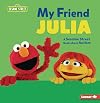
When Julia was introduced to Sesame Street in 2017, I was ecstatic. Finally, there was some representation of autism in children's shows. Yet, in the six years that followed, there have been few, if any, books about Julia. So, when I came across My Friend Julia by Jennifer Cook, I knew I had to read it. I especially love that Jennifer Cook is also autistic—nothing for us without us.
My Friend Julia introduces Julia as "funny, smart, and autistic." I love this word order because autism is show more only part of who she is, just like her red hair. It then goes through activities Julia enjoys with other muppets, like art with Elmo or building with Ernie. It also shows Julia's bunny Fluffster, her flapping, and her headphones. As an autistic adult, I still have my Mr. Bear and do the same things. I loved the representation. The entire book is positive and inclusive. It ends with suggestions on how to be a good friend. It's great for autistic kids and their friends and would be perfect for schools.
Recommended age: 4-6 years old
Writing style: The book goes back and forth between descriptions of Julia and quotes by other muppets saying how they are similar or different from that description.
Lexile range (unofficial): 410L - 600L
Decoding difficulty: 4/5
Vocabulary difficulty: 4/5
Sentences difficulty: 4/5
Patterns difficulty: 5/5
Illustration style: Solid color backgrounds with full-color photos of the muppets.
Reality-based: Julia is one example of an autistic person. It works well for young children and can lead to more conversations about autism.
Disclaimer: Thank you, NetGalley and Lerner Publications, for this title. All opinions are my own. show less
My Friend Julia introduces Julia as "funny, smart, and autistic." I love this word order because autism is show more only part of who she is, just like her red hair. It then goes through activities Julia enjoys with other muppets, like art with Elmo or building with Ernie. It also shows Julia's bunny Fluffster, her flapping, and her headphones. As an autistic adult, I still have my Mr. Bear and do the same things. I loved the representation. The entire book is positive and inclusive. It ends with suggestions on how to be a good friend. It's great for autistic kids and their friends and would be perfect for schools.
Recommended age: 4-6 years old
Writing style: The book goes back and forth between descriptions of Julia and quotes by other muppets saying how they are similar or different from that description.
Lexile range (unofficial): 410L - 600L
Decoding difficulty: 4/5
Vocabulary difficulty: 4/5
Sentences difficulty: 4/5
Patterns difficulty: 5/5
Illustration style: Solid color backgrounds with full-color photos of the muppets.
Reality-based: Julia is one example of an autistic person. It works well for young children and can lead to more conversations about autism.
Disclaimer: Thank you, NetGalley and Lerner Publications, for this title. All opinions are my own. show less
This is kind of hard to nail down.
When she's talking about her research and giving her chick list of how female autism can look, she is compelling and funny and you understand why she would be a great speaker and why her Asperkids books are so popular.
And then there are segments on bullying she endured in school and on intimate partner violence and that is just excruciating because it is so visceral.
But it is also hard to read in other ways that aren't important, but just a little grating. show more Bits that pulled me out of the narrative entirely. At least a couple of times she mentions her IQ, which is pertinent in that one reason females with autism are not evaluated and if evaluated, not diagnosed, that is, they ate overlooked in part because they're smart, often very verbal, and well behaved. So it makes sense to pull from her life to illustrate a concept. Yes. But she brings it up more than once and doesn't give the number. Maybe it seemed like it made more sense to avoid a specific number in favor of a range, which is fine, but she doesn't exactly do that either.
Likewise, in the school section, she talks about her mom being kind of flabbergasted at stuff the child doesn't know or doesn't understand, stuff which seems so obvious to the mother. So yeah, her mother found her odd and without a recognized female phenotype of autism, the mother has no context for why her only child is like this. Again, this is totally central to the point of the book: Cook is alone with her mom for years and she doesn't have friends and her mother doesn't get her, so she throws herself into academics and performing and such for validation. I get it. But more than once she mentions being this performer on command for adults, and how it pissed off other kids the way she was showing off. Every time this comes up she gives a "but it wasn't showing off" because of the adult validation imperative. Multiple times, which I did not count. Until I am just gobsmacked that she doesn't understand that it doesn't matter to the other kids what the motivation is or who asked her to do it: it is still, explicitly, well within the connotation and denotation of "showing off." To be fair, this is one of the traits of autism: not getting it, I mean.
Last one, several times she refers to the things that other people are astounded that people with autism don't just understand. Things which people can't even explain properly because they do just get it, and it's never been explicit anywhere. And autism spectrum or not, that's always a thing that fascinates people. But we all assume other people are like us, so you might not realize until your 50s, to take an example at random, that when people say "I could see it in my mind" they aren't being metaphorical. They literally mean that they have a clear, precise image in the head. If you're aphantasic and have no visual imagination, you might not have realized that other people could really do such a thing. Right with the concept, and she talks about this in different anecdotes. And then, when she's writing about something, she says in effect, people with autism can't do this kind of detailed strategizing and tactical planning. Whoops! I have no idea how common or rare this ability is, but there are definitely people with autism who can do that. I can't, but some people are really good at it, which comes up a lot in gaming.
Okay, I am done with that, it's just some things that vexed me.
More importantly, when differentiating between the boy and girl phenotypes, Cook describes looking at the criteria and working out what the trait in question is for and then looking at things girls do that serve the same purpose even if it isn't "lining up their cars" or "studying traintables" and it's really some brilliant thinking on her part, and it is described so clearly that you get it. Girls without brothers probably don't even have cars. It's elegant.
There's a lot of good stuff about things she did for her kids when they were diagnosed, and stuff she does for others. I think she probably is a fabulous mentor for people with autism, and an amazing example of people studying what they think is important, rather than what researchers think is important from the outside.
Library copy show less
When she's talking about her research and giving her chick list of how female autism can look, she is compelling and funny and you understand why she would be a great speaker and why her Asperkids books are so popular.
And then there are segments on bullying she endured in school and on intimate partner violence and that is just excruciating because it is so visceral.
But it is also hard to read in other ways that aren't important, but just a little grating. show more Bits that pulled me out of the narrative entirely. At least a couple of times she mentions her IQ, which is pertinent in that one reason females with autism are not evaluated and if evaluated, not diagnosed, that is, they ate overlooked in part because they're smart, often very verbal, and well behaved. So it makes sense to pull from her life to illustrate a concept. Yes. But she brings it up more than once and doesn't give the number. Maybe it seemed like it made more sense to avoid a specific number in favor of a range, which is fine, but she doesn't exactly do that either.
Likewise, in the school section, she talks about her mom being kind of flabbergasted at stuff the child doesn't know or doesn't understand, stuff which seems so obvious to the mother. So yeah, her mother found her odd and without a recognized female phenotype of autism, the mother has no context for why her only child is like this. Again, this is totally central to the point of the book: Cook is alone with her mom for years and she doesn't have friends and her mother doesn't get her, so she throws herself into academics and performing and such for validation. I get it. But more than once she mentions being this performer on command for adults, and how it pissed off other kids the way she was showing off. Every time this comes up she gives a "but it wasn't showing off" because of the adult validation imperative. Multiple times, which I did not count. Until I am just gobsmacked that she doesn't understand that it doesn't matter to the other kids what the motivation is or who asked her to do it: it is still, explicitly, well within the connotation and denotation of "showing off." To be fair, this is one of the traits of autism: not getting it, I mean.
Last one, several times she refers to the things that other people are astounded that people with autism don't just understand. Things which people can't even explain properly because they do just get it, and it's never been explicit anywhere. And autism spectrum or not, that's always a thing that fascinates people. But we all assume other people are like us, so you might not realize until your 50s, to take an example at random, that when people say "I could see it in my mind" they aren't being metaphorical. They literally mean that they have a clear, precise image in the head. If you're aphantasic and have no visual imagination, you might not have realized that other people could really do such a thing. Right with the concept, and she talks about this in different anecdotes. And then, when she's writing about something, she says in effect, people with autism can't do this kind of detailed strategizing and tactical planning. Whoops! I have no idea how common or rare this ability is, but there are definitely people with autism who can do that. I can't, but some people are really good at it, which comes up a lot in gaming.
Okay, I am done with that, it's just some things that vexed me.
More importantly, when differentiating between the boy and girl phenotypes, Cook describes looking at the criteria and working out what the trait in question is for and then looking at things girls do that serve the same purpose even if it isn't "lining up their cars" or "studying traintables" and it's really some brilliant thinking on her part, and it is described so clearly that you get it. Girls without brothers probably don't even have cars. It's elegant.
There's a lot of good stuff about things she did for her kids when they were diagnosed, and stuff she does for others. I think she probably is a fabulous mentor for people with autism, and an amazing example of people studying what they think is important, rather than what researchers think is important from the outside.
Library copy show less
A rather eye-opening memoir by a woman who, in her mid-thirties, was diagnosed with Asperger’s syndrome, and who put in a lot of her own research to show how autism “looks a bit different in pink” and that because autism was identified in boys in a study, many girls and women are never diagnosed because their behaviors are different. A little too self-promotional at times for my taste, but nevertheless, an interesting account of being in a world with which you feel out of sync, a show more sensation I have felt most of my life. show less
It’s difficult to listen to a memoir with another purpose (in this case autism awareness for women) and not be a little confused. I appreciated learning so much that I didn’t know. But as the author didn’t get diagnosed until her thirties, the memoir part retroactively places autism as the reason for her experiences. I think I just would like to see more out there, so I’ll go to more books to learn. I wasn’t able to find any common ground here with the author’s life, but I’m show more glad that she’s out there telling her story. show less
You May Also Like


Statistics
- Works
- 10
- Members
- 448
- Popularity
- #54,748
- Rating
- 3.9
- Reviews
- 11
- ISBNs
- 25
- Languages
- 2
- Favorited
- 1