
Laura F. Marsh
Author of Polar Bears (National Geographic Readers) (Level 1)
About the Author
Image credit: via amazon.com
Works by Laura F. Marsh
Great Migrations: Amazing Animal Journeys (National Geographic Readers) (Level 3) (2010) 1,233 copies, 4 reviews
Great Migrations: Butterflies (National Geographic Readers) (Level 3) (2010) 1,195 copies, 2 reviews
Toot & Puddle: The Mystery of the Disappearing Swing (National Geographic Kids) (2008) — Adapter — 31 copies
Great Migrations: Dolphins, Sea Turtles, Whales (National Geographic Readers) (Levels 2 & 3) (2012) 1 copy
The secret garden 1 copy
Tagged
Common Knowledge
- Gender
- female
- Nationality
- USA
- Places of residence
- Westchester County, New York, USA
- Associated Place (for map)
- New York, USA
Members
Reviews
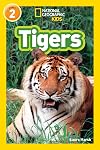
I can't believe I have never reviewed one of National Geographic's utterly cool nonfiction easy readers before, but according to my post listing I have not. Oh the horror!
So, I discovered these last year and they have instantly, crazily successful at my library. Kids, and parents, have figured out to look for the yellow spine and I have made a list of all the titles we own, they get asked for that often.
There are so many reasons I love these, but the top three are: nonfiction for younger show more readers, amazing photographs, and text that is challenging but in a large font and enticing to read.
National Geographic Kids publishes easy readers at four levels, pre-reader, level 1, level 2, and level 3. This particular title by Laura Marsh, who has written the bulk of the Nat'l Geographic easy readers, is a level 2, aimed at children learning to read independently. It is 32 pages long, begins with a table of contents, and finishes with fun quiz questions and a simple picture glossary. The text is divided into "chapters" of a few pages each. Each spread has abundant photographs with captions, jokes (I thought these were kind of corny, but the kids LOVE them) and when needed simple maps and "tiger terms" or word definitions. Here's a sample of the simple text; "Tigers are full-grown when they leave their families. They are big, heavy cats, but they can climb trees and jump great distances."
Like all of National Geographic's publications, the photographs are clear and gorgeous. The book has an excellent layout, not too cluttered but with many points of interest. The pages alternate between simple paragraphs and more graphic layouts, like "Cool Cat Facts" that has pictures of tigers in pawprint outlines accompanied by a few simple sentences.
Verdict: I strongly recommend purchasing at least a few of these easy readers for your library. Ideally, you'll buy all of them! Start with the titles by Laura Marsh - a nice variety of subjects, concisely written, and appropriate for beginning readers at various levels. Tell your patrons to look for the yellow spines and happy reading!
ISBN: 9781426309120; Published January 2012 by National Geographic; Borrowed from the library; Purchased for the library show less
So, I discovered these last year and they have instantly, crazily successful at my library. Kids, and parents, have figured out to look for the yellow spine and I have made a list of all the titles we own, they get asked for that often.
There are so many reasons I love these, but the top three are: nonfiction for younger show more readers, amazing photographs, and text that is challenging but in a large font and enticing to read.
National Geographic Kids publishes easy readers at four levels, pre-reader, level 1, level 2, and level 3. This particular title by Laura Marsh, who has written the bulk of the Nat'l Geographic easy readers, is a level 2, aimed at children learning to read independently. It is 32 pages long, begins with a table of contents, and finishes with fun quiz questions and a simple picture glossary. The text is divided into "chapters" of a few pages each. Each spread has abundant photographs with captions, jokes (I thought these were kind of corny, but the kids LOVE them) and when needed simple maps and "tiger terms" or word definitions. Here's a sample of the simple text; "Tigers are full-grown when they leave their families. They are big, heavy cats, but they can climb trees and jump great distances."
Like all of National Geographic's publications, the photographs are clear and gorgeous. The book has an excellent layout, not too cluttered but with many points of interest. The pages alternate between simple paragraphs and more graphic layouts, like "Cool Cat Facts" that has pictures of tigers in pawprint outlines accompanied by a few simple sentences.
Verdict: I strongly recommend purchasing at least a few of these easy readers for your library. Ideally, you'll buy all of them! Start with the titles by Laura Marsh - a nice variety of subjects, concisely written, and appropriate for beginning readers at various levels. Tell your patrons to look for the yellow spines and happy reading!
ISBN: 9781426309120; Published January 2012 by National Geographic; Borrowed from the library; Purchased for the library show less
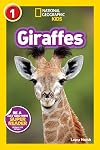
It's been a while since I reviewed any National Geographic easy readers, but rest assured, I am still buying them diligently! I picked this one up because it was nominated for Cybils.
This level one reader has about 8 sections, each a page or two long. They cover general facts about giraffes, their habitats, fun facts, baby giraffes, how they protect themselves from predators, and their food and eating habits.
Back matter includes a guessing game with photos of things mentioned in the book, show more some vocabulary words, and a brief picture glossary. Like all National Geographic titles, this includes vibrant photographs as well as colorful text and backgrounds. Jokes and interesting facts are interspersed throughout the book.
There aren't really any publishers whose levels correspond to actual reading levels used in most schools, but I have a sneaking suspicion National Geographic is worse than most. This level one easy reader has lengthy and sometimes complex text. It's suggested for kids who are beginning to read on their own, but in our leveling system (our school uses Lexiles and we generally look at a variety of sources, including Fountas and Pinnell) it comes in as a level three which is almost an intermediate reader.
Verdict: Although the levels tend to be wildly off, these easy readers are still extremely popular with my beginning readers and I'm personally very skeptical about levels anyways. It does help to have a more accurate guide for parents and caregivers, which we do have available in several different forms. Otherwise, this is a fun, well-done easy reader that animal fans will enjoy tackling.
ISBN: 9781426324499; Published 2016 by National Geographic Kids; Purchased for the library show less
This level one reader has about 8 sections, each a page or two long. They cover general facts about giraffes, their habitats, fun facts, baby giraffes, how they protect themselves from predators, and their food and eating habits.
Back matter includes a guessing game with photos of things mentioned in the book, show more some vocabulary words, and a brief picture glossary. Like all National Geographic titles, this includes vibrant photographs as well as colorful text and backgrounds. Jokes and interesting facts are interspersed throughout the book.
There aren't really any publishers whose levels correspond to actual reading levels used in most schools, but I have a sneaking suspicion National Geographic is worse than most. This level one easy reader has lengthy and sometimes complex text. It's suggested for kids who are beginning to read on their own, but in our leveling system (our school uses Lexiles and we generally look at a variety of sources, including Fountas and Pinnell) it comes in as a level three which is almost an intermediate reader.
Verdict: Although the levels tend to be wildly off, these easy readers are still extremely popular with my beginning readers and I'm personally very skeptical about levels anyways. It does help to have a more accurate guide for parents and caregivers, which we do have available in several different forms. Otherwise, this is a fun, well-done easy reader that animal fans will enjoy tackling.
ISBN: 9781426324499; Published 2016 by National Geographic Kids; Purchased for the library show less
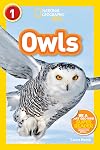
Being that it's from National Geographic, I knew before reading that this informational book on owls would be accurate and interactive information. I was right, and the book's structure is what made me like it so much. Unlike a lot of nonfiction books on animals, this book's language is fun and friendly, making it much more appealing than most. It even begins with a rhyme - "What hoots in the night and flies through the air? What has feathers and big eyes, but do not have hair? You may never show more see one, but you'll know if you do. Did you guess? yes? It's an owl, that's who!" This stood out to me since most informational books aren't as engaging language-wise and it pulled me right in. I knew I was in for a treat. Its rich with real, quality photographs and bright-colored pages and text, making it very visually appealing. Each photograph has a caption, and each page is structured differently, keeping the reader on their toes. This does have its disadvantages, however, since it's not consistent and could throw off a young reader a little bit. Every harder vocabulary word is defined right on the page in a "bird box," which really stood out to me as a useful tool. The same vocabulary also has pronunciations in parentheses right next to them. On the same note, they include multiple Q&A questions at the top with interesting facts that kids would likely ask themselves while reading, which I really enjoyed for its success in engagement. It ends with a picture quiz with the answers included in the back - it's like we just completed a lesson on owls. Defined as a Level 1 book on the cover, this book is designed for younger readers, though it could easily be enjoyed at all ages. This is probably the best nonfiction book I've read in a while. show less
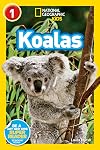
With a seemingly permanent half-smile on their face, koalas are appealing to boys and girls alike. Filled with adorable photos, and carefully leveled text, this level 1 reader introduces beginning readers to these furry creatures, from cub to adult, exploring where they live, what they eat, and even the way they say "hello" --by touching noses!
Lists
You May Also Like


Associated Authors
Statistics
- Works
- 55
- Members
- 26,985
- Popularity
- #766
- Rating
- 4.1
- Reviews
- 93
- ISBNs
- 404
- Languages
- 6