

Susan L. Shirk
Author of China: Fragile Superpower
About the Author
Susan L. Shirk is Director of the University of California's Institute on Global Conflict and Cooperation, and Professor at UC-San Diego
Works by Susan L. Shirk
Tagged
Common Knowledge
- Birthdate
- 20th century
- Gender
- female
- Nationality
- USA
- Associated Place (for map)
- USA
Members
Reviews
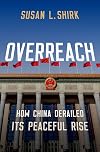
Susan L. Shirk’s Overreach remarkably charts the changes of Chinese leadership at home and their actions abroad since the demise of Mao Tsedong.
The regime of Xi Jinping is much more authoritarian and insecure than we generally understand, leading us to both underestimate the Chinese Communist Party’s ambition and overestimate its capabilities for world domination.
While the diminutive Deng Xiaoping began a process of decentralizing China’s government to prevent the concentration of show more power in the hands of a charismatic leader in the future, the men who followed him turned the bureaucracy into a self-serving mosh pit of corruption and inertia.
Xi attempts to turn the ship of state around with crackdowns on corruption, more stringent social controls, and aggression on foreign objectives. He announced a new “socialism with Chinese characteristics.”
Shirk’s thesis is that Xi is achieving the opposite of his goals making his regime less secure in the process.
At the risk of making Xi the bogeyman, one has to ask, in all fairness and with a straight face, what really is “socialism with Chinese characteristics?”
a) A country where most people would rather speculate on real estate than attend Party meetings?
b) A country so corrupt that the new bridge built for a state of the art high-speed train collapses within a couple years because its builders opted to use low-grade concrete and pay out enormous bribes to get the contract?
c) A country that gives brownie points to citizens who don’t jay walk using social media and high-powered facial recognition technology?
“Socialism with Chinese characteristics” harkens back to Alexander Dubcek’s famous speech associated with the doomed Prague Spring of1968. As Czechoslovakian exports began losing competitiveness on world markets Dubcek became First Secretary of the Czech Communist Party promising economic and cultural reforms.
He called his new program “socialism with a human face,” in fact too human for his conservative opponents. Dubcek’s reforms were snubbed out when Warsaw Pact countries answered with columns of Russian tanks. The following year he was dumped from the leadership of the Party.
Nuclear scientist and Russian dissident Andrei Sakharov later credited Dubcek with the birth of dissent in the Soviet Soviet Union and made possible Gorbachev’s perestroika and the breakup of the Soviet union.
Xi’s announced reforms had nothing to do with liberalization. Rather, he has hardened the Chinese Communist Party’s response to dissent in Beijing, in Hong Kong, and throughout the CCP’s sphere of influence.
Slogans aside, there is no justification on God’s Green Earth for a single party state. None.
It’s not as though people are clamoring to immigrate to the great workers’ paradise.
Not even given what we know about the Republican Party, amazon.com, and the Sam Bankman-Frieds of the world. (Winston Churchill once said that: “democracy is the worst form of government – except for all the others that have been tried.”)
Yet President for life Xi Jinping operates as if there were.
And it is one of the great ironies of history that instead of building a workers’ paradise, China’s social architects have built a Walmart paradise.
While Shirk doesn’t go quite this far, it is both ironic and fitting that Xi’s prdecessors, incl. Hu Jintao and Jang Zemin, ultimately built governments of such self-dealing and logrolling it would have made the bureaucracies of Ronald Reagan and George W. Bush blush with shame.
Shirk’s prescription for US Presidents handling the Chinese Leviathan in international affairs is to fix democracy at home and slowly feed incentives to the Chinese leadership to want to cooperate with its neighbours so that they will bully them less.
But in the real world the US and its ally the United Kingdom are arming Australia with nuclear subs to police the South China Sea.
Also in the real world Xi brokers a deal re-opening diplomatic ties between Saudi Arabia and Iran which if it lasts demonstrates that One Party States can prove helpful to international relations. Granted it was one dictatorship talking to two other dictatorships. show less
The regime of Xi Jinping is much more authoritarian and insecure than we generally understand, leading us to both underestimate the Chinese Communist Party’s ambition and overestimate its capabilities for world domination.
While the diminutive Deng Xiaoping began a process of decentralizing China’s government to prevent the concentration of show more power in the hands of a charismatic leader in the future, the men who followed him turned the bureaucracy into a self-serving mosh pit of corruption and inertia.
Xi attempts to turn the ship of state around with crackdowns on corruption, more stringent social controls, and aggression on foreign objectives. He announced a new “socialism with Chinese characteristics.”
Shirk’s thesis is that Xi is achieving the opposite of his goals making his regime less secure in the process.
At the risk of making Xi the bogeyman, one has to ask, in all fairness and with a straight face, what really is “socialism with Chinese characteristics?”
a) A country where most people would rather speculate on real estate than attend Party meetings?
b) A country so corrupt that the new bridge built for a state of the art high-speed train collapses within a couple years because its builders opted to use low-grade concrete and pay out enormous bribes to get the contract?
c) A country that gives brownie points to citizens who don’t jay walk using social media and high-powered facial recognition technology?
“Socialism with Chinese characteristics” harkens back to Alexander Dubcek’s famous speech associated with the doomed Prague Spring of1968. As Czechoslovakian exports began losing competitiveness on world markets Dubcek became First Secretary of the Czech Communist Party promising economic and cultural reforms.
He called his new program “socialism with a human face,” in fact too human for his conservative opponents. Dubcek’s reforms were snubbed out when Warsaw Pact countries answered with columns of Russian tanks. The following year he was dumped from the leadership of the Party.
Nuclear scientist and Russian dissident Andrei Sakharov later credited Dubcek with the birth of dissent in the Soviet Soviet Union and made possible Gorbachev’s perestroika and the breakup of the Soviet union.
Xi’s announced reforms had nothing to do with liberalization. Rather, he has hardened the Chinese Communist Party’s response to dissent in Beijing, in Hong Kong, and throughout the CCP’s sphere of influence.
Slogans aside, there is no justification on God’s Green Earth for a single party state. None.
It’s not as though people are clamoring to immigrate to the great workers’ paradise.
Not even given what we know about the Republican Party, amazon.com, and the Sam Bankman-Frieds of the world. (Winston Churchill once said that: “democracy is the worst form of government – except for all the others that have been tried.”)
Yet President for life Xi Jinping operates as if there were.
And it is one of the great ironies of history that instead of building a workers’ paradise, China’s social architects have built a Walmart paradise.
While Shirk doesn’t go quite this far, it is both ironic and fitting that Xi’s prdecessors, incl. Hu Jintao and Jang Zemin, ultimately built governments of such self-dealing and logrolling it would have made the bureaucracies of Ronald Reagan and George W. Bush blush with shame.
Shirk’s prescription for US Presidents handling the Chinese Leviathan in international affairs is to fix democracy at home and slowly feed incentives to the Chinese leadership to want to cooperate with its neighbours so that they will bully them less.
But in the real world the US and its ally the United Kingdom are arming Australia with nuclear subs to police the South China Sea.
Also in the real world Xi brokers a deal re-opening diplomatic ties between Saudi Arabia and Iran which if it lasts demonstrates that One Party States can prove helpful to international relations. Granted it was one dictatorship talking to two other dictatorships. show less
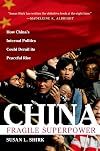
Susan Shirk was Deputy Assistant Secretary of State responsible for relations with China in the Clinton administration and she is now director of the University of California's Institute on Global Conflict and Cooperation.
In this extremely well informed book she reflects on her lifetimes' experience with Chinese affairs and explains why China is more of a "fragile" superpower than is immediately apparent to Western observers.
The basic problem is that Communist ideology doesn't convince the show more Chinese (or anyone else) any longer, so in fear for their own survival, the Chinese Communist leadership have fomented and appropriated a strident form on nationalism directed at the Japanese, Taiwanese and Americans,in that order.
She gives full credit to the economic reforms and openness initiated by Deng Xiaoping, quoting the World Bank in saying that since 1979 the reforms have lifted 400 million people out of poverty, which is a remarkable figure. The Chinese take pride in their achievement but her opinion is that a combination of pride and nationalism + a newly informed population thanks to the Internet, risks popular demands for military action that the Politbureau could not hold back (and remain in power) - in other words, they would become hostages of their their own nationalist creation.
The Chinese people also leave the Communist government alone while they provide the economic conditions for the growth to absorb the rural workforce as it migrates to the cities. A war would obviously break this link but she doesn't really consider the (more likely) disruption caused by an economic crisis.
As of 2010 the Chinese economy is overheating and could expect some economic instability, either from interior conditions or from the exterior ones resulting from the high level of integration of China into the world economy.
I feel that this is an important point that she doesn't explore sufficiently, but otherwise I'd easily give the book 5 stars. show less
In this extremely well informed book she reflects on her lifetimes' experience with Chinese affairs and explains why China is more of a "fragile" superpower than is immediately apparent to Western observers.
The basic problem is that Communist ideology doesn't convince the show more Chinese (or anyone else) any longer, so in fear for their own survival, the Chinese Communist leadership have fomented and appropriated a strident form on nationalism directed at the Japanese, Taiwanese and Americans,in that order.
She gives full credit to the economic reforms and openness initiated by Deng Xiaoping, quoting the World Bank in saying that since 1979 the reforms have lifted 400 million people out of poverty, which is a remarkable figure. The Chinese take pride in their achievement but her opinion is that a combination of pride and nationalism + a newly informed population thanks to the Internet, risks popular demands for military action that the Politbureau could not hold back (and remain in power) - in other words, they would become hostages of their their own nationalist creation.
The Chinese people also leave the Communist government alone while they provide the economic conditions for the growth to absorb the rural workforce as it migrates to the cities. A war would obviously break this link but she doesn't really consider the (more likely) disruption caused by an economic crisis.
As of 2010 the Chinese economy is overheating and could expect some economic instability, either from interior conditions or from the exterior ones resulting from the high level of integration of China into the world economy.
I feel that this is an important point that she doesn't explore sufficiently, but otherwise I'd easily give the book 5 stars. show less
How China's internal politics could derail its peaceful rise
China: Fragile Superpower: How China's Internal Politics Could Derail Its Peaceful Rise by Susan L. Shirk
Excellent, easy to read. Great intro to China
Lists
Awards


You May Also Like


Statistics
- Works
- 8
- Members
- 256
- Popularity
- #89,546
- Rating
- 3.9
- Reviews
- 7
- ISBNs
- 30
- Languages
- 1