
Jessica Hart (1)
Author of Best Made Plans
For other authors named Jessica Hart, see the disambiguation page.
Jessica Hart (1) has been aliased into Pamela Hartshorne.
Series
Works by Jessica Hart
Works have been aliased into Pamela Hartshorne.
Here Comes the Bride (The Bridesmaid's Proposal / The Billionaire's Blind Date) (2005) — Contributor — 18 copies
Sleigh Bells and Wedding Rings (The Silver Thaw / The Christmas Basket / Mistletoe Marriage) (2009) — Contributor — 6 copies
Loving Our Heroes (Last-Minute Proposal / Mission: Mountain Rescue / Mistress: Hired for the Billionaire's Pleasure) (2011) — Contributor — 5 copies
All in a Day (His Darling Valentine / The Bridesmaid's Proposal / Billionaire's Blind Date) (2005) — Contributor — 4 copies
Christmas Dreams (Winter Wedding / Kissing Santa / The Baby Discovery) (2008) — Contributor — 4 copies
Brides for Christmas (Claiming His Christmas Bride / Christmas Eve Marriage / A Surprise Christmas Proposal) (2007) — Contributor — 3 copies
Twins Come Too! (For the Babies' Sakes / Inherited: Twins! / Adopted: Twins!) (2006) — Contributor — 2 copies
Christmas Angel for the Billionaire [and] Under the Boss's Mistletoe (2009) — Contributor — 2 copies
Mothers Wanted (Hot Summer Bride / Brand-New Father, Brand-New Family / For His Baby's Sake) (2008) — Contributor — 2 copies
Outback Proposals (Outback Mistress / Outback Baby / Wedding at Waverley Creek) (2006) — Contributor — 2 copies
Delta Disappearance 2 copies
Weddings Down Under (An Ideal Marriage? / Georgia and the Tycoon / Outback Bride) (2001) — Contributor — 2 copies
Harlequin Comics Best Selection, Vol. 007 — Original Text — 1 copy
Summer Desserts / Mistletoe Marriage / Barely Behaving — Contributor — 1 copy
Paradise Nights (Taken by the Bad Boy / Barefoot Bride / Behind Closed Doors) (2011) — Contributor — 1 copy
Special collection, Mills & Boon — Contributor — 1 copy
Associated Works
Works have been aliased into Pamela Hartshorne.
Um Sheik Na Cidade & Mãe e Mulher — Author, some editions — 1 copy
Tagged
Common Knowledge
- Other names
- Hart, Jessica
- Gender
- female
- Short biography
- Jessica Hart was born in Ghana, and grew up around Africa, she has suffered from itchy feet ever since. She has traveled by Tanganyika, South Africa, Papua New Guinea, Oman, Australian Outback, Kathmandu, India, Pakistan, Afghanistan, Iran, Turkey, Cameroon, Algeria, USA, Egypt, Kenya, France, Belize, Turkey, Sri Lanka, Spain, Italy, Greece… many of these countries have featured as settings in her books in one way or another. She obtained a degree in French from the University of Edinburgh, Scotland, where her mother continues living.
After some years spent working and traveling around the world, she stumbled into writing as a way of funding her Ph.D. in medieval history, obtained in 2004, and she is now a full-time author based in York, England dividing her time between Yorkshire and Wiltshire, where her partner, John, lives. The more she writes, the more interested she is in how and why romance works, and in spite of much grumbling about the writing process, suspects she is now hooked! Jessica has written more than 50 books and is winner of the two most prestigious awards in romance writing, a RITA® award for the best traditional romance of 2005, and the coveted Romance Prize, awarded by the U.K.'s Romantic Novelists' Association in 2006, an award for which she was also short-listed in 2007 and 2009. - Nationality
- UK
- Birthplace
- Ghana
- Places of residence
- Ghana
Edinburgh, Scotland, UK
Iran
Kathmandu
Turkey
Papua New Guinea (show all 12)
Tanganyika
Afghanistan
Pakistan
India
New Zealand
Oman
Members
Reviews
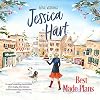
This is the second book in a series, the couple from the previous novel does appear briefly in this one, but Flora and Max are very much the focus so it should be easy enough to read as a standalone.
I felt like this had some unnecessary tropes. Flora and Max already had legit reasons to be around each other, she’s good friends with his sister, she’s catering the sister’s wedding, and she’s borrowing Max’s kitchen for seven months for her side business, they didn’t need to fake show more date or share a room/bed to frequently cross-paths. And if fake dating did have to happen, I wish there had been a stronger reason behind it than just the need to fill out a boy-girl seating chart.
The fake dating and the sharing a room/bed felt a bit forced, and since most of that occurred during the “royal” segments of the story, maybe that’s why I much more preferred Flora and Max in the village, their interractions in his kitchen and in her cottage were so much more natural and engaging, and easily rate as all my favorite moments of the novel.
I also appreciated the timeline of this story, that it takes place over months rather than a few days, it’s so much easier to buy in when love takes a bit of time rather than happening overnight. I less appreciated a sad moment that happens (keeping it vague to avoid spoilers), that’s kind of the last thing I want to read about at the moment given something that I’m going through, so it wasn’t ideal timing, it did make sense that the story would go that way though, and there was a lovely gesture included so that helped lift things back up a bit. show less
I felt like this had some unnecessary tropes. Flora and Max already had legit reasons to be around each other, she’s good friends with his sister, she’s catering the sister’s wedding, and she’s borrowing Max’s kitchen for seven months for her side business, they didn’t need to fake show more date or share a room/bed to frequently cross-paths. And if fake dating did have to happen, I wish there had been a stronger reason behind it than just the need to fill out a boy-girl seating chart.
The fake dating and the sharing a room/bed felt a bit forced, and since most of that occurred during the “royal” segments of the story, maybe that’s why I much more preferred Flora and Max in the village, their interractions in his kitchen and in her cottage were so much more natural and engaging, and easily rate as all my favorite moments of the novel.
I also appreciated the timeline of this story, that it takes place over months rather than a few days, it’s so much easier to buy in when love takes a bit of time rather than happening overnight. I less appreciated a sad moment that happens (keeping it vague to avoid spoilers), that’s kind of the last thing I want to read about at the moment given something that I’m going through, so it wasn’t ideal timing, it did make sense that the story would go that way though, and there was a lovely gesture included so that helped lift things back up a bit. show less

Truth be told I have a sincere soft spot for many of the late 80's/early 90's Harlequin titles. I grew up on those as a young teen. Even now, as I prefer historical romance or paranormal romance, I have at least a dozen of my favorites from Harlequin that still please me. I only recently began reading Hart and since I saw this as my used bookstore I decided to pick it up.
Admittedly I had to first put aside the eye-rolling at the male lead (Kier's) preponderance with posturing and acting like show more the female lead (Penelope called Poppy) didn't affect him. Anyone with half a brain could see that a normally placid, professional man who suddenly becomes prickly and irritated when a certain female around is obviously having some sort of big feelings for her. It also helps to ignore how passive Poppy tended to be.
In short this was, while not being one of my favorite Old School Romances, definitely was in my top twenty-five percentile. There were definite moments when Poppy was sassy and gave Kier back as good as she got and it was with some relief that at the end Kier isn't asking Poppy to give up what she is good at.
I am seeing a definite trend in some of Hart's characters thought; she seems to like writing about the off-beat sorts who march to their own drummer and make people's lives a little brighter just by being themselves. show less
Admittedly I had to first put aside the eye-rolling at the male lead (Kier's) preponderance with posturing and acting like show more the female lead (Penelope called Poppy) didn't affect him. Anyone with half a brain could see that a normally placid, professional man who suddenly becomes prickly and irritated when a certain female around is obviously having some sort of big feelings for her. It also helps to ignore how passive Poppy tended to be.
In short this was, while not being one of my favorite Old School Romances, definitely was in my top twenty-five percentile. There were definite moments when Poppy was sassy and gave Kier back as good as she got and it was with some relief that at the end Kier isn't asking Poppy to give up what she is good at.
I am seeing a definite trend in some of Hart's characters thought; she seems to like writing about the off-beat sorts who march to their own drummer and make people's lives a little brighter just by being themselves. show less

Its been a while since I picked up a harlequin romance title by an author I wasn't previously exposed to. However I'm kind of a sucker for ordinary girls who swap with their royal friends (or royal look-a-likes or twins swapping lives or anything in that brand of romance actually) and Borders had both books in the duology for 50% so...
I was pleasantly surprised! While I still kind of grew exasperated by the sheer amount of miscommunication that occurred between the leads, I enjoyed watching show more as Caro got practically an entire country to adjust their way of thinking just by being eccentric and personable. I take issue with the cover, its pretty, but rather bland and does nothing for either character (it doesn't show Caro's luscious curves or her unique style of dressing for starters). That's par for the course in Harlequins isn't it though?
As I said earlier the miscommunication issues vexed me, there were several times I really wanted to just ask why neither thought to just say something. Some of the walls built between them felt very artificial and a little silly (Philippe's constant criticisms about Caro's outfits, or Caro's rather reckless penchant for ignoring what Philippe told her), but it was amusing to watch Philippe's obvious deep feelings for Caro and her pragmatic approach. It was usually Caro who had to remind Philippe that he had to step back and remember it was a temporary gig and Philippe who made (silent) plans for their future.
You can't tell from the cover picture, but Caro has 'luscious' curves and though its never explicitly stated more of an 'average' woman sized figure I'm guessing. I liked that she dressed how she liked--in vintage clothing mainly that was a little offbeat, but had emotional significance to her usually.
While some of Caro's backstory was a bit spotty and if looked at too closely a bit implausible to boot, I thought the genuine affection she and Lotty felt for each other was an endearing piece of the story.
The companion book to this, The Secret Princess, parallels the timeline during Ordinary as Caro and Philippe begin their charade and it quickly becomes something more. Throughout the novel there are email exchanges between Caro and Lotty that give us a little bit about what's happening with Lotty, but surprisingly the end of this book does not ruin the end of that book. show less
I was pleasantly surprised! While I still kind of grew exasperated by the sheer amount of miscommunication that occurred between the leads, I enjoyed watching show more as Caro got practically an entire country to adjust their way of thinking just by being eccentric and personable. I take issue with the cover, its pretty, but rather bland and does nothing for either character (it doesn't show Caro's luscious curves or her unique style of dressing for starters). That's par for the course in Harlequins isn't it though?
As I said earlier the miscommunication issues vexed me, there were several times I really wanted to just ask why neither thought to just say something. Some of the walls built between them felt very artificial and a little silly (Philippe's constant criticisms about Caro's outfits, or Caro's rather reckless penchant for ignoring what Philippe told her), but it was amusing to watch Philippe's obvious deep feelings for Caro and her pragmatic approach. It was usually Caro who had to remind Philippe that he had to step back and remember it was a temporary gig and Philippe who made (silent) plans for their future.
You can't tell from the cover picture, but Caro has 'luscious' curves and though its never explicitly stated more of an 'average' woman sized figure I'm guessing. I liked that she dressed how she liked--in vintage clothing mainly that was a little offbeat, but had emotional significance to her usually.
While some of Caro's backstory was a bit spotty and if looked at too closely a bit implausible to boot, I thought the genuine affection she and Lotty felt for each other was an endearing piece of the story.
The companion book to this, The Secret Princess, parallels the timeline during Ordinary as Caro and Philippe begin their charade and it quickly becomes something more. Throughout the novel there are email exchanges between Caro and Lotty that give us a little bit about what's happening with Lotty, but surprisingly the end of this book does not ruin the end of that book. show less
Sweet old Harlequin romance. The heroine was a klutz which is a character type I like and there aren't enough of them written for my tastes. The hero was a grumpy scientist who had to deal with the heroine in a jungle setting. She turned him upside down of course. There was an evil OW of course. Some books you just can't wait to get to the end because things are going so poorly for the heroine but this one was a fun read all the way through.
Awards


You May Also Like
Associated Authors
Statistics
- Works
- 98
- Also by
- 14
- Members
- 847
- Popularity
- #30,189
- Rating
- 3.4
- Reviews
- 23
- ISBNs
- 497
- Languages
- 14
- Favorited
- 1
