
Works by Andy Molinsky
Tagged
Common Knowledge
There is no Common Knowledge data for this author yet. You can help.
Members
Reviews
Reach: A New Strategy to Help You Step Outside Your Comfort Zone, Rise to the Challenge and Build Confidence by Andy Molinsky
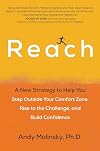
I'm neither a fan of business books nor self-help books, but as an introvert in a new job where I have to step out of my comfort zone, I thought I'd give Reach a try. Refreshingly, the book is well thought out, backed with research, and (mostly) free of bromides. It clearly breaks down the types of inner obstacles we feel when we have to do something we're not comfortable with and provides clear strategies for confronting them. And thankfully, it doesn't sugarcoat the difficulties this will show more entail. Best of all, it provides a workbook of sorts at the end to help you create your own plan of action. I'm looking forward to trying it IRL soon. show less
 This review was written for LibraryThing Early Reviewers.
Reach: A New Strategy to Help You Step Outside Your Comfort Zone, Rise to the Challenge and Build Confidence by Andy Molinsky

Decent advice book on a difficult subject. Author Andy Molinsky offers up clear, practical solutions for systematically stepping outside of your comfort zone and taking risks. In addition to laying the groundwork for these new habits, the author also rightfully makes the case that one size will certainly not fit all. Each person is expected to find their optimal path to achieve true reach.
From my own experience, I would add that repeatedly stepping outside your comfort zone, especially if show more the task is routine, will over time cause it to feel completely normal. A kind of desensitization through exposure. My favorite example is making cold calls—do it enough and the extraordinary-ness of it will wear off. show less
From my own experience, I would add that repeatedly stepping outside your comfort zone, especially if show more the task is routine, will over time cause it to feel completely normal. A kind of desensitization through exposure. My favorite example is making cold calls—do it enough and the extraordinary-ness of it will wear off. show less
This review was written for LibraryThing Early Reviewers.Reach: A New Strategy to Help You Step Outside Your Comfort Zone, Rise to the Challenge and Build Confidence by Andy Molinsky
_Reach_, I cannot imagine a more perfect title for this book.
_Break Out_ would have perhaps been more snazzy. _Face Your Fears_, to the point with a no nonsense edge. _Quit Being a Baby_....well, you get my point. But _Reach_ - whether for the stars or just beyond yourself: going from the comfort zone to the magic zone. Beautiful. Happily, the title does the book justice. To begin, author Andy Moolinsky lays out what to expect from this book using his own experiences as an example. He then show more issues several challenges; to you rauthenticity, your likeabilty, your competence, your morality and yes, even your resentment. Areas in which we are most likely to talk ourselves out of something in order to apease some belief or fear that may or may not be true. He then gets down and dirty with the avoidance tactics we use to hide from these beliefs and fears. Generally, we spend more time avoiding a problem (and setting ourselves up for a negative feedback loop) then it would take to just fix it and move on (cliche alert - whatever we resist, persists). After (gently) shaming us for our wimpy ways, Molinsky gives us the tools to overcome whatever is holding us back. And here is the true gem of the book, we are then guided to making this behavior a positive feedback loop - making it a part of ourselves instead of merely an exercise Perfect.
I'll be honest, I consider myself a competent person in most areas of my life but there are a couple of things that bring out my inner doormat with a vengence. This book has helped me tremendously with fixing those areas and, while a long way from perfect, I am making progress. Molinsky was inspiring; not only in being an innovative researcher in this area but also as someone who has struggled with and overcome these same issues. I found the assessment tool in the last section of the book to be particularly valuable to as it pulls the entire book into one package (as opposed to a scattershot series of exercises) and has you apply what you have learned. Brilliant. If you, like me, have struggled with your inner wimp, I cannot recommend this book highly enough show less
_Break Out_ would have perhaps been more snazzy. _Face Your Fears_, to the point with a no nonsense edge. _Quit Being a Baby_....well, you get my point. But _Reach_ - whether for the stars or just beyond yourself: going from the comfort zone to the magic zone. Beautiful. Happily, the title does the book justice. To begin, author Andy Moolinsky lays out what to expect from this book using his own experiences as an example. He then show more issues several challenges; to you rauthenticity, your likeabilty, your competence, your morality and yes, even your resentment. Areas in which we are most likely to talk ourselves out of something in order to apease some belief or fear that may or may not be true. He then gets down and dirty with the avoidance tactics we use to hide from these beliefs and fears. Generally, we spend more time avoiding a problem (and setting ourselves up for a negative feedback loop) then it would take to just fix it and move on (cliche alert - whatever we resist, persists). After (gently) shaming us for our wimpy ways, Molinsky gives us the tools to overcome whatever is holding us back. And here is the true gem of the book, we are then guided to making this behavior a positive feedback loop - making it a part of ourselves instead of merely an exercise Perfect.
I'll be honest, I consider myself a competent person in most areas of my life but there are a couple of things that bring out my inner doormat with a vengence. This book has helped me tremendously with fixing those areas and, while a long way from perfect, I am making progress. Molinsky was inspiring; not only in being an innovative researcher in this area but also as someone who has struggled with and overcome these same issues. I found the assessment tool in the last section of the book to be particularly valuable to as it pulls the entire book into one package (as opposed to a scattershot series of exercises) and has you apply what you have learned. Brilliant. If you, like me, have struggled with your inner wimp, I cannot recommend this book highly enough show less
This review was written for LibraryThing Early Reviewers.Reach: A New Strategy to Help You Step Outside Your Comfort Zone, Rise to the Challenge and Build Confidence by Andy Molinsky
I received a LibraryThing Earlier Reviewers copy of Andy Molinsky's Reach in the post today, and I'd had the kind of day at work that found me wanting to do anything other than continue working after dinner, so I sat down and read the book. The timing was serendipitous: I am trying to figure out how to build a better "fit" with my job and organizational culture. A couple elements of Molisnky's book spoke to my needs.
It's a quick read, and the core principles are easily summarized. In fact, show more the contents page and introduction provide lovely road maps; and the fourth section of the book, which is more akin to an appendix, translates how readers can treat the content of the book like that of a workbook, applying it to their lives. (Engaged readers who are doing more than just reading--that is, who are thinking and reflecting on their lives as they read the examples and analyses Molinsky presents--might have accomplished several of the exercises in the fourth section by the time they reach it.) Molinsky presents and describes five reasons why we are reluctant to step outside our comfort zones and then describes four avoidance strategies before getting to the heart of his strategy: articulating conviction, customizing an approach to make challenges more approachable, and developing clarity (really, just being honest about situations: neither overreacting negatively nor being overly optimistic about yourself vis-à-vis change). (A friend of mine refers to this later technique as developing "critical distance.") Molinsky provides suggestions for developing the three C's before addressing how to maintain attitudes that leave one open to taking on challenges--and, as his experience and research reveal, learning that reality is not as scary as presumed . . . or that you're actually not as bad at something as you'd feared. He deconstructs five myths in the final chapter (well, before presenting the appendix qua fourth section).
Molinsky uses a lot of examples, but he refers to a core cast of characters and their work-related challenges and ultimate triumphs several times throughout the work. (If you read the book in one sitting, you might tire a bit from the contextual build-up each time a character is reintroduced in a new chapter or even later in the same chapter. If you read the book in several sittings--or don't have the best memory for names--then you probably won't mind.) His presentation of research is quite unobtrusive; it's clear he's writing for the broadest audience possible. (I'd have appreciated more details, but endnotes direct the inquisitive to sources.)
The book I reviewed is an advance uncorrected proof. Sometimes I fail to realize how helpful the metadata on covers or book jackets can be. In this case, I had to Google the author to learn where he teaches (since a reader can't really tell whether it's Brandeis or Harvard). (It's Brandeis.) I guess that sort of thing shouldn't really matter: but when "Ph.D." is on the cover, spine, and title page, and when it's clear that the author has an academic affiliation, that little detail is helpful (well, especially if you're an academic yourself).
I did have a curious reaction to this sentence on p. 77: "if you've picked up this book, there must be something outside your comfort zone you'd like to get better at." This sentence summed up the one thing that I thought was missing from the book: helping readers understand ways of realizing potentials to which they're oblivious. In other words, I would have appreciated more of a helping hand in identifying examples of actions or activities that, by avoiding for years and years precisely because they're outside my comfort zone, I have come not even to see as possibilities. If we already know what we're avoiding, it's actually not the most difficult thing in the world to be able to conceptualize what we're missing. But, for me, real change and personal development--leading to greater and greater self-efficacy (a concept Molinsky invokes on p. 170)--occurs when the figurative scales are lifted from my eyes. This book therefore didn't lead to any epiphanies for me, but I suppose I felt validated in realizing that other people resent--a strong term, but it's how Molinsky accurately describes the feeling--having to flex in their work or private lives. (I differentiate between what's outside my comfort zone and the kinds of behaviors that just baffle and annoy me--but with which I must put up in my line of work; and the flexing I do has me being more accommodating than I would normally be. But I am being accommodating of behaviors that I perceive as negative, so I don't equate flexing as stepping outside my comfort zone in a positive manner. Rather, it's stepping into a discomfort zone that other, less fastidious or alert or conscientious individuals force me to inhabit. A fine distinction, perhaps, but one for which changing one's own behaviors isn't always the most effective approach.) show less
It's a quick read, and the core principles are easily summarized. In fact, show more the contents page and introduction provide lovely road maps; and the fourth section of the book, which is more akin to an appendix, translates how readers can treat the content of the book like that of a workbook, applying it to their lives. (Engaged readers who are doing more than just reading--that is, who are thinking and reflecting on their lives as they read the examples and analyses Molinsky presents--might have accomplished several of the exercises in the fourth section by the time they reach it.) Molinsky presents and describes five reasons why we are reluctant to step outside our comfort zones and then describes four avoidance strategies before getting to the heart of his strategy: articulating conviction, customizing an approach to make challenges more approachable, and developing clarity (really, just being honest about situations: neither overreacting negatively nor being overly optimistic about yourself vis-à-vis change). (A friend of mine refers to this later technique as developing "critical distance.") Molinsky provides suggestions for developing the three C's before addressing how to maintain attitudes that leave one open to taking on challenges--and, as his experience and research reveal, learning that reality is not as scary as presumed . . . or that you're actually not as bad at something as you'd feared. He deconstructs five myths in the final chapter (well, before presenting the appendix qua fourth section).
Molinsky uses a lot of examples, but he refers to a core cast of characters and their work-related challenges and ultimate triumphs several times throughout the work. (If you read the book in one sitting, you might tire a bit from the contextual build-up each time a character is reintroduced in a new chapter or even later in the same chapter. If you read the book in several sittings--or don't have the best memory for names--then you probably won't mind.) His presentation of research is quite unobtrusive; it's clear he's writing for the broadest audience possible. (I'd have appreciated more details, but endnotes direct the inquisitive to sources.)
The book I reviewed is an advance uncorrected proof. Sometimes I fail to realize how helpful the metadata on covers or book jackets can be. In this case, I had to Google the author to learn where he teaches (since a reader can't really tell whether it's Brandeis or Harvard). (It's Brandeis.) I guess that sort of thing shouldn't really matter: but when "Ph.D." is on the cover, spine, and title page, and when it's clear that the author has an academic affiliation, that little detail is helpful (well, especially if you're an academic yourself).
I did have a curious reaction to this sentence on p. 77: "if you've picked up this book, there must be something outside your comfort zone you'd like to get better at." This sentence summed up the one thing that I thought was missing from the book: helping readers understand ways of realizing potentials to which they're oblivious. In other words, I would have appreciated more of a helping hand in identifying examples of actions or activities that, by avoiding for years and years precisely because they're outside my comfort zone, I have come not even to see as possibilities. If we already know what we're avoiding, it's actually not the most difficult thing in the world to be able to conceptualize what we're missing. But, for me, real change and personal development--leading to greater and greater self-efficacy (a concept Molinsky invokes on p. 170)--occurs when the figurative scales are lifted from my eyes. This book therefore didn't lead to any epiphanies for me, but I suppose I felt validated in realizing that other people resent--a strong term, but it's how Molinsky accurately describes the feeling--having to flex in their work or private lives. (I differentiate between what's outside my comfort zone and the kinds of behaviors that just baffle and annoy me--but with which I must put up in my line of work; and the flexing I do has me being more accommodating than I would normally be. But I am being accommodating of behaviors that I perceive as negative, so I don't equate flexing as stepping outside my comfort zone in a positive manner. Rather, it's stepping into a discomfort zone that other, less fastidious or alert or conscientious individuals force me to inhabit. A fine distinction, perhaps, but one for which changing one's own behaviors isn't always the most effective approach.) show less
This review was written for LibraryThing Early Reviewers.Statistics
- Works
- 3
- Members
- 74
- Popularity
- #238,153
- Rating
- 3.8
- Reviews
- 14
- ISBNs
- 12
