
Heather Cox Richardson
Author of Democracy Awakening: Notes on the State of America
About the Author
Heather Cox Richardson is Professor of History at Boston College. The author of West from Appomattox, The Greatest Nation of the Earth, and The Death of Reconstruction, she lives in Massachusetts.
Works by Heather Cox Richardson
How the South Won the Civil War: Oligarchy, Democracy, and the Continuing Fight for the Soul of America (2020) 588 copies, 14 reviews
West from Appomattox: The Reconstruction of America after the Civil War (2007) 260 copies, 2 reviews
The Death of Reconstruction: Race, Labor, and Politics in the Post-Civil War North, 1865-1901 (2001) 110 copies, 1 review
The Greatest Nation of the Earth: Republican Economic Policies During the Civil War (1997) 38 copies
Democracy Awakening 1 copy
Associated Works
Tagged
Common Knowledge
- Canonical name
- Richardson, Heather Cox
- Birthdate
- 1962-10-08
- Gender
- female
- Education
- Harvard University (BA|MA|Ph.D|1992)
- Occupations
- historian
university professor - Organizations
- Boston College
Massachusetts Institute of Technology
University of Massachusetts, Amherst - Awards and honors
- American Academy of Arts & Sciences (2022)
Ruth Ratner Miller Memorial Award of Excellence in American History (2021)
Massachusetts Governor's Awards in the Humanities (2021)
Frances Perkins Center Intelligence and Courage Award (2021)
Robert M. Utley Prize (2021)
William Hickling Prescott Award for Excellence in Historical Writing (2022) (show all 8)
USA Today's Women of the Year (2022)
The Baldacci Award for Literary Activism (2024) - Agent
- The Garamond Agency
- Relationships
- Poland, Buddy (spouse)
- Nationality
- USA
- Birthplace
- Chicago, Illinois, USA
- Places of residence
- Round Pond, Maine, USA
- Associated Place (for map)
- USA
Members
Reviews
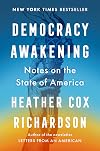
Heather Cox Richardson’s Democracy Awakening presents itself as a sweeping explanation of how the United States entered its current democratic crisis, and the book does provide an accessible overview of long political arcs connected to the present. However, it suffers from a fundamental flaw that undermines its credibility. It engages in complete erasure of the Democratic Party’s own role in weakening democratic norms, expanding corporate power, and losing the trust of the American show more public. The book avoids essential context, and the omission is a deliberate narrowing of history that erases major decisions and missteps by Democratic administrations and the party establishment.
A serious account of democratic decline cannot exclude the fact that the Obama administration expanded government surveillance, renewed Patriot Act authorities, and allowed Big Tech companies to consolidate unprecedented power over public communication. These decisions weakened Americans’ privacy rights and helped create the digital environment that fuels disinformation, political manipulation, and corporate dominance today. To pretend these choices had no impact on the current crisis is historically inaccurate.
The book also fails to grapple with Democratic shortcomings surrounding the 2016 Supreme Court vacancy. Republican obstruction was unprecedented, but the Democratic response lacked force and strategic imagination, and the administration’s choice to pursue a centrist consensus nominee added to the stalemate. This context is essential to understanding the normalization of political hardball, yet it is largely erased.
Even more striking is the complete omission of the Democratic Party’s interference in the 2016 primary. The leaked DNC emails revealed clear institutional hostility toward Bernie Sanders, and the subsequent lawsuit confirmed that the party claims no legal obligation to neutrality in its own nominating process. Clinton’s fundraising arrangements and her influence within the DNC raised serious concerns about fairness for millions of voters, especially younger and working class Democrats. This was a defining moment in the collapse of trust in the political system, and its absence from a book about democratic decline illustrates the depth of the erasure shaping this narrative.
This selective storytelling also conceals the larger structural reality that defines the present crisis. For more than 40 years, both major parties have embraced deregulation, Wall Street influence, corporate lobbying power, privatization of public goods, expansions of the security state, and economic policies that have left ordinary people more precarious. Erasing these bipartisan choices produces a comforting partisan story rather than a truthful examination of how democracy became so vulnerable.
The result is that the book functions as strongly centrist Democratic propaganda. It is compelling in parts but incomplete as a whole, because it refuses to acknowledge that both parties helped create the conditions that threaten American democracy today. Without that honesty, any diagnosis of the crisis is shallow, and any path forward remains obscured by the very erasure the book relies on. show less
A serious account of democratic decline cannot exclude the fact that the Obama administration expanded government surveillance, renewed Patriot Act authorities, and allowed Big Tech companies to consolidate unprecedented power over public communication. These decisions weakened Americans’ privacy rights and helped create the digital environment that fuels disinformation, political manipulation, and corporate dominance today. To pretend these choices had no impact on the current crisis is historically inaccurate.
The book also fails to grapple with Democratic shortcomings surrounding the 2016 Supreme Court vacancy. Republican obstruction was unprecedented, but the Democratic response lacked force and strategic imagination, and the administration’s choice to pursue a centrist consensus nominee added to the stalemate. This context is essential to understanding the normalization of political hardball, yet it is largely erased.
Even more striking is the complete omission of the Democratic Party’s interference in the 2016 primary. The leaked DNC emails revealed clear institutional hostility toward Bernie Sanders, and the subsequent lawsuit confirmed that the party claims no legal obligation to neutrality in its own nominating process. Clinton’s fundraising arrangements and her influence within the DNC raised serious concerns about fairness for millions of voters, especially younger and working class Democrats. This was a defining moment in the collapse of trust in the political system, and its absence from a book about democratic decline illustrates the depth of the erasure shaping this narrative.
This selective storytelling also conceals the larger structural reality that defines the present crisis. For more than 40 years, both major parties have embraced deregulation, Wall Street influence, corporate lobbying power, privatization of public goods, expansions of the security state, and economic policies that have left ordinary people more precarious. Erasing these bipartisan choices produces a comforting partisan story rather than a truthful examination of how democracy became so vulnerable.
The result is that the book functions as strongly centrist Democratic propaganda. It is compelling in parts but incomplete as a whole, because it refuses to acknowledge that both parties helped create the conditions that threaten American democracy today. Without that honesty, any diagnosis of the crisis is shallow, and any path forward remains obscured by the very erasure the book relies on. show less
“Engaging and highly accessible.”—Boston Globe
“A vibrant, and essential history of America's unending, enraging and utterly compelling struggle since its founding to live up to its own best ideals… It's both a cause for hope, and a call to arms.”--Jane Mayer, author Dark Money
From historian and author of the popular daily newsletter LETTERS FROM AN AMERICAN, a vital narrative that explains how America, once a beacon of democracy, now teeters on the brink of autocracy -- and how show more we can turn back.
In the midst of the impeachment crisis of 2019, Heather Cox Richardson launched a daily Facebook essay providing the historical background of the daily torrent of news. It soon turned into a newsletter and its readership ballooned to more than 2 million dedicated readers who rely on her plainspoken and informed take on the present and past in America.
In Democracy Awakening, Richardson crafts a compelling and original narrative, explaining how, over the decades, a small group of wealthy people have made war on American ideals. By weaponizing language and promoting false history they have led us into authoritarianism -- creating a disaffected population and then promising to recreate an imagined past where those people could feel important again. She argues that taking our country back starts by remembering the elements of the nation’s true history that marginalized Americans have always upheld. Their dedication to the principles on which this nation was founded has enabled us to renew and expand our commitment to democracy in the past. Richardson sees this history as a roadmap for the nation’s future.
Richardson’s talent is to wrangle our giant, meandering, and confusing news feed into a coherent story that singles out what we should pay attention to, what the precedents are, and what possible paths lie ahead. In her trademark calm prose, she is realistic and optimistic about the future of democracy. Her command of history allows her to pivot effortlessly from the Founders to the abolitionists to Reconstruction to Goldwater to Mitch McConnell, highlighting the political legacies of the New Deal, the lingering fears of socialism, the death of the liberal consensus and birth of “movement conservatism.”
Many books tell us what has happened over the last five years. Democracy Awakening explains how we got to this perilous point, what our history really tells us about ourselves, and what the future of democracy can be. show less
“A vibrant, and essential history of America's unending, enraging and utterly compelling struggle since its founding to live up to its own best ideals… It's both a cause for hope, and a call to arms.”--Jane Mayer, author Dark Money
From historian and author of the popular daily newsletter LETTERS FROM AN AMERICAN, a vital narrative that explains how America, once a beacon of democracy, now teeters on the brink of autocracy -- and how show more we can turn back.
In the midst of the impeachment crisis of 2019, Heather Cox Richardson launched a daily Facebook essay providing the historical background of the daily torrent of news. It soon turned into a newsletter and its readership ballooned to more than 2 million dedicated readers who rely on her plainspoken and informed take on the present and past in America.
In Democracy Awakening, Richardson crafts a compelling and original narrative, explaining how, over the decades, a small group of wealthy people have made war on American ideals. By weaponizing language and promoting false history they have led us into authoritarianism -- creating a disaffected population and then promising to recreate an imagined past where those people could feel important again. She argues that taking our country back starts by remembering the elements of the nation’s true history that marginalized Americans have always upheld. Their dedication to the principles on which this nation was founded has enabled us to renew and expand our commitment to democracy in the past. Richardson sees this history as a roadmap for the nation’s future.
Richardson’s talent is to wrangle our giant, meandering, and confusing news feed into a coherent story that singles out what we should pay attention to, what the precedents are, and what possible paths lie ahead. In her trademark calm prose, she is realistic and optimistic about the future of democracy. Her command of history allows her to pivot effortlessly from the Founders to the abolitionists to Reconstruction to Goldwater to Mitch McConnell, highlighting the political legacies of the New Deal, the lingering fears of socialism, the death of the liberal consensus and birth of “movement conservatism.”
Many books tell us what has happened over the last five years. Democracy Awakening explains how we got to this perilous point, what our history really tells us about ourselves, and what the future of democracy can be. show less
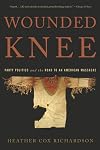
I picked up Wounded Knee: Politics and the Road to An American Massacre because it helped fill in my bingo card for an author with whom I share a name. The book has been on my Kindle for a long time as I wasn't ready to revisit the horror of the 1890 massacre of almost 300 Native Americans, mostly women and children. Bob and I visited the Pine Ridge Reservation in 1998 and stood at the site of the massacre.
This was the best book I have read this year. Richardson put the massacre in the show more context of the time with a powerful, deeply researched history. What was particularly startling were the parallels between Harrison's Republican administration with our current leaders. Tariffs were part of the gospel of the day and when Republicans were faced with losing power, they began rig the system to keep their opponents from winning elections. This included legislatures simply throwing our chosen candidates and adding western states who could be relied on to support Republican candidates.
I had to keep checking the publication date: 2010 before we really knew what was going to happen. If there is a positive message in the book, it is that the despite all their best efforts, Republicans lost power and no one really remembers Benjamin Harrison except Virginians who cross the bridge over the James River that is near his family's plantation.
I'm posting a trigger warning because this book will be a challenge. show less
This was the best book I have read this year. Richardson put the massacre in the show more context of the time with a powerful, deeply researched history. What was particularly startling were the parallels between Harrison's Republican administration with our current leaders. Tariffs were part of the gospel of the day and when Republicans were faced with losing power, they began rig the system to keep their opponents from winning elections. This included legislatures simply throwing our chosen candidates and adding western states who could be relied on to support Republican candidates.
I had to keep checking the publication date: 2010 before we really knew what was going to happen. If there is a positive message in the book, it is that the despite all their best efforts, Republicans lost power and no one really remembers Benjamin Harrison except Virginians who cross the bridge over the James River that is near his family's plantation.
I'm posting a trigger warning because this book will be a challenge. show less
How the South Won the Civil War: Oligarchy, Democracy, and the Continuing Fight for the Soul of America by Heather Cox Richardson
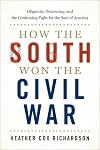
This is a clear-eyed retelling of US history focusing on the many step-by-step legal and economic maneuverings that condemned black and other people people of color to a lower caste. Richardson, a political historian, presents a variety of factors at multiple turning points that created the United States we know today, casting light particularly on the ever-growing chasm between the two political parties. It's a must read for anyone interested in how we got where we are now and how we might show more create a better future. show less
Lists
Awards


You May Also Like


Associated Authors
Statistics
- Works
- 11
- Also by
- 2
- Members
- 2,179
- Popularity
- #11,760
- Rating
- 4.0
- Reviews
- 36
- ISBNs
- 37
- Favorited
- 3