
Hyder Edward Rollins (1889–1958)
Author of The Renaissance in England; non-dramatic prose and verse of the sixteenth century
About the Author
Works by Hyder Edward Rollins
The Renaissance in England; non-dramatic prose and verse of the sixteenth century (1954) 112 copies, 1 review
A Pepysian Garland: Broadside Ballads of the Years 1595-1639, Chiefly from the Collection of Samuel Pepys (1922) — Editor — 19 copies
Cavalier and Puritan: ballads and broadsides illustrating the period of the great rebellion, 1640-1660 (1923) 4 copies
An analytical index to the ballad-entries (1557-1709) in the registers of the Company of Stationers of London (1924) 3 copies, 1 review
The Pepys Ballads 2 copies
Associated Works
Tottel's Miscellany: Songs and Sonnets of Henry Howard, Earl of Surrey, Sir Thomas Wyatt and Others (Penguin Classics) (1897) — Editor, some editions — 79 copies, 3 reviews
The Letters of John Keats, 1814-1821: Vols. 1 and 2 (1958) — Editor, some editions — 25 copies, 1 review
A Bower of Delights — Editor, some editions — 4 copies
Studies in Bibliography (Vol. 9) — Contributor — 3 copies
Tagged
Common Knowledge
- Birthdate
- 1889-11-08
- Date of death
- 1958-07-25
- Gender
- male
- Education
- Southwestern University
University of Texas
Johns Hopkins University
Harvard University - Nationality
- USA
- Birthplace
- Abilene, Texas, USA
- Associated Place (for map)
- Texas, USA
Members
Reviews
An Analytical Index to the Ballad-Entries (1557-1709) in the Registers of the Company of Stationers in London by Hyder Edward Rollins

This is a book that knows its job and does it.
The Stationer's Register was, in effect, the record of copyrights in England from the time the Stationer's Guild founded it until newer methods could be found. When a publication (book, pamphlet, broadsheet) was printed, it was required that it be registered and a fee paid. This was partly to keep unacceptable things from being printed but mostly to allow one printer to have (temporary) exclusive rights to a piece -- the equivalent of copyright. show more Printers could be fined either for not registering a piece or for violating another printer's registration.
The Register is, naturally, chronological; as printers registered things, they went into the book. So if you need to find if something was registered in the past, you have to check the whole book, with all the different handwritings and notations used.
This book solves that problem. Instead of listing the pieces chronologically, it lists them by title, along with the date and the printer who registered them and occasionally other odds and ends of information. There are also secondary indices to help you find items if you can't guess the title. The book is specific to ballads and short pieces, but on the whole, that makes it simpler to use.
As far as that goes, the book does its job well. The only thing that bothers me -- the only reason I don't give it five stars -- is that author Rollins sometimes tried to identify the title with a known broadside or song, and there are instances where I really don't think he got this right. But if you accept that caveat, it's an excellent work. Very specialized, of course -- if you don't care about some old poem that somebody wrote and tried to sell in the seventeenth century, this isn't for you. But you had probably figured that out even before you read this review.
[CORRECTION 11/17/2020: changed the second sentence of the last paragraph to read "the only reason I didn't give it FIVE stars"] show less
The Stationer's Register was, in effect, the record of copyrights in England from the time the Stationer's Guild founded it until newer methods could be found. When a publication (book, pamphlet, broadsheet) was printed, it was required that it be registered and a fee paid. This was partly to keep unacceptable things from being printed but mostly to allow one printer to have (temporary) exclusive rights to a piece -- the equivalent of copyright. show more Printers could be fined either for not registering a piece or for violating another printer's registration.
The Register is, naturally, chronological; as printers registered things, they went into the book. So if you need to find if something was registered in the past, you have to check the whole book, with all the different handwritings and notations used.
This book solves that problem. Instead of listing the pieces chronologically, it lists them by title, along with the date and the printer who registered them and occasionally other odds and ends of information. There are also secondary indices to help you find items if you can't guess the title. The book is specific to ballads and short pieces, but on the whole, that makes it simpler to use.
As far as that goes, the book does its job well. The only thing that bothers me -- the only reason I don't give it five stars -- is that author Rollins sometimes tried to identify the title with a known broadside or song, and there are instances where I really don't think he got this right. But if you accept that caveat, it's an excellent work. Very specialized, of course -- if you don't care about some old poem that somebody wrote and tried to sell in the seventeenth century, this isn't for you. But you had probably figured that out even before you read this review.
[CORRECTION 11/17/2020: changed the second sentence of the last paragraph to read "the only reason I didn't give it FIVE stars"] show less

A poetry miscellany which proved to be the most popular collection printed during the reign of Queen Elizabeth I. It was immediately successful and reprinted in each of the subsequent two years and became a trend setter with other collections such as “a Gorgeous gallery of Gallant Inventions” quickly following suit, but nothing equaled the popularity of The Paradise. It was a collection of the minor poets of the day with the big names: Edmond Spenser, Sir Philip Sydney, and George show more Gascoigne not being represented. There were other omissions George Turberville, Thomas Howell and Nicholas Grimald and although further poems were added with the first few reprints this practice had ceased by 1585 and so it was too early for Shakespeare and Raleigh.
Richard Edwards edited the first editions and contributed the most poems; Lord Vaux, William Hunnis, Jasper Heywood, Edward De Verre and Francis Kindlemarsh made other sizeable contributions.
“Death is the door whereby we draw to joy
Life is a lake, that drowneth all in pain
Death is so dole it seaseth all awaie,
Life is so leude that all it yelds is vaine.
And as by life, in bondage man is brought,
Even so by death is freedom likewise wrought.”
This was a stanza from a poem from a person referred to as D. S. (there are a good number of poems where the only clue to the identity of the poet are initials), but it does highlight the overall melancholy feel of the collection. Ten of the 127 poems has death as it’s main subject, but it is a preoccupation that is prevalent in many others. This should not be such a great surprise as war, disease, and unrest added to a short life expectancy was a major concern of the poets of the time, who came largely from the Court surrounding Elizabeth I or from the academic classes. Ideas associated with courtly love conventions still predominate with 16 of the poems being little more than lovers complaints, there are epitaphs and other poems in praise of great men and many deal with the subject of false friends and lack of trust. There are a handful of religious poems, but nothing from the clergy, although fear of God and fortunes wheel are significant themes.
Many of the poems have a song like quality and would probably have been sung rather than recited, there are references to this scattered among them. However the overall feel that I get from reading through is one of morality, or at least wise/good advice. M Edwards poem “Of perfect wisdom” is a good example it starts with the lines:
“Who so wii be accompted wise, and truly claim the same,
By joining virtue to his deeds, he must achieve the same:”
There are some good poems scattered through this collection and few outstay their welcome. It does also contain a sizeable number of poems by Lord Vaux, whose melancholia fits so well here. This edition contains a wealth of information for scholars who wish to note how the different version or words within the poems have changed, with the different versions that were printed. There are pen pictures of those poets about whom something is known and some educated thoughts on those that remain something of a mystery; who for example is the poet who signed himself “My Luck is Loss”
It is a good collection for those interested in Elizabethan poetry, but there is little here that will entertain the more general reader. show less
Richard Edwards edited the first editions and contributed the most poems; Lord Vaux, William Hunnis, Jasper Heywood, Edward De Verre and Francis Kindlemarsh made other sizeable contributions.
“Death is the door whereby we draw to joy
Life is a lake, that drowneth all in pain
Death is so dole it seaseth all awaie,
Life is so leude that all it yelds is vaine.
And as by life, in bondage man is brought,
Even so by death is freedom likewise wrought.”
This was a stanza from a poem from a person referred to as D. S. (there are a good number of poems where the only clue to the identity of the poet are initials), but it does highlight the overall melancholy feel of the collection. Ten of the 127 poems has death as it’s main subject, but it is a preoccupation that is prevalent in many others. This should not be such a great surprise as war, disease, and unrest added to a short life expectancy was a major concern of the poets of the time, who came largely from the Court surrounding Elizabeth I or from the academic classes. Ideas associated with courtly love conventions still predominate with 16 of the poems being little more than lovers complaints, there are epitaphs and other poems in praise of great men and many deal with the subject of false friends and lack of trust. There are a handful of religious poems, but nothing from the clergy, although fear of God and fortunes wheel are significant themes.
Many of the poems have a song like quality and would probably have been sung rather than recited, there are references to this scattered among them. However the overall feel that I get from reading through is one of morality, or at least wise/good advice. M Edwards poem “Of perfect wisdom” is a good example it starts with the lines:
“Who so wii be accompted wise, and truly claim the same,
By joining virtue to his deeds, he must achieve the same:”
There are some good poems scattered through this collection and few outstay their welcome. It does also contain a sizeable number of poems by Lord Vaux, whose melancholia fits so well here. This edition contains a wealth of information for scholars who wish to note how the different version or words within the poems have changed, with the different versions that were printed. There are pen pictures of those poets about whom something is known and some educated thoughts on those that remain something of a mystery; who for example is the poet who signed himself “My Luck is Loss”
It is a good collection for those interested in Elizabethan poetry, but there is little here that will entertain the more general reader. show less
The Renaissance in England: Non-Dramatic Prose and Verse of the 16th Century by Hyder Edward Rollins
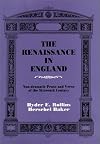
Important works in English and English translation that formed the basis of the English language and usage as we now know it.
You May Also Like


Associated Authors
Statistics
- Works
- 25
- Also by
- 13
- Members
- 188
- Popularity
- #115,782
- Rating
- 4.3
- Reviews
- 3
- ISBNs
- 21