
About the Author
Journalist and historian Robert Strauss has been a reporter for Sports Illustrated, a feature writer for the Philadelphia Daily News, a news and sports producer for an NBC affiliate, and a TV critic for the Philadelphia Inquirer and the Asbury Park Press. He has more than one thousand bylines in show more the New York Times and also writes for the Washington Post, the Los Angeles Times, the Philadelphia newspapers, and more. He lives in Haddonfield, New Jersey. show less
Works by Robert Strauss
Worst. President. Ever.: James Buchanan, the POTUS Rating Game, and the Legacy of the Least of the Lesser Presidents (2016) 97 copies, 9 reviews
4D Man 1 copy
Associated Works
Tagged
Common Knowledge
- Gender
- male
Members
Reviews
Worst. President. Ever.: James Buchanan, the POTUS Rating Game, and the Legacy of the Least of the Lesser Presidents by Robert Strauss
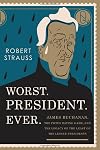
Review of: Worst. President. Ever.: James Buchanan, the POTUS Rating Game, and the Legacy of the Least of the Lesser Presidents, by Robert Strauss
by Stan Prager (3-8-17)
Worst. Biography. Ever.
Perhaps that seems overly harsh, but Worst. President. Ever.: James Buchanan, the POTUS Rating Game, and the Legacy of the Least of the Lesser Presidents, by Robert Strauss, is not only more poorly constructed than its awkwardly convoluted title, but it features some of the most abysmal writing that I show more have come across in years. I really hate to write bad reviews, but this is truly a very bad book, on so many levels. Even poor James Buchanan, worst president or not, deserves better than this.
Historians have been rating former presidents for some time. The top three are fairly consistent, with Washington and Lincoln typically jockeying for first place and FDR coming in third. The bottom three tends to vary from one list to another, but Buchanan is almost invariably ranked dead last, with sometimes strong competition from Warren G. Harding, Andrew Johnson, and more recently, George W. Bush. Buchanan, known in the parlance of the time as a “doughface” for his Southern sympathies, was an otherwise unexceptional career politician who waited his turn for the White House but had the bad fortune to win election as the country was coming apart over slavery. Unfortunately, he seemed to lack both the vision and the conviction to act constructively to mitigate the looming crisis, instead putting the weight of his office on the wrong side of explosive issues such as the Supreme Court’s Dred Scott decision, as well as the effort by pro-slavery partisans to foist the illegitimate Lecompton Constitution upon Kansas territory, where a bloody prequel to the Civil War was raging. A staunch Unionist but also a strict Constitutional constructionist, Buchanan seemed paralyzed by inaction as secession unfolded in the months between the election and inauguration of Abraham Lincoln, which then occurred in March rather than January. It was Buchanan’s failure to act during that long interregnum that consigns him to last place by most historians who compile such rankings.
Strauss’ book was released during the tumultuous 2016 election season, which made it seem all the more relevant. Buchanan, not a popular subject, has not had many biographers. While I know much about his tenure from other works on the antebellum period, I had never read his biography. But I have read more than two dozen biographies of American presidents, written for both scholarly and popular audiences. Some were masterful, some ponderous, some insightful, and still others unremarkable. I have read Flexner, Ellis, Meacham, McCullough, Donald, Remini, Dallek, Reeves, Caro and many more. The best products of this genre not only chronicle the life of its subject but adroitly explore the era when he walked the earth, revealing the complexity and nuance of people and events that a careful historian brings to a studied analysis. Unfortunately, all of that is conspicuous in its absence in Worst. President. Ever. This is especially regrettable because a quality, balanced treatment of Buchanan would be a welcome addition to the historiography.
Instead, the narrative is choppy and superficial, and offers almost no thoughtful analysis. Rife with clichés and clumsy metaphors, the author’s voice utterly lacks authority. The entire book is delivered in an idiomatic, conversational tone, as if it was related by a random person sitting on the barstool next to you. While the style, if we can call it that, is suitable to a tavern milieu, it has absolutely no place in a serious work of history. And the writing is bad. Really bad. More than once I found myself flipping to the back flap of the dustjacket to confirm the author’s résumé, which apparently includes reporting for the Washington Post and Sports Illustrated—and teaching a non-fiction writing class at the University of Pennsylvania! I rarely include multiple excerpts from a book in reviews, but I am going to make an exception here, for unless you read such excerpts you may judge me harshly for my harsh judgments! So here we go:
On the economic panic of 1857: "By midsummer no one could take a ride on the Reading, as Uncle Pennybags does in the Monopoly game, since it had shut down…" [p160]
Regarding Andrew Jackson’s accession to the presidency: "He was a general and loved being in charge. Further, he was miffed about how the previous election had come out, with Adams and Clay back-door dealing, which he presumed meant they thought of him not smart enough to be the big boss." [p75]
On the nominating process for the election of 1852: "With Polk bowing out … Buchanan again figured he was deserving of the nomination. His scheme was the usual … say little controversial, and then proclaim: 'Aw, shucks, well, OK…'" [p110]
Strauss frequently makes broad, simplistic statements about critical historical events that simply made me wince. As in:
On the great issue of slavery: "Most Northerners let the issue ride. They might've been against slavery personally, but like a tic a neighbor might have that they shrugged their shoulders about, they tolerated slavery for the places where it already existed . . . [p115] And: "Still, much like the Southeastern Conference against the Big Ten in football today, whatever helps the 'team' got strong support from all concerned … So slavery became the chicken, not just the egg." [p133]
Clichés abound, and there are many more wild and weird analogies between Buchanan’s time and ours, as well, such as:
On Buchanan’s relationship with James K. Polk: "The office of secretary of state was different then than in the twentieth century and beyond. There was no jetting off to seventy-five countries a year and meeting with statesmen every week." [p107]
On Jesse Benton Fremont, wife of John C. Fremont: "Like Kris Kardashian, whose fame started when she began to burnish the reputation of her Olympian husband Bruce Jenner … Jesse Benton, knowing the way of politics from her father, saw that kind of legend in her husband … She was unafraid of what might seem like a dicey past." [p127] And on a campaign song that pays tribute to her: "It does not seem likely that calling, say, Michelle Obama or Laura Bush —or even Sarah Palin—'the flower of the land' would've made it in the feminist twenty-first century, but the song does show what a celebrity Jesse Fremont had become…" [p147]
Sadly, there is much, much more of these painful passages, interspersed with occasional odd tangents about the author’s various field trips and what sparked his interest in history. Surprisingly, despite the book’s subtitle, there is precious little analysis of what actually constitutes bad ratings for presidents and why Buchanan is at the bottom, although there are hints throughout, as in a discussion of the Dred Scott case that asserts: "… James Buchanan would find his way to intercede in it—and on that intercession, get quickly as he could on the road to becoming the Worst. President. Ever." [p149] There is finally a brief chapter that runs down the list of troubled presidencies and makes a poor attempt at appropriate evaluation, which can only be properly summarized by still another excerpt:
“Andrew Johnson was no prize as a president, but he did keep the country from buckling after the Civil War… Johnson was impeached because of his policies … and survived being shown the door by just one Senate vote." [p167] And "…though he really blew it with Kansas-Nebraska, Pierce at least advocated that the Union was paramount … Pierce was no prize but he kept the United States intact …" Only then does Strauss pass judgment: "Buchanan, then, takes that prize. Though he had some positives, they were primarily social and short-lived. He was not an evil man personally and had a partying spirit when it came time for that, but even there, he could not bring himself to be even a mediocre administrator." [p174]
I am sure that this review will find critics among those who appreciate Strauss’ chaotic, bantering style, but I am even more certain that few who would defend this work are serious students of American history. Was Buchanan really the worst president ever? Do not look to this book to find out.
The latest review: "Worst. President. Ever.: James Buchanan ..." by Robert Strauss is live on the Regarp Book Blog https://regarp.com/2017/03/08/review-of-worst-president-ever-james-buchanan-the-... show less
by Stan Prager (3-8-17)
Worst. Biography. Ever.
Perhaps that seems overly harsh, but Worst. President. Ever.: James Buchanan, the POTUS Rating Game, and the Legacy of the Least of the Lesser Presidents, by Robert Strauss, is not only more poorly constructed than its awkwardly convoluted title, but it features some of the most abysmal writing that I show more have come across in years. I really hate to write bad reviews, but this is truly a very bad book, on so many levels. Even poor James Buchanan, worst president or not, deserves better than this.
Historians have been rating former presidents for some time. The top three are fairly consistent, with Washington and Lincoln typically jockeying for first place and FDR coming in third. The bottom three tends to vary from one list to another, but Buchanan is almost invariably ranked dead last, with sometimes strong competition from Warren G. Harding, Andrew Johnson, and more recently, George W. Bush. Buchanan, known in the parlance of the time as a “doughface” for his Southern sympathies, was an otherwise unexceptional career politician who waited his turn for the White House but had the bad fortune to win election as the country was coming apart over slavery. Unfortunately, he seemed to lack both the vision and the conviction to act constructively to mitigate the looming crisis, instead putting the weight of his office on the wrong side of explosive issues such as the Supreme Court’s Dred Scott decision, as well as the effort by pro-slavery partisans to foist the illegitimate Lecompton Constitution upon Kansas territory, where a bloody prequel to the Civil War was raging. A staunch Unionist but also a strict Constitutional constructionist, Buchanan seemed paralyzed by inaction as secession unfolded in the months between the election and inauguration of Abraham Lincoln, which then occurred in March rather than January. It was Buchanan’s failure to act during that long interregnum that consigns him to last place by most historians who compile such rankings.
Strauss’ book was released during the tumultuous 2016 election season, which made it seem all the more relevant. Buchanan, not a popular subject, has not had many biographers. While I know much about his tenure from other works on the antebellum period, I had never read his biography. But I have read more than two dozen biographies of American presidents, written for both scholarly and popular audiences. Some were masterful, some ponderous, some insightful, and still others unremarkable. I have read Flexner, Ellis, Meacham, McCullough, Donald, Remini, Dallek, Reeves, Caro and many more. The best products of this genre not only chronicle the life of its subject but adroitly explore the era when he walked the earth, revealing the complexity and nuance of people and events that a careful historian brings to a studied analysis. Unfortunately, all of that is conspicuous in its absence in Worst. President. Ever. This is especially regrettable because a quality, balanced treatment of Buchanan would be a welcome addition to the historiography.
Instead, the narrative is choppy and superficial, and offers almost no thoughtful analysis. Rife with clichés and clumsy metaphors, the author’s voice utterly lacks authority. The entire book is delivered in an idiomatic, conversational tone, as if it was related by a random person sitting on the barstool next to you. While the style, if we can call it that, is suitable to a tavern milieu, it has absolutely no place in a serious work of history. And the writing is bad. Really bad. More than once I found myself flipping to the back flap of the dustjacket to confirm the author’s résumé, which apparently includes reporting for the Washington Post and Sports Illustrated—and teaching a non-fiction writing class at the University of Pennsylvania! I rarely include multiple excerpts from a book in reviews, but I am going to make an exception here, for unless you read such excerpts you may judge me harshly for my harsh judgments! So here we go:
On the economic panic of 1857: "By midsummer no one could take a ride on the Reading, as Uncle Pennybags does in the Monopoly game, since it had shut down…" [p160]
Regarding Andrew Jackson’s accession to the presidency: "He was a general and loved being in charge. Further, he was miffed about how the previous election had come out, with Adams and Clay back-door dealing, which he presumed meant they thought of him not smart enough to be the big boss." [p75]
On the nominating process for the election of 1852: "With Polk bowing out … Buchanan again figured he was deserving of the nomination. His scheme was the usual … say little controversial, and then proclaim: 'Aw, shucks, well, OK…'" [p110]
Strauss frequently makes broad, simplistic statements about critical historical events that simply made me wince. As in:
On the great issue of slavery: "Most Northerners let the issue ride. They might've been against slavery personally, but like a tic a neighbor might have that they shrugged their shoulders about, they tolerated slavery for the places where it already existed . . . [p115] And: "Still, much like the Southeastern Conference against the Big Ten in football today, whatever helps the 'team' got strong support from all concerned … So slavery became the chicken, not just the egg." [p133]
Clichés abound, and there are many more wild and weird analogies between Buchanan’s time and ours, as well, such as:
On Buchanan’s relationship with James K. Polk: "The office of secretary of state was different then than in the twentieth century and beyond. There was no jetting off to seventy-five countries a year and meeting with statesmen every week." [p107]
On Jesse Benton Fremont, wife of John C. Fremont: "Like Kris Kardashian, whose fame started when she began to burnish the reputation of her Olympian husband Bruce Jenner … Jesse Benton, knowing the way of politics from her father, saw that kind of legend in her husband … She was unafraid of what might seem like a dicey past." [p127] And on a campaign song that pays tribute to her: "It does not seem likely that calling, say, Michelle Obama or Laura Bush —or even Sarah Palin—'the flower of the land' would've made it in the feminist twenty-first century, but the song does show what a celebrity Jesse Fremont had become…" [p147]
Sadly, there is much, much more of these painful passages, interspersed with occasional odd tangents about the author’s various field trips and what sparked his interest in history. Surprisingly, despite the book’s subtitle, there is precious little analysis of what actually constitutes bad ratings for presidents and why Buchanan is at the bottom, although there are hints throughout, as in a discussion of the Dred Scott case that asserts: "… James Buchanan would find his way to intercede in it—and on that intercession, get quickly as he could on the road to becoming the Worst. President. Ever." [p149] There is finally a brief chapter that runs down the list of troubled presidencies and makes a poor attempt at appropriate evaluation, which can only be properly summarized by still another excerpt:
“Andrew Johnson was no prize as a president, but he did keep the country from buckling after the Civil War… Johnson was impeached because of his policies … and survived being shown the door by just one Senate vote." [p167] And "…though he really blew it with Kansas-Nebraska, Pierce at least advocated that the Union was paramount … Pierce was no prize but he kept the United States intact …" Only then does Strauss pass judgment: "Buchanan, then, takes that prize. Though he had some positives, they were primarily social and short-lived. He was not an evil man personally and had a partying spirit when it came time for that, but even there, he could not bring himself to be even a mediocre administrator." [p174]
I am sure that this review will find critics among those who appreciate Strauss’ chaotic, bantering style, but I am even more certain that few who would defend this work are serious students of American history. Was Buchanan really the worst president ever? Do not look to this book to find out.
The latest review: "Worst. President. Ever.: James Buchanan ..." by Robert Strauss is live on the Regarp Book Blog https://regarp.com/2017/03/08/review-of-worst-president-ever-james-buchanan-the-... show less
Worst. President. Ever.: James Buchanan, the POTUS Rating Game, and the Legacy of the Least of the Lesser Presidents by Robert Strauss
"What bet did you lose?"
This is the question Strauss was asked by a librarian during the course of his research into President James Buchanan's life. When Strauss later asked how often anyone asked to look at these Buchanan papers? The answer was "Not very". Which should give you an indication of how little regard Buchanan is given among the pantheon of former POTUS's.
Seriously, do you even know the time period when the guy was president?
Without looking it up on Wikipedia?
Yeah, me neither show more before this book. So I was extremely interested when I saw it on Netgalley, especially when I realized he was preceded by my boy, Franklin Pierce. This book is very well written, and clearly very well researched. The author talks about his love of presidential history, and it comes through in the details added throughout. This isn't just a biography, as the title suggests. It's also about the "POTUS Rating Game", and how historians have come to the general conclusion that James Buchanan may very well be the Worst. President. Ever. Strauss goes into quite a bit of detail on other presidents to explain why this is, and I really enjoyed reading that synopsis.
I will say that the writing meanders at places. Generally the chapters begin with the history of Buchanan and at some point they shift over into the authors experiences and opinions, or his thoughts on the POTUS ratings, etc. This resulted in several bits of repeated information that made me double take to make sure I hadn't accidentally flipped back a few pages. It was just a little annoying to me personally. I would have preferred to read all of the history together, then read all of the authors asides together.
I think it's obvious by now, but I really REALLY liked this book. I would highly recommend it to everyone, especially those who love US Presidential history. It was so interesting to read a POTUS biography that wasn't trying to paint its subject in glowing terms, but being very honest about their missteps and foibles.
I'll leave you with this list that displays a slice of the terribad things that happened during Buchanan's presidency, not all of which were his fault.
- The Dred Scott SCOTUS decision (The decision was handed down on the second day he was in office, and he was involved in this decision and thought it would halt the hostilities. I. Can't. Even.)
- Bleeding Kansas (Resulting from the Kansas-Nebraska act which was actually Pierce's baby, but the violence happened on Buchanan's watch)
- The Panic of 1957 (A recession. The year he came into office, no less)
- The Mormon Wars (aka the Utah War, but either way this was a colossal blunder of his)
- Fort Sumpter (I think we all know about this one)
- South Carolina Secession (Which happened just as Buchanan was leaving office and Lincoln was coming in.)
Copy courtesy of Rowman & Littlefield/Lyons Press, via Netgalley in exchange for an honest review. show less
This is the question Strauss was asked by a librarian during the course of his research into President James Buchanan's life. When Strauss later asked how often anyone asked to look at these Buchanan papers? The answer was "Not very". Which should give you an indication of how little regard Buchanan is given among the pantheon of former POTUS's.
Seriously, do you even know the time period when the guy was president?
Without looking it up on Wikipedia?
Yeah, me neither show more before this book. So I was extremely interested when I saw it on Netgalley, especially when I realized he was preceded by my boy, Franklin Pierce. This book is very well written, and clearly very well researched. The author talks about his love of presidential history, and it comes through in the details added throughout. This isn't just a biography, as the title suggests. It's also about the "POTUS Rating Game", and how historians have come to the general conclusion that James Buchanan may very well be the Worst. President. Ever. Strauss goes into quite a bit of detail on other presidents to explain why this is, and I really enjoyed reading that synopsis.
I will say that the writing meanders at places. Generally the chapters begin with the history of Buchanan and at some point they shift over into the authors experiences and opinions, or his thoughts on the POTUS ratings, etc. This resulted in several bits of repeated information that made me double take to make sure I hadn't accidentally flipped back a few pages. It was just a little annoying to me personally. I would have preferred to read all of the history together, then read all of the authors asides together.
I think it's obvious by now, but I really REALLY liked this book. I would highly recommend it to everyone, especially those who love US Presidential history. It was so interesting to read a POTUS biography that wasn't trying to paint its subject in glowing terms, but being very honest about their missteps and foibles.
I'll leave you with this list that displays a slice of the terribad things that happened during Buchanan's presidency, not all of which were his fault.
- The Dred Scott SCOTUS decision (The decision was handed down on the second day he was in office, and he was involved in this decision and thought it would halt the hostilities. I. Can't. Even.)
- Bleeding Kansas (Resulting from the Kansas-Nebraska act which was actually Pierce's baby, but the violence happened on Buchanan's watch)
- The Panic of 1957 (A recession. The year he came into office, no less)
- The Mormon Wars (aka the Utah War, but either way this was a colossal blunder of his)
- Fort Sumpter (I think we all know about this one)
- South Carolina Secession (Which happened just as Buchanan was leaving office and Lincoln was coming in.)
Copy courtesy of Rowman & Littlefield/Lyons Press, via Netgalley in exchange for an honest review. show less
Worst. President. Ever.: James Buchanan, the POTUS Rating Game, and the Legacy of the Least of the Lesser Presidents by Robert Strauss
The United States fell apart under James Buchanan, the president before Abe Lincoln. It would be hard for a president to do worse than to start a Civil War. Yet his effort to heal the nation's blue-gray divide involved some Supreme Court log-rolling in the Dred Scott case. What could possibly go wrong?
There's not much here on the antebellum South, John Brown's slave revolt, the Panic of 1857 or most other events that did not go Buchanan's way. Still, young adults or casual history readers show more should appreciate this thumbnail sketch of Buchanan's resume (Senator, Secretary of State--more Clinton than Trump) and musings about how a feckless leader can make things go South. We may pass this way again. show less
There's not much here on the antebellum South, John Brown's slave revolt, the Panic of 1857 or most other events that did not go Buchanan's way. Still, young adults or casual history readers show more should appreciate this thumbnail sketch of Buchanan's resume (Senator, Secretary of State--more Clinton than Trump) and musings about how a feckless leader can make things go South. We may pass this way again. show less
Worst. President. Ever. : James Buchanan, the POTUS rating game, and the legacy of the least of the lesser presidents by Robert Strauss
Enjoyable history of the "least of our lesser presidents" - complete with modern-day commentary detours that help address Buchanan's legacy and the obsession to rank our presidents.
Recommended for presidential history lovers, those interested in the run-up to the Civil War, and any dyed-in-the-wool-but-still-realistic Buchananites from Lancaster interested in their native son.
Recommended for presidential history lovers, those interested in the run-up to the Civil War, and any dyed-in-the-wool-but-still-realistic Buchananites from Lancaster interested in their native son.
Awards

You May Also Like


Associated Authors
Statistics
- Works
- 10
- Also by
- 9
- Members
- 204
- Popularity
- #108,206
- Rating
- 3.7
- Reviews
- 10
- ISBNs
- 22