
Lisa Zunshine
Author of Why We Read Fiction: Theory of Mind and the Novel
About the Author
Lisa Zunshine teaches English literature at the University of Kentucky, Lexington
Works by Lisa Zunshine
Strange Concepts and the Stories They Make Possible: Cognition, Culture, Narrative (2008) 12 copies, 1 review
Associated Works
Tagged
Common Knowledge
- Birthdate
- 1968
- Gender
- female
- Occupations
- English professor, University of Kentucky, Lexington
- Nationality
- USA (naturalized)
Russia (birth)
Members
Reviews

The idea of cognitive literary theory either seems seductive or appalling to critics-- most seeming coming down on the side of appalling because of a tendency to reductionism, or maybe just because it'd put most of them out of a job. I didn't have any strong opinions on the topic myself, beyond the fact that the two cognitive science-based talks I'd been to were terrible... but if we judged literary theories by bad talks, we wouldn't have much of a field. So I asked a devotee to recommend show more a book that would (if any book could) sell me on the field, and he recommended this, an anthology of various essays edited by Lisa Zunshine. Actually, by the time I got around to reading it, I'd already read Zunshine's Strange Concepts and the Stories They Make Possible, but that's another review.
Maybe I was just in a bad mood when I read it (I did read it coming off nine months of exam reading), but I find myself unconvinced. Even by Zunshine's own essays, and I actually found the work she presented in Strange Concepts fairly convincing. It may be an artifact of the book's size: though in theory it's 386 pages long, the last 76 are notes, bibliography, and index, meaning you have 310 pages for 15 essays. That's 20 pages per essay, which might seem like enough, but these essays have a lot of lifting to do, in that they have to establish their cog-sci concepts for an audience of literary scholars and use them to do a compelling reading of a text. In Strange Concepts, Zunshine uses a full third of the book on the cog-sci setup! So you're left with a lot of hastily conveyed details of cognitive science and then an even more hastily conveyed literary reading.
The true proof of any literary theory is of course in the results it spits out, and I rarely felt convinced by the cog-sci reading of the texts in question. Or rather, at best, I felt no more convinced than I would be by any other literary theory, but cog-sci tries to make a special claim on truth beyond that of most literary theory: Zunshine says in the introduction, "cognitive cultural studies is cultural studies as originally conceptualized" (8). And later: "the grounding assumptions of cognitive evolutionary science... make this science indispensable to nonreductive cultural analysis" (13). But I never felt like I was reading analyses where the the theory was indispensable; the essays struck me as being like much literary criticism that attempts to bring in theories from other disciplines. Yes, that's neat... but so what? Why should I buy that more than any other reading? Because you read an article in Science? (I don't have a firm grasp of what actual cognitive scientists think of cognitive criticism, and I am curious.) Okay, I am being glib, but hopefully my glibness reveals an underlying point: as presented in this book, at least, cognitive literary theory does not offer any textual readings that make me more interested in it than in any other literary theory. Most are fine, some are awful.
I did quite like Patrick Colm Hogan's essay "Literary Universals," which made a cogent argument for both why we ought to look at literary universals and how examining such might be useful. I found myself agreeing, though not tempted to do such work myself (much as I agree we ought to study black holes, but have no desire to become an astrophysicist). Unfortunately, it's the second essay, so it's all downhill from there.
I found myself, on the other hand, a little baffled by the idea of cognitive historicism, which seems no different from any other literature and science criticism. It looks at how authors rendered the cognitive theory of their day in literary texts, just as (for example) Gillian Beer looks at how George Eliot rendered the evolutionary theory of her day in her novels. Those old cognitive theories don't have any compelling purchase on truth, as it is not based on those "grounding assumptions of cognitive evolutionary science," so why should I be into that kind of reading any more than Shuttleworth's? Not that I'm besmirching this kind of work-- I do a very similar work myself-- I'm just not convinced it belongs in this book. show less
Maybe I was just in a bad mood when I read it (I did read it coming off nine months of exam reading), but I find myself unconvinced. Even by Zunshine's own essays, and I actually found the work she presented in Strange Concepts fairly convincing. It may be an artifact of the book's size: though in theory it's 386 pages long, the last 76 are notes, bibliography, and index, meaning you have 310 pages for 15 essays. That's 20 pages per essay, which might seem like enough, but these essays have a lot of lifting to do, in that they have to establish their cog-sci concepts for an audience of literary scholars and use them to do a compelling reading of a text. In Strange Concepts, Zunshine uses a full third of the book on the cog-sci setup! So you're left with a lot of hastily conveyed details of cognitive science and then an even more hastily conveyed literary reading.
The true proof of any literary theory is of course in the results it spits out, and I rarely felt convinced by the cog-sci reading of the texts in question. Or rather, at best, I felt no more convinced than I would be by any other literary theory, but cog-sci tries to make a special claim on truth beyond that of most literary theory: Zunshine says in the introduction, "cognitive cultural studies is cultural studies as originally conceptualized" (8). And later: "the grounding assumptions of cognitive evolutionary science... make this science indispensable to nonreductive cultural analysis" (13). But I never felt like I was reading analyses where the the theory was indispensable; the essays struck me as being like much literary criticism that attempts to bring in theories from other disciplines. Yes, that's neat... but so what? Why should I buy that more than any other reading? Because you read an article in Science? (I don't have a firm grasp of what actual cognitive scientists think of cognitive criticism, and I am curious.) Okay, I am being glib, but hopefully my glibness reveals an underlying point: as presented in this book, at least, cognitive literary theory does not offer any textual readings that make me more interested in it than in any other literary theory. Most are fine, some are awful.
I did quite like Patrick Colm Hogan's essay "Literary Universals," which made a cogent argument for both why we ought to look at literary universals and how examining such might be useful. I found myself agreeing, though not tempted to do such work myself (much as I agree we ought to study black holes, but have no desire to become an astrophysicist). Unfortunately, it's the second essay, so it's all downhill from there.
I found myself, on the other hand, a little baffled by the idea of cognitive historicism, which seems no different from any other literature and science criticism. It looks at how authors rendered the cognitive theory of their day in literary texts, just as (for example) Gillian Beer looks at how George Eliot rendered the evolutionary theory of her day in her novels. Those old cognitive theories don't have any compelling purchase on truth, as it is not based on those "grounding assumptions of cognitive evolutionary science," so why should I be into that kind of reading any more than Shuttleworth's? Not that I'm besmirching this kind of work-- I do a very similar work myself-- I'm just not convinced it belongs in this book. show less

I know I have detailed notes on this book somewhere, but I'll be damned if I can find them now, so a cursory review will have to do. Cognitive literary theory is a field I've often struggled with, including an anthology edited by Zunshine herself where I found almost every essay unconvincing, but this is probably the example of the field I've gotten along the best with. Zunshine lays out how "strange concepts" work, especially in the arena of science fiction. A "strange concept" is show more "counterontological," which means it includes "information contradicting some information provided by ontological categories" (Boyer, qtd. in Zunshine 67). She works mostly with robots: they resist categorization because they have some attributes of machine life, but (in science fiction) they also have many attributes of organic life. Thus they might not be subject to (for example) the rules regarding death that we feel thinking beings ought to follow.
Strange concepts are the foundation of much science fiction (and other kinds of fiction, of course; Zunshine also discusses fairy tales a lot): "Violations of ontological expectations thus seem to be ripe with narrative possibilities. Turn to any realm of ordinary human experience (social, emotional, ethical), and consider it in the light of such a violation-- and there is a story waiting for you" (69). This, if I'm remembering and understanding Zunshine right, makes strange concepts very powerful: by violating our assumptions about how the universe works, they allow us to expose and explore those very assumptions, which is at its base, I think, the appeal of science fiction. (In sf, the counterontologies have an empirical/rational framework, as opposed to fairy tales, where it's all done by magic, which I think convinces us that the counterontologies have some level of real meaning in the case of robots that they don't in the case of orcs.)
It's a well written, clear book, obviously aimed at a literary critic who is not familiar with cognitive literary theory; I could see assigning this book to advanced undergraduates. If I have a complaint, it's that Zunshine betrays little awareness that people have gone before in some of these areas; I found her work pretty congruent with that of Darko Suvin (he claims "cognition" as one of the necessary conditions for sf, after all), for example, yet he goes uncited. show less
Strange concepts are the foundation of much science fiction (and other kinds of fiction, of course; Zunshine also discusses fairy tales a lot): "Violations of ontological expectations thus seem to be ripe with narrative possibilities. Turn to any realm of ordinary human experience (social, emotional, ethical), and consider it in the light of such a violation-- and there is a story waiting for you" (69). This, if I'm remembering and understanding Zunshine right, makes strange concepts very powerful: by violating our assumptions about how the universe works, they allow us to expose and explore those very assumptions, which is at its base, I think, the appeal of science fiction. (In sf, the counterontologies have an empirical/rational framework, as opposed to fairy tales, where it's all done by magic, which I think convinces us that the counterontologies have some level of real meaning in the case of robots that they don't in the case of orcs.)
It's a well written, clear book, obviously aimed at a literary critic who is not familiar with cognitive literary theory; I could see assigning this book to advanced undergraduates. If I have a complaint, it's that Zunshine betrays little awareness that people have gone before in some of these areas; I found her work pretty congruent with that of Darko Suvin (he claims "cognition" as one of the necessary conditions for sf, after all), for example, yet he goes uncited. show less

The author's concept of "the secret life of literature" is "thinking about thinking about thinking," which she explains occurs more often in lit than in reality. An example she uses early in the book of this third level embedment of thought is, “I wonder if she realizes that I’m hoping.” That is the secret, so this reads more like a cognitive psychology work than of literature. I'd hoped for this title to relate to ways literature influences individuals and cultures, or maybe to be a show more work about how ideas in literature survive and morph. Instead, it is about "thinking about thinking about thinking." show less
Why We Read Fiction: Theory of Mind and the Novel (Theory and Interpretation of Narrative) by Lisa Zunshine
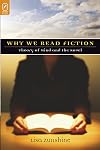
I found this book to be less about WHY we read fiction than HOW to read fiction in the author's opinion. Books and opinions such as those represented in this book were the reason I dropped English Literature in my second year at university. I could not stand to be told what to think about a book, poem or passage. I found this book very pompous, as if the author was standing atop her soap box. The first person declarations really got on my nerves. It read like a PhD dissertation that had been show more adapted for the general public by throwing in multitudes of bracketed phrases to 'translate' her heady words. Sections relating to autism made me angry because it assumed that an autistic brain was a primitive brain, incapable of emotion or understanding and thus could be used as good counterbalance for Theory of Mind. Not that I am an expert, but clearly the author does not know much about the autism spectrum and I was surprised she wrote this book in 2006 and not 1880. If my e-reader was not expensive, I would have thrown it out a window. I did finish the book, however my reading of it reminded me of the Simpsons episode where Bart was trying to train Santa's Little Helper..."blah blah, blah blah blah".
Personally, I read fiction for the simple purpose of escapism, and I imagine so does most of the rest of the world. No stars. show less
Personally, I read fiction for the simple purpose of escapism, and I imagine so does most of the rest of the world. No stars. show less
Lists
Awards

You May Also Like


Associated Authors
Statistics
- Works
- 14
- Also by
- 1
- Members
- 290
- Popularity
- #80,655
- Rating
- 3.7
- Reviews
- 5
- ISBNs
- 37