

Brooks Landon
Author of Building Great Sentences: Exploring the Writer's Craft
About the Author
Works by Brooks Landon
Associated Works
Storming the Reality Studio: A Casebook of Cyberpunk and Postmodern Science Fiction (1991) — Contributor — 263 copies
Tagged
Common Knowledge
- Birthdate
- 20th century
- Gender
- male
- Education
- The University of Texas, Austin (PhD)
- Awards and honors
- IAFA Distinguished Scholarship (2001)
- Nationality
- USA
- Map Location
- USA
Members
Reviews
Building Great Sentences: How to Write the Kinds of Sentences You Love to Read (Great Courses, 1) by Brooks Landon
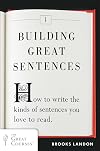
If you have the DVD, then we're talking 5 stars. This guidebook that accompanies the DVD, while complete, lacks Landon's delivery and many examples that he presents in the lecture. It's like the "Cliff Notes" version of the lectures. Let me put it another way: The lectures have been boiled down, and this guidebook is the precipitate. While it covers the essential nuggets and provides what you need to know, it doesn't deliver the goods in the same way as Landon's lectures.
Landon opened my show more eyes to the potential of the sentence. I was a long sentence skeptic, but Landon demonstrated that they can be done well and delivered eloquently. He fights the notion that style should be invisible as it drains writing of its joy and makes it a tiresome burden for many a student. He sees long sentences as instrumental in the development of a writer's style, the text lending shape to the writer's voice.
In the DVD, Landon's delivery clearly demonstrates his passion for literature. Not only is he lively, but he also punctuates his lectures with emphatic gesture and wit. At no point did I ever find myself bored, even when the material seemed too technical for my needs. The time spent viewing these lectures was well worth it. While I don't see myself trying to emulate Faulkner, following his lengthy written footsteps, I do feel that I can apply what I've learned to my writing. I highly recommend it for all aspiring authors. show less
Landon opened my show more eyes to the potential of the sentence. I was a long sentence skeptic, but Landon demonstrated that they can be done well and delivered eloquently. He fights the notion that style should be invisible as it drains writing of its joy and makes it a tiresome burden for many a student. He sees long sentences as instrumental in the development of a writer's style, the text lending shape to the writer's voice.
In the DVD, Landon's delivery clearly demonstrates his passion for literature. Not only is he lively, but he also punctuates his lectures with emphatic gesture and wit. At no point did I ever find myself bored, even when the material seemed too technical for my needs. The time spent viewing these lectures was well worth it. While I don't see myself trying to emulate Faulkner, following his lengthy written footsteps, I do feel that I can apply what I've learned to my writing. I highly recommend it for all aspiring authors. show less
Building Great Sentences: How to Write the Kinds of Sentences You Love to Read (Great Courses, 1) by Brooks Landon
Landon explores a topic that is often overlooked in writing instruction: the craft of building sentences. The last time I remember discussing sentences specifically in a formal writing course was in seventh grade, and there our attention was mainly on diagramming sentences rather than composing and refining them. For writers and non writers alike, it's as if sentences are part of the air we breathe, so abundant and commonplace that we hardly pay them any attention, despite how essential they show more are in our social, communicative human existence.
While expressing his own strong bias toward particular kinds of sentences and phrases, Landon does a good job of pointing to others--writers, linguists, grammarians--that condone and use the same kinds of strategies he discusses. I'm not sure if anyone would find his ideas controversial, but, at the very least, I feel a greater awareness after reading the book, a greater awareness of the choices a writer makes, of the little parallel universes of alternative possibilities that converge around an idea waiting to be expressed.
I was actually exposed to this material first in Landon's Teaching Company course covering the same material (Building Great Sentences: Exploring the Writer's Craft). While the content is essentially the same, I have to admit that something is lost in the book version. You can't hear the delight in Landon's voice as he reads sample sentences from master writers, and it's not as easy to hear how expressive the cumulative sentences he condones can be. At the same time, the book makes it easier to browse through the material, to find particular examples and quotes, and I'm glad to have access to the book along with other resources for writing. show less
While expressing his own strong bias toward particular kinds of sentences and phrases, Landon does a good job of pointing to others--writers, linguists, grammarians--that condone and use the same kinds of strategies he discusses. I'm not sure if anyone would find his ideas controversial, but, at the very least, I feel a greater awareness after reading the book, a greater awareness of the choices a writer makes, of the little parallel universes of alternative possibilities that converge around an idea waiting to be expressed.
I was actually exposed to this material first in Landon's Teaching Company course covering the same material (Building Great Sentences: Exploring the Writer's Craft). While the content is essentially the same, I have to admit that something is lost in the book version. You can't hear the delight in Landon's voice as he reads sample sentences from master writers, and it's not as easy to hear how expressive the cumulative sentences he condones can be. At the same time, the book makes it easier to browse through the material, to find particular examples and quotes, and I'm glad to have access to the book along with other resources for writing. show less
Building Great Sentences: How to Write the Kinds of Sentences You Love to Read (Great Courses, 1) by Brooks Landon
Landon explores a topic that is often overlooked in writing instruction: the craft of building sentences. The last time I remember discussing sentences specifically in a formal writing course was in seventh grade, and there our attention was mainly on diagramming sentences rather than composing and refining them. For writers and non writers alike, it's as if sentences are part of the air we breathe, so abundant and commonplace that we hardly pay them any attention, despite how essential they show more are in our social, communicative human existence.
While expressing his own strong bias toward particular kinds of sentences and phrases, Landon does a good job of pointing to others--writers, linguists, grammarians--that condone and use the same kinds of strategies he discusses. I'm not sure if anyone would find his ideas controversial, but, at the very least, I feel a greater awareness after reading the book, a greater awareness of the choices a writer makes, of the little parallel universes of alternative possibilities that converge around an idea waiting to be expressed.
I was actually exposed to this material first in Landon's Teaching Company course covering the same material (Building Great Sentences: Exploring the Writer's Craft). While the content is essentially the same, I have to admit that something is lost in the book version. You can't hear the delight in Landon's voice as he reads sample sentences from master writers, and it's not as easy to hear how expressive the cumulative sentences he condones can be. At the same time, the book makes it easier to browse through the material, to find particular examples and quotes, and I'm glad to have access to the book along with other resources for writing. show less
While expressing his own strong bias toward particular kinds of sentences and phrases, Landon does a good job of pointing to others--writers, linguists, grammarians--that condone and use the same kinds of strategies he discusses. I'm not sure if anyone would find his ideas controversial, but, at the very least, I feel a greater awareness after reading the book, a greater awareness of the choices a writer makes, of the little parallel universes of alternative possibilities that converge around an idea waiting to be expressed.
I was actually exposed to this material first in Landon's Teaching Company course covering the same material (Building Great Sentences: Exploring the Writer's Craft). While the content is essentially the same, I have to admit that something is lost in the book version. You can't hear the delight in Landon's voice as he reads sample sentences from master writers, and it's not as easy to hear how expressive the cumulative sentences he condones can be. At the same time, the book makes it easier to browse through the material, to find particular examples and quotes, and I'm glad to have access to the book along with other resources for writing. show less

This is a Great Courses video series on crafting sentences. It walks its audience through different sentence types and goes into the rhythm of a sentence, discussing the value of longer and shorter sentences and why. There are a lot of examples, it wanders into ideas from antiquity and touches on the bad ideas and why they are bad.
Overall, it provides a wealth of information and will enhance the audience appreciation of a well-written sentence.
Overall, it provides a wealth of information and will enhance the audience appreciation of a well-written sentence.
You May Also Like


Associated Authors
Statistics
- Works
- 9
- Also by
- 4
- Members
- 499
- Popularity
- #49,588
- Rating
- 4.1
- Reviews
- 8
- ISBNs
- 21
- Languages
- 1