
D. R. Brooks
Author of Evolution As Entropy: Toward a Unified Theory of Biology
About the Author
Works by D. R. Brooks
Tagged
Common Knowledge
- Legal name
- Brooks, Daniel Rusk
- Other names
- Brooks, Daniel R.
- Birthdate
- 1951
- Gender
- male
Members
Reviews
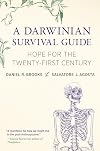
Begins by restating how the process of Darwinian evolution actually happens, excavating it from self-serving popular misinterpretations especially the notorious “survival of the fittest”. Explains how from their first 100K generations, humans participated in the biosphere in a manner that allowed evolution to happen. How, starting around ~10K years ago, the sum total of humans behaviour resulted in the species diverging from the evolutionary processes, in particular by not allowing show more Darwinian conflict resolution. People (or their sociopathic leaders at least) did not want to leave large centres of population density when resources became scarce, so instead they began to wag war on other human groups. Led to repeated iterations of conflict with no ultimate resolution. In the 20th century the crisis accelerated further with an arms race mentality. Now humanity faces convergence of many crises - climate change, pandemics, biodiversity loss, economic inequality, political instability etc. Technology cannot not keep up with solving the problems it causes. Whew, quite the problem set! 🙈
No way out? Behaviour change will necessary and it’s acknowledged that this will be very difficult. Humans must shed the idea that they can control everything as it’s impossible. Switch from sustainability (attempting to control everything, so that it doesn’t change) to survivability. Allow evolution to happen by letting the contents of the natural world move around and explore its huge evolutionary potential. Conflict resolution is possible. Found new guidelines and policies on - hat tip to Asimov - the Four Laws of Biotics. Based on this shift to survivability, remedies are described, such as reductions in population density by repopulating rural areas. Local circular economies with more grass roots political power that are modular and can be connected in a modular way. High level institutions are still necessary to maintain aspects of advanced civilisation, but they must not tell local groups what to do. Similarly local centres must accept that higher level institutions are necessary. There are two big choices. Either humanity starts changing now (at huge costs), or, collapse will happen. Even in the latter case, evolution gives hope: humanity as whole will survive and rebuild.
Very enjoyable read despite the grim future with which the book grapples The early chapters on human prehistory dragged a little. Some repetition, but it helps when the thinking is new. Useful “concluding remark” summarising each chapter. The switch from sustainability to survivability may make the future seem less daunting. show less
No way out? Behaviour change will necessary and it’s acknowledged that this will be very difficult. Humans must shed the idea that they can control everything as it’s impossible. Switch from sustainability (attempting to control everything, so that it doesn’t change) to survivability. Allow evolution to happen by letting the contents of the natural world move around and explore its huge evolutionary potential. Conflict resolution is possible. Found new guidelines and policies on - hat tip to Asimov - the Four Laws of Biotics. Based on this shift to survivability, remedies are described, such as reductions in population density by repopulating rural areas. Local circular economies with more grass roots political power that are modular and can be connected in a modular way. High level institutions are still necessary to maintain aspects of advanced civilisation, but they must not tell local groups what to do. Similarly local centres must accept that higher level institutions are necessary. There are two big choices. Either humanity starts changing now (at huge costs), or, collapse will happen. Even in the latter case, evolution gives hope: humanity as whole will survive and rebuild.
Very enjoyable read despite the grim future with which the book grapples The early chapters on human prehistory dragged a little. Some repetition, but it helps when the thinking is new. Useful “concluding remark” summarising each chapter. The switch from sustainability to survivability may make the future seem less daunting. show less
You May Also Like
Associated Authors
Statistics
- Works
- 13
- Members
- 157
- Popularity
- #133,742
- Rating
- 3.4
- Reviews
- 1
- ISBNs
- 19