
Chih-Yuan Chen
Author of Guji Guji
About the Author
Works by Chih-Yuan Chen
Associated Works
Tagged
Common Knowledge
Members
Reviews
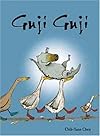
I thought that this was a wonderful book. In this picture book, Guji Guji is a crocodile that hatched in a duck’s nest. The mother duck did not notice when the egg rolled into her nest, but when they all hatched she noticed how all the hatchlings were different: “one has blue spots, one has stripes, one is golden-colored... and one is, well, a lot bigger and not quite so feathery! But Mother Duck loves them all.” The language described how Mother Duck noted the differences, but to her show more it did not matter, she loved them all anyway. I think this sends a powerful message to the reader that aids in diminishing the reoccurring stigma of being different by implying being different does not matter. When Guji Guji encounters real crocodiles he begins to question his duck-ness for the first time. He ultimately realizes that Mother Duck is his mother at heart and he defends his family from the crocodiles. The illustrations in this book were wonderful and truly enhanced the story. They portrayed the issue of identity that Guji Guji felt, in different ways throughout the book. For example, at the end of the book Guji Guji’s reflection in the water is a duck. Physically he may be an alligator, but he still considers himself a duck and identifies with the ducks. Also, at the end of the book, I really liked how Guji Guji made his identity a “croco-duck.” Ultimately, the main idea of this book addressed the importance of family, identity, and loyalty. I think it also touches on adoption, too. Someone does not have to be related by blood in order to be family—love and support are always more important. show less

Originally published in Chih-Yuan Chen's native Taiwan, and inspired by the life-story of one of the author/artist's American friends, who was ethnically Korean, but adopted by a non-Korean family, Guji Guji follows the adventures of a young "crocoduck," as he finds his rightful place in the world, and in his adopted community. When a crocodile egg tumbles into a mother duck's nest one day, she is too busy reading to notice. When that egg hatches out into a creature most unlike her other show more offspring, she accepts the situation with aplomb. Although different, in both appearance and abilities, from his siblings, Guji Guji never questions his place in his adoptive family - until, that is, three grinning adult crocodiles happen upon him and try to convince him that he belongs with them, and that he should lure his duck family into a trap. Suddenly, Guji Guji is confronted with the issue of identity, and with the problem of safe-guarding his anatine family...
Although I found the artwork here adorable, and believe the author's motivations, in telling this story, are admirable - Chen writes, in a statement on the rear dust-jacket flap, that "It is my hope that children from all over the world can learn to accept different people and things, and see the world with broader views and minds" - I find the storyline somewhat problematic. I don't believe that it was intentional at all, and I don't think it necessarily has to be interpreted in this way, but I could see a child reader, particularly if adopted across national, ethnic or racial lines, taking away the message that their identity of origin was somehow dangerous or undesirable: something to be abandoned. On the other hand, I could also see coming away with the message that family is defined more by love, than by "blood," so take that as you will.
The illustrations, as mentioned above, are lovely: immensely appealing, cute without being saccharine, and possessing an overall color scheme (fairly dark, in the image with the three crocodiles, lighter in those involving Guji Guji's family) that varies according to the mood of each scene. This is a book that might be very helpful for adopted children, but given the range of interpretations possible, I recommend that their parents and/or adult care-givers read it over first, to make sure it is suitable for their specific circumstances. show less
Although I found the artwork here adorable, and believe the author's motivations, in telling this story, are admirable - Chen writes, in a statement on the rear dust-jacket flap, that "It is my hope that children from all over the world can learn to accept different people and things, and see the world with broader views and minds" - I find the storyline somewhat problematic. I don't believe that it was intentional at all, and I don't think it necessarily has to be interpreted in this way, but I could see a child reader, particularly if adopted across national, ethnic or racial lines, taking away the message that their identity of origin was somehow dangerous or undesirable: something to be abandoned. On the other hand, I could also see coming away with the message that family is defined more by love, than by "blood," so take that as you will.
The illustrations, as mentioned above, are lovely: immensely appealing, cute without being saccharine, and possessing an overall color scheme (fairly dark, in the image with the three crocodiles, lighter in those involving Guji Guji's family) that varies according to the mood of each scene. This is a book that might be very helpful for adopted children, but given the range of interpretations possible, I recommend that their parents and/or adult care-givers read it over first, to make sure it is suitable for their specific circumstances. show less
The story Guji Guji is about learning to know, accept, and love yourself despite adversity. I enjoyed this book for many reasons. I quite enjoyed the conflict and suspense of the plot. I thought that the pacing of the plot lended itself to the building of this tension in the conflict. For example, the story begins with Guji Guji going about his life as a happy, content "duck." Then, Guji Guji meets the three crocodiles who tell him about his "true nature" and attempt to convince him to help show more them with a mean act. Then, Guji Guji goes through some self-reflection. This is where I feel that the pacing and tension are most excellently done. Guji Guji thinks about his physical appearance as a crocodile, but also how he relates and identifies more to his duck family. Guji Guji spends a few pages contemplating this and ultimately has to decide how to reconcile his physical appearance and how he feels. Then he spends time thinking of a plan to save his family. The suspense is built even further as Guji Guji leads his family to the lake. The reader is unaware of what Guji Guji's plan is. I believe that because the author took time to allow Guji Guji some self-reflection and did not tell the reader Guji Guji's plan, the suspense was built in the plot. The self-reflection slowed down the pace of the story and allowed time for the reader to build up anticipation of what Guji Guji would decide to do.
I also enjoyed this book because it challenges readers to broaden their perspectives. The readers learn about how physical appearance does not dictate how a person thinks and feels. For example, though Guji Guji was a crocodile outwardly, inwardly, he was more of a duck. He did not want to chomp his teeth and eat ducks, but was happy and content just waddling around with his brothers. Though he had "blue gray skin" this did not mean that his personality was a certain way. I think that this, in a way, deals with racism and stereotypes. Oftentimes when we meet someone, we judge them based on their physical appearance. We assume the way that they think and feel because of the judgements we make on the appearance. Guji Guji challenges readers to not make assumptions or stereotypes about others. We should also realize that we are not bound by our physicality. Who we are and what we want to be does not have to be determined by how we look. And most importantly, we must respect, accept, and love each other, no matter what we look like. I thought that the most powerful line of the story summed this up nicely: "No matter how big they were or what they looked like, Mother Duck loved all her ducklings the same." show less
I also enjoyed this book because it challenges readers to broaden their perspectives. The readers learn about how physical appearance does not dictate how a person thinks and feels. For example, though Guji Guji was a crocodile outwardly, inwardly, he was more of a duck. He did not want to chomp his teeth and eat ducks, but was happy and content just waddling around with his brothers. Though he had "blue gray skin" this did not mean that his personality was a certain way. I think that this, in a way, deals with racism and stereotypes. Oftentimes when we meet someone, we judge them based on their physical appearance. We assume the way that they think and feel because of the judgements we make on the appearance. Guji Guji challenges readers to not make assumptions or stereotypes about others. We should also realize that we are not bound by our physicality. Who we are and what we want to be does not have to be determined by how we look. And most importantly, we must respect, accept, and love each other, no matter what we look like. I thought that the most powerful line of the story summed this up nicely: "No matter how big they were or what they looked like, Mother Duck loved all her ducklings the same." show less
I thought this was a great picture book that reflects how someone from a different ethnicity is raised by another ethnicity. I really loved the message of this story and how it used animals to get the message across. It was a subtle way of telling the reader that differences in appearance do not matter in families. A crocodile can be raised by ducks and fit in better with ducks than crocodiles. Guji Guji is clearly different from his brothers and sisters but he is loved by the family and show more ends up saving them from the bad crocodiles. The illustrations were also a great complement to the story and brought out even more meaning. When Guji Guji looked at his reflection in the water, it was always an upside down duck. This shows that he still maintains qualities of a duck even though he is really a crocodile. The colors used were also very effective. The blue-gray of the crocodiles was very eerie and gave a very cautious feel. Overall, this international book was a wonderful example of modern fantasy. show less
Lists
Awards


You May Also Like


Associated Authors
Statistics
- Works
- 14
- Also by
- 2
- Members
- 1,034
- Popularity
- #24,904
- Rating
- 4.0
- Reviews
- 91
- ISBNs
- 39
- Languages
- 7