
H. H. Scullard (1903–1983)
Author of From the Gracchi to Nero
About the Author
H. H. Scullard (1903-1983) taught at New College Oxford from 1935 to 1939 before becoming Professor of Ancient History at King's College London. His many books include the Oxford Classical Dictionary and From the Gracchi to Nero, which is also in the Routledge Classics series.
Works by H. H. Scullard
Scipio Africanus : Soldier and Politician (Aspects of Greek and Roman life) (1970) 26 copies, 5 reviews
Associated Works
Ancient society and institutions: studies presented to Victor Ehrenberg on his 75th birthday (1966) — Contributor — 13 copies
Tagged
Common Knowledge
- Canonical name
- Scullard, H. H.
- Legal name
- Scullard, Howard Hayes
- Birthdate
- 1903-02-09
- Date of death
- 1983-03-31
- Gender
- male
- Education
- St. John's College, University of Cambridge (BA|1926)
University College London (Ph.D|1930) - Occupations
- historian
classicist
professor - Organizations
- King's College London
New College London
Society for the Promotion of Roman Studies
Hampstead Golf Club - Awards and honors
- British Academy (Fellow, 1955)
Society of Antiquaries of London (Fellow)
Royal Numismatic Society (Fellow) - Nationality
- UK
- Birthplace
- Bedford, England, UK
- Places of residence
- London, England, UK
- Place of death
- London, England, UK
- Associated Place (for map)
- England, UK
Members
Reviews

This is one of my prized possessions, something that fits with what a dear friend has termed my love for "fine old things" -- most apt!
The book -- and I'm sure a new reprint won't do at all (not Scullard's updated version!), it must be an old version like the 1960 edition I have -- is a treasure, a true gem for the book lover.
It is a classic of scholarship, first of all. One of the perennial histories that has stood the test of time. But it is more than that. It is a sacred object, in its show more way. Each dense paragraph has a single italicized sentence in the margin succinctly summarizing the paragraph, for easier assimilation of the thread of the account.
It has plates with old photographs and drawings of important sites, including architectural plans of major buildings and public places. It has maps that are delicately and precisely folded into the pages, so one turns the page and unfolds a new mystery.
There is a pull-out glossary of Latin terms and major Latin aphorisms, with author.
To remove the volume from the shelf and open it is to travel into a magical place of the past, the closest to time travel we have, and all by way of a book of the type "they don't make anymore", rendered with love and care.
Probably not the book for the latest viewpoint. But this seemed like the place to profess my love! show less
The book -- and I'm sure a new reprint won't do at all (not Scullard's updated version!), it must be an old version like the 1960 edition I have -- is a treasure, a true gem for the book lover.
It is a classic of scholarship, first of all. One of the perennial histories that has stood the test of time. But it is more than that. It is a sacred object, in its show more way. Each dense paragraph has a single italicized sentence in the margin succinctly summarizing the paragraph, for easier assimilation of the thread of the account.
It has plates with old photographs and drawings of important sites, including architectural plans of major buildings and public places. It has maps that are delicately and precisely folded into the pages, so one turns the page and unfolds a new mystery.
There is a pull-out glossary of Latin terms and major Latin aphorisms, with author.
To remove the volume from the shelf and open it is to travel into a magical place of the past, the closest to time travel we have, and all by way of a book of the type "they don't make anymore", rendered with love and care.
Probably not the book for the latest viewpoint. But this seemed like the place to profess my love! show less
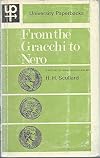
Over the course of more than a year, I read this excellent Roman history one chunk at a time. It was well worth it. For good reason this is Scullard's most well known work. It is thorough, interesting and covers that important transition period of Roman history. He begins with the agrarian struggle which leads to the tottering and dysfunctional late Republic. This eventually settles into the successful constitutional settlement of Augustus and a well managed empire. Eventually, though show more Tiberius and Claudius were worthy successors of Augustus, Caligula and Nero bring about the moral and political collapse of the Julio-Claudian dynasty. Scullard's chronology ends with the chaotic "Year of the Four Emperors". Chapters on literature, society, religion and the arts were enlightening though inescapably superficial surveys of the times. Like many ancient histories, Scullard extrapolates from outside of the covered time periods to supplement his generalizations. My heart longs to read this book again because there are so many fascinating characters in there. Knowing how long it took me to get through this once and how many other books distracted me from staying on task, I'm going to leave it alone and wait for the right moment and allow Scullard to distract me from some other book I'm trying to plow through. show less
Scullard is a long time favorite. I have read From the Gracchi to Nero a couple of times. Cary and Scullard, A History of Rome (3rd ed.) was the textbook for the Roman history class that I had in college. Somehow I never got around to reading this one until now. After a chapter on prehistoric Rome, Scullard begins with regal Rome and continues to the end of the Third Punic War and the destruction of Carthage in 146 BC. He divides the book into four sections: Rome and Italy, Rome and show more Carthage, Rome and the Mediterranean, and Roman Life and Culture. The first three sections cover the history proper chronologically and by region. This necessitates some duplication and cross referencing. Scullard focuses almost entirely on traditional political and military history in these sections. The fourth and final section covers everyday life and culture by topic: family, the city itself, law, literature, religion, etc. It is a nice survey that succinctly explains the basics of Roman culture before the Gracchi.
Scullard is generally clear and engaging. He takes inscriptions and archaeology into account, but tends to stick to the traditional Roman accounts when there is no compelling reason to do otherwise (the most sensible course). Although Scullard knew the sources and the scholarship of his time thoroughly and provides extensive notes, there have been a number of developments since. A couple of examples. He recounts the traditional version of the destruction of Carthage: burning it, ploughing it under, sowing it with salt. That's what I learned in school. Only it turns out there is absolutely no ancient evidence for the salting, and the first references to it date from the nineteenth century. A good story that should be true and isn't. Another: he refers (no less than three times) to the Praeneste Fibula as one of the earliest examples of archaic Latin to survive, supposedly from ca. 650 BC. Also what I learned in a survey of Latin lit in college. But since Scullard wrote there has been a serious challenge to its authenticity; the jury is still out but many now believe it to be a nineteenth-century forgery. The dangers of reading an older book. But Scullard is informative and often entertaining; he gets a lot more right than not. show less
Scullard is generally clear and engaging. He takes inscriptions and archaeology into account, but tends to stick to the traditional Roman accounts when there is no compelling reason to do otherwise (the most sensible course). Although Scullard knew the sources and the scholarship of his time thoroughly and provides extensive notes, there have been a number of developments since. A couple of examples. He recounts the traditional version of the destruction of Carthage: burning it, ploughing it under, sowing it with salt. That's what I learned in school. Only it turns out there is absolutely no ancient evidence for the salting, and the first references to it date from the nineteenth century. A good story that should be true and isn't. Another: he refers (no less than three times) to the Praeneste Fibula as one of the earliest examples of archaic Latin to survive, supposedly from ca. 650 BC. Also what I learned in a survey of Latin lit in college. But since Scullard wrote there has been a serious challenge to its authenticity; the jury is still out but many now believe it to be a nineteenth-century forgery. The dangers of reading an older book. But Scullard is informative and often entertaining; he gets a lot more right than not. show less
One of the clearest, most balanced accounting of the Roman Republican period I have read. Scullard was able to summarize the scholarship and give fair treatment to various interpretations without seeming to have an axe to grind. Witty, engaging prose, and the footnotes are almost as good as the text. Although there is no general bibliography, the footnotes are immensely helpful.
Lists
You May Also Like


Associated Authors
Statistics
- Works
- 20
- Also by
- 4
- Members
- 2,032
- Popularity
- #12,649
- Rating
- 4.2
- Reviews
- 29
- ISBNs
- 54
- Languages
- 3
- Favorited
- 1