
David Wenzel
Author of The Hobbit: Graphic Novel
About the Author
Image credit: Self-portrait, found at Tolkien Gateway.
Series
Works by David Wenzel
The Hobbit: or There and Back Again (Graphic Novel, Book 1) (1998) — Illustrator — 131 copies, 1 review
The Hobbit: or There and Back Again (Graphic Novel, Book 2) (1990) — Illustrator — 104 copies, 2 reviews
Bilbo Le Hobbit TPB: Livre 1 1 copy
Lo Hobbit a fumetti 1 copy
Associated Works
Liberty!: How the Revolutionary War Began (Landmark Books) (2002) — Illustrator, some editions — 658 copies
Your Special Gift (Max Lucado's Wemmicks) (Max Lucado's Wemmicks, 6) (Volume 6) (2005) — Illustrator, some editions — 153 copies, 2 reviews
Tagged
Common Knowledge
- Birthdate
- 1950-11-22
- Gender
- male
- Occupations
- illustrator
book artist - Relationships
- Wenzel, Gregory (sibling)
Wenzel, Brendan (child) - Nationality
- USA
- Places of residence
- Connecticut, USA
- Associated Place (for map)
- Connecticut, USA
Members
Reviews

I read The Hobbit when I was nine years old and never since, but thought I remembered it pretty well. My six year old was interested enough this year to accept having it read to him a few pages at a time each night. In the course of doing so, I felt the contrasts between my first impression and now. As a child I was awestruck by the depths of the Misty Mountains and the dreaded Mirkwood forest; the entire story had a vast tone of menace to it, filled with dangers and fear. Conversely, as an show more adult I now find the book fairly light in tone. As a child I was thrilled by the characters but my memories of the dwarves were vague, and now I can see why. We know that Thorin is their leader, Bombur is overweight, Balin is probably the bravest, Fili and Kili are the youngest, but not a whole lot else. Most of the dwarves we scarcely know besides their names.
Obviously my son wasn't making these observations. There was always something foreshadowed to keep him engaged. The trolls, the goblins, Gollum's riddles, the wolves; then the eagles, Beorn, and the dark path through Mirkwood ... all the way to the battle of the Five Armies, the next encounter or bit of action was always on the horizon. Even the advanced language didn't dissuade him, and I didn't try to simplify it - though I did summarize what had happened as I closed the book each time, to ensure he'd grasped it all. We laughed together over the foolish trolls, the introductions at Beorn's house, and Bombur's slumber. Often we'd speculate over what might happen next.
I was privately astonished how frequently - and for what prolonged duration - Bilbo made use of his magic ring. I recognized Elrond, and the Moria references. The Gandalf presented here is reminiscent of LOTR's opening passages - not much less bumbling in appearance than the dwarves, even when danger threatens. He seems to view the entire Hobbit adventure as a lark; and so must I, in anticipation of the deeper darker story I know is to come. This was a fun trip down memory lane for me, and a satisfying series of evenings for my son who can one day make his own return visit to Laketown and the Lonely Mountain. show less
Obviously my son wasn't making these observations. There was always something foreshadowed to keep him engaged. The trolls, the goblins, Gollum's riddles, the wolves; then the eagles, Beorn, and the dark path through Mirkwood ... all the way to the battle of the Five Armies, the next encounter or bit of action was always on the horizon. Even the advanced language didn't dissuade him, and I didn't try to simplify it - though I did summarize what had happened as I closed the book each time, to ensure he'd grasped it all. We laughed together over the foolish trolls, the introductions at Beorn's house, and Bombur's slumber. Often we'd speculate over what might happen next.
I was privately astonished how frequently - and for what prolonged duration - Bilbo made use of his magic ring. I recognized Elrond, and the Moria references. The Gandalf presented here is reminiscent of LOTR's opening passages - not much less bumbling in appearance than the dwarves, even when danger threatens. He seems to view the entire Hobbit adventure as a lark; and so must I, in anticipation of the deeper darker story I know is to come. This was a fun trip down memory lane for me, and a satisfying series of evenings for my son who can one day make his own return visit to Laketown and the Lonely Mountain. show less

I scarcely need to introduce the story of Bilbo Baggins, a halfling who is persuaded by a wizard and thirteen dwarfs to go on a long and dangerous journey to an isolated mountain, where treasure is guarded by a wicked dragon, and who finally returns home (as the subtitle proclaims).
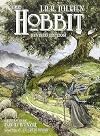
First published in 1937, revised in 1951 and adapted for radio, animated and live action films, and for the stage, The Hobbit has been around in in its many guises for over 80 years now. As a graphic novel show more illustrated by David Wenzel it first began to be issued three decades ago, in 1989, and was reissued with revisions and thirty pages of new artwork in 2006.
Each medium has its advantages and drawbacks and so the question to ask when confronted by David Wenzel's most famous work is, what does it add to the experience of Tolkien’s original saga?
First off, most of the original text is present, so you won't be small-changed there, or not by much. There is some adapting - tenses changed, reordering of sentences and phrases, a few excisions (some verses from the songs, for example) - but this is largely Tolkien's own words. Occasionally the text overloads the images, showing how difficult a compromise it is to remain faithful to the original in a medium in which the guiding principle is 'show, don't tell'.
Next, how enamoured one may be with the illustrations depends on characterisation and on the artwork itself. If you've accepted the image of Bilbo from the Peter Jackson films then you may be disconcerted by the appearance of Wenzel's Hobbit, middle-aged and with a Beatle haircut. (On the other hand, this may be closer to Tolkien's vision, who probably thought of Bilbo as a aspect of himself.)
Gandalf is hard to get wrong but the Rivendell elves are less fay and more medieval than the movie versions while the Mirkwood elves could be extras for a Robin Hood film. The dwarves (this is Tolkien's preferred spelling) are neither Disneyesque nor Jacksonesque, more like grumpy garden gnomes in Lapplander clothing, and Gollum is as you'd expect, bug-eyed and tricksy.
Wenzel goes for a pen-and-ink with colour wash approach, a style associated more with children's picture books (think Raymond Briggs) than with comics or graphic novels. The page layout is never the same twice, occasionally going for a full page illustration as with our first view of Smaug (more impressive than Tolkien’s painting, though clearly inspired by it).
So, what's the final verdict? Certainly this is an enjoyable way to envisage Bilbo's epic voyage to and return from Erebor, the Lonely Mountain, and once you get used to the finish misses little out in the retelling. When the text dominates the presentation too much that's to its disadvantage, but to my mind this is a more successful adaptation than, for example, that of the Ralph Bakshi fotonovel of The Lord of the Rings, however innovative the truncated animated film was. show less
First published in 1937, revised in 1951 and adapted for radio, animated and live action films, and for the stage, The Hobbit has been around in in its many guises for over 80 years now. As a graphic novel show more illustrated by David Wenzel it first began to be issued three decades ago, in 1989, and was reissued with revisions and thirty pages of new artwork in 2006.
Each medium has its advantages and drawbacks and so the question to ask when confronted by David Wenzel's most famous work is, what does it add to the experience of Tolkien’s original saga?
First off, most of the original text is present, so you won't be small-changed there, or not by much. There is some adapting - tenses changed, reordering of sentences and phrases, a few excisions (some verses from the songs, for example) - but this is largely Tolkien's own words. Occasionally the text overloads the images, showing how difficult a compromise it is to remain faithful to the original in a medium in which the guiding principle is 'show, don't tell'.
Next, how enamoured one may be with the illustrations depends on characterisation and on the artwork itself. If you've accepted the image of Bilbo from the Peter Jackson films then you may be disconcerted by the appearance of Wenzel's Hobbit, middle-aged and with a Beatle haircut. (On the other hand, this may be closer to Tolkien's vision, who probably thought of Bilbo as a aspect of himself.)
Gandalf is hard to get wrong but the Rivendell elves are less fay and more medieval than the movie versions while the Mirkwood elves could be extras for a Robin Hood film. The dwarves (this is Tolkien's preferred spelling) are neither Disneyesque nor Jacksonesque, more like grumpy garden gnomes in Lapplander clothing, and Gollum is as you'd expect, bug-eyed and tricksy.
Wenzel goes for a pen-and-ink with colour wash approach, a style associated more with children's picture books (think Raymond Briggs) than with comics or graphic novels. The page layout is never the same twice, occasionally going for a full page illustration as with our first view of Smaug (more impressive than Tolkien’s painting, though clearly inspired by it).
So, what's the final verdict? Certainly this is an enjoyable way to envisage Bilbo's epic voyage to and return from Erebor, the Lonely Mountain, and once you get used to the finish misses little out in the retelling. When the text dominates the presentation too much that's to its disadvantage, but to my mind this is a more successful adaptation than, for example, that of the Ralph Bakshi fotonovel of The Lord of the Rings, however innovative the truncated animated film was. show less
Reread the Hobbit in preparation for my Great Winter Reread of The Lord of the Rings (since it's been a whole three years or something, and I've been coming down with a cold and needed some comfort reading.)
I should probably read The History of the Hobbit at some point, because I am very interested in the textual history of this book - it is such a weird concept when taken on its own. I mean, hobbits? In some vaguely defined but obviously incredibly rich secondary fantasy world? In a book show more that's written for children, mostly, but isn't horrible and saccharine?
Most of the book gets by on the merit of being fun and wacky and having a good protagonist, but the end is actually quite dark and moving - Bilbo weaves his riddles before the dragon, a quarter of a town is decimated, Thorin walls himself in with his treasure and dies defending it.
Thorin is a really, really interesting character, actually, although it only struck me on this rereading. Normally Tolkien takes kings and the descendants of kings pretty seriously. Not all kings are good, but nevertheless they are of High Blood and are by default entitled to be a bit imperious, at least in his other writings.
Not so in The Hobbit! Tolkien is constantly poking fun at Thorin's grandiosity and long speeches, pointing to the artificiality of his royal pomp. The Elvenking is also a figure of fond ridicule. And even Bard, who as a warrior and the descendant of kings is of course just the person to kill Smaug, save Esgaroth, and rule Dale (God forbid some upstart commoner accomplish all three), is a slightly comic character. Much of this is due to the difference in tone of The Hobbit from his more "serious" works, but I think it's still interesting to see Tolkien writing questionable rulers more along the lines of Denethor than Feanor, who nevertheless have a right to their power. show less
I should probably read The History of the Hobbit at some point, because I am very interested in the textual history of this book - it is such a weird concept when taken on its own. I mean, hobbits? In some vaguely defined but obviously incredibly rich secondary fantasy world? In a book show more that's written for children, mostly, but isn't horrible and saccharine?
Most of the book gets by on the merit of being fun and wacky and having a good protagonist, but the end is actually quite dark and moving - Bilbo weaves his riddles before the dragon, a quarter of a town is decimated, Thorin walls himself in with his treasure and dies defending it.
Thorin is a really, really interesting character, actually, although it only struck me on this rereading. Normally Tolkien takes kings and the descendants of kings pretty seriously. Not all kings are good, but nevertheless they are of High Blood and are by default entitled to be a bit imperious, at least in his other writings.
Not so in The Hobbit! Tolkien is constantly poking fun at Thorin's grandiosity and long speeches, pointing to the artificiality of his royal pomp. The Elvenking is also a figure of fond ridicule. And even Bard, who as a warrior and the descendant of kings is of course just the person to kill Smaug, save Esgaroth, and rule Dale (God forbid some upstart commoner accomplish all three), is a slightly comic character. Much of this is due to the difference in tone of The Hobbit from his more "serious" works, but I think it's still interesting to see Tolkien writing questionable rulers more along the lines of Denethor than Feanor, who nevertheless have a right to their power. show less
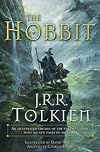
As a visual representation of the characters, plot, and setting of The Hobbit, this is far superior to the films that have been made of this book. As such, it may work as brain-bleach for Tolkien fans unsettled by the casting and rewriting of the Peter Jackson "epic" Hobbit or the horrible cartoon version that preceded it.
The adaptation uses Tolkien's words extensively and chooses its omissions with grace. I'm so grateful not having to read the elves going "Tralala lalley"! It's an excellent show more introduction to The Hobbit for graphic novel fans. Highly recommended. show less
The adaptation uses Tolkien's words extensively and chooses its omissions with grace. I'm so grateful not having to read the elves going "Tralala lalley"! It's an excellent show more introduction to The Hobbit for graphic novel fans. Highly recommended. show less
Lists
Awards


You May Also Like


Associated Authors
Statistics
- Works
- 22
- Also by
- 24
- Members
- 5,498
- Popularity
- #4,532
- Rating
- 4.2
- Reviews
- 72
- ISBNs
- 78
- Languages
- 13